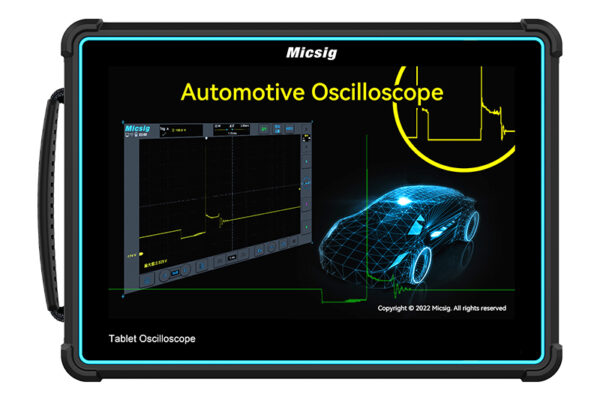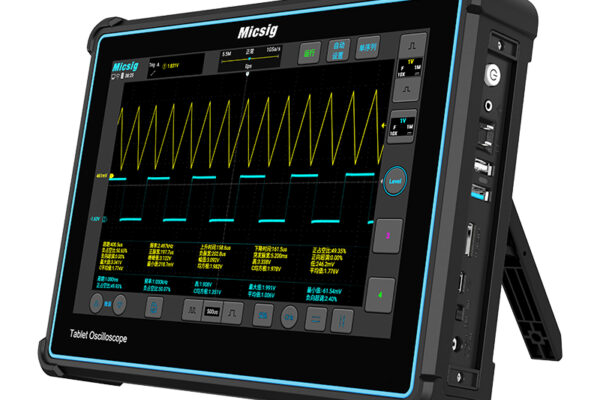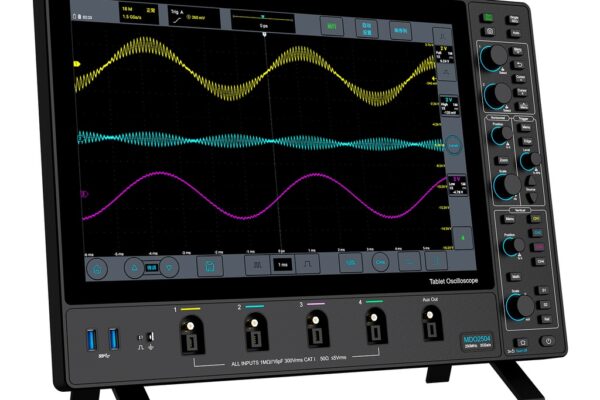


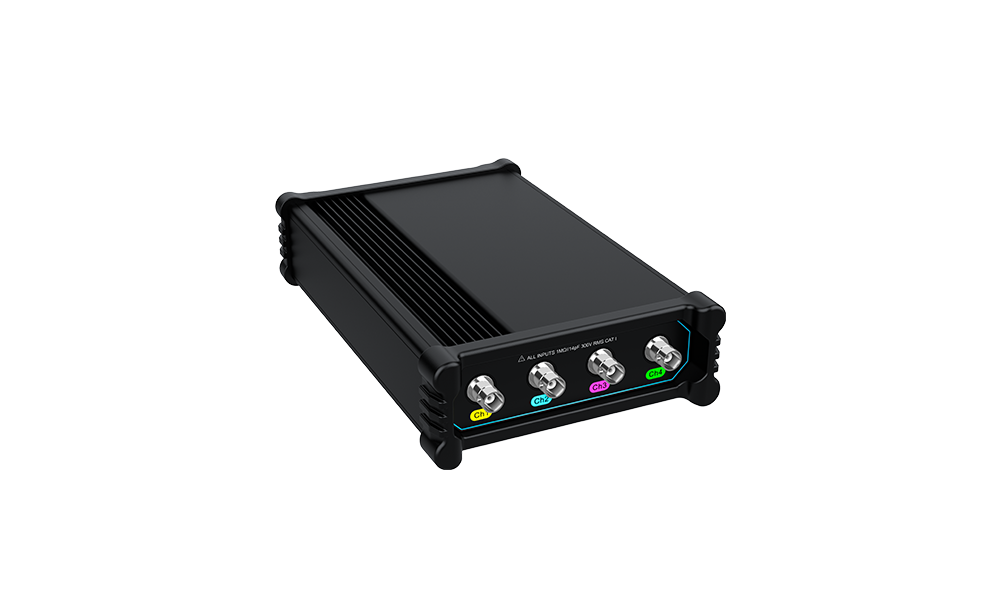
When a system integrator, panel builder, procurement team or electrical engineer is close to issuing an RFQ, an oscilloscope is no longer a generic lab accessory. It becomes a decision tool for signal verification, commissioning evidence, troubleshooting speed and acceptance documentation. The Oscillograph VTO Series VTO2004 is positioned for that moment: a compact portable split-type oscilloscope with 200MHz bandwidth, 4 analog channels, 1GSa/s maximum sampling rate and up to 50Mpts memory depth. For B2B projects where a desktop instrument is not always practical, the VTO2004 helps teams capture signal behavior directly at the cabinet, machine, vehicle platform, prototype bench or service location.
TPS ELEKTRONIK supports global B2B customers with oscilloscope products, equivalent measurement solutions and project-level selection support. Teams evaluating the VTO2004 can review the VTO2004 portable oscilloscope in the TPS Shop or start a measurement-system discussion through the TPS oscilloscope solution page. The goal of this article is not only to explain the specification. It is to help RFQ teams decide whether this class of portable oscilloscope fits their integration, purchasing and engineering workflow.
200MHz bandwidth · 4 analog channels · 1GSa/s sampling · up to 50Mpts memory depth
Capture field signals, compare channels, document test evidence and align procurement around a defined measurement package.
Product supply, equivalent solutions, probe/accessory discussion and project-level measurement consultation for global B2B customers.
Why the VTO2004 Matters in an RFQ Stage
BoFu readers are usually not asking whether an oscilloscope can display a waveform. They are asking whether the selected instrument reduces project risk. In a control cabinet, power electronics prototype, automotive service environment or embedded system validation task, the team needs a reliable way to capture transients, timing errors, bus activity and channel-to-channel behavior before a design is released or a site acceptance test is signed. A portable oscilloscope supports these tasks when the measurement point is not conveniently located near a bench instrument.
The VTO2004 is a split-type portable oscilloscope. The measurement unit connects to Android-based display platforms, including tablets, smartphones and Android computers. That architecture is useful when engineers want a larger display, flexible positioning and a light measurement unit near the device under test. The compact body, built-in optional battery and USB Type-C interface also make it practical for service teams moving between machines, test benches or cabinets.
For system integrators, the value is the ability to validate multiple signals in one field session. Four analog channels make it easier to compare supply rails, gate signals, sensor feedback or timing relationships. For panel builders, the instrument can support commissioning checks around relays, PLC I/O, low-voltage control circuits and noise-sensitive signals. For procurement, a defined model with clear parameters helps avoid unstructured tool buying and supports repeatable purchasing across teams. For electrical engineers, bandwidth, sampling rate, memory depth, trigger options and bus decode functions determine whether the instrument can capture the events that matter.
TPS can support the same decision path. Instead of treating an oscilloscope as an isolated SKU, TPS helps customers evaluate whether the instrument, probes, accessories and related power-test equipment form a usable project package. Teams can move from the VTO2004 product page to a broader oscilloscope and measurement consultation with TPS when they need application fit, alternative options or a project BOM discussion.
Selection Logic for System Integrators, Panel Builders and Engineers
Start with bandwidth, channels and signal class
A common RFQ mistake is to select an oscilloscope by price or display format before defining the signal class. The VTO2004 offers 200MHz bandwidth and 4 analog channels, which is a strong fit for many embedded electronics, control, bus-related and power-conversion diagnostic tasks. The 4-channel structure is especially important when teams need to view cause and effect in one acquisition: input voltage versus output ripple, control signal versus load response, or two bus lines with additional supply and trigger references.
The 1GSa/s maximum sampling rate and rise time of no more than 1.8ns support faster waveform analysis than entry-level field tools. In RFQ language, this means the buyer should specify not only “portable oscilloscope” but also bandwidth, number of channels, sample rate, memory, required probes, operating environment and documentation expectations. This avoids purchasing an instrument that looks portable but cannot resolve the signal events the engineering team actually needs.
Use deep memory when intermittent events matter
Memory depth is critical when problems are not continuous. The VTO2004 provides up to 50Mpts memory depth, allowing teams to capture longer time windows while preserving detail. In commissioning, this helps when a transient appears only during machine startup, relay switching, motor drive behavior, bus communication, load changes or fault recovery. Deep memory also supports post-event analysis because engineers can zoom into details after capturing the broader picture.
This is also where TPS can help RFQ teams translate the application into a measurement package. For example, a team validating a programmable DC supply may need both an oscilloscope and a controllable source such as the EA-PS 3200-02 C desktop programmable DC power supply. A larger laboratory or production validation setup may need a programmable supply class such as the EA-PSI 9000 DT desktop programmable DC power supply. For field-oriented oscilloscope use, TPS can discuss the measurement instrument and the supporting power-test environment together.
Bandwidth for fast embedded and control signals
Compare cause, response and references
Capture faster waveform behavior
Preserve detail in longer acquisitions
Support bus-related diagnostics
Enable field and service work
Key Technical Parameters That Affect Real Projects
The following parameters are the most relevant for RFQ evaluation. They should be checked against the actual test point, probe selection and project environment before purchase.
| Parameter | VTO2004 value | RFQ relevance |
|---|---|---|
| Bandwidth | 200MHz | Defines the signal range for many embedded, control and diagnostic tasks. |
| Analog channels | 4 | Supports multi-signal comparison during commissioning and troubleshooting. |
| Maximum sampling rate | 1GSa/s | Important for capturing faster waveform edges and timing behavior. |
| Memory depth | Up to 50Mpts | Useful for intermittent events, startup sequences and long captures with zoom analysis. |
| Input sensitivity | 5mV/div to 10V/div | Supports a broad range of low-level and control-signal measurements. |
| Input impedance | 1MΩ ±1% || 14pF | Important for probe loading and signal integrity. |
| Maximum input voltage | CAT I 300Vrms at 1MΩ input | Requires correct probe and safety review for the intended measurement category. |
| Battery | Optional 7.4V, 7500mAh Li-ion battery | Supports field operation and mobile troubleshooting. |
| Interface | USB Type-C, DC power, probe calibration output | Affects setup, power supply, data access and probe verification. |
For buyers who need a defined commercial item, the TPS Shop listing for the Oscillograph VTO2004 is the starting point. For buyers who need an engineering discussion, equivalent solution mapping or a project-level measurement bundle, the TPS oscilloscope portfolio page provides the more suitable RFQ path.
Application Fit: Where a Portable 4-Channel Oscilloscope Adds Value
Control cabinets, panel testing and commissioning
Panel builders often need to validate low-voltage control signals, relay timing, PLC I/O behavior, sensor response and supply stability after wiring is complete. A portable oscilloscope lets technicians work directly at the cabinet without moving the machine or relying only on multimeter readings. When panel power architecture is part of the project, TPS can also support related DIN rail supply discussions, including compact supply families such as the TPS010-100W GP Series DIN rail power supply, the TPS030-130W Pro Series 24V DIN rail power supply and higher-boost options such as the TPS100-320W Peak DR Plus DIN rail power supply.
Power electronics, loads and bidirectional systems
For power electronics teams, the oscilloscope is part of a wider validation stack. Engineers may need to observe startup sequences, ripple, load-step behavior, gate timing, current probe signals or communication events. When the project includes programmable loads, regenerative energy handling or bidirectional power modules, TPS can align the oscilloscope discussion with related product groups such as the EA-PUL 10000 6U regenerative DC load, AC/DC bidirectional power modules for cell formation or the TPS-BM75053KTIF-S 750V bidirectional power module.
Automotive, mobile service and embedded diagnostics
The VTO2004 supports CAN and LIN bus decoding, which is useful for vehicle-related service, embedded systems and machine communication diagnostics. Teams that already evaluate portable automotive measurement formats can also compare the VTO Series with TPS content on the Automotive Tablet Oscilloscope ATO Series. The point is not to force one product format into every project. The point is to define the signal, operating location, user interface, accessory set and documentation requirement, then select the oscilloscope class that reduces commissioning and troubleshooting risk.
PLC I/O, relays, sensor signals, 24V control rails
Ripple, startup, load steps, switching behavior
CAN/LIN decode, timing checks, communication troubleshooting
Battery operation, Android display flexibility, quick evidence capture
Integration, Installation and Measurement Workflow Considerations
A portable oscilloscope should be easy to buy, but it should not be specified casually. Measurement workflow affects productivity and safety. The VTO2004 includes four front BNC channels, USB Type-C, DC power, a probe calibration output and a power lock. The physical size of 140 × 215 × 52mm and net weight of about 640g make it manageable for mobile use, but the RFQ should still define how the instrument will be carried, stored, charged and assigned to users.
Probe selection deserves special attention. The oscilloscope main unit rating does not automatically make every measurement safe. Teams should define the voltage level, measurement category, differential or isolated requirements, current probe needs and environmental conditions before ordering. The datasheet refers to accessory classes such as high-voltage differential probes, optical-fiber isolated probes and current probes. TPS can help customers discuss whether the standard accessory set is enough or whether a project-specific probe package is required.
Data handling also matters. The VTO2004 supports storage formats such as WAV and CSV, quick screenshots, reference waveform display and user setting storage. For engineering teams, this supports repeatability: a technician can capture a waveform, export a file and share evidence with a design or quality team. For procurement and quality departments, these features help define a common tool chain instead of leaving each site to improvise. If the instrument is used together with a rack, cabinet or test-bench integration project, TPS can also support mechanical and power infrastructure discussions through solutions such as Sentinel-Y 42U 19-inch power cabinets and 6U 19-inch chassis power supply integration.
Operating environment should be specified in the RFQ. The datasheet lists operating temperature from 0°C to 45°C, operating humidity of 5% to 85% at 25°C and operating altitude below 3000m. If the oscilloscope will be used in harsher environments, the buyer should discuss storage, transport protection and measurement procedures. TPS can support global B2B customers by clarifying the commercial scope, accessory package and project documentation expected before purchase.
Procurement, Reliability and TPS Project Support
Procurement teams need more than a technical datasheet. They need a model reference, accessory list, warranty expectation, documentation, delivery path and a way to ask engineering questions before the PO is released. The VTO2004 standard accessories include passive BNC probes, power cable, power adapter, Type-C cable, calibration certificate, quick operation guide, manual and packing list, with a built-in battery listed as optional. The main unit warranty is specified as one year, while probe and accessory terms should be checked separately.
For RFQ clarity, the purchasing document should state whether the optional battery is required, whether additional probes are needed, whether calibration documentation must accompany each unit, whether multiple users require standardized settings and whether the oscilloscope must be delivered as part of a broader TPS solution package. This is where TPS adds value: product supply can be combined with selection support, equivalent alternatives, accessory clarification and integration discussion.
When customers are standardizing diagnostic tools across multiple production lines, service teams or global sites, TPS can help align the oscilloscope selection with the wider electrical environment. For example, the same project may involve DIN rail power supplies, programmable DC sources, regenerative loads or cabinet-level integration. That is why a buyer can start with the VTO2004 order page in the TPS Shop and then move to TPS oscilloscope solution consulting when the scope includes accessories, application review or multiple instruments.
RFQ Checklist for the VTO Series
Before requesting a quote, define the following points. This helps TPS respond with a clearer recommendation and reduces back-and-forth between engineering, purchasing and the end customer.
- Signal types: analog voltage, digital timing, CAN/LIN bus, ripple, transient, current probe measurement or differential voltage.
- Performance requirements: bandwidth, sample rate, memory depth, channel count, trigger type and storage format.
- Measurement safety: expected voltage, probe category, isolation needs and required accessories.
- Field use: battery requirement, Android display device, carrying case, transport protection and user environment.
- Documentation: calibration certificate, manual, internal test record format and acceptance evidence.
- Project scope: standalone oscilloscope, multiple-site standardization, power-test bundle, cabinet/test-bench integration or equivalent solution request.
For a direct product review, open the Oscillograph VTO2004 page. For supplier screening, technical selection or a broader measurement package, contact TPS through the oscilloscope solution page. TPS can support product selection, custom project discussion, integration planning and global B2B supply coordination.
FAQ
Is the VTO2004 suitable for field service work?
Yes, it is designed as a portable split-type oscilloscope with compact dimensions, low weight and optional 7500mAh battery support. It is a practical choice when measurements must be made at machines, cabinets, prototypes or service locations. The actual fit should still be confirmed against voltage, probe and environment requirements.
Why does 50Mpts memory depth matter?
Deep memory helps capture longer signal windows while preserving detail. This is useful for intermittent faults, startup behavior, bus events, load transitions and machine sequences that cannot be captured reliably with short memory.
Can TPS support probes and accessories for this oscilloscope?
TPS can discuss the required measurement package, including standard probes, differential or current measurement needs, transport accessories and documentation requirements. The RFQ should specify the expected voltage, signal type and safety conditions.
Can the VTO2004 be part of a broader TPS solution?
Yes. TPS supports oscilloscopes as part of wider B2B projects, including power supplies, loads, bidirectional power modules, cabinet infrastructure and test-bench integration. This is useful when a customer wants one supplier discussion rather than separate purchasing paths.
Where should I start: product page or consultation page?
Use the VTO2004 product page for direct model review and use the TPS oscilloscope consultation page when the RFQ includes application review, accessories, equivalent solutions or project integration.