

For system integrators, panel builders, procurement teams, and electrical engineers, the real question is not whether a 42U cabinet exists on the market. The real question is whether the cabinet can reduce integration risk, support safety expectations, simplify installation, and arrive with the documentation and engineering support required to move an RFQ toward approval.
This page is written for late-stage evaluation. It focuses on fit-for-application, technical confidence, compliance signals, integration practicality, and commercial readiness rather than generic top-of-funnel traffic.
Why the 42U cabinet matters in BoFu supplier screening
In late-stage B2B buying, a cabinet is rarely judged as a sheet-metal object alone. It is judged as an integration platform. That is why the Sentinel-Y 42U Cabinet deserves evaluation as a project component rather than a commodity rack. For many 19-inch power, control, and test-system projects, the cabinet determines how quickly power distribution can be organized, how safely field wiring can be handled, how clearly operating status can be presented, and how smoothly the system can pass internal design review or customer acceptance.
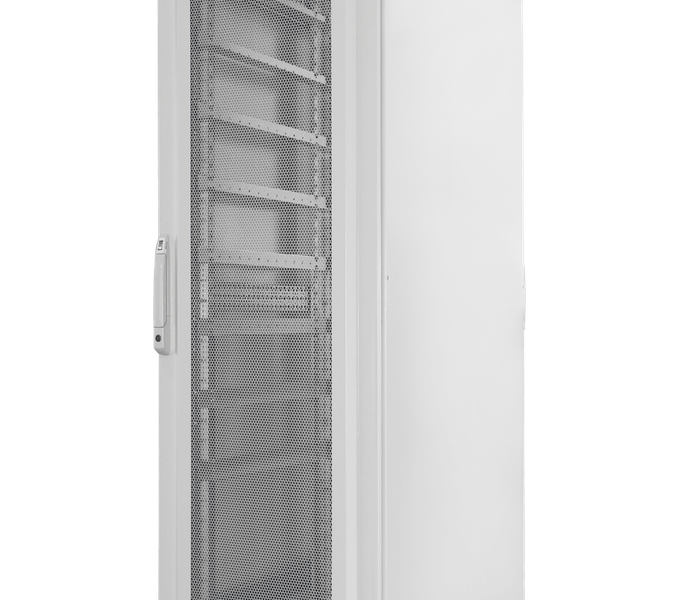
The Sentinel-Y family is positioned for compact 19-inch power-rack applications, and the 42U variant is especially relevant when the project needs meaningful vertical capacity without moving immediately to a much larger cabinet architecture. That makes it a practical fit for system integrators building configured power platforms, panel builders looking for an enclosure that supports documented wiring and safety functions, procurement teams comparing risk between supplier offers, and electrical engineers who need to confirm that cabinet selection will not create later problems in protection, cooling, service access, or compliance documentation.
A strong RFQ response should therefore ask more than “What is the cabinet size?” It should ask whether the supplier can support configuration decisions, whether the cabinet can be delivered as part of a larger solution, and whether customization, documentation, and project communication are mature enough to keep the commercial schedule intact. This is exactly where TPS should be evaluated: not only as a product source, but as a cabinet and solution partner for global B2B programs.
Key technical parameters and what they mean for selection
For the Sentinel-Y 42U configuration, the published data points are useful because they support practical engineering decisions rather than generic catalog comparisons. The cabinet dimensions are listed as 610 x 2120 x 1070 mm, with the standard 19-inch rack width of 482.6 mm and a 42U rack capacity. The rated voltage is 400 VAC / 480 VAC, the rated frequency is 50 Hz / 60 Hz, and the power inlet is 3L + PE. The listed short-circuit current rating is 10 kA, and the cabinet integrates an output-side door monitoring function with safety door interlock, a dual-channel emergency-stop pushbutton, a PILZ safety relay, ISO 13849 Category 4, and ISO 13849 Performance Level d.
Those figures matter because they frame the cabinet’s intended deployment window. The 42U version is not simply “tall enough.” It is structured for a real industrial environment where wiring discipline, operator access, protection coordination, and safety monitoring have to coexist. The applicable standards list in the specification also signals a serious engineering direction: UL 508A, NFPA 79, IEC 61439, IEC 60204, and ISO 13849 are exactly the kinds of references procurement and engineering teams want to see when they are reducing supplier risk rather than only negotiating price.
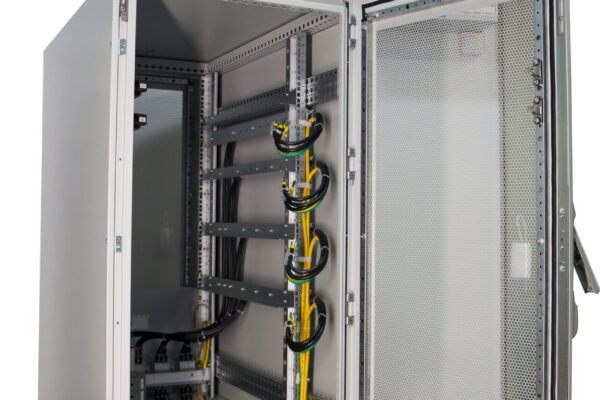
The scope of supply is another detail that matters in project review. For the 42U cabinet, the published scope includes the organizing cabinet with power distribution, six sets of power brackets, four leveling feet, four lifting eyebolts, and one set of electrical schematic and manual. In many RFQs, those seemingly small details are what separate a usable industrial offer from a quote that still hides mechanical and documentation work on the buyer side.
| Selection item | Sentinel-Y 42U relevance | Why it matters in RFQ review |
|---|---|---|
| Mechanical envelope | 610 x 2120 x 1070 mm, 42U, 19-inch rack | Confirms floor planning, service clearance, and compatibility with 19-inch system architecture. |
| Electrical base | 400/480 VAC, 50/60 Hz, 3L+PE | Supports early coordination with facility power and regional project requirements. |
| Protection signal | 10 kA SCCR, UL 489 breaker reference | Helps procurement compare offers on actual safety and plant-acceptance readiness, not only on enclosure price. |
| Safety architecture | Door interlock, dual-channel E-stop, PILZ relay, Cat. 4 / PL d | Reduces concern about operator access, machine interface, and integration into broader safety concepts. |
| Project readiness | Power distribution, brackets, leveling feet, lifting eyebolts, schematic and manual | Improves install planning and lowers hidden engineering effort after PO release. |
Selection logic: when Sentinel-Y 42U is the right cabinet
The best late-stage selection question is not “Is 42U better than 24U?” but “Which platform reduces integration compromise for this project?” The Sentinel-Y 42U Cabinet is typically the better choice when the project needs a full-height 19-inch cabinet, enough vertical capacity for a customer-specific power-module configuration, industrial power distribution inside the rack footprint, and a more future-proof service envelope than a smaller cabinet can provide. It is especially useful when teams want one documented cabinet package instead of combining a generic rack, separate accessories, and partially defined field work.
By contrast, a 24U or 15U cabinet may be more appropriate when the power-module configuration is simpler, the site footprint is tighter, the thermal load is lower, or the project is optimized around a smaller subsystem rather than a more expandable platform. On the other end, some higher-power or more distribution-intensive architectures may justify stepping toward a broader cabinet-and-distribution concept inside the larger Sentinel portfolio. That is why TPS should be engaged early in the supplier-selection phase: not to push one enclosure by default, but to match cabinet form factor to system architecture, wiring strategy, and project rollout.
This is also why the Sentinel-Y 42U product page should be read alongside the broader TPS 19-inch cabinets and chassis portfolio. The product page helps with immediate item-level review; the portfolio page supports broader solution matching and technical consultation.
Integration and installation considerations
For integrators and panel builders, installation effort often determines whether a cabinet offer is commercially attractive. A cabinet that looks acceptable on paper can still become expensive when the team has to redesign bracket placement, add power-distribution components, rework cable access, or prepare missing installation documentation. The Sentinel-Y 42U Cabinet addresses this concern in a more project-aware way by presenting the cabinet as a configured industrial platform rather than a bare enclosure.
The product data indicates that power distribution is integrated into the rack concept, which is important when floor space is limited and when the buyer wants a clean interface between cabinet mechanicals and electrical architecture. The cabinet also supports customer-specific customization options such as power modules, cabinet temperature and humidity control, audible and visual alarm systems, and other control requirements. That matters because late-stage engineering teams rarely buy exactly the same cabinet twice. They buy a base platform and then adapt it to the project’s control logic, environmental behavior, service strategy, and HMI or remote-signaling needs.
Another practical point is handling and site readiness. The included leveling feet and lifting eyebolts may look minor in a datasheet, but they are highly relevant in real projects. They support staging, transport, and installation workflow. Likewise, the availability of schematics and manuals reduces commissioning friction. If your team is trying to avoid unexpected site work, ask TPS upfront how the Sentinel-Y 42U will be configured for cable routing, internal segregation, operator access, labeling, and future service.
This is where a supplier capable of cabinet engineering has an advantage over a generic rack source. TPS can support not only the cabinet itself, but the surrounding application logic: power distribution, protection concept, control requirements, and how the enclosure fits into a broader electrical or power-conversion system.
Compliance, safety, and reliability signals
In many industrial RFQs, cabinet compliance is less about marketing language and more about whether the supplier understands the real burden of documentation and component coordination. The Sentinel-Y 42U specification sends several useful signals here. It references UL 508A as a core standard direction and lists safety-relevant architecture such as door interlock monitoring, dual-channel emergency stop, PILZ safety relay, and ISO 13849 Cat. 4 / PL d. It also references UL 489 breaker specification, UL 508 / UL 60947 contactor specification, and UL 1015 wire specification.
From a buyer’s perspective, that means the conversation can move quickly from “Do you have a cabinet?” to “How do you build a cabinet that stands up in a real industrial review process?” Procurement teams can compare offers on safety substance, not just lead time. Engineers can ask how the safety loop is implemented, how door access is handled, how emergency stop behavior interacts with the rest of the system, and how the selected component set supports the declared architecture.
The stated 10 kA SCCR for the Sentinel-Y 42U is also commercially important. Even when the final project requires deeper short-circuit coordination review, having a clearly stated SCCR and a cabinet architecture aligned with industrial panel practice is much better than receiving an enclosure quote with no credible protection narrative behind it. In late-stage vendor comparison, that difference can decide who gets invited into the final technical clarification round.
Reliability is not only about component life. It is also about whether the cabinet can be selected, installed, and maintained without creating hidden project instability. A supplier that can explain the compliance logic, clarify configuration limits, and document the delivered cabinet reduces commercial risk as much as technical risk.
RFQ checklist for procurement and engineering teams
If your organization is evaluating the Sentinel-Y 42U Cabinet for a live project, the fastest path to a qualified supplier decision is to structure the RFQ around application questions rather than only around commercial fields. Ask the supplier to confirm the exact internal configuration, power-distribution layout, protection concept, safety architecture, cable-routing assumptions, interface requirements, environmental options, and documentation package. Ask what is standard, what is configurable, and what depends on final project definition.
For procurement, the priority questions usually include: What is the cabinet scope of supply? What are the lead-time assumptions? Which items are customized? What documentation will be delivered at approval and shipment stages? How is change management handled if the project evolves after quotation? For engineering, the priority questions are often different: How is the 10 kA SCCR supported? How is the emergency-stop chain implemented? How are door interlocks handled? Which breaker, contactor, and wire standards are used? How flexible is the cabinet for alarms, environmental control, or remote signaling?
The advantage of working with TPS is that the conversation does not need to stop at item-level quoting. TPS can support project selection, customization, and integration logic. So instead of treating the cabinet as a standalone purchase, you can align the RFQ with the final system requirement and shorten the gap between vendor selection and project execution.
Fast-action RFQ path
Review the Sentinel-Y 42U product page for item-level fit, then move directly to the TPS cabinet and chassis solution page if your RFQ involves configuration, integration, or broader solution consultation.
That flow is usually more effective than comparing generic cabinet offers that still leave safety, distribution, and engineering coordination unresolved.
How the cabinet fits broader TPS solution projects
In real B2B projects, the cabinet is often only one layer of the system. A 42U power cabinet may sit alongside control power, bench validation, programmable DC sources, or higher-power energy-conversion infrastructure. That is why late-stage buyers should also evaluate whether the supplier can support adjacent product categories instead of only delivering an empty mechanical platform.
TPS already shows this broader capability across related product content. If your project also needs compact control power inside the cabinet or surrounding control panels, the articles on the TPS010 GP compact DIN rail power supply, the TPS030 PRO 24V DIN rail series, and the TPS100-320W Peak DR+ platform are relevant starting points. If your project includes benchtop development, validation, or programmable sourcing, the EA-PS 3200-02-C desktop DC power supply and the EA-PSI 9000 DT programmable desktop series provide additional context. And if the project extends into power-intensive test or cell-formation architecture, the article on AC/DC bidirectional power modules for cell formation shows that TPS can also support more advanced solution paths.
That broader product-and-solution capability matters commercially. It means buyers can engage TPS not only for a cabinet SKU, but for a larger project discussion around integration, compatibility, and staged expansion.
Why work with TPS
At BoFu stage, trust is built through execution clarity. TPS is relevant because the company can support the cabinet itself, related products, project-level selection, customization, engineering consultation, and global B2B communication. That is a materially different value proposition from a low-context cabinet listing that leaves all application decisions to the buyer.
If your RFQ requires supplier coordination around cabinet configuration, power-distribution integration, safety expectations, documentation package, or adjacent power products, TPS is positioned to support that workflow. The goal is not only to sell a 42U enclosure, but to help the customer move from specification uncertainty to a workable, reviewable solution.
Move from cabinet comparison to solution confirmation
Use the product page for immediate item review, and use the cabinet portfolio page when you need configuration support, engineering discussion, or a broader solution conversation.
FAQ
Is the Sentinel-Y 42U Cabinet only a generic 19-inch rack?
No. The commercial value is that it is presented as an industrial cabinet platform with integrated power-distribution intent, safety functions, documentation, and customer-specific configuration options. That is very different from sourcing a bare rack and resolving the rest later.
When should I choose the 42U version instead of 24U or 15U?
Choose 42U when the project needs more vertical reserve, a stronger service envelope, and a cleaner path for customer-specific integration. Smaller cabinets may be sufficient for simpler subsystems, but the 42U option is often the better balance for industrial power projects that may grow or change during engineering review.
Can TPS support customization and project-level integration?
Yes. The specification already indicates customer-specific options for power modules, environmental control, alarms, and other control requirements. TPS can also support broader cabinet and power-solution discussions for global B2B customers.
Why does SCCR matter during vendor selection?
Because SCCR is not a cosmetic data point. It affects whether the cabinet’s protection narrative is credible in an industrial installation. A supplier that can clearly state and discuss SCCR is usually better prepared for technical clarification and acceptance review.
Where should I start if I want to move toward quotation?
Start with the Sentinel-Y 42U product page to confirm immediate fit, then continue to the TPS 19-inch cabinet solution page if your team needs application discussion, cabinet matching, or project consultation.