

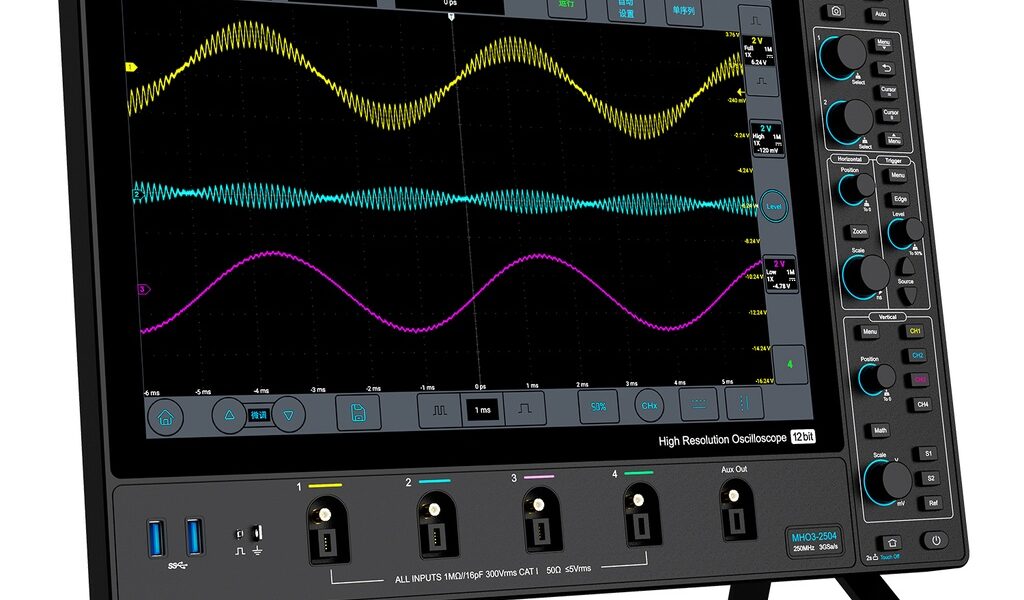
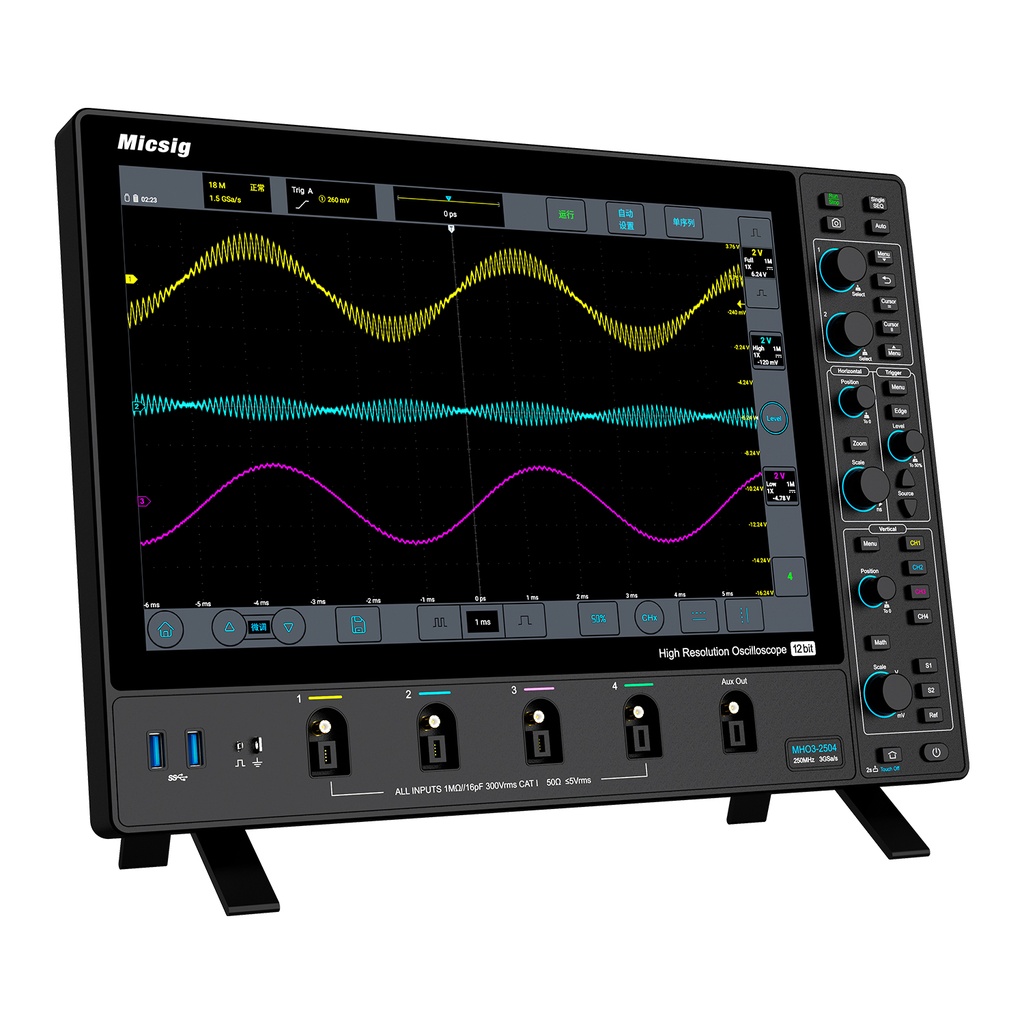
Selecting an oscilloscope for a development lab is not simply a bandwidth decision. The instrument must reveal small waveform details, retain enough history for intermittent faults, fit the available bench or wall space, and support the interfaces and probes required by the test plan. The MHO3 Series addresses these evaluation points with four analog channels, 12-bit vertical resolution, bandwidth choices from 250 MHz to 500 MHz, up to 3 GSa/s real-time sampling, up to 360 Mpts memory, and a 14-inch touch display. TPS Elektronik GmbH supplies this class of high-resolution oscilloscope and supports B2B customers with model selection, accessory matching and project-level consultation.
Procurement snapshot
Why the MHO3 Series belongs on a technical shortlist
For a system integrator or engineering team, the business case is the combination of measurement confidence and workflow efficiency. A 12-bit ADC provides 4,096 quantization levels—16 times the levels of a conventional 8-bit architecture—helping engineers distinguish small variations on larger signals. Deep memory supports long acquisition windows without immediately sacrificing time resolution, while the high waveform update rate improves the probability of seeing infrequent events.
For a first commercial and technical check, review the MHO3-3504 product page or contact TPS through the oscilloscope solutions page.
Core specifications that matter in supplier evaluation
A specification should be read as a system, not as isolated headline numbers. The MHO3 platform provides four analog channels across the three listed bandwidth models. Maximum real-time sampling is 3 GSa/s when one channel in each channel pair is active; when both channels in a pair are active, the specified sampling rate is 1.5 GSa/s. Maximum memory follows the same channel-use logic: up to 360 Mpts in the first configuration and up to 180 Mpts when both paired channels are active. This distinction belongs in a procurement comparison because the practical performance depends on the channel plan.
| Parameter | MHO3-2504 | MHO3-3504 | MHO3-5004 |
|---|---|---|---|
| Analog bandwidth | 250 MHz | 350 MHz | 500 MHz |
| Specified rise time | ≤1.4 ns | ≤1 ns | ≤0.7 ns |
| Analog channels | 4 | ||
| Maximum real-time sampling | 3 GSa/s, subject to channel configuration | ||
| Maximum memory depth | 360 Mpts, subject to channel configuration | ||
| Vertical resolution / noise floor | 12 bit / ≤80 µVrms at 1 mV/div, 1 MΩ | ||
| Display | 14-inch capacitive TFT touch screen, 1920 × 1200 | ||
| Size / net weight | 400 × 280 × 35.8 mm / 4.3 kg | ||
Other relevant specifications include a waveform update rate up to 230,000 waveforms per second, a 20 ppm time-base accuracy, selectable 1 MΩ or 50 Ω input impedance, 20 MHz and high-/low-pass bandwidth filtering, and input ratings stated as CAT I 300 Vrms/400 Vpk at 1 MΩ or 5 Vrms at 50 Ω. Input safety must always be assessed together with the selected probe, attenuation ratio, grounding method and circuit category; the oscilloscope rating alone is not authorization to connect directly to a higher-energy node.
How to select 250 MHz, 350 MHz or 500 MHz
Start from the fastest edge that must be reproduced with useful fidelity, not only the nominal clock frequency. A practical bandwidth allowance must account for edge content, probe bandwidth, loading, amplitude accuracy and the uncertainty permitted by the verification plan. The MHO3-2504 is the cost-controlled choice when 250 MHz is sufficient for power-supply control, general embedded work and moderate-speed digital debugging. The MHO3-3504 adds headroom for mixed development programs. The MHO3-5004 is the preferred series model when faster transitions, more bandwidth margin or broader reuse across teams is required.
Do not buy bandwidth without checking the whole signal path
A 500 MHz front end cannot compensate for a probe that is too slow, excessive loop area, unsuitable input loading or an unsafe connection. Define the signal amplitude, common-mode voltage, rise time, node impedance and required probe type in the RFQ. This lets TPS evaluate the oscilloscope and probe as one measurement chain.
Also define whether the quotation must include passive probes, differential or high-voltage probes, current probes, wall-mount hardware, calibration documentation or additional adapters. A complete accessory definition prevents a nominally suitable instrument from arriving without the measurement chain needed for commissioning.
Signal detail, long records and intermittent-fault capture
12-bit acquisition for small details on complex waveforms
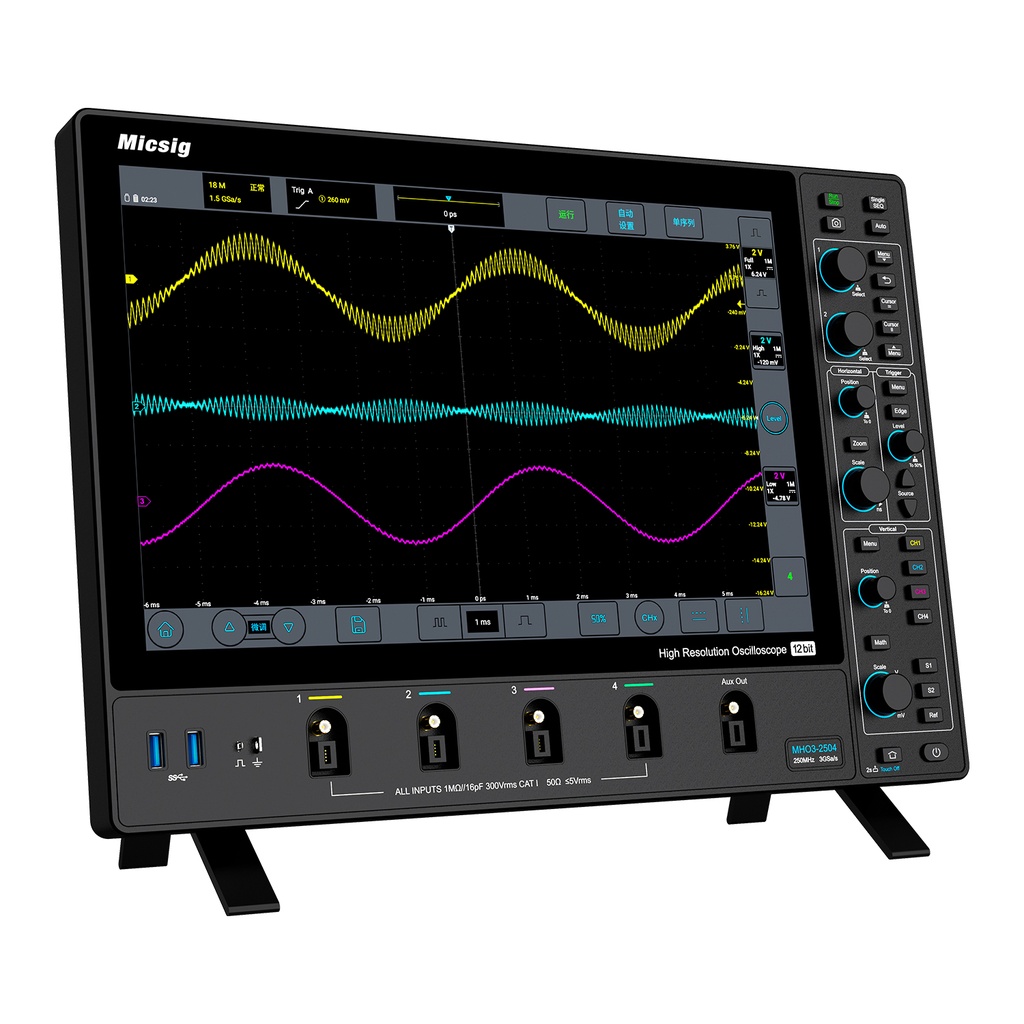
The 12-bit acquisition architecture is valuable when a team must examine ripple, ringing, overshoot or modulation superimposed on a larger waveform. The specified low noise floor supports this use case, but measurement results still depend on vertical scale, probe noise, bandwidth limiting, grounding and environmental interference. For power-electronics development, engineers can combine the MHO3 with a controlled source such as a programmable desktop DC power supply to investigate turn-on behavior, control-loop response and load transitions under repeatable conditions.
Deep memory and segmented acquisition
Up to 360 Mpts allows a long time record to be captured while retaining more detail for later zooming. Segmented storage is useful when the event of interest is separated by long idle periods: the instrument can concentrate storage on repeated target events instead of spending the entire record on inactivity. Combined with up to 230,000 waveforms per second, this supports troubleshooting of rare pulses, serial-bus anomalies, startup sequences and sporadic control instability.
Trigger, decode and analysis functions
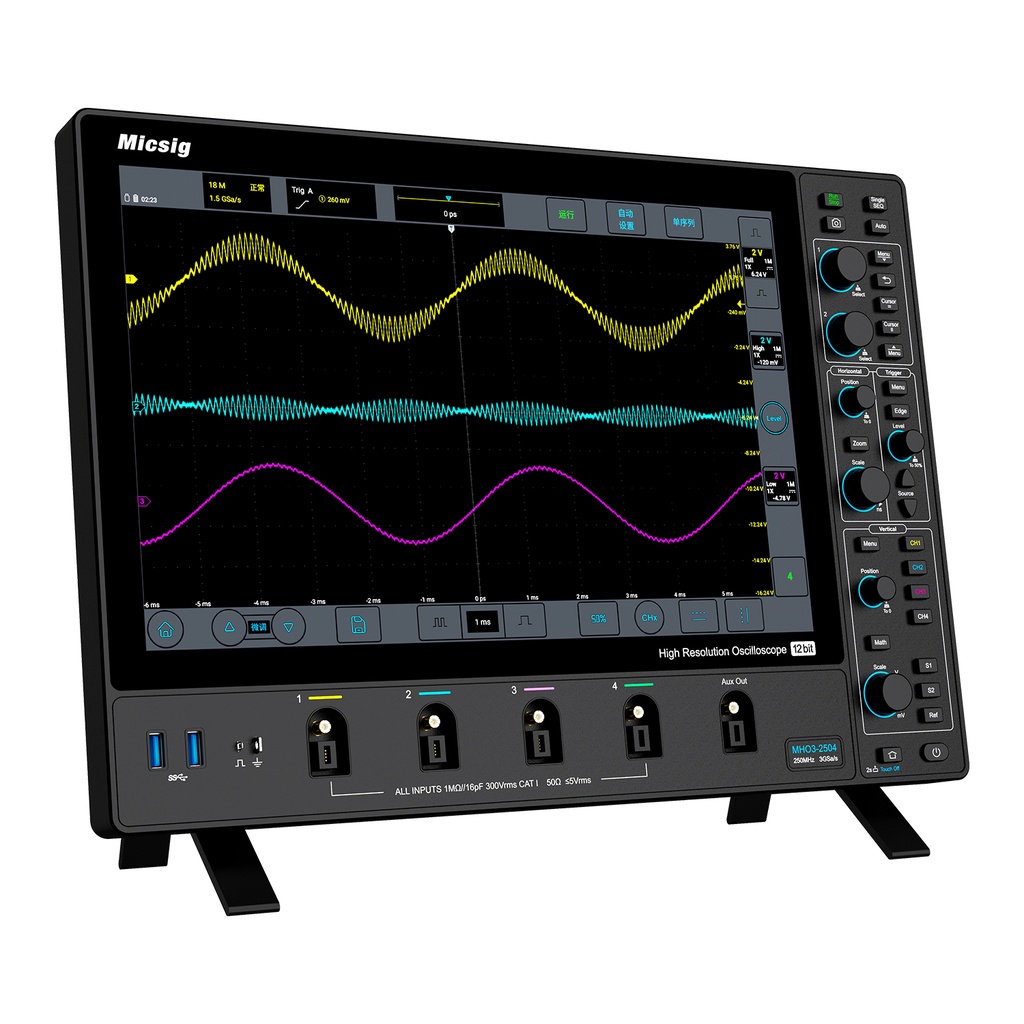
Trigger modes include edge, pulse width, logic, Nth edge, runt, slope, timeout, video and serial triggering. Standard decode coverage listed in the specification includes RS-232/422/485/UART, CAN, CAN FD, LIN, SPI, I²C, ARINC 429 and MIL-STD-1553B. Advanced math, user-defined formulas and FFT help move from detection to diagnosis.
The platform also supports statistics for up to ten measurement items, waveform export in WAV, CSV and BIN formats, screenshots and video recording. These functions help engineering teams attach repeatable evidence to test reports and supplier discussions.
Integration, installation and automated test considerations
The MHO3 is a thin bench instrument at 35.8 mm and provides a 130 × 300 mm wall-mount interface. This can free bench space or place the display at a shared station, but panel builders should confirm bracket design, ventilation, cable bend radius, connector access and service clearance before finalizing the enclosure or workstation. The power adapter is specified for 100–240 VAC, 50/60 Hz input and 24 VDC, 5 A output, with instrument consumption below 120 W. Operating conditions are specified at 0–45 °C, 5–85% relative humidity at 25 °C and below 3,000 m altitude.
Connectivity includes USB 3.0 host, USB Type-C, LAN, HDMI and trigger output. PC control, Android/iOS remote control and SCPI support allow the scope to participate in shared lab setups and automated test sequences. For an RFQ, state whether the project needs scripted measurements, remote file retrieval, synchronized triggering, a demonstration display over HDMI or integration into a rack. If the project is moving toward a complete station, TPS can also discuss mechanical and power integration, including a 4U 19-inch chassis approach or a 24U cabinet platform.
Standardizing a lab fleet
Procurement teams should evaluate more than the initial unit price: common probes, operator training, remote-control compatibility, storage format, warranty handling and the cost of inconsistent measurements all affect lifecycle value. The supplied specification lists a three-year warranty for the main unit; probes and accessories follow their respective terms, so the applicable coverage should be confirmed in the quotation.
TPS can support phased purchasing, model alignment and equivalent-solution discussions for global B2B programs. Begin with the TPS oscilloscope portfolio and share the intended test matrix.
Where the MHO3 Series fits best
Power electronics and power-supply validation
Four channels are useful for correlating control, gate-drive, input and output behavior. High-resolution acquisition helps assess ripple and transient detail, while deep memory supports startup or load-step sequences. The correct isolated or differential voltage probe and current probe must be selected for the circuit energy and common-mode conditions. TPS can discuss the oscilloscope alongside programmable sources, loads and bidirectional power equipment—for example, when building a test concept around a regenerative DC load.
Embedded control and serial communications
Standard serial decoding and flexible triggers make the platform suitable for correlating analog behavior with command traffic. The engineering question is whether the required bus, signal voltage and fault condition are covered—not simply whether “decode” appears on a comparison sheet. Define which channels carry analog signals, which bus is decoded, how long the event lasts and what evidence must be exported.
Production engineering, training and shared laboratories
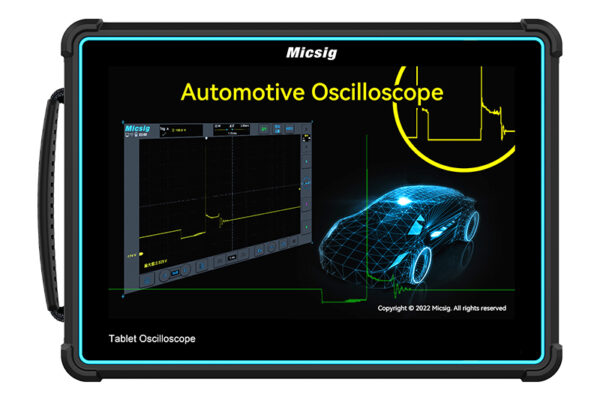
The large touch display, remote access and multilingual Android-based user interface can reduce training friction. Saved settings and reference waveforms can help standardize repeated checks, although production release still requires a controlled method, calibration policy and acceptance limits. Teams that need greater mobility can compare the bench platform with the VTO2004 portable oscilloscope or the ETO Series tablet format.
What to include in an MHO3 oscilloscope RFQ
A concise technical RFQ allows TPS to recommend a suitable configuration without unnecessary back-and-forth. Include:
- Signal profile: highest fundamental frequency, fastest rise time, amplitude, offset, common-mode voltage and expected transient.
- Channel use: number of channels used simultaneously and the required sampling rate and record length in that configuration.
- Probe plan: passive, differential, high-voltage or current probes, required bandwidth, isolation and connector type.
- Analysis: bus standards, trigger conditions, FFT/math functions, automatic measurements and evidence-export format.
- Integration: bench or wall mounting, remote-control method, SCPI automation, LAN policy, HDMI use and workstation constraints.
- Commercial scope: quantity, destination, requested delivery window, calibration documentation, warranty expectations and any required compliance documents.
TPS Elektronik GmbH can support product selection, equivalent-solution assessment, accessory definition and integration consultation for global B2B customers. Review the 250 MHz model, 350 MHz model and 500 MHz model, then use the solution request below to confirm availability and the project-specific configuration.
Convert the test requirement into a quote-ready configuration
Send TPS your bandwidth target, channel plan, signal levels, probe requirements, automation interface, quantity and delivery destination. Our team can help determine whether an MHO3 model or another TPS-supported oscilloscope solution is the better technical and commercial fit.
Frequently asked questions
Which MHO3 model should I specify?
Choose the lowest bandwidth that still provides adequate margin for the fastest edge and required accuracy, after including probe limitations. MHO3-2504, MHO3-3504 and MHO3-5004 provide 250, 350 and 500 MHz respectively, with the same four-channel, 12-bit platform concept.
Is 3 GSa/s available with all four channels active?
The specification states 3 GSa/s when one channel from CH1/CH2 and one from CH3/CH4 are active. When both channels in a pair are active, the stated rate is 1.5 GSa/s. Describe the simultaneous-channel requirement in the RFQ.
Are serial-bus decoders included?
The supplied specification lists standard decoding for RS-232/422/485/UART, CAN, CAN FD, LIN, SPI, I²C, ARINC 429 and MIL-STD-1553B. Confirm the current firmware scope and required protocol details in the quotation.
Can the MHO3 be integrated into an automated test setup?
Yes. LAN, USB, trigger output, PC control and SCPI support provide the basis for automation. Send TPS the preferred control environment, measurement sequence and data-export requirements so interface compatibility can be checked.
What must be confirmed before purchase?
Confirm the model, probe set, input safety, simultaneous-channel performance, accessories, calibration documentation, required compliance evidence, warranty terms, price, delivery time and destination. TPS can consolidate these points into a project-specific RFQ response through the oscilloscope contact page.