

Product Blog | BoFu RFQ Guide
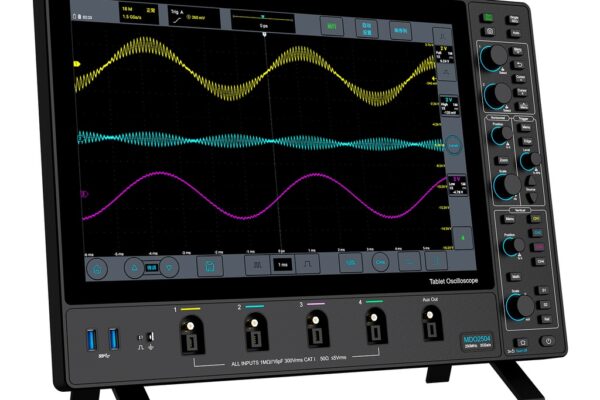
For system integrators, panel builders, procurement teams and electrical engineers, the right oscilloscope is not only a measurement instrument. It is a project decision that affects debugging speed, field service efficiency, validation workflow and supplier qualification. The ETO Series tablet oscilloscope portfolio available from TPS supports 4-channel digital signal analysis with 350MHz or 500MHz bandwidth options, deep memory, serial bus decoding, touch operation and remote-control capability.
Why the ETO Series matters in RFQ-stage oscilloscope selection
At the bottom of the funnel, buyers are usually not asking “what is an oscilloscope?” They are asking whether a specific oscilloscope platform will reduce technical risk, fit existing test workflows and be available through a supplier that can support the complete project. This is where TPS positions the ETO Series as a practical 4-channel tablet oscilloscope solution for professional signal debugging, portable field testing and automated measurement workflows.
The two target models are the ETO3504 350MHz 4-channel tablet oscilloscope and the ETO5004 500MHz 4-channel tablet oscilloscope. Both are designed for engineers who need a large touch display, battery-powered mobility, deep memory acquisition and advanced analysis functions. For a broader view of available platforms, buyers can start from the TPS oscilloscope portfolio page and then request a quotation based on bandwidth, channel count, probe configuration and delivery requirements.

Tablet oscilloscope format for lab and field work
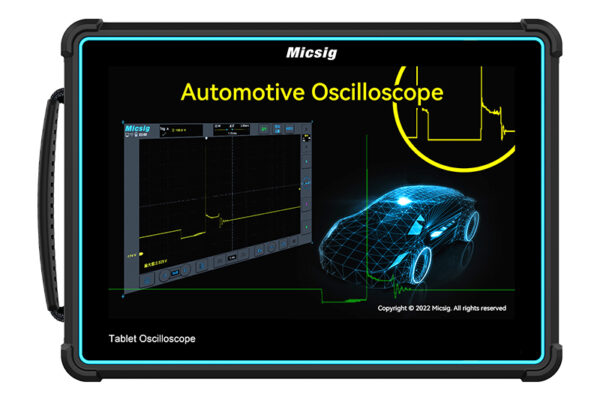
A tablet oscilloscope gives engineers a large visual workspace without limiting the instrument to one bench location. For field troubleshooting, service teams and flexible engineering labs, the ETO Series combines touchscreen operation, battery operation and multiple interface options in one platform.
Key technical parameters for engineering evaluation
For electrical engineers, the decision usually starts with bandwidth, sampling rate, memory depth and triggering. For procurement, the same decision also includes documentation, delivery reliability, accessory availability and supplier responsiveness. TPS can support both perspectives by helping customers compare the ETO3504 and ETO5004 against the signal types and operating environments in the target project.
| Parameter | ETO3504 | ETO5004 | RFQ relevance |
|---|---|---|---|
| Bandwidth | 350MHz | 500MHz | Defines usable frequency range and rise-time visibility. |
| Analog channels | 4CH | 4CH | Important for multi-node power, control and bus analysis. |
| Real-time sampling | Up to 3GSa/s | Up to 3GSa/s | Supports detailed waveform reconstruction. |
| Memory depth | Up to 360Mpts | Up to 360Mpts | Useful for long time-base debugging without losing detail. |
| Waveform capture rate | Up to 230,000 wfms/s | Up to 230,000 wfms/s | Helps reveal rare glitches and intermittent events. |
| Display | 14 inch, 1920 x 1200 touch display | 14 inch, 1920 x 1200 touch display | Supports fast operation and waveform comparison. |
| Battery | 7.4V / 13500mAh Li-ion | 7.4V / 13500mAh Li-ion | Relevant for mobile diagnostics and field service. |
Selection logic: ETO3504 vs. ETO5004
Choose bandwidth according to signal edge speed, not only nominal frequency
The ETO3504 is a strong fit when the project requires a professional 350MHz, 4-channel oscilloscope for general electronics debugging, embedded control, power supply validation and field diagnostics. The ETO5004 should be considered when the application has faster edge rates, tighter timing analysis or greater bandwidth headroom requirements. During RFQ preparation, TPS can help the buyer evaluate whether 350MHz is sufficient or whether the 500MHz model gives the safer engineering margin.
Use memory depth and segmented storage to capture long or intermittent events
Deep memory is important when engineers need to zoom into a long acquisition without losing signal fidelity. The ETO Series supports up to 360Mpts memory depth and segmented storage for up to 10,000 events. In practical terms, this helps capture intermittent switching events, serial bus faults, laser pulse timing, start-up behavior, relay transients and communication errors that may not appear in a short acquisition window.
Confirm trigger and bus decoding requirements before ordering
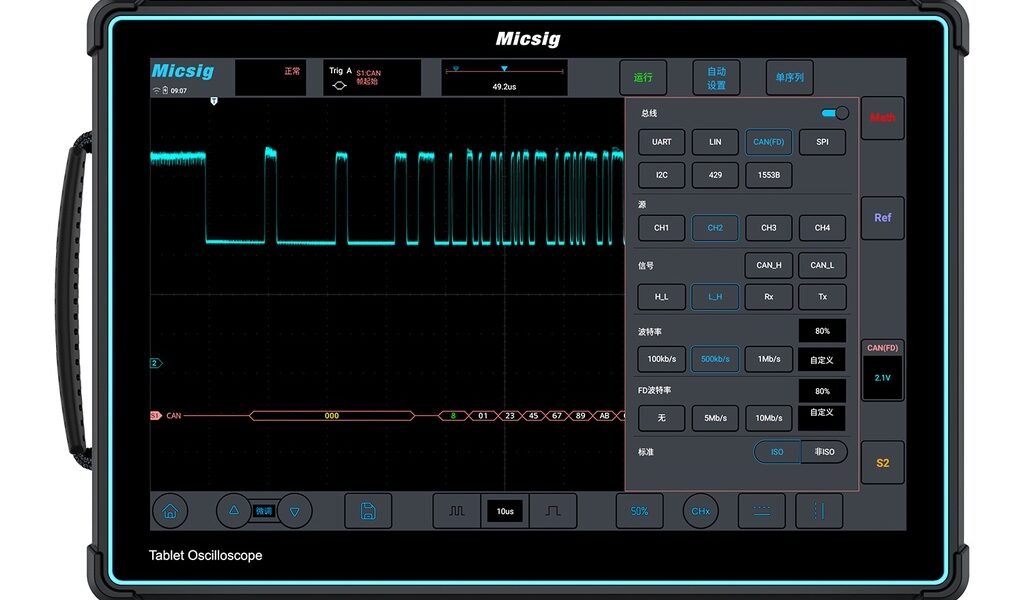
Trigger types include edge, pulse width, logic, Nth edge, runt, slope, time out, video and serial bus triggering. Serial bus decoding supports RS-232/422/485/UART, CAN, CAN FD, LIN, SPI, I2C, ARINC-429 and MIL-STD-1553B. For procurement, this means the RFQ should not only state “4-channel oscilloscope.” It should also list the protocols, voltage levels, probe types and analysis workflows that need to be supported.
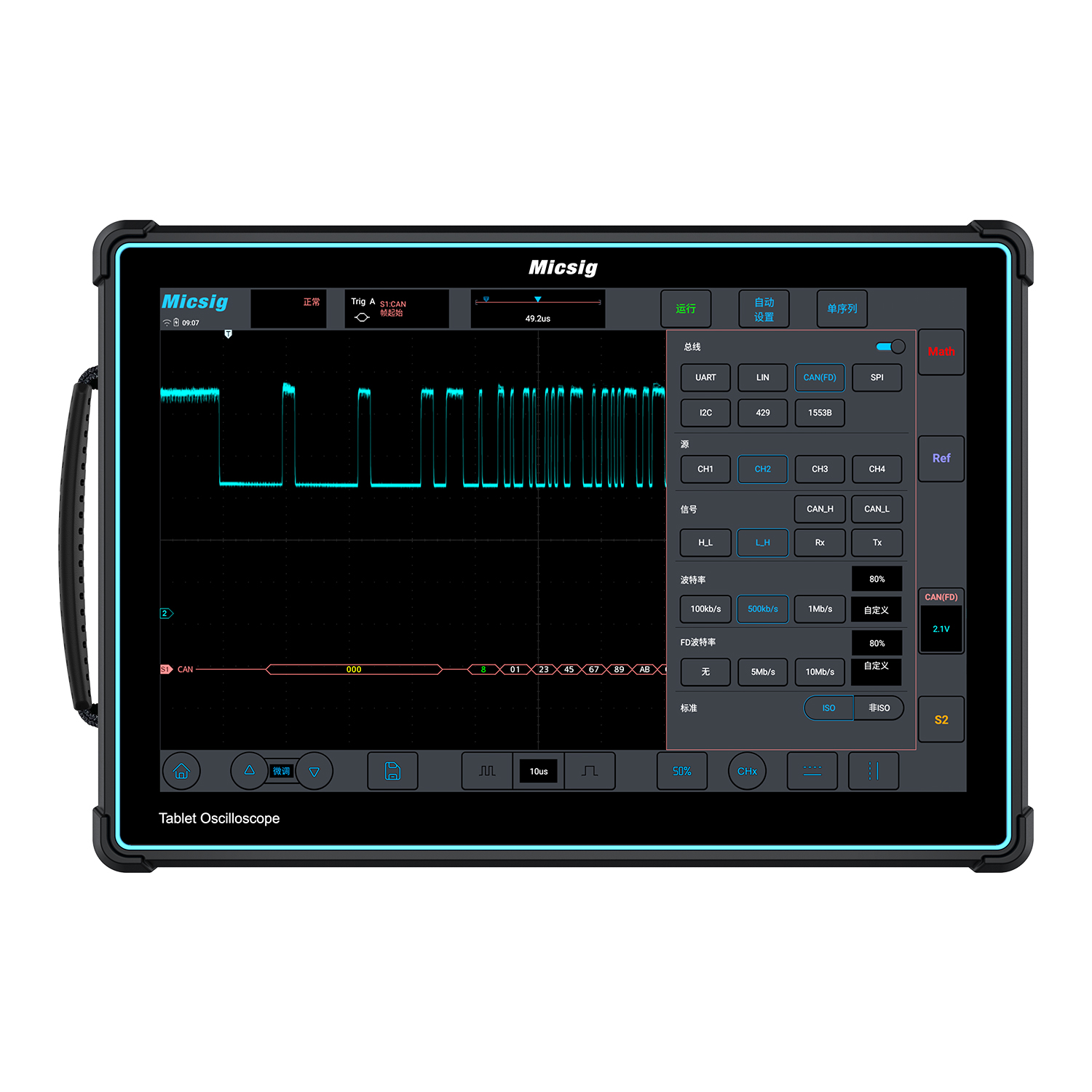
500MHz option for higher bandwidth margin
Where faster transient behavior, higher-frequency signal content or future test requirements are expected, the 500MHz version can provide additional measurement headroom. TPS can review the application and recommend a practical model, probe and accessory configuration.
Application fit for lab, field and system integration
For electrical engineers: faster debugging and more complete waveform context
Electrical engineers typically care about signal integrity, trigger accuracy, noise floor, channel correlation and repeatable analysis. The ETO Series supports hardware digital filtering, advanced math functions, FFT analysis, statistical measurement and file saving in formats such as CSV, BIN and WAV. This makes it suitable for circuit debugging, power electronics checks, communication line analysis and validation workflows where data export matters.
For system integrators: remote control, SCPI and repeatable test workflows
For system integrators, the oscilloscope must often become part of a repeatable test environment. The ETO Series supports PC and mobile remote control, HDMI projection and SCPI commands. This is useful when the oscilloscope is used near a test rack, in a service station, or in a power electronics validation bench. TPS can also help connect the oscilloscope discussion to related test equipment, such as desktop programmable DC power supplies, higher-performance programmable DC sources or a regenerative DC load.
For panel builders and procurement: practical handling, documentation and supplier response
Panel builders and procurement teams need clear product data, accessory lists, compliance documentation, quotation validity and delivery coordination. The ETO Series has a 75 x 75mm VESA mount interface, multiple physical interfaces and standard accessories such as passive probes, probe adapters, power adapter, power cord, built-in battery, side handle, calibration certificate, quick guide, packing list and user instructions. For mixed projects, TPS can also support related infrastructure, including DIN rail power supplies, 19-inch chassis integration and 19-inch cabinet power integration.
Integration, installation and accessory considerations
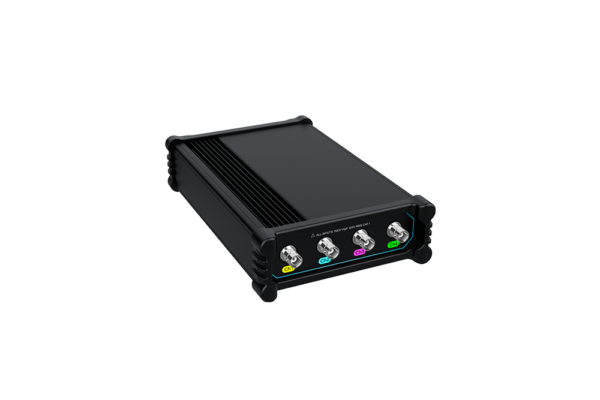
The ETO Series is not limited to classic bench use. The 14-inch integrated touch display supports fast interaction, while the physical interface set supports a wide range of workflows: USB 3.0 host, USB 2.0 host, USB Type-C, HDMI, trigger out, grounding and DC power input. Adapter input is 100-240VAC, 50/60Hz, with power consumption below 84W and 12VDC / 7A adapter output. Operating temperature is specified from 0°C to 45°C, which should be checked against the project’s service environment.
Probe planning is equally important. Standard passive probes may be sufficient for many general-purpose measurements, but high-voltage, differential, current or isolated measurements may require dedicated optional probes. For power electronics projects involving bidirectional converters, battery systems or load testing, TPS can help align oscilloscope selection with related power modules such as 750V bidirectional power modules or AC-DC bidirectional modules for cell formation.
RFQ note: define the complete measuring chain
A professional RFQ should define the oscilloscope, probes, adapters, calibration documentation, software/remote-control needs, delivery destination and after-sales contact route. TPS can support these details before order placement.
RFQ checklist and TPS project support
A successful RFQ should help the supplier answer quickly and accurately. TPS recommends sending the following information when requesting the ETO3504, ETO5004 or an equivalent oscilloscope configuration.
| RFQ item | What to provide | Why it matters |
|---|---|---|
| Target model | ETO3504, ETO5004 or “please recommend” | Enables direct quotation or technical alternative selection. |
| Signal and application | Power electronics, embedded bus, service, lab validation, field diagnostics | Determines bandwidth, probes and trigger/decoding needs. |
| Quantity and delivery country | Units, delivery address, preferred Incoterms | Supports accurate logistics and lead-time planning. |
| Accessory set | Passive probes, differential probes, current probes, isolated probes, case | Avoids incomplete measuring setups after delivery. |
| Documentation | Calibration certificate, compliance documents, data sheet, user guide | Important for quality, incoming inspection and customer approval. |
TPS can provide the product, support technical selection, propose equivalent solutions where appropriate, coordinate project-level supply and connect the oscilloscope with broader test, power and integration requirements. Buyers can request a quotation directly via the TPS oscilloscope consultation page, or review the target product pages for the ETO3504 and ETO5004 before sending the RFQ.
Need a quotation or technical confirmation?
Send TPS your required bandwidth, quantity, target application, protocol decoding needs, probe requirements and delivery country. TPS can help confirm whether the ETO3504, ETO5004 or another oscilloscope solution is the best fit for your project.
FAQ
How should I choose between the ETO3504 and ETO5004?
Choose the ETO3504 when 350MHz bandwidth provides enough measurement margin for your signal. Choose the ETO5004 when faster edge rates, higher-frequency content or future validation requirements justify a 500MHz platform. TPS can review your application before quotation.
Is the ETO Series suitable for field service?
Yes. The tablet format, built-in battery, large touch display and remote-control options make the ETO Series suitable for field diagnostics, service work and mobile engineering tasks, provided the operating environment matches the specified conditions.
Should probes be included in the RFQ?
Yes. The oscilloscope is only one part of the measuring chain. Include passive probes, differential probes, current probes or isolated probes if your application requires them. TPS can help define the accessory set.
Can the ETO Series support automated testing?
The ETO Series supports SCPI commands and remote-control workflows, which can be useful for repeatable engineering tests and system integration. For larger validation benches, TPS can also advise on related power supplies, loads and cabinet or chassis integration.
What information should procurement send to TPS?
Please send the target model, quantity, delivery country, application, required protocols, probe/accessory needs, documentation requirements and expected delivery date. This allows TPS to prepare a more accurate quotation and technical recommendation.