

For system integrators, panel builders, OEMs, and procurement teams, transformer selection affects both control-system performance and project execution. Incorrect voltage configurations, inadequate sizing for inrush loads, missing documentation, or delivery delays can lead to voltage drops, nuisance tripping, overheating, commissioning delays, and on-site rework.
Industrial control transformers are designed for the specific electrical requirements of control circuits, including the short-duration inrush currents associated with contactors, relays, and solenoids. They can also provide galvanic isolation and the required secondary voltage for control equipment such as PLCs, HMIs, and safety relays.
TPS Elektronik’s transformer sale service, delivered through its global sales partner network, supports the sourcing and supply of industrial control, automation, isolation, and machine tool transformers. Selection is based on the electrical requirements, target-market requirements, documentation needs, quantities, and delivery schedule of the application.
1. Why industrial control transformers require application-specific selection
In an industrial control panel, a control transformer has different operating requirements from a transformer intended primarily for steady-state power loads. Its role is typically to provide an appropriate secondary voltage for control circuits while, where required by the design, providing galvanic isolation between the supply and the connected equipment.
Control circuits may include contactor and relay coils, solenoids, PLCs, HMIs, safety relays, and other automation components. Depending on the system architecture, secondary voltages may include values such as 24 V AC or 230 V AC.
A key consideration is the behavior of electromagnetic loads during switching. Contactors, relays, and solenoids can draw substantially higher current during pickup than during steady-state operation. The transformer must therefore be selected not only for the continuous VA demand but also for the short-duration inrush requirements of the connected loads.
If the transformer is inadequately sized for these conditions, the secondary voltage may drop during switching. Depending on the application and the connected devices, excessive voltage drop can contribute to contactor chatter, relay dropout, control-system resets, or unstable machine operation.
Transformer selection must also consider the standards and regulatory requirements applicable to the machine, panel, installation, and target market. Relevant requirements may include UL 508A for industrial control panels in North America and the IEC/EN 61558 series for certain transformer and power-supply applications.
TPS supports transformer sourcing based on these electrical and application requirements, including the documentation and approvals specified for the target project. For a broader overview of TPS sales and supply capabilities, see TPS as a global sales partner for electronics.
2. TPS transformer sale service: sourcing, selection, and supply
TPS Elektronik is not limited to a single transformer brand. As a global sales partner for electronic and electromechanical components, TPS can source industrial transformers from different manufacturers according to the requirements of the application.
This supplier-independent approach allows transformer selection to consider several project parameters together:
- Primary and secondary voltage
- Frequency
- Continuous VA requirement
- Inrush characteristics
- Transformer type and construction
- Required approvals and standards
- Installation and environmental conditions
- Quantity and production volume
- Lead time and delivery schedule
The transformer sale service can support requirements ranging from prototype and pilot quantities to recurring series-production demand. Where appropriate, TPS can also assist with technical clarification during the RFQ process and coordinate the required product and compliance documentation.
An example of TPS’s broader approach to sourcing and market requirements is available in the global sales partnership and compliance case study.
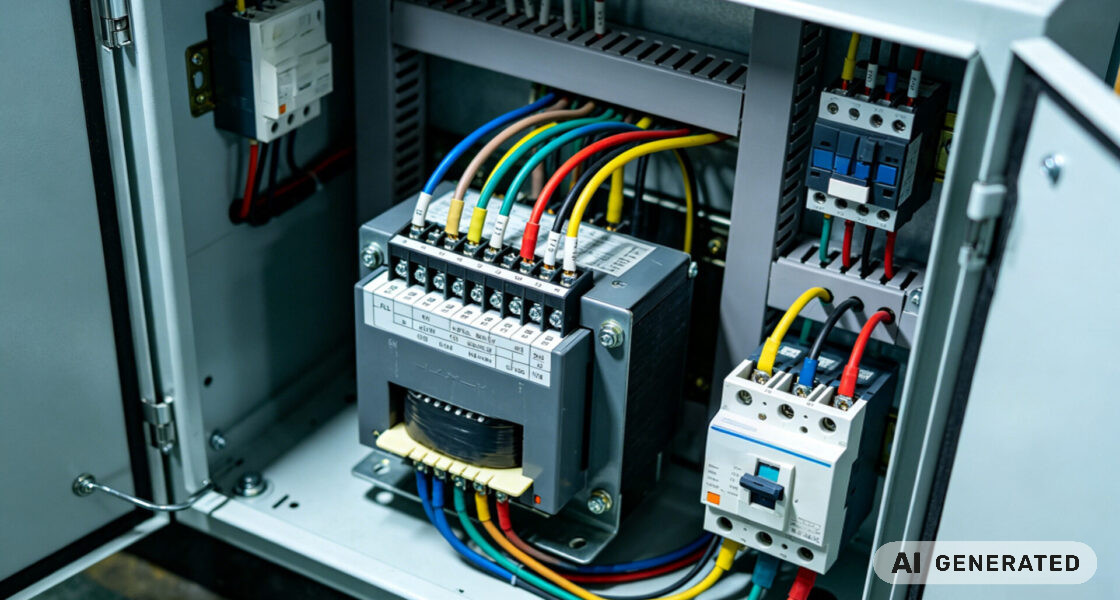
2.1 Transformer types for industrial applications
Depending on the application, TPS can source different categories of industrial transformers, including:
- Control transformers for supplying contactors, relays, solenoids, and other control-circuit loads
- Isolation transformers for applications requiring galvanic separation between input and output circuits
- Machine tool transformers for control and auxiliary circuits within industrial machinery
- Three-phase transformers for higher-power industrial and automation applications
- Encapsulated transformers for applications in which the construction must accommodate specific environmental or mechanical requirements
Transformer ratings and configurations depend on the selected manufacturer and product series. The appropriate transformer should therefore be determined from the actual electrical, mechanical, environmental, and regulatory requirements rather than from transformer type alone.
Consolidating transformer sourcing through a single supply partner can also simplify purchasing where a machine or production program requires several transformer types or configurations.
2.2 Key selection criteria: voltage, VA rating, and inrush current
Correct transformer sizing begins with the input and output requirements. The primary voltage must correspond to the available supply, while the secondary voltage must meet the requirements of the connected control circuit. Frequency, voltage tolerances, available taps, and the required isolation arrangement should also be defined.
The continuous load is normally expressed in volt-amperes (VA). For a control transformer, however, the sum of the steady-state loads is only part of the sizing process. The designer must also consider loads that may be energized simultaneously and the inrush demand of electromagnetic devices such as contactors and relays.
A typical engineering assessment therefore considers:
- The total continuous VA of the connected loads
- The inrush VA of contactors, relays, solenoids, and similar devices
- Which loads can be energized simultaneously
- The permissible secondary-voltage drop during switching
- Any design margin required by the application or applicable engineering practice
Rather than applying a fixed percentage margin to every application, sizing should be based on the characteristics of the actual loads and the transformer manufacturer’s selection data.
TPS’s sales engineering team can assist during the RFQ process by reviewing the available application data and identifying suitable transformer options. For more information on TPS’s sourcing and logistics approach, see supply chain optimization for electronics.
3. Standards and compliance considerations: UL 508A and IEC 61558
Standards and approvals are an important part of transformer selection, particularly when equipment is intended for international markets.
For industrial control panels intended for North America, UL 508A may be relevant to the construction and certification of the complete panel. Transformer selection must therefore be coordinated with the requirements of the panel design, applicable component standards, and the intended certification or listing process.
For the European market, transformers may fall within the scope of applicable EU legislation, including the Low Voltage Directive 2014/35/EU where its conditions of applicability are met. The IEC 61558 series and corresponding EN standards cover safety requirements for various transformers, reactors, power supply units, and combinations thereof.
The exact standard and approval requirements depend on the transformer type, application, equipment design, and target market. A CE marking, UL certification, CSA certification, or other approval should therefore not be treated as interchangeable.
TPS can source transformers according to the approvals and documentation specified in the RFQ. Required documentation should be defined during procurement and verified for the selected product before it is incorporated into the final equipment.
For an example of TPS’s approach to documented quality processes, see the quality assurance customer case.
4. Applications: control panels, machine tools, and factory automation
Industrial transformers are used across a wide range of automation and machine-building applications. Typical scenarios include:
- Factory automation control panels: A control transformer can supply contactor coils, relays, and other AC control loads. Correct sizing for simultaneous pickup loads can help maintain the secondary voltage within the operating range required by the connected devices.
- Machine tool isolation: An isolation transformer can provide galvanic separation between the mains supply and designated machine circuits. The required rating, insulation system, protective measures, and applicable standards depend on the machine design and electrical architecture.
- Motor control systems: Control transformers can supply contactors, motor starters, protection devices, and auxiliary control circuits. Where several electromagnetic loads can switch simultaneously, their combined inrush demand becomes an important transformer-sizing parameter.
- Industrial automation equipment: Transformers may be used to provide specific AC voltages or galvanic isolation for auxiliary circuits within production machinery, test systems, and automation equipment.
Across these applications, transformer selection should account for both continuous loading and dynamic operating conditions. Inrush capability, voltage regulation, insulation, thermal performance, installation conditions, and applicable standards should be evaluated as part of the overall electrical design.
5. RFQ checklist for industrial control transformers
Providing complete application data at the RFQ stage can simplify technical clarification and help identify suitable transformer options.
- Primary voltage: Nominal input voltage and required taps or voltage range
- Secondary voltage: Required output voltage or multiple secondary voltages
- Frequency: For example, 50 Hz, 60 Hz, or 50/60 Hz as required
- Continuous load: Total required VA under normal operating conditions
- Inrush load: Inrush VA and switching characteristics of simultaneously energized contactors, relays, solenoids, or other loads
- Transformer type: Control, isolation, machine tool, three-phase, encapsulated, or other required construction
- Installation requirements: Mounting method, dimensions, terminal configuration, enclosure requirements, and available installation space
- Environmental conditions: Relevant temperature, humidity, dust, vibration, or other operating conditions
- Standards and approvals: Required UL, CSA, CE-related, IEC/EN, or other project-specific requirements
- Documentation: Required declarations, certificates, technical data, drawings, or compliance documentation
- Quantity and schedule: Prototype, pilot, and series-production quantities together with required delivery dates
6. FAQ
What is the difference between a control transformer and a standard power transformer?
A control transformer is selected for the operating characteristics of industrial control circuits, particularly loads such as contactors, relays, and solenoids that can produce high short-duration inrush currents. In addition to continuous VA demand, the transformer must be capable of supporting the required secondary voltage during these switching events. Transformers intended primarily for steady-state loads may not have the same performance characteristics.
How do I size a control transformer for my panel?
Determine the total continuous VA of the connected loads and identify the inrush VA of electromagnetic devices that can be energized simultaneously. The transformer should then be selected using the manufacturer’s sizing and regulation data, taking into account the permissible voltage drop, operating conditions, and any application-specific design margin. TPS can assist with the selection process when the relevant load data is provided.
Does TPS provide transformers for North American and European applications?
TPS can source transformers for projects intended for different target markets. Required input and output voltages, frequency, standards, approvals, and documentation should be specified in the RFQ so that suitable transformer options can be evaluated.
Which certifications or standards should I specify?
This depends on the transformer type, application, final equipment, and destination market. UL, CSA, CE-related requirements, and IEC/EN standards are not interchangeable. The applicable requirements should be established as part of the equipment’s compliance strategy and communicated during transformer sourcing.
Where can I learn more about TPS’s broader sales and supply capabilities?
Visit the TPS global sales partner service page or read about global sales partnerships for 2026.