

Scope: Global sales enablement, supplier qualification, and documentation readines
Executive Summary
A mid-sized OEM (name withheld under NDA) aimed to scale an industrial electronics platform across multiple regions while maintaining control over RoHS compliance, documentation quality, and supplier performance.
The engineering team was experienced, but internal handoffs between design, procurement, and market-entry requirements were inconsistent—particularly when dealing with EU obligations and U.S. regulatory expectations.
Objective
Establish a repeatable and auditable market-entry process so that new product variants can be quoted and delivered more efficiently.
Constraint
Shorten timelines without reducing QA/QC rigor.
Approach
TPS supported the customer as a global sales partner by aligning supplier capabilities, compliance evidence, and commercial workflows.
Client Profile (Anonymous)
The customer develops industrial systems combining:
- Power electronics
- Control PCBs
- Ruggedized enclosures
The primary challenge was not component sourcing, but building a structured and repeatable go-to-market workflow covering:
- RFQ packages
- Supplier validation
- Documentation sets
- Pre-shipment quality checks
Note on confidentiality
Product roadmap and supplier data are commercially sensitive. This case study focuses on workflows and outcomes only.
What Was Blocking Launch
1) RoHS evidence Not Audit-Ready
Declarations existed but were not consistently supported by traceable documentation required for audits or customer follow-up requests.
TPS helped align:
- Materials strategy with EU RoHS (Directive 2011/65/EU)
- Documentation structure for traceability
- Evidence expectations across procurement and sales
2) Supplier Qualification Gaps
Variations in materials (metals vs. non-metals) impacted:
- EMI behaviour
- Corrosion resistance
- Manufacturability
- Inspection requirements
Additional gaps included:
- Inconsistent process controls
- Limited standardization of sealing and enclosure validation
- Lack of defined inspection criteria (e.g., pressure/leak verification)
3) Inconsistent Security Positioning
The embedded compute module raised recurring customer questions about security standards.
TPS clarified expectations and aligned communication around:
- Common Criteria (ISO/IEC 15408) as a recognized framework
- Practical positioning for sales and procurement teams
4) Global Expansion Complexity
The customer required a structured approach to:
- Regional compliance requirements
- Labelling and documentation
- Supplier documentation quality
- Customer questionnaires
TPS helped standardize procurement inputs to reduce iteration cycles.
TPS Sales Playbook
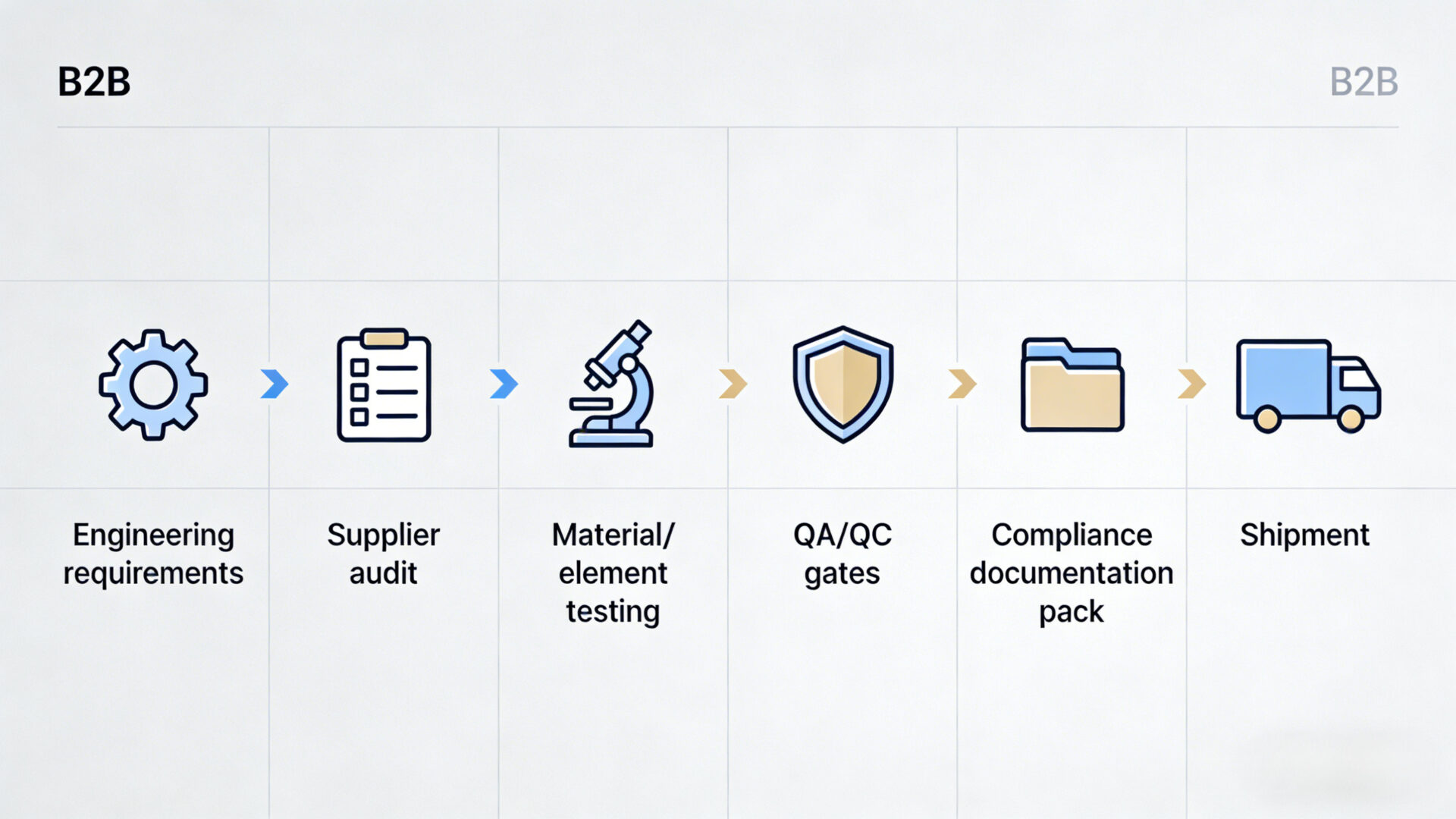
Phase 1 — Quote-Ready Requirements & Compliance Map
Creation of a centralized “source of truth” including:
- Product variants
- Critical-to-quality (CTQ) parameters
- Compliance mapping (EU + U.S.)
- RoHS evidence expectations
Outcome: Reduced back-and-forth between engineering and procurement
Phase 2 — Supplier Selection & Test Alignment
Supplier evaluation for:
- PCBAs
- Cable assemblies
- Machined components
- Enclosures
Alignment included:
- Inspection plans
- Process controls
- Test expectations
Where relevant:
- NDT competence (aligned with ISO 9712 principles)
- Pressure and leak verification criteria
Phase 3 — Material Evidence & QA/QC Gates
Structured approach to:
- Material declarations
- Test reports
- Traceability
Definition of QA/QC elements:
- Incoming inspection
- Sampling plans
- Re-test triggers
- Escalation paths

Phase 4 — Sales Enablement
Translation of technical readiness into clear commercial communication:
- Standardized questionnaire responses
- Documentation index
- Security positioning
Support included templates to maintain consistency across customer interactions.
Reusable Deliverables
The following assets were designed for reuse across projects:
- RFQ package
- BOM, drawings, CTQ list, inspection plan, variant structure
- Supplier shortlist
- Capability matrix, audit results, risk register
- Compliance documentation structure
- RoHS declarations with traceable supporting data
- QA/QC framework
- Inspection criteria, sampling plans, escalation logic
- Sales enablement templates
- Customer responses, documentation index, positioning guidance
Results & Business Impact
Following implementation of the structured workflow:
- Improved RFQ efficiency
Fewer clarification cycles due to standardized input data - Reduced supplier-related risk
Clearer qualification criteria and documented QA/QC gates - More consistent customer communication
Compliance and security topics addressed with structured documentation
Overall, the customer established a more predictable and repeatable process for market entry across regions.
How to Start (RFQ Path)
To initiate collaboration, provide:
- Target markets
- Product variants
- Known compliance requirements (e.g., RoHS, security, customer-specific)
- Current supplier list (if available)
TPS will define a structured commercial and technical pathway toward a quote-ready and launch-ready state.
FAQ
Does TPS provide final certifications?
No. TPS supports documentation readiness and compliance structuring. Final certifications are issued by accredited bodies where required.
How are design changes handled?
TPS supports workflow continuity by aligning:
- Variant management
- Documentation updates
- Supplier coordination
- RFQ structuring
What about mechanical parts requiring NDT or sealing validation?
TPS helps:
- Assess supplier capability (including NDT-related competence where applicable)
- Define acceptance criteria (e.g., pressure/leak checks)
- Integrate requirements into QA/QC processes
How quickly can we start?
After receiving initial RFQ inputs, TPS can begin with a compliance and supplier-risk mapping phase, followed by structured implementation steps.