

System integrators and panel builders rarely lose time because of product design alone. They lose time — and margin — when supply chains fragment during the pivotal transition from prototyping to series production. Sourcing a PCB from one vendor, an enclosure from a machine shop. And a custom wire harness from a third cable house creates invisible but costly tolerance mismatches. Which delayed deliveries, and a scattered chain of compliance that jeopardizes the final system acceptance test.
TPS Elektronik’s turnkey cable assembly services are built to consolidate that risk. By combining our in‑house cable assembly manufacturing with full electromechanical box build integration, we provide a single accountable source for your complex interconnect needs. This approach serves OEMs and contract manufacturers across industrial automation, medical diagnostics, and telecommunications infrastructure — sectors where a single failed harness can bring a production line to a halt.
1. The real cost of fragmented cable sourcing
When procurement teams seek out cable assembly companies, the impulse is often to compare per‑piece cost across a shortlist of vendors. But for system integrators assembling complex control panels or medical diagnostic equipment, the true cost of a cable harness extends far beyond its unit price. Fragmented sourcing — where connectors arrive from one distributor, wire from a second, and assembly occurs at a third location — introduces cascading risks that inflate the total cost of ownership.
1.1 DFM for wire harnesses: the hidden procurement lever
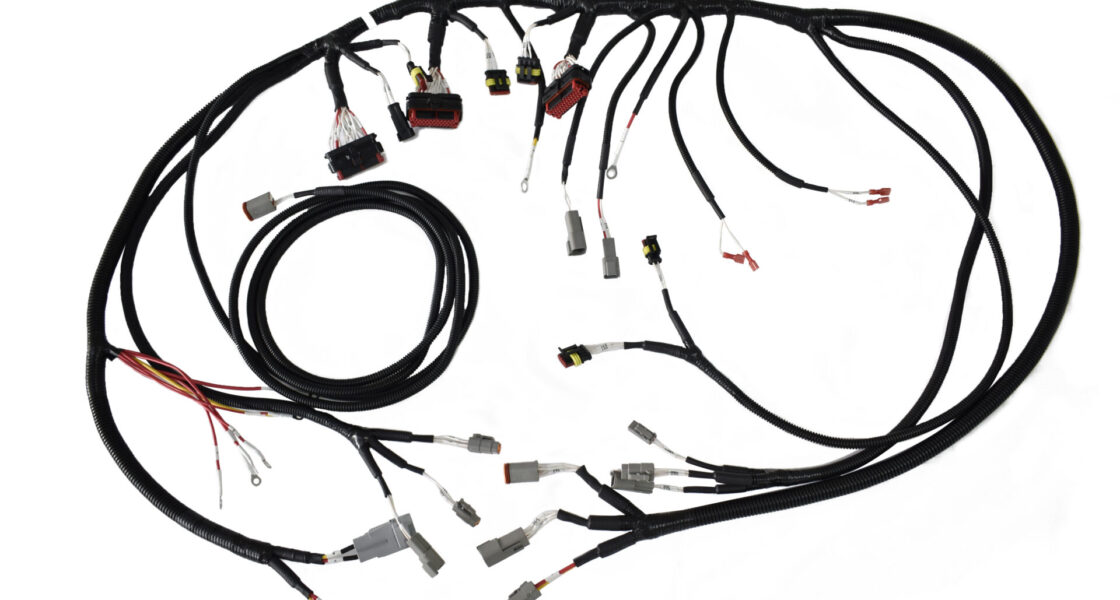
Design for Manufacturability (DFM) is routinely applied to PCBs. Few procurement teams extend the same rigor to their cable harness assembly. That gap is costly. A harness designed with overly tight bend radii, incompatible connector families. Or insufficient strain relief leads to field failures that are far more expensive to investigate and rework than to prevent during engineering review.
TPS Elektronik provides in‑house DFM support as part of every custom cable assembly project. Our engineers review schematics, verify wire gauge (AWG) selections against expected current draw and voltage drop tolerances. And align connector choices with the environmental demands of the end application — whether that means IP67‑rated seals for washdown environments or high‑flex jacket materials for robotic arms. This proactive review reduces procurement iterations and eliminates costly engineering change orders late in the build schedule.
1.2 Wire gauge and voltage drop: why AWG choices matter for system reliability
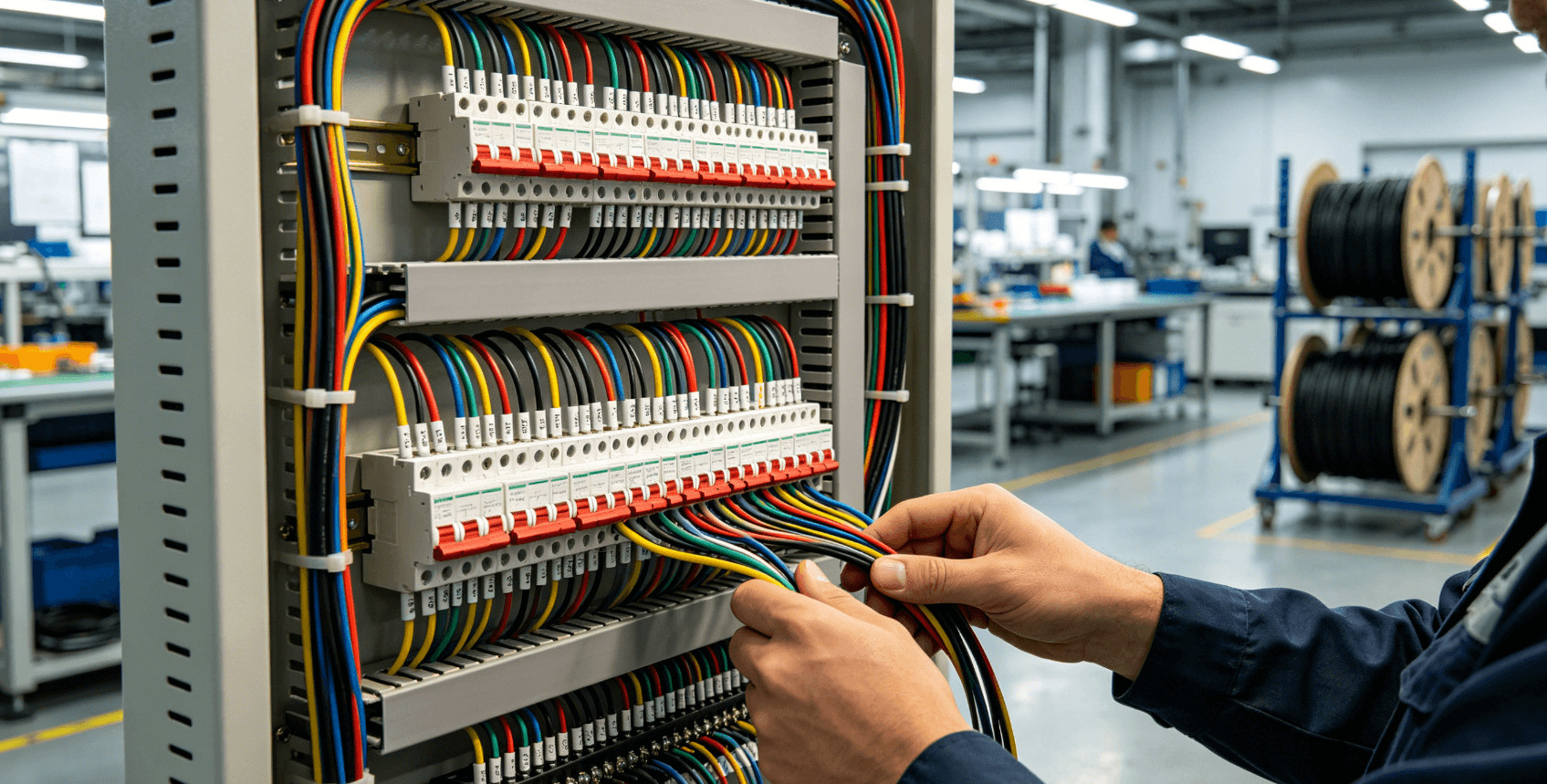
Electrical engineers who specify a custom wire harness face a fundamental trade‑off: thicker conductors (lower AWG) reduce voltage drop and heat buildup but increase weight, cost, and stiffness. In automated test equipment, where dozens of power and signal lines run inside a single cable chain, improper gauge selection causes cumulative errors that are difficult to trace. An undersized ground return path, for instance, elevates the reference voltage of analog sensor circuits, degrading measurement accuracy across an entire instrument rack.
TPS Elektronik’s approach to wire harness contract manufacturing includes a thorough review of conductor sizing against both steady‑state and inrush current conditions.
2. RF and coaxial cable assembly: impedance control and signal integrity
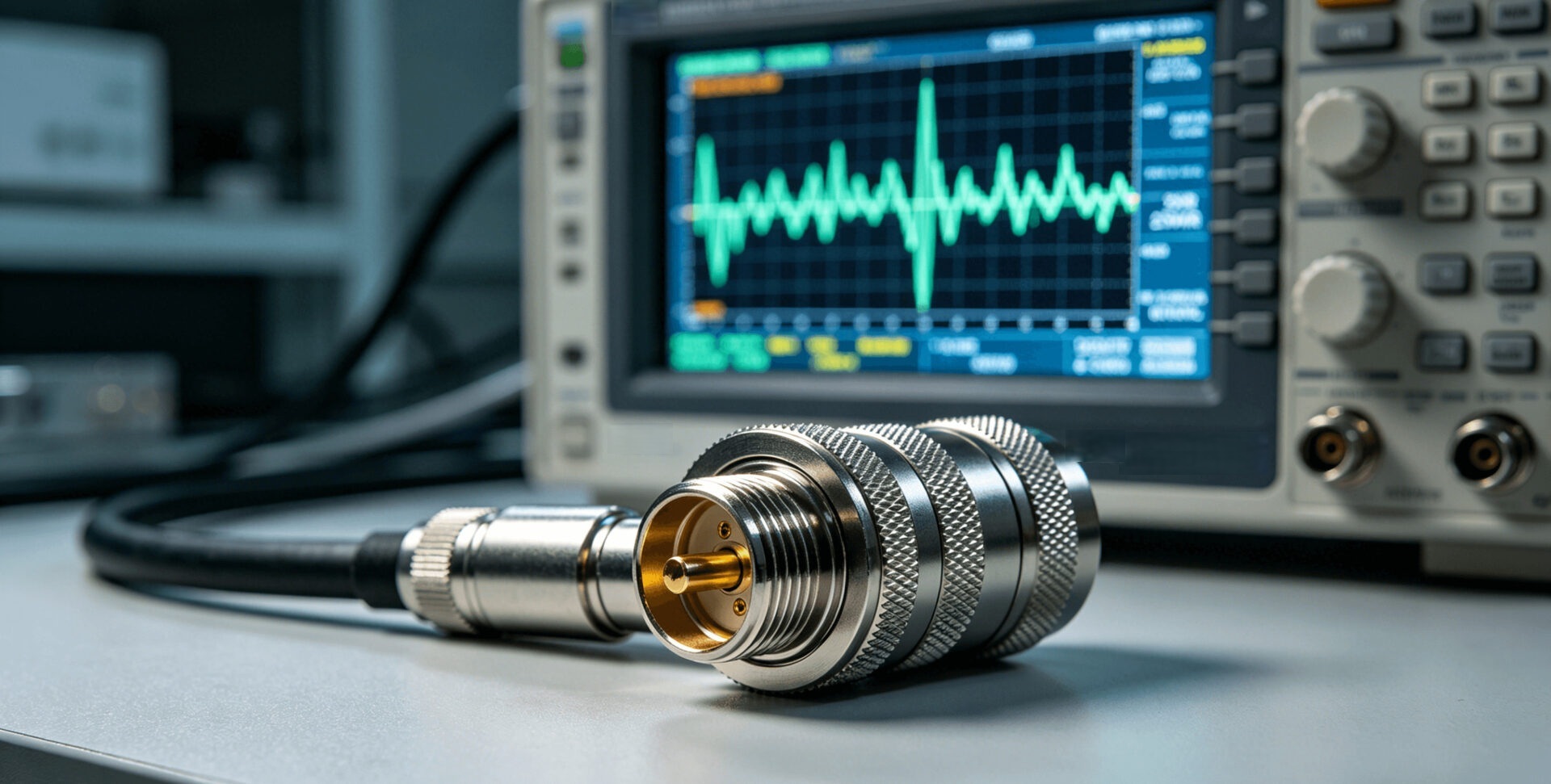
In high‑frequency communication systems — from industrial IoT gateways to radar modules — the physical assembly of a coaxial cable matters as much as the board‑level circuit design. A microscopic void in the solder joint, an incorrectly prepared dielectric. Or a loose crimp on the shielding braid creates an impedance discontinuity. That discontinuity produces signal reflections. Which measured as Voltage Standing Wave Ratio (VSWR), that degrade receiver sensitivity or distort transmitted waveforms.
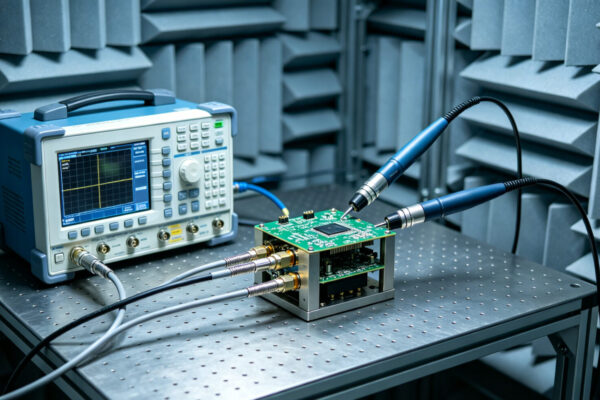
Our RF coaxial cable assembly services address these risks through controlled processes. We terminate common connector families — BNC, N‑type, SMA, and flange‑mount SMA variants — with calibrated tooling that preserves the cable’s characteristic impedance. For panel builders integrating RF modules into shielded enclosures, we supply assemblies with SMA male‑to‑female bulkhead adapters. These pass signals cleanly through enclosure walls while maintaining the grounding integrity of the Faraday cage. Every RF assembly is tested on a Vector Network Analyzer (VNA) to verify insertion loss and return loss against target specifications.
For a deeper technical reference, see our BNC connector guide and our SMA connector specifications.
3. Fiber optic cable assembly: bandwidth, testing, and connector selection
Copper cables reach their limits at high bandwidths, over long distances, or wherever electromagnetic interference (EMI) threatens signal integrity. Medical imaging systems — MRI and CT scanners. Demand fiber optic interconnects that transmit massive data streams without adding noise to sensitive receiver circuits. Data center backbones require thousands of fiber links, each of which must be tested and certified to meet insertion loss budgets.
TPS Elektronik’s fiber optic cable assembly capability covers the full process: precision cleaving, epoxy curing, ceramic ferrule polishing, end‑face inspection. And insertion loss testing with Optical Time Domain Reflectometers (OTDR). We build assemblies with LC, SC, and ST connectors and provide comprehensive test documentation. This level of in‑process quality control is mandatory for medical and telecom applications where a single faulty fiber link can render an entire system non‑compliant during acceptance testing.
Additional technical background is available in our fiber optic cable assembly guide and our EMS fiber optic assemblies overview.
4. Full turnkey integration: bridging cable assembly and box build
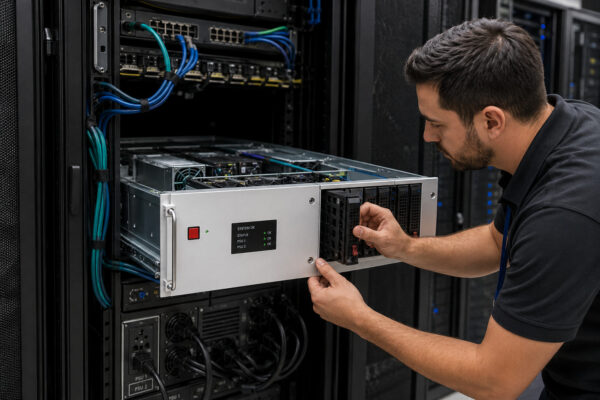
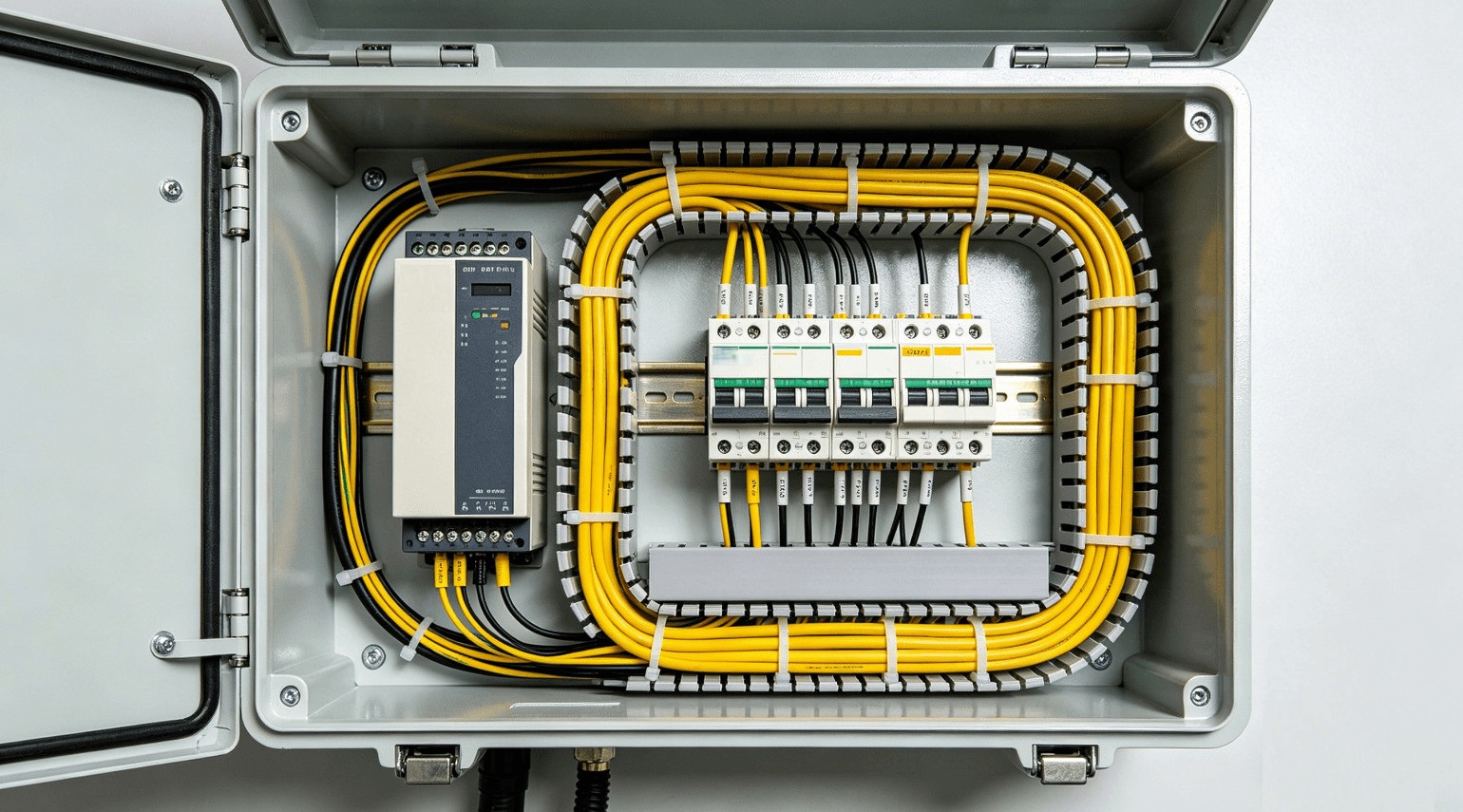
The line between cable assembly services and electromechanical box build is artificial. In practice, every complex enclosure contains hundreds of interconnect points: wires routed from power supply terminals to PLC I/O modules, shielded data cables snaked through finger ducting. And sensor cables dressed into cable carriers on moving gantries. When these sub‑assemblies arrive from separate suppliers, the system integrator must absorb the integration risk. This verifying that connector pinouts match, that wire lengths reach without strain. And that cable shields terminate correctly at both ends.
Full turnkey cable assembly eliminates this risk by combining wire harness manufacturing and box build assembly under a single quality management system. TPS Elektronik sources components, manufactures the cable harnesses, fabricates or integrates enclosures. Also mounts sub‑assemblies, routes and dresses all wiring, and performs functional system testing — all before shipment.
For procurement professionals, this means one purchase order, one quality standard, and one accountable partner. Our approach is documented in our detailed guide: EMS cable assembly — tested, documented, RFQ‑ready.
5. Quality assurance: IPC/WHMA‑A‑620 compliance
Most cable assembly companies claim to “meet industry standards.” For procurement teams responsible for acceptance testing, that statement carries little weight without verifiable evidence. IPC/WHMA‑A‑620 is the only industry‑consensus standard for requirements and acceptance of cable and wire harness assemblies. It is maintained jointly by IPC and the Wire Harness Manufacturers Association (WHMA). The current revision — IPC/WHMA‑A‑620F‑2025 — defines materials, methods, tests, and acceptance criteria for crimped, mechanically secured, and soldered interconnections. It categorizes products into three classes: Class 1 (General Electronic Products), Class 2 (Dedicated Service), and Class 3 (High Performance/Harsh Environment).
TPS Elektronik trains its production operators to IPC/WHMA‑A‑620 criteria and provides documented evidence of compliance for each production batch. This ensures that every custom wire harness assembly — from a simple power cord to a complex multi‑branch control harness — meets the visual, mechanical, and electrical acceptance criteria that your end customer will demand during factory acceptance testing. For projects that require certified IPC specialists (CIS), TPS can provide additional documentation layers that further streamline the audit process.
6. Electrical and environmental testing: beyond visual checks
Visual inspection alone cannot detect a partially crimped terminal that passes a low‑current continuity test but fails under load, nor can it reveal a pin‑hole defect in a molded strain relief that permits moisture ingress. Industrial cable assembly integration requires a rigorous, multi‑stage test protocol.
TPS Elektronik performs the following in‑house electrical QA tests on cable assemblies:
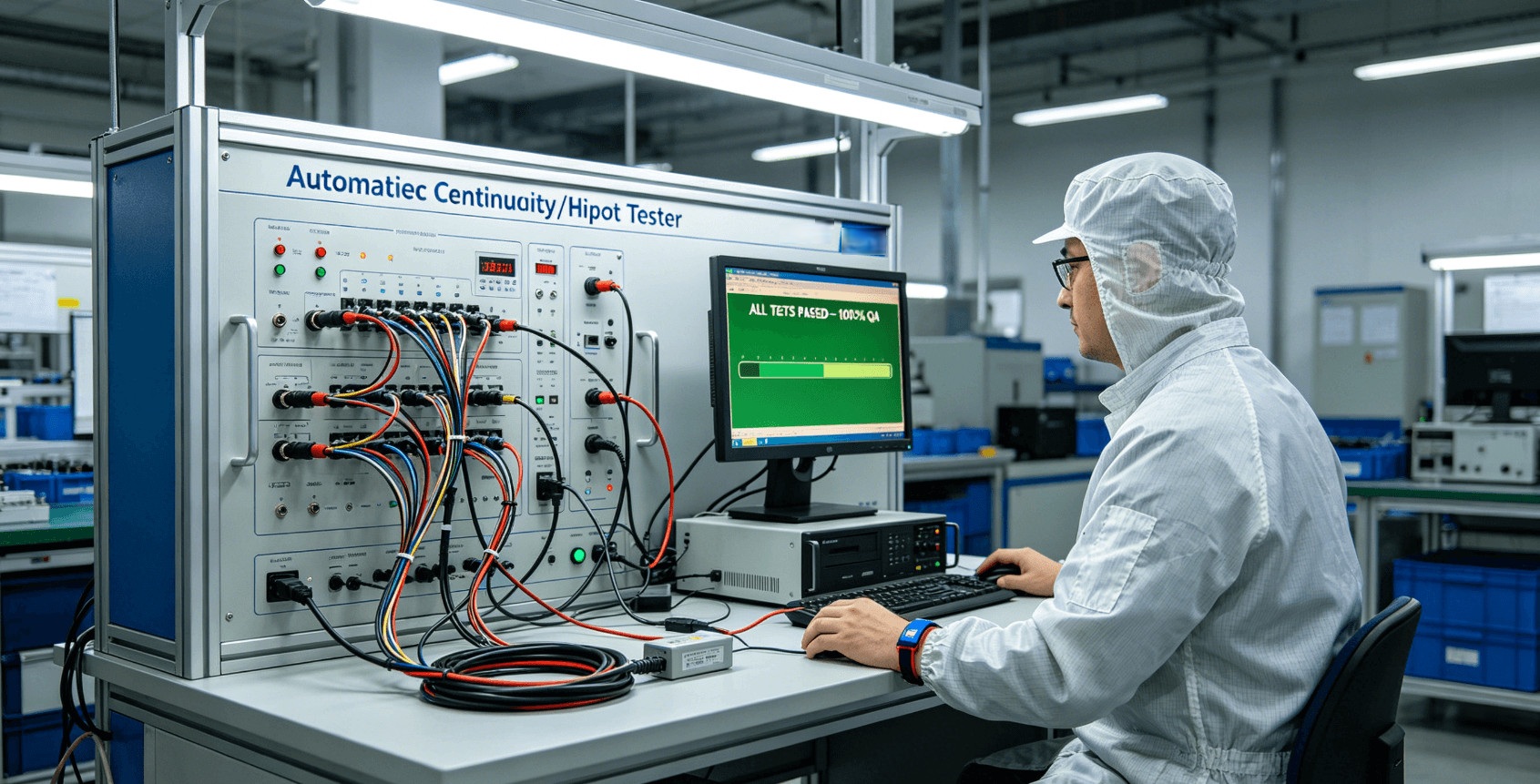
- Continuity testing — 100 % verification of pin‑to‑pin wiring accuracy using automated continuity testers.
- High‑potential (hipot) testing — AC or DC hipot tests to detect insulation breakdown or clearance violations between conductors and shields.
- Insulation resistance (IR) testing — Megohm‑range measurements to validate the integrity of insulation materials, especially critical for medical devices and high‑humidity environments.
- VNA‑based RF testing — Insertion loss and return loss measurements on coaxial assemblies from DC to the specified upper frequency limit.
- OTDR‑based fiber testing — End‑face inspection and insertion loss certification for all fiber optic cable assemblies.
Documented test reports are provided with every production lot and can be formatted to align with your internal quality or regulatory submission requirements.
7. Component sourcing and supply chain management for cable assemblies
The performance of a custom wire harness manufacturer depends as much on component sourcing as on assembly skill. A properly crimped contact still fails if the connector housing is made from a counterfeit or sub‑standard polymer that warps under soldering heat. TPS Elektronik’s EMS operations extend into supply chain management, including verification of component authenticity, traceability documentation, and management of minimum order quantities (MOQs) for specialized connectors and jacketing materials. By consolidating component procurement within our EMS framework, we reduce the risk of counterfeit parts entering your cable assembly and provide full material traceability for regulated industries.
8. Compliance, certifications, and global market access
8.1 IEC 62368‑1 safety compliance for harness assemblies
The safety standard IEC 62368‑1 governs audio/video, information, and communication technology equipment. For custom cable assemblies integrated into these systems, the standard’s requirements cascade down: protective conductor (PE) continuity, creepage and clearance distances within connector backshells, and flammability ratings of insulation materials. Our team ensures that every harness assembly meets the applicable requirements, and we provide supporting documentation for your technical file.
8.2 Electromagnetic compatibility and cable shielding
Cables are often the primary radiating antenna in an electronic system. A poorly terminated shield, an incorrect grounding topology. Or a missing ferrite on a data line can cause a system to fail conducted or radiated emissions testing — even if the PCB layout is otherwise well designed. Our in‑house EMC pre‑compliance capability allows us to evaluate shielding solutions during the prototyping stage. Which avoiding a situation where a fully assembled box build fails its formal EMC certification. TPS resources such as our tested and documented cable assembly guide reflect this integration logic.
9. Application areas: industrial, medical, and telecommunications
TPS Elektronik’s custom cable assembly services span a broad range of regulated and harsh‑environment applications:
- Industrial automation and panel building: Multi‑conductor control cables for PLC I/O wiring, shielded encoder cables for servo drives, and flexible cable chains for robotic material handling.
- Medical diagnostic equipment: Low‑leakage‑current harnesses for patient‑connected devices, fiber optic interconnects for MRI‑safe environments, and fully documented manufacturing records for FDA or EU MDR submissions.
- Telecommunications infrastructure: High‑density fiber optic patch panels, RF jumper assemblies for base station installations, and ruggedized outdoor cable assemblies with IP67‑rated connectors.
- Test and measurement systems: Precision coaxial assemblies for RF test setups, low‑thermal‑EMF cabling for precision voltage measurement, and multi‑branch harnesses that interconnect PXI chassis with external signal conditioning units.
10. RFQ checklist: what to prepare for your cable assembly quotation
To receive an accurate quotation for custom cable assembly services, the following information should be gathered before submission. Providing complete data reduces quotation turnaround time and minimizes revision cycles.
- Bill of materials (BOM): Connector part numbers, wire specifications (AWG, insulation type, color), labeling requirements.
- Assembly drawings or schematics: Cable routing diagrams, pinout tables, crimp specifications.
- Quantities and delivery schedule: Prototype quantity, pre‑series volume, and target series production quantity with expected delivery dates.
- Environmental requirements: Operating temperature range, exposure to chemicals or moisture, IP rating (e.g., IP67).
- Testing and documentation: Required test protocol (continuity, hipot, VNA, OTDR), certification requirements (IPC/WHMA‑A‑620 Class 2 or Class 3), reporting format.
- Box build integration: If the cable assembly will be installed into an enclosure by TPS, provide enclosure drawings, panel layout, and functional test specifications.
- Compliance requirements: Relevant standards (e.g., IEC 62368‑1, RoHS, REACH), required certifications (CE, UKCA), special material declarations.
11. Frequently asked questions
What is the difference between a wire harness and a cable assembly?
A wire harness bundles multiple individual wires, often using sleeves, tape, or conduit, and is designed for internal routing inside equipment or panels. A cable assembly encases conductors within a protective outer jacket — typically ruggedized for harsh environments — and includes terminated connectors at both ends. TPS Elektronik manufactures both product types, selecting the appropriate construction based on your application’s mechanical, thermal, and environmental demands.
Does TPS Elektronik manufacture according to IPC/WHMA‑A‑620?
Yes. Our production operators are trained to IPC/WHMA‑A‑620 criteria, and we provide documented acceptance evidence for every production batch, supporting both Class 2 (Dedicated Service) and Class 3 (High Performance/Harsh Environment) requirements.
What types of connectors can TPS terminate?
We terminate a wide range of connector families including BNC, N‑type, SMA, and flange‑mount SMA bulkhead adapters for RF applications; LC, SC, and ST connectors for fiber optic assemblies; and industrial connectors from manufacturers such as Phoenix Contact, Weidmüller, Harting, and TE Connectivity for power and signal applications.
How does TPS verify the quality of each cable assembly?
Every assembly undergoes 100 % electrical testing including continuity verification. Additional tests — hipot, insulation resistance, VNA insertion/return loss, and OTDR fiber certification — are performed according to the quality plan agreed during the RFQ stage. Full test documentation is provided with every shipment.
Can TPS integrate cable assemblies into a completed box build?
Yes. Full turnkey integration — from wire harness manufacturing to enclosure assembly, cable routing, functional testing, and final packaging — is a core part of our EMS offering. This approach consolidates your vendor base and transfers integration risk to TPS.
Where can I learn more about TPS’s EMS cable assembly capabilities?
Visit the TPS cable assembly service page or read our technical guides on tested and documented cable assembly and EMS fiber optic assemblies.