

System integrators, panel builders, and procurement teams in industrial automation rarely fail because they lack a control design. They lose time—and budget—when a standard enclosure corrodes, leaks, or fails inspection in a washdown environment, forcing costly changeouts and delaying factory acceptance testing.
TPS Elektronik’s sheet metal processing services are built to eliminate that risk: NEMA 4X power supply enclosures fabricated from 304 or 316L stainless steel, with continuously welded seams, FDA-compliant silicone gaskets, and sloped-top designs that meet IP66/IP69K washdown requirements.
1. What is a NEMA 4X power supply enclosure?
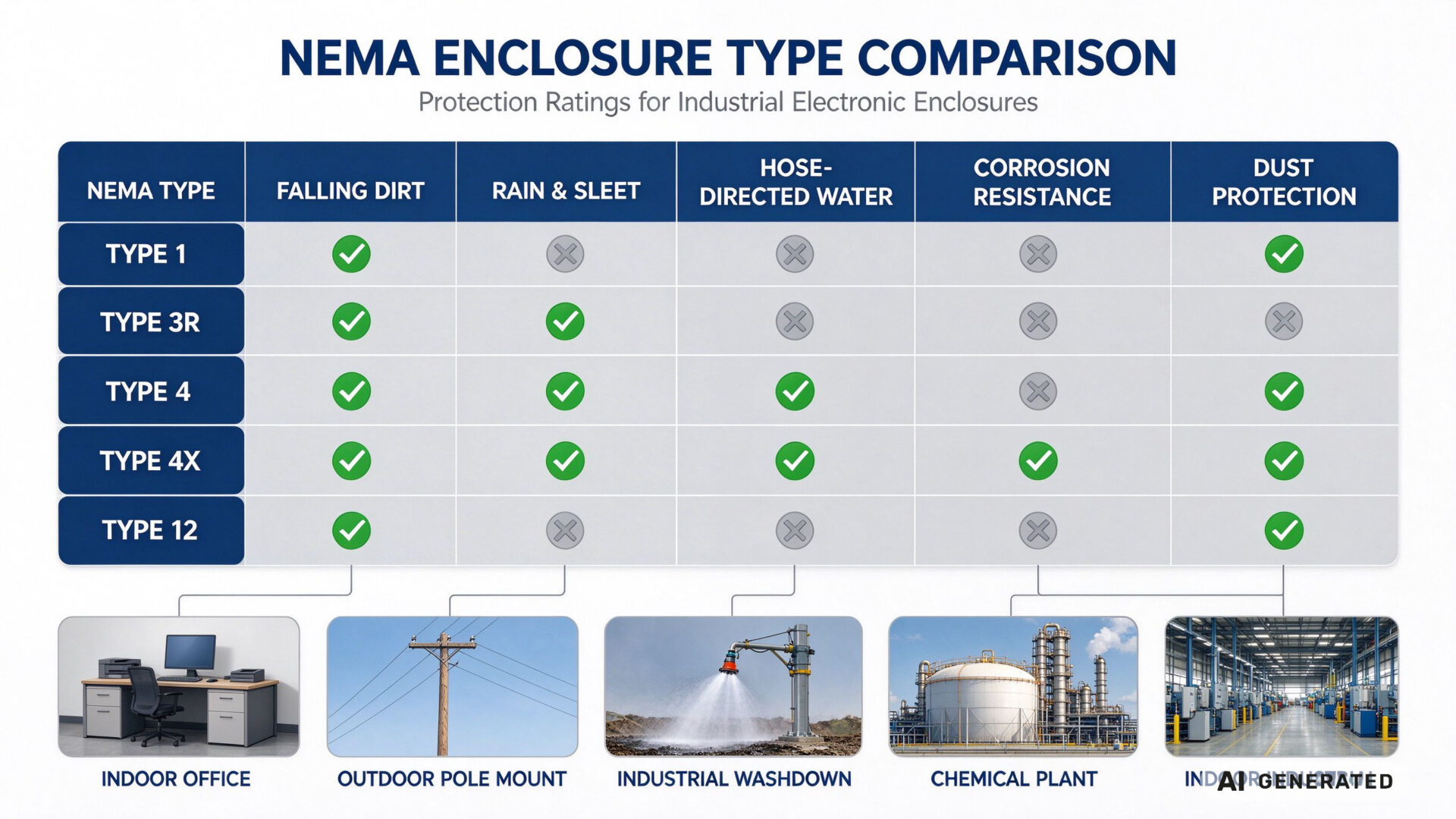
A NEMA 4X power supply enclosure is an electrical enclosure rated by the National Electrical Manufacturers Association for both indoor and outdoor use, providing protection against falling dirt, rain, sleet, snow, windblown dust, splashing water, hose-directed water, and corrosion. The “X” designation specifically indicates corrosion resistance—the feature that distinguishes NEMA 4X from NEMA 4.
The rating is defined in NEMA 250, Enclosures for Electrical Equipment (1000 Volts Maximum), with equivalent requirements in ANSI/UL 50E. According to the NEMA 250 standard, Type 4X enclosures are “constructed for either indoor or outdoor use to provide a degree of protection to personnel against incidental contact with the enclosed equipment; to provide a degree of protection against falling dirt, rain, sleet, snow, windblown dust, splashing water, and hose-directed water; and corrosion; and that will be undamaged by the external formation of ice on the enclosure”.
For industrial automation power supply applications, the NEMA 4X rating is the minimum requirement when the enclosure is exposed to washdown routines, chemical cleaning agents, or corrosive atmospheric conditions. A washdown rated power supply box must maintain its seal under direct water spray while simultaneously resisting the corrosive effects of detergents, caustic cleaners, and sanitizing chemicals.
View TPS NEMA 4X enclosure capabilities →
1.1 NEMA 4X vs. IP66/IP69K: understanding the dual rating system
Industrial equipment deployed globally typically carries both NEMA and IP ratings. The IP (Ingress Protection) rating system is defined by IEC 60529 and indicates the level of protection against solids and liquids. NEMA 4X enclosures commonly achieve IP66, IP67, or IP69K ratings depending on the specific design and testing.
The practical distinction matters for specification. IP66 provides protection against powerful water jets from any direction. IP67 adds protection against temporary immersion. IP69K provides protection against high-pressure, high-temperature washdowns at close range—up to 80°C at 100 bar from 10–15 cm distance. For food and pharmaceutical processing environments where intensive sanitization is standard, IP69K capability is often the operational requirement, even when the formal specification calls for NEMA 4X.
| Rating | Water Protection | Corrosion Protection | Typical Application |
|---|---|---|---|
| NEMA 3R | Falling rain, snow, sleet | None | Outdoor utility boxes, vented |
| NEMA 4 | Hose-directed water | None | Indoor washdown, painted steel |
| NEMA 4X | Hose-directed water | Yes (304/316L SS or polymers) | Washdown, chemical, food processing |
| NEMA 12 | Dripping, light splashing | None | Indoor, dust and oil mist |
| IP66 | Powerful water jets | Depends on material | Outdoor, intense industrial |
| IP69K | High-pressure, high-temp washdown | Depends on material | Food, pharma, hygienic environments |
1.2 Why NEMA 3R or NEMA 12 is not enough for washdown environments
A NEMA 3R enclosure is designed for falling rain and snow, but it relies on ventilation louvers that allow hot air to escape. Under hose-directed water or pressure washing, those louvers become water entry points. NEMA 3R enclosures are also typically made from painted carbon steel, which corrodes over time when exposed to cleaning chemicals and moisture.
NEMA 12 enclosures are designed for indoor use and protect against circulating dust and light splashing of non-corrosive liquids. They are not rated for hose-directed water or corrosion resistance. In a food processing facility where equipment undergoes daily washdown with caustic cleaners, a NEMA 12 enclosure will fail within weeks—the gasket degrades, water enters through the door seal, and the power supply inside is damaged.
The industrial automation power enclosure specification should match the worst-case environmental exposure, not the average condition. If the facility uses pressure washers, the enclosure must be fully sealed and corrosion-resistant.
2. Stainless steel material selection: 304 vs. 316L for corrosive environments
The material choice for a stainless steel power supply enclosure determines its service life in the target environment. Two grades dominate NEMA 4X enclosure construction: 304 and 316L stainless steel.
Type 304 stainless steel contains approximately 18–20% chromium and 8–10.5% nickel. It provides corrosion resistance against most corrosive solvents, alkalis, and some acids, making it suitable for washdown environments with standard cleaning agents. It is the standard choice for food processing areas where aggressive chlorides are not present.
Type 316L stainless steel adds 2–3% molybdenum, which significantly improves resistance to chlorides and industrial chemicals. For pharmaceutical facilities, chemical processing plants, and coastal installations where salt spray exposure is a factor, 316L is the appropriate grade. The “L” designation indicates low carbon content, which reduces the risk of weld sensitization—a critical consideration when the enclosure body requires continuous welding.
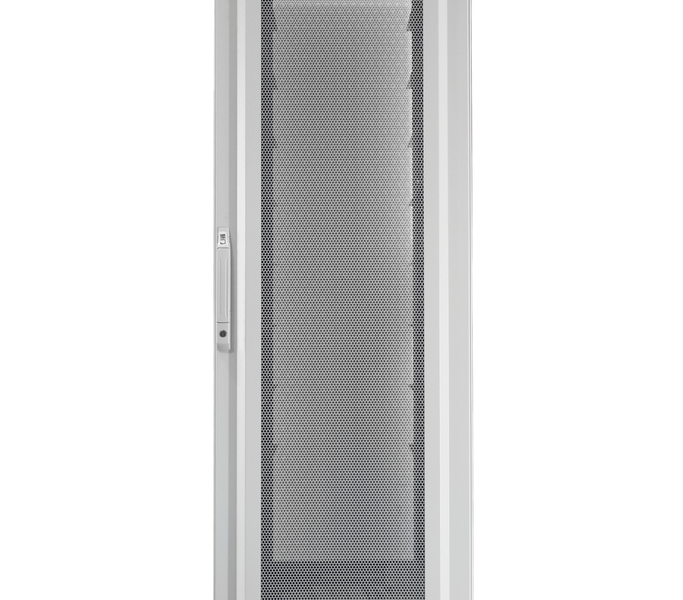
The manufacturing method is equally important. NEMA 4X enclosures require continuously welded seams ground smooth—spot welding or folded seams will not maintain the IP66/IP69K seal under pressure washing. The surface finish must be smooth (typically 400 grit for hygienic applications) to prevent bacterial harborage and facilitate cleaning. A formed lip on the enclosure excludes flowing liquids and contaminants from reaching the gasket sealing surface.
TPS’s custom sheet metal fabrication capabilities include MIG and TIG welding, CNC bending, and surface finishing appropriate for NEMA 4X enclosure production. The MIG vs. TIG welding comparison documents how the welding method affects seam integrity and corrosion resistance.
3. Washdown and hygiene requirements for food, beverage, and pharmaceutical facilities
In food and beverage processing, the electrical enclosures of automated equipment must satisfy more than the NEMA 4X water and corrosion requirements. Hygienic design principles apply: the enclosure must prevent pooling of liquids and debris that could harbor bacteria, and all materials in the food zone must be non-toxic and cleanable.
Key requirements for enclosures installed in food and beverage contact or processing areas include:
- IP69 rating to IEC 60529 for equipment protection against high-pressure washdown
- Enclosure body of 1.5 mm Type 304 stainless steel with a 400 grit surface finish for protection from bacteria and corrosion
- FDA-grade silicone gaskets compliant with FDA 21 CFR 177.2600 for food protection, blue in color for easy detection by vision systems
- Internally mounted hinges to reduce bacteria-harboring catch points and prevent premature corrosion failure
- Crevice-free, convex locking mechanisms on external surfaces to prevent bacteria retention
- Sloped top at minimum 30 degrees to ensure fluid run-off and prevent objects from being placed on the enclosure top
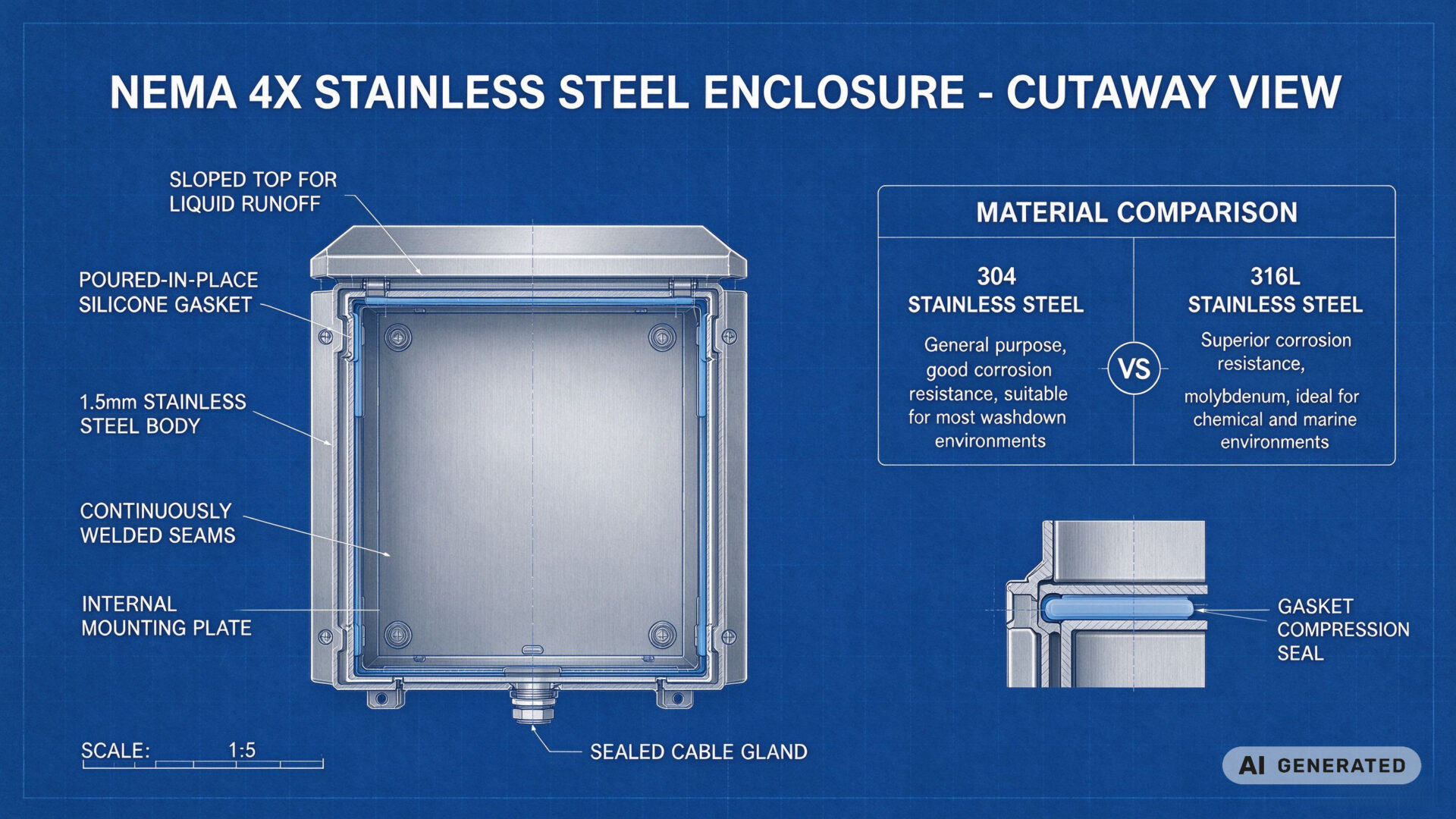
Under the FDA’s Food Traceability Final Rule, by 2026 all operations that store, pack, process, and manufacture food must comply with new tracking requirements. Connectivity of automated equipment will need to support this traceability—and the construction of that equipment must satisfy hygienic design requirements. The food processing power supply enclosure is therefore not merely a protective housing but a component of the facility’s food safety infrastructure.
4. Internal integration: power supplies, DIN rail, and thermal management inside NEMA 4X enclosures
A NEMA 4X enclosure is fully sealed by design. This creates a thermal management challenge: the heat generated by the power supply inside has no convection path to escape. Internal temperature rise must be managed through careful component selection and, where necessary, through sealed heat exchange solutions.
The internal layout of a NEMA 4X power supply housing should address:
- Power supply selection: Choose power supplies with high efficiency (≥90%) to minimize internal heat generation. DIN-rail mountable power supplies are the standard choice for industrial automation enclosures.
- Thermal analysis: Calculate the internal temperature rise based on total power dissipation and enclosure surface area. For enclosures above 50W dissipation, consider sealed heat exchangers or air conditioners rated for NEMA 4X environments.
- DIN rail and mounting plate: The enclosure should include a galvanized or stainless steel mounting plate and DIN rail for power supply and component mounting. Cable entry should use NEMA 4X rated cable glands.
- Grounding and bonding: A bonding stud on the door and a grounding stud in the enclosure body ensure proper electrical continuity. This is critical for both safety and EMC performance.
- UL 508A compliance: If the enclosure houses an industrial control panel, the assembly must comply with UL 508A. All components used in the enclosure must have suitable UL approval, and the panel must have a door latch to prevent the system being switched on while doors are open.
TPS integrates power supply selection, DIN rail layout, and thermal analysis into the enclosure specification process. The EMS sheet metal processing for electronics enclosures resource documents how electrical and mechanical design converge in NEMA 4X applications.
5. TPS sheet metal fabrication capabilities for NEMA 4X enclosures
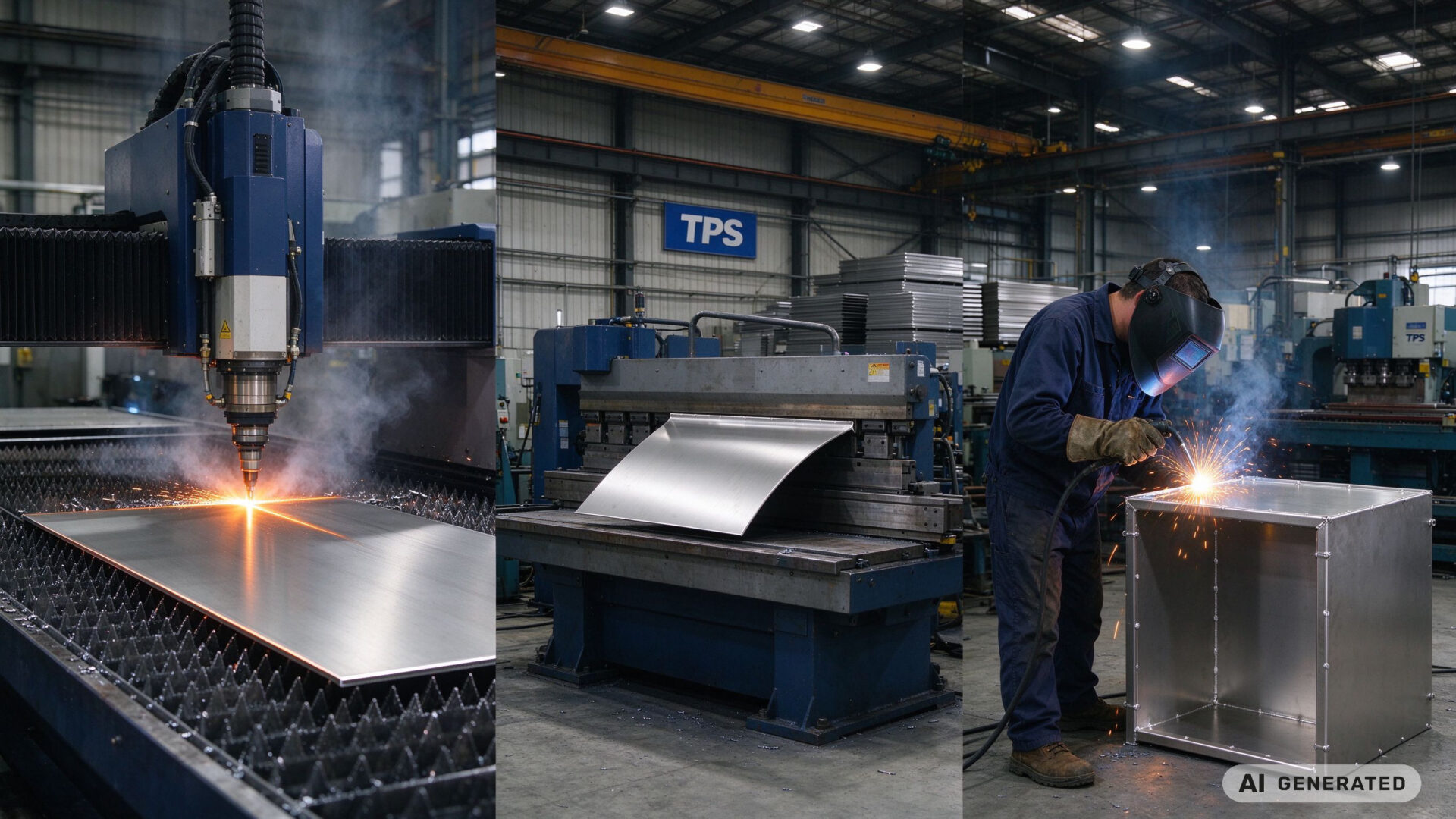
TPS Elektronik operates sheet metal processing capabilities specifically configured for NEMA 4X enclosure production, integrated with its EMS and electronic assembly services.
Fabrication Process
| Step | Capability | Relevance to NEMA 4X |
|---|---|---|
| Laser cutting | Fiber laser, stainless steel up to 6mm | Precise cutouts for cable glands, DIN rail, and door hardware |
| CNC bending | Press brake with multi-axis back gauge | Formed lip on enclosure to exclude flowing liquids |
| MIG/TIG welding | Continuous seam welding, ground smooth | Watertight seams required for IP66/IP69K rating |
| Surface finishing | Brushed finish, 400 grit for hygienic | Smooth surfaces prevent bacterial harborage |
| Gasket installation | Poured-in-place silicone, FDA-compliant | Seal integrity for washdown protection |
The RFQ-ready CNC bending service provides fast quotation turnaround for custom enclosure projects. For projects involving welding, the MIG welding machine resource documents the equipment and process controls used for enclosure seam welding.
6. RFQ checklist for NEMA 4X power supply enclosures
To streamline quotation and evaluation, provide the following information when requesting a NEMA 4X power supply enclosure quotation:
- Enclosure dimensions: External width × height × depth, and internal mounting space requirements
- Material grade: 304 or 316L stainless steel, wall thickness, surface finish specification
- Ingress protection target: IP66 or IP69K, and whether NEMA 4X certification is required for inspection
- Power supply specification: Voltage, current, DIN-rail mount, and thermal dissipation (for internal temperature analysis)
- Door and access configuration: Single or double door, hinge side, locking mechanism type
- Hygienic design requirements: Sloped top angle, FDA-compliant gasket, crevice-free fasteners (for food/pharma applications)
- Cable entry requirements: Number and size of cable glands, NEMA 4X rated gland specification
- Documentation needs: Material certificates, IP test reports, UL 508A documentation, dimensional drawings
Providing these details reduces clarification cycles during evaluation. TPS’s engineering team can support material selection, thermal analysis, and sealing architecture design as part of the RFQ process.