

For system integrators, panel builders, and procurement teams supporting test and measurement environments, the power supply is not just a source of DC voltage—it is a critical component that directly affects measurement accuracy, test repeatability, and equipment reliability. A power supply with excessive ripple, poor load regulation, or inadequate transient response can introduce errors that compromise every measurement on the bench.
TPS Elektronik’s industrial power supply systems are engineered specifically for test benches and measurement equipment: precision regulation, ultra-low ripple and noise, fast transient response, and comprehensive remote control capabilities. From individual bench power supplies to integrated ATE power systems, TPS delivers stable, reliable power that lets engineers focus on measurement—not on power supply artifacts.
1. The Test Bench Challenge: Why Power Supply Quality Determines Measurement Accuracy
Test benches and measurement systems are the foundation of electronics validation. Whether characterizing a new semiconductor device, calibrating a sensor, or running production acceptance tests, the accuracy and repeatability of the measurements depend on the stability of the power supplied to the device under test (DUT).
A power supply that introduces ripple, noise, or voltage drift directly contaminates the measurement. Consider these common scenarios:
- Analog measurements: A power supply with 100mV of ripple on a 3.3V rail introduces a 3% error—enough to mask true device performance and cause false failures
- Low-power devices: Measuring the sleep current of a microcontroller in the microamp range requires a power supply with noise floor below the measurement threshold
- Dynamic loads: A device that switches between operating modes draws transient currents; a power supply with slow transient response causes voltage droops that can reset the device or corrupt measurements
- Sensor characterization: Precision sensors—strain gauges, RTDs, pressure transducers—require stable excitation voltage; power supply noise directly translates to measurement noise
For system integrators and electrical engineers, the challenge is selecting an industrial test power system that meets the specific requirements of each test bench. The power supply must deliver not only the required voltage and current but also the precision, stability, and programmability needed for reliable, repeatable measurements.
TPS Elektronik’s industrial power supply systems are designed to meet these demanding requirements, delivering the precision and stability that test and measurement applications demand.
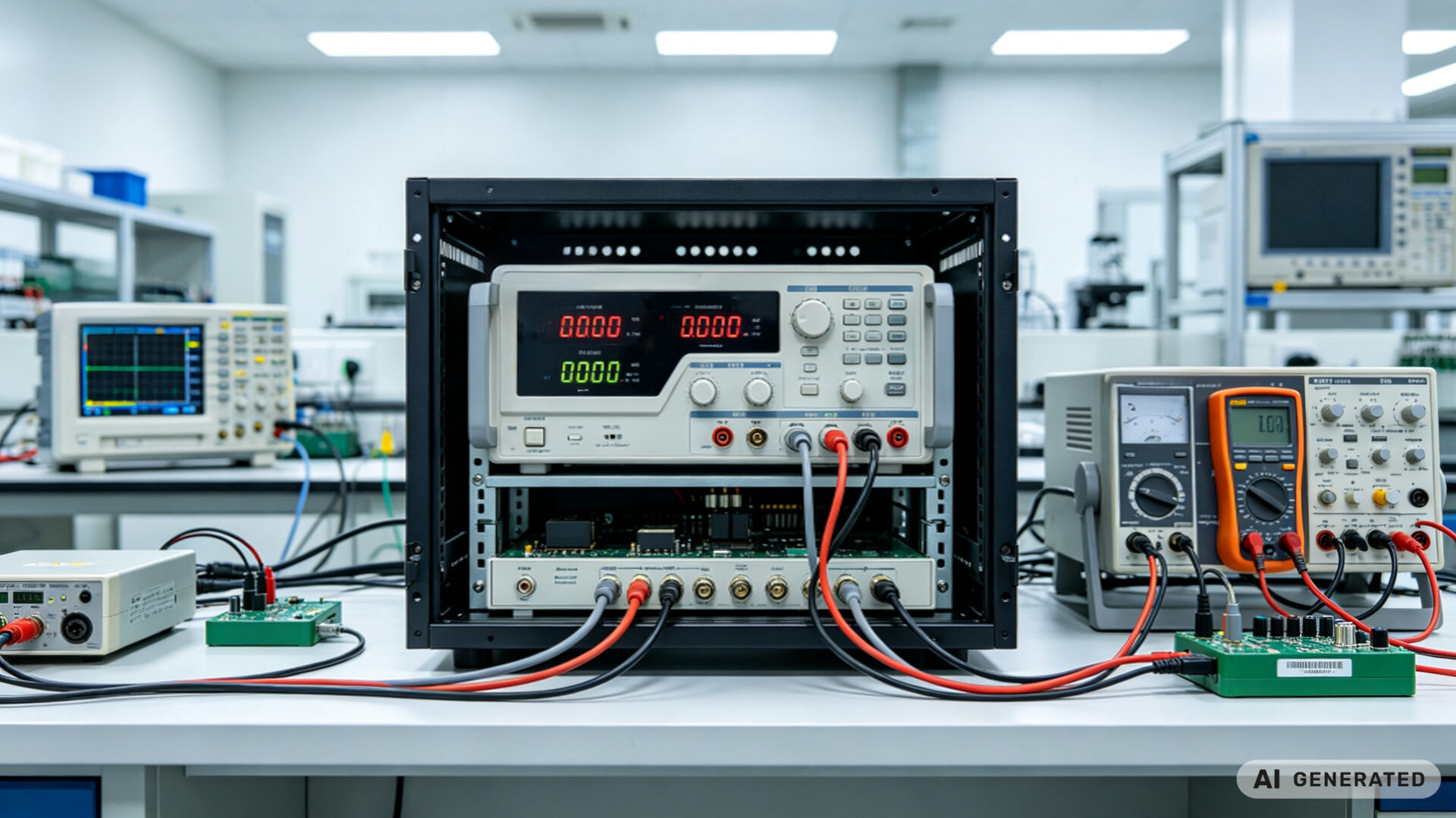
2. Precision Regulation and Low Ripple: The Foundation of Stable Test Power
The quality of a power supply for test bench applications is defined by three key parameters: regulation, ripple, and transient response. These parameters determine how well the power supply maintains a stable output voltage under varying conditions.
Regulation: Load regulation measures how much the output voltage changes when the load current changes from no load to full load. Line regulation measures how much the output voltage changes when the input AC voltage varies. For precision test applications, both parameters should be well below 0.1%.
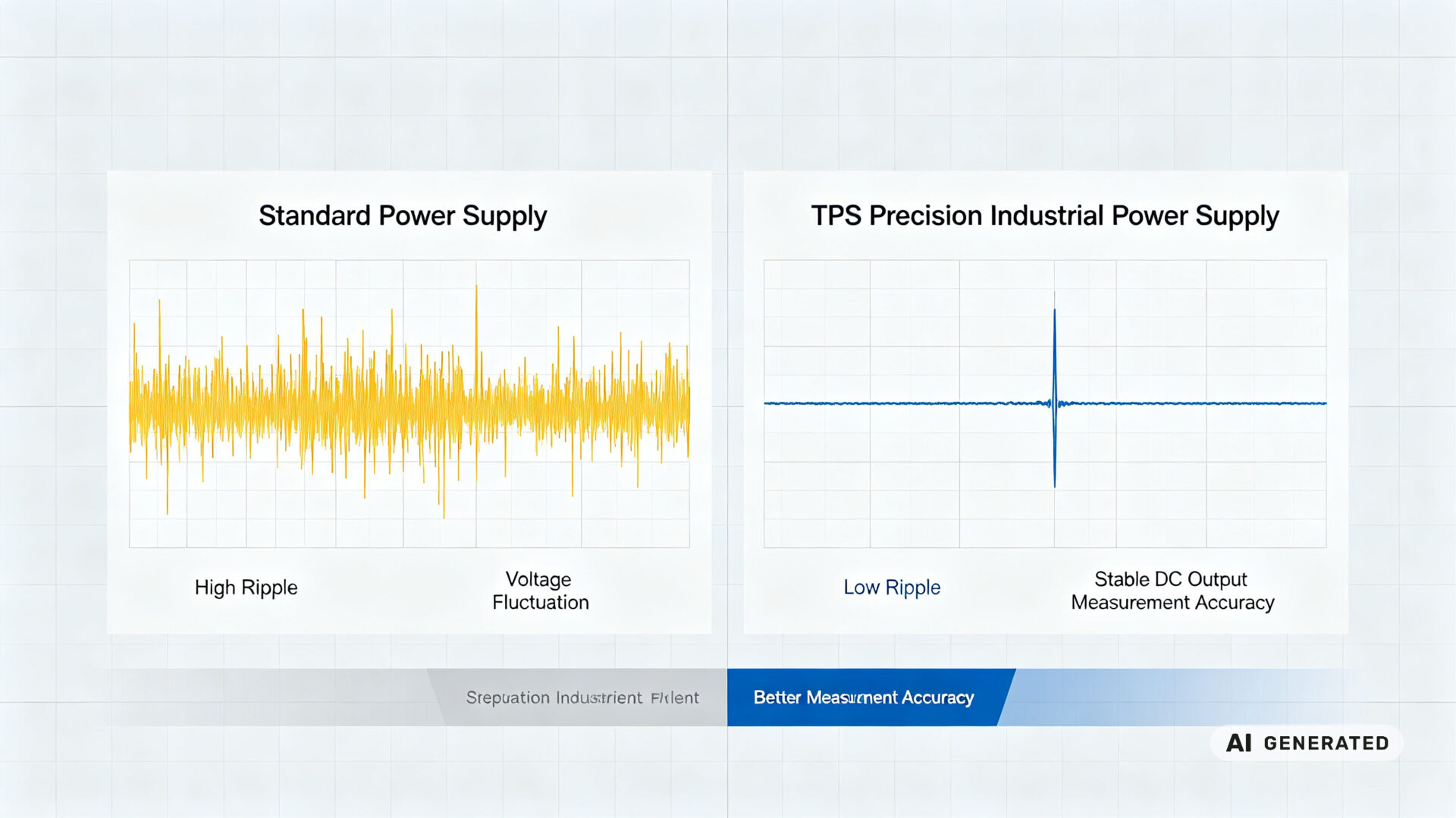
Ripple and Noise: Ripple is the residual AC component superimposed on the DC output. It originates from the switching frequency of the power supply and its harmonics. For sensitive measurements, low ripple is essential—typically measured in millivolts RMS or peak-to-peak. TPS power supplies achieve ripple as low as 10mV RMS and 80mV peak-to-peak, ensuring clean DC power for even the most sensitive measurements.
Transient Response: When a load changes suddenly—for example, when a digital device switches from sleep to active mode—the power supply must respond quickly to maintain voltage stability. TPS power supplies achieve load regulation times of less than 1ms, ensuring that voltage remains stable during rapid load changes.
For measurement equipment power applications, these specifications translate directly to measurement confidence. A power supply with excellent regulation, low ripple, and fast transient response ensures that measured variations are due to the DUT, not the power source. For more on precision power supply design, see the Buck-Boost Converter Design and PCB Layout Guide.
3. Powering Automated Test Equipment (ATE) Systems
Automated test equipment (ATE) systems are the backbone of high-volume production testing. These systems require power supplies that can be controlled programmatically, deliver multiple output voltages, and integrate seamlessly into test automation software.
Key requirements for ATE power supply systems include:
- Programmability: Voltage and current setpoints must be controllable via SCPI commands, LabVIEW, or other test automation software
- Multiple outputs: ATE systems often require multiple independent voltage rails—for example, 3.3V for digital logic, 5V for analog, and 12V for communication interfaces
- Fast settling time: When switching between test conditions, the power supply must settle quickly to minimize test time
- Remote sensing: For accurate voltage at the DUT, the power supply must compensate for voltage drops in test cables and fixtures
- Comprehensive protection: ATE systems test valuable devices; the power supply must protect against overvoltage, overcurrent, and overtemperature conditions
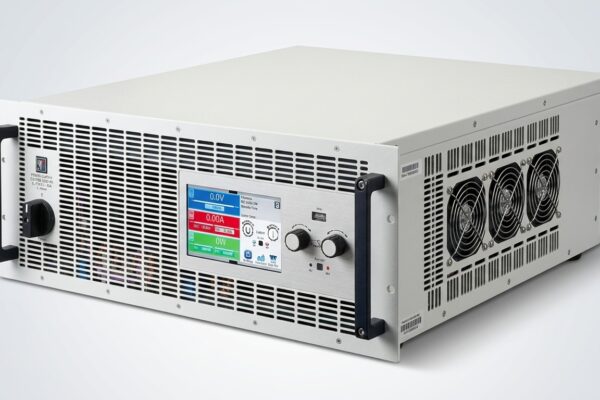
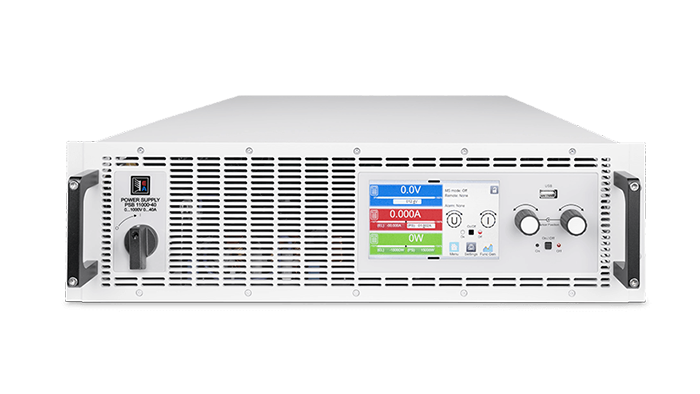
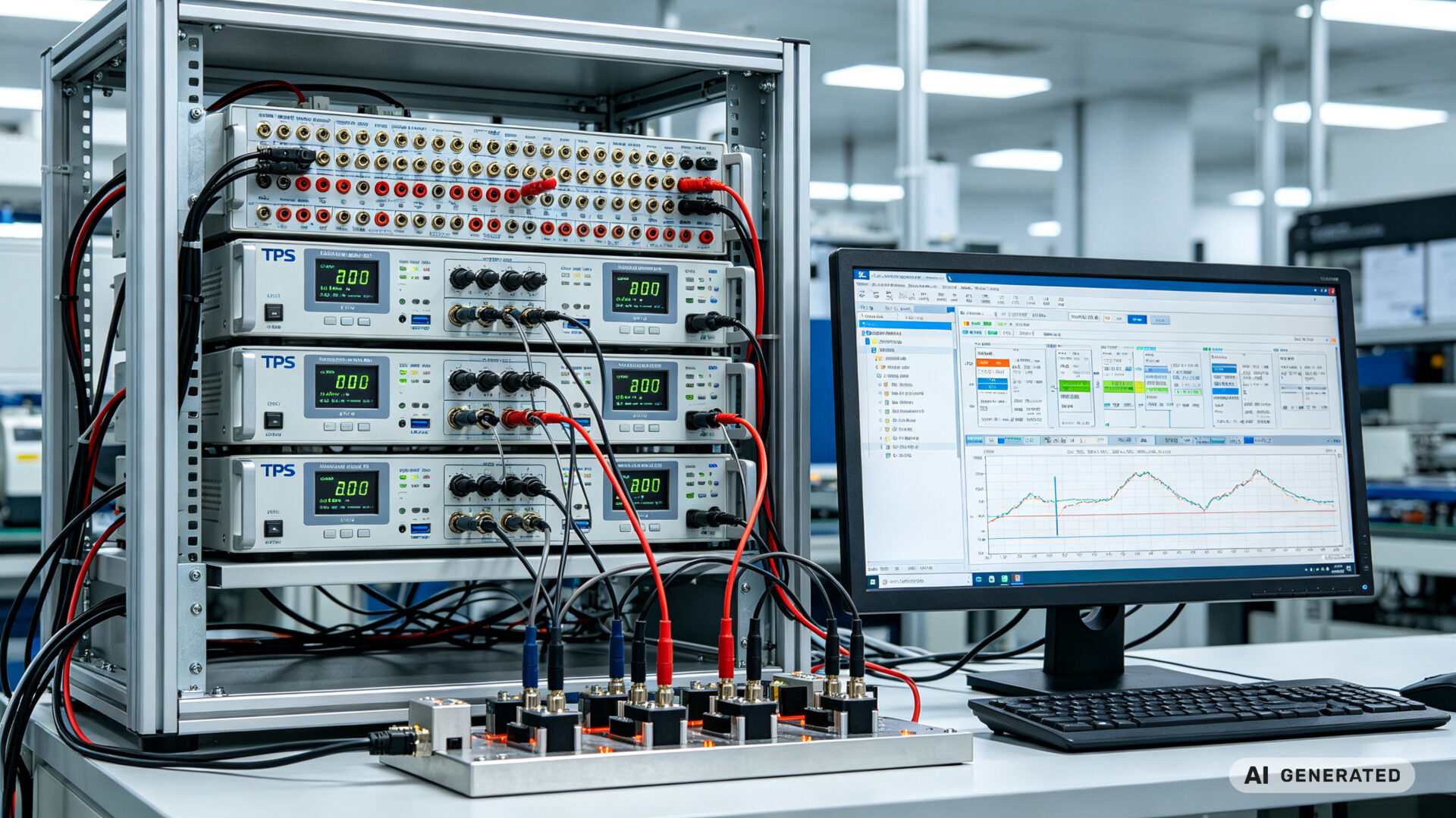
TPS Elektronik’s industrial testing power solutions are designed for ATE integration. The EA-PSI series of programmable DC power supplies offers multiple interfaces (USB, Ethernet, analog), SCPI command support, and LabVIEW drivers, enabling seamless integration into automated test systems. The auto-ranging output stage provides flexibility to test different devices with a single power supply.
For system integrators designing ATE systems, TPS provides comprehensive support, including power supply selection, integration guidance, and custom power system design. See the Development Services for Hardware, Firmware, and Protocol for more information.
4. Remote Sensing and Load Compensation
In test bench applications, the power supply is often located some distance from the device under test. The cables connecting the power supply to the DUT have resistance, and the current flowing through these cables causes a voltage drop. For a 1A load with 0.1Ω of cable resistance, the voltage drop is 100mV—significant for a 3.3V rail.
Remote sensing solves this problem by using a separate pair of sense wires to measure the voltage directly at the DUT. The power supply adjusts its output to compensate for the cable drop, ensuring that the DUT receives exactly the programmed voltage.
TPS power supplies include remote sensing terminals as standard. For test bench applications, this capability is essential for:
- Accurate voltage at the DUT: Ensuring that the device receives the specified voltage regardless of cable length
- Repeatable measurements: Eliminating cable drop as a source of measurement variation
- Long cable runs: Enabling the power supply to be located in a rack while the DUT is on a separate bench
For calibration equipment power applications, remote sensing is particularly important. Calibration standards require precise, known voltages; any error introduced by cable drop compromises the calibration.
The auto-ranging output stage of TPS power supplies supports constant voltage, constant current, constant power, and constant resistance modes with fast crossover, providing flexibility for diverse test applications. The built-in supervision features reduce test equipment requirements and eliminate the need for external monitoring hardware.
5. TPS Industrial Power Supply System Capabilities
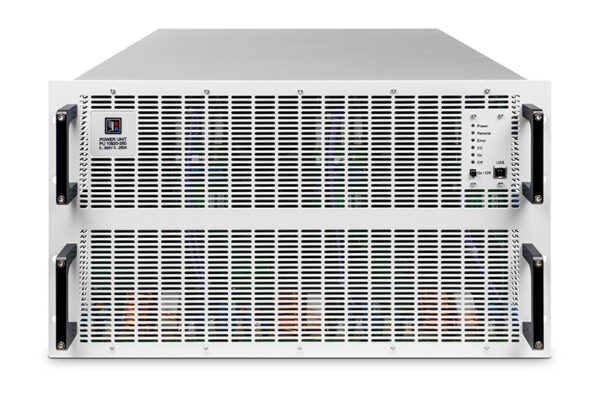
TPS Elektronik’s industrial power supply systems for test benches and measurement equipment combine precision engineering, comprehensive features, and integration support to deliver stable, reliable power for demanding test applications.
Power Supply Range:
- Desktop programmable power supplies: 0–40V to 0–200V, up to 640W, ideal for bench testing
- 1U–6U rack-mount power supplies: For ATE and system integration, with power levels from 1kW to 60kW
- Bidirectional power supplies: For battery testing and regenerative applications
- High-voltage power supplies: Up to 2000V for specialized test applications
Key Features for Test and Measurement:
- Precision regulation: <0.08% voltage load regulation, <0.02% line regulation
- Low ripple: <10mV RMS, <80mV peak-to-peak
- Fast transient response: <1ms load regulation time
- High accuracy: <0.2% voltage and current accuracy
- Auto-ranging output: Full power across wide voltage/current range
- Multiple interfaces: USB, Ethernet, analog, SCPI, LabVIEW
- Remote sensing: For accurate voltage at the DUT
- Comprehensive protection: OVP, OCP, OPP, OTP
Applications:
- Semiconductor device characterization
- PCB assembly testing and validation
- Sensor calibration and characterization
- Battery testing and simulation
- Automotive electronic control unit (ECU) testing
- Medical device testing and validation
- Production acceptance testing
TPS supports projects from individual bench power supplies to complete ATE power systems, with documented quality and comprehensive support. For custom power supply requirements, see the Custom Power Supply Design and Battery Test Systems Case Study.
6. Custom Power Solutions for Specialized Test Applications
While TPS offers a comprehensive range of standard power supplies, some test applications require custom solutions. TPS Elektronik’s development services provide end-to-end custom power system design, from concept through production.
Custom Power System Capabilities:
- Custom voltage and current ratings: Tailored to specific test requirements
- Multiple output configurations: Independent, isolated, or series/parallel outputs
- Specialized interfaces: Custom communication protocols or control interfaces
- Environmental hardening: Extended temperature range, shock and vibration resistance
- Integrated test systems: Power supplies integrated with measurement and control electronics
TPS’s development team includes expertise in hardware design, firmware development, PCB layout, and system integration. The company’s experience with Battery Test System and Custom Power Supply Design demonstrates its capability to deliver complex, application-specific power solutions.
For test benches and measurement equipment, custom power solutions can address unique requirements such as:
- Multi-channel synchronized outputs: For testing multi-rail devices
- Ultra-low noise outputs: For sensitive analog measurements
- High-speed programmable outputs: For dynamic test sequences
- Integrated measurement: Voltage and current monitoring built into the power supply
TPS supports custom projects from initial concept through prototype validation and series production, with documented quality processes per ISO 9001 and IATF 16949. For medical device test applications, TPS also operates under ISO 13485. See the Medical Device Software Development Guide for related capabilities.