

System integrators and procurement teams rarely fail because they lack a power supply design. They lose time—and budget. When a batch of 1,000 industrial power supplies fails final acceptance testing because the isolation barrier in the transformer breaks down at operating temperature. A transformer that passes a bench test but fails in a hot enclosure after six months of continuous operation creates a warranty liability that can damage an OEM’s reputation far more than the cost of the component itself.
TPS Elektronik’s coil winding technology for industrial power supplies built to eliminate this risk. By deploying automated multi‑axis winding systems, rigorous in‑line quality control, and a full suite of electrical testing. TPS delivers high‑volume transformer coils with the consistent isolation, tight coupling, and long‑term reliability that industrial applications demand.
1. Why winding technology defines transformer reliability
An industrial power supply transformer is a deceptively simple component: a magnetic core, copper wire, and insulation. Yet the way that wire placed onto the core determines nearly every critical performance parameter. A winding with inconsistent tension creates hot spots that degrade insulation over time. A secondary winding placed without proper inter‑layer insulation fails the hipot test after thermal cycling. A bobbin wound with insufficient margin tape does not meet the creepage requirements of IEC 62368‑1, rendering the entire power supply non‑compliant.
Automated transformer winding technology addresses these failure modes at their root cause. Multi‑axis CNC winding machines apply precisely controlled tension to the magnet wire, layer after layer. Which ensuring that every turn is placed in the same position as the one before it. This consistency is not achievable with manual winding, especially in high‑volume production where operator fatigue introduces variability. TPS’s approach to winding automation further contextualized in our comprehensive overview of EMS winding goods and coil winding service.
2. TPS automated coil winding technology
TPS Elektronik operates a fleet of multi‑axis CNC winding machines capable of producing transformers ranging from miniature EFD cores for compact DC‑DC converters to large toroidal cores for industrial power supplies. The technology designed for repeatability: once a winding program is validated for a specific transformer design, every subsequent unit produced on that machine is identical within tight electrical and mechanical tolerances.
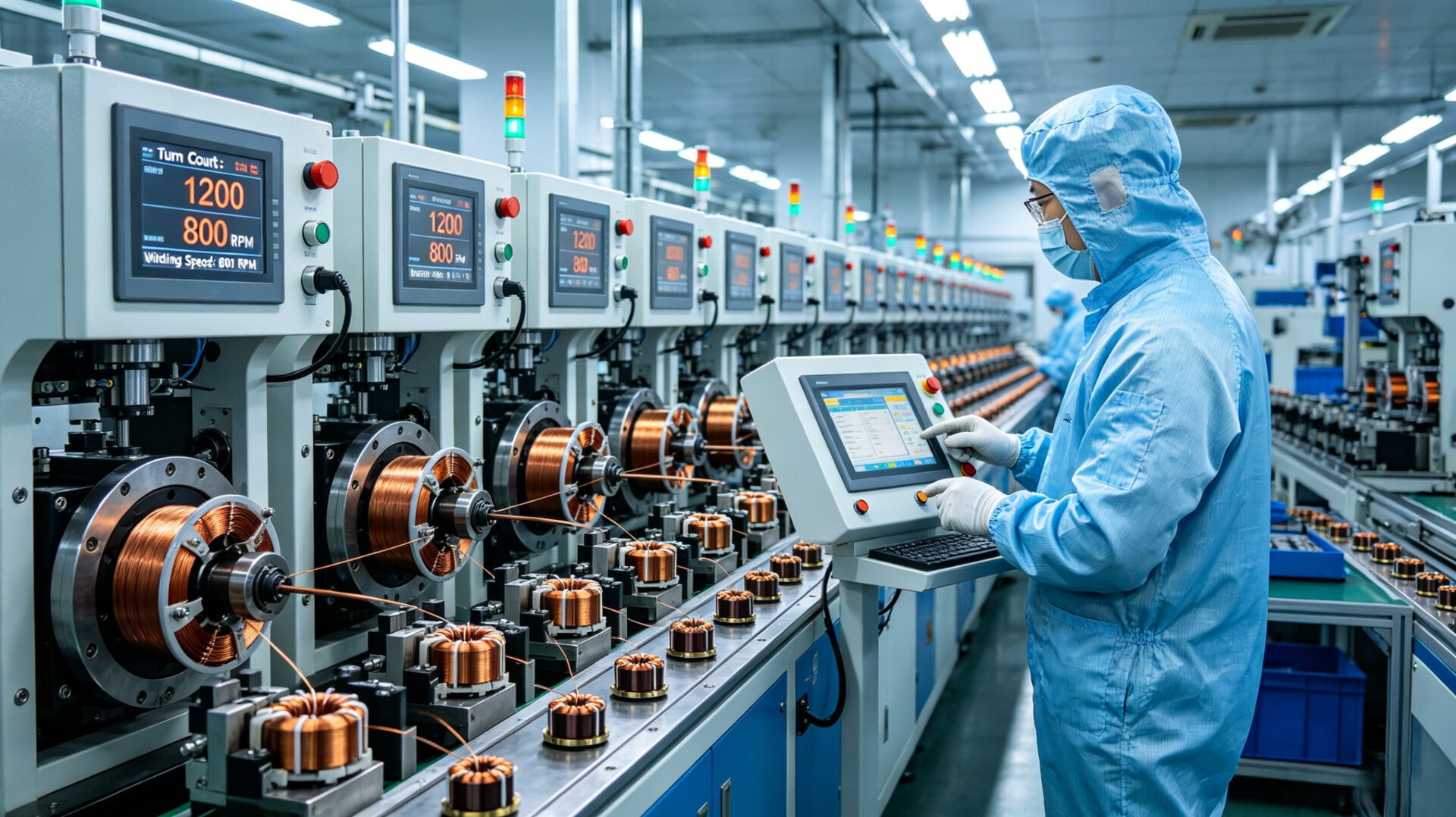
2.1 Multi‑axis CNC winding and tension control
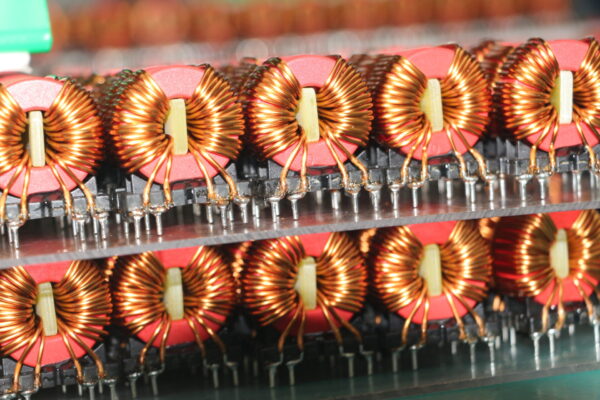
At the heart of TPS’s winding capability is the ability to control wire placement in multiple axes simultaneously. This is particularly critical for complex winding patterns such as interleaved flyback transformers. Where the primary is split into two layers that sandwich the secondary to minimize leakage inductance. Or for toroidal transformers that require uniform circumferential winding. Wire tension dynamically controlled to compensate for changes in bobbin diameter as layers build up, preventing wire stretch and insulation damage. TPS’s proven production‑ready approach is detailed in our resource on toroidal coils, dv/dt chokes, and production‑ready transformers.
2.2 Isolation techniques: margin tape, inter‑layer insulation, and triple‑insulated wire
Isolation is the transformer’s primary safety function. TPS applies multiple insulation strategies depending on the required isolation level. For basic and functional isolation, polyester or polyimide tape applied between winding layers. For reinforced isolation — required in medical power supplies per IEC 60601‑1 or in industrial drives where the transformer bridges a mains‑to‑SELV barrier — TPS uses margin tape construction or triple‑insulated wire (e.g., TEX‑E). The choice of insulation material is driven by the thermal class (130 °C, 155 °C, or 220 °C) and the required dielectric withstand voltage. A detailed comparison of wire insulation types is available in our guide to wire insulation materials, types, and applications.
3. Quality assurance and electrical testing
Automated winding alone does not guarantee quality. TPS validates every transformer through 100 % electrical testing. The standard test protocol includes inductance and turns ratio verification, leakage inductance measurement, DC winding resistance on all windings, and hipot testing at the specified isolation voltage. For high‑reliability applications, additional tests such as partial discharge (PD) testing can performed to detect microscopic voids in the insulation that would eventually lead to failure.
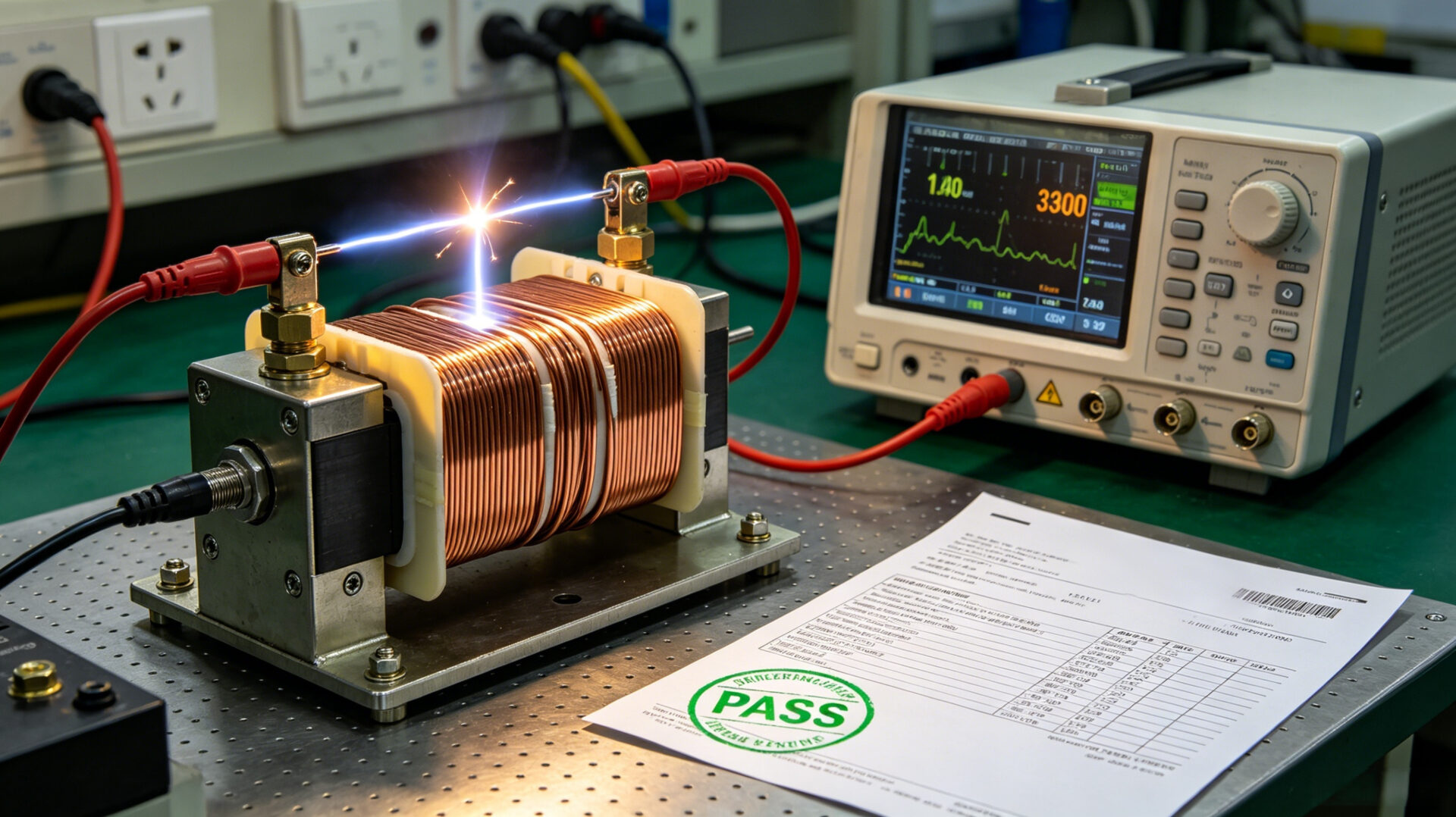
Documented test reports accompany every production lot, providing objective evidence of conformance. For medical and industrial OEMs, this documentation supports regulatory submissions and reduces the need for incoming inspection at the customer’s facility.
4. Application examples: EV chargers, industrial automation, and medical power supplies
TPS’s coil winding technology supports three rapidly growing industrial sectors:
- EV charging infrastructure: High‑frequency transformers for on‑board chargers (3.3–22 kW) and DC fast‑charging stations require isolation voltages up to 4 kV and must operate efficiently at frequencies up to 300 kHz. TPS’s automated winding delivers the interleaved, low‑leakage‑inductance designs these converters demand.
- Industrial automation power supplies: DIN‑rail power supplies for factory automation require high‑volume production of consistent, cost‑effective flyback and forward converter transformers. Automated winding ensures that every unit meets the efficiency and EMC performance targets.
- Medical power supplies: Patient‑connected equipment requires reinforced isolation with stringent leakage current limits. TPS winds transformers for medical power supplies using triple‑insulated wire and margin tape techniques compliant with IEC 60601‑1. Detailed information on this application is available in our resource on medical high‑frequency transformer coil winding.
5. RFQ checklist for industrial transformer coil winding
- Electrical specification: Topology (flyback, forward, LLC, etc.), input/output voltage, power level, switching frequency.
- Inductance and turns ratio: Primary inductance, leakage inductance limit, turns ratio.
- Core preference: Core type (EE, ETD, PQ, toroid) and maximum mechanical dimensions.
- Isolation requirements: Basic or reinforced insulation, working voltage, hipot test voltage.
- Applicable standards: IEC 62368‑1, IEC 61558, IEC 60601‑1, or customer‑specific.
- Quantities and schedule: Prototype, pilot, and annual production volumes.
6. FAQ
What is the advantage of automated winding over manual winding for industrial transformers?
Automated winding provides consistent tension, precise turn placement, and identical electrical performance across every unit in a production batch. This repeatability is unachievable with manual winding, where operator fatigue and skill variation introduce variability that affects isolation quality and reliability.
How does TPS ensure consistent isolation quality in high‑volume production?
TPS uses calibrated CNC winding machines with real‑time tension monitoring, combined with 100 % hipot testing on every transformer. Lot traceability and statistical process control ensure that any drift in isolation performance is detected and corrected before it affects production.
What is the maximum isolation voltage TPS can achieve?
Using triple‑insulated wire and margin tape construction, TPS can achieve reinforced isolation up to 4 kV AC working voltage and corresponding hipot test voltages, meeting the requirements of IEC 60601‑1 for medical applications.
Where can I learn more about TPS’s broader winding capabilities?
Visit the TPS winding goods service page, or read our technical resources on toroidal coils and dv/dt chokes and Helmholtz coil applications.