

System integrators, panel builders, and procurement teams in electronics manufacturing rarely lose production time because they lack a design or a supplier. They lose time—and margin. When a single long-lead component is not available at the line-side bin, forcing a partial build, a rescheduled SMT run. Or an expedited spot-market purchase at three to ten times the contracted price.
TPS Elektronik’s contract warehousing services are built to eliminate that risk: dedicated buffer stock storage for critical electronic components, Kanban-driven replenishment signals, BOM kitting aligned to production schedules, and validated inventory reporting that supports lean manufacturing and JIT delivery commitments.
1. What contract warehousing for EMS buffer stock actually means
Contract warehousing services for electronics manufacturing describe a long-term, dedicated warehousing arrangement in which a third-party provider—typically an EMS partner or 3PL—operates a defined warehouse space exclusively for one client’s inventory. The building layout, equipment, standard operating procedures, and IT systems are specified according to the client’s exact production and delivery requirements. Unlike public warehousing, which serves multiple short-term tenants, contract warehousing gives the client exclusive use of space and labor allocation.
For EMS buffer stock warehousing, this model applied specifically to electronic components: resistors, MLCCs, ICs, connectors, and subassemblies that must be available at the production line when needed, without requiring the OEM to carry the inventory on its own balance sheet or lease warehouse space independently.

1.1 Dedicated contract warehousing vs. public warehousing
The distinction matters for procurement teams evaluating warehousing options. Public warehousing is a variable-cost, short-term arrangement suitable for seasonal overflow or finished goods staging. Contract warehousing—sometimes called dedicated warehousing—designed for lean inventory management warehouse operations with stable volume, repeatable processes. And a need for consistent operational control.
For EMS production, the practical difference is control. In a dedicated contract warehouse, the SOPs written around the client’s production schedule, component handling requirements. Which including ESD protection and moisture sensitivity level control, and delivery cadence. The warehouse not shared with other tenants whose priorities may conflict. The client has real-time visibility into inventory levels, Kanban trigger points, and replenishment status.
1.2 Buffer stock vs. safety stock: a distinction that changes planning
The ASCM Supply Chain Dictionary defines safety stock—also called buffer stock or reserve stock. As inventory carried to protect against forecast errors and fluctuations in demand or supply, intended to reduce the frequency of stockouts. In practice, however, the two terms used differently in EMS planning.
Safety stock is a statistical buffer sized to absorb normal demand variability. Buffer stock in the contract warehousing context is a strategic inventory position. Which deliberately held at a decoupling point in the supply chain to protect production flow against supplier lead-time shifts, allocation events, or transportation disruptions. The ASCM notes that inventory buffers used to protect the throughput of an operation against the negative effects caused by statistical fluctuations. For a production buffer stock service, the sizing logic driven by the cost of a line stop relative to the carrying cost of the buffer—not by demand forecast accuracy alone.
For a deeper examination of how TPS structures inventory management for electronic components, see the inventory management for electronics component stock guide.
2. Why pure JIT delivery fails in electronics manufacturing
Just-in-time delivery is an inventory management strategy in which components are received only when they needed for production, minimizing storage costs and reducing waste. In a stable supply environment with short, predictable lead times, JIT works exceptionally well. In electronics manufacturing, that environment has not existed consistently for years.
The 2026 component market illustrates the problem. Passive components—commodity MLCCs, standard resistors—have quoted lead times of 8 to 20 weeks, and buyers advised to maintain an 8-to-10-week safety stock of critical components as insurance against the bullwhip effect caused by AI infrastructure orders. For any component on a known allocation list, applying a 30–50% buffer to the manufacturer’s quoted lead time is a more realistic planning assumption than taking the quoted date at face value.
The operational consequence of ignoring this reality is predictable. A just in time component delivery commitment that assumes 12-week lead times for an allocated IC will fail when the actual delivery arrives at week 18. The production line stops. The SMT run is rescheduled. The OEM either accepts a delivery delay to its own customer or pays spot-market premiums of three to ten times contracted pricing to expedite the missing part.
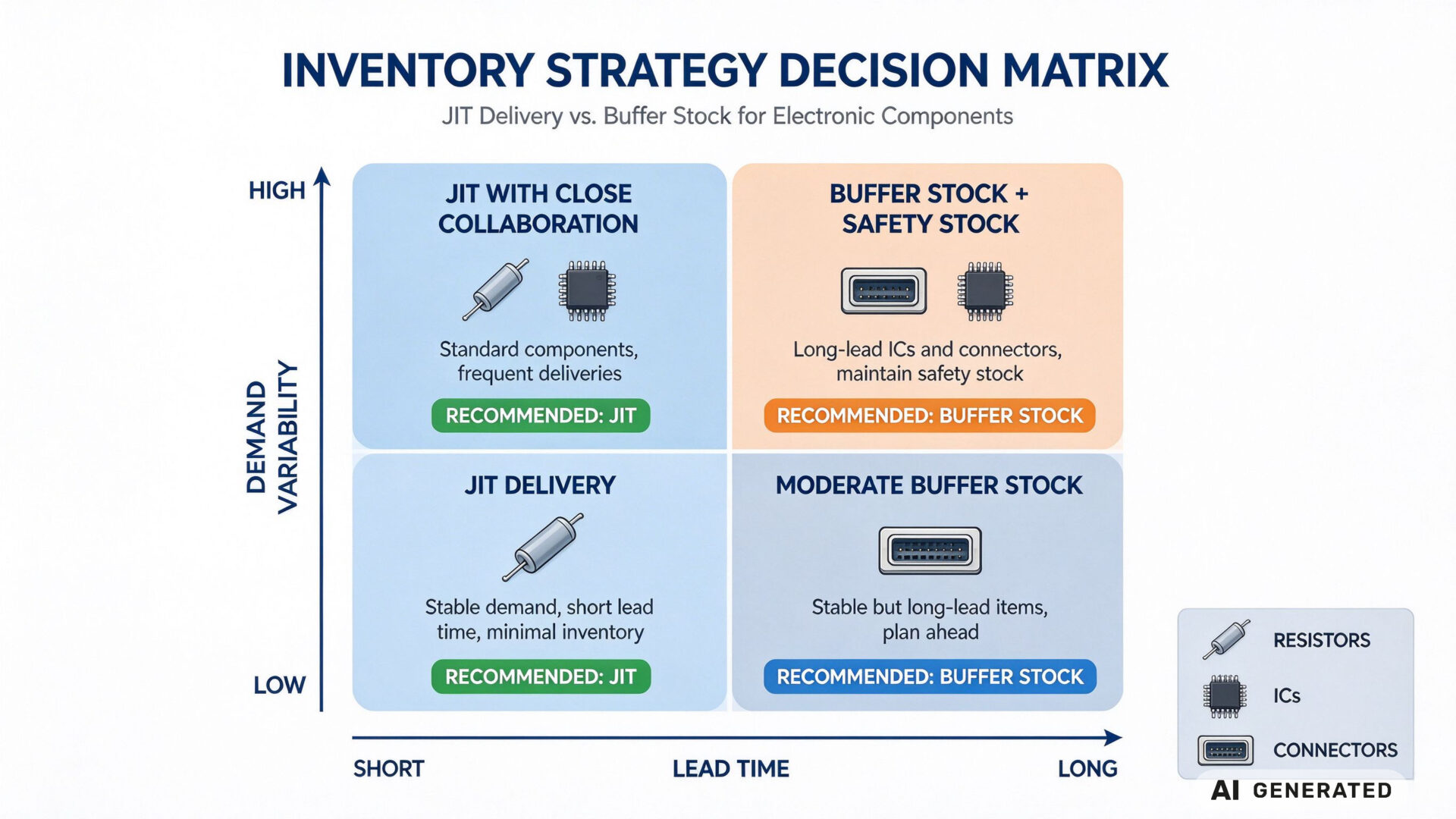
Many electronics manufacturers are now adopting a hybrid approach: JIT for predictable, multi-sourced commodity components. And buffer stock for long-lead-time or single-sourced critical parts. The contract warehouse is the physical infrastructure that makes this hybrid strategy executable. It provides buffer stock storage electronics capacity without requiring the OEM to invest in or manage warehouse space directly.
TPS’s supply chain solutions and procurement solutions case study document how this hybrid model is implemented in practice.
3. How TPS Elektronik implements contract warehousing for EMS production
TPS Elektronik operates contract warehousing as an integrated element of its EMS offering, not as a standalone storage service. The objective is to position inventory so that production schedules are protected without creating excess carrying cost or obsolescence risk.
3.1 Warehouse location and inventory positioning
Buffer stock is most effective when it positioned close to the consumption point. TPS operates warehouse capacity within or adjacent to its EMS production facilities, enabling JIT warehousing for EMS delivery to the line-side bin without the latency of external transportation. For OEMs with production in multiple regions, TPS can configure inventory positions at multiple warehouse nodes to support contract logistics for EMS across geographies.
The warehouse layout designed around the production workflow: fast-moving components at the line-side Kanban locations, slower-moving. Or high-value components in secured storage with restricted access, and long-lead-time parts in dedicated buffer zones with extended depth shelving. Component handling follows ESD and moisture-sensitivity protocols appropriate to the component class.
3.2 Kanban-driven replenishment and min-max agreements
TPS implements a mixture of consignment stock, buffer stock, Kanban, and min-max agreements with its suppliers—governing where stock is kept, who owns the stock, at what rate it is replenished, and when payment is made. This multi-mechanism approach allows each component class to governed by the inventory policy best suited to its risk profile.
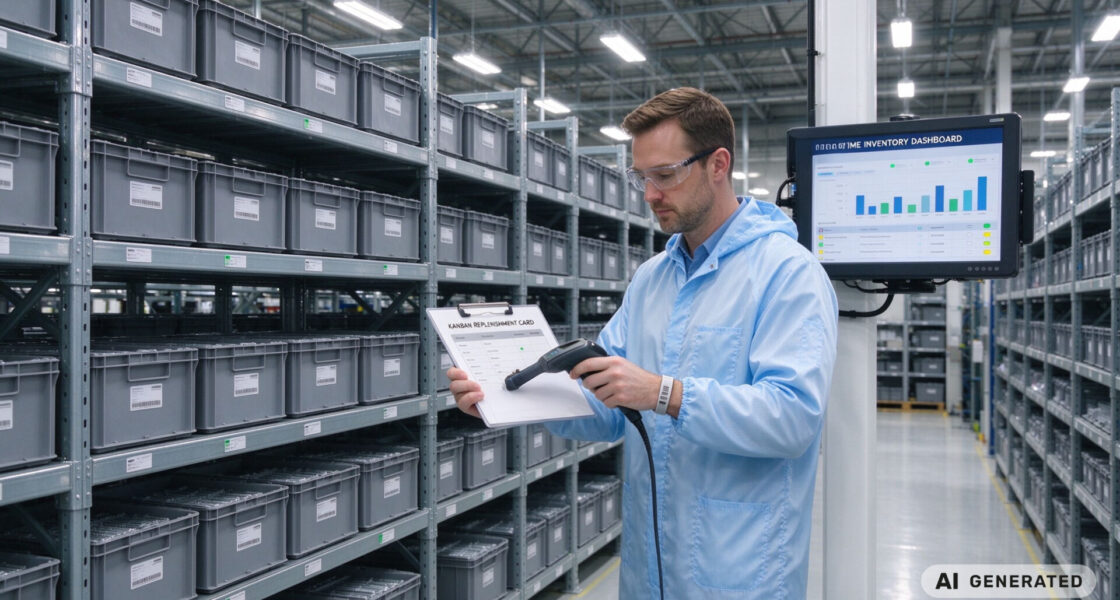
Kanban inventory warehousing is the operational backbone of the system. A Kanban card accompanies a standard-size bin and signals when material needs to replenished from an internal or external source. When a bin is depleted to the trigger point, the replenishment signal transmitted—to the TPS warehouse or to the upstream supplier—and the replacement bin is prepared. The system uses a two-bin or three-bin configuration depending on consumption rate and replenishment lead time.
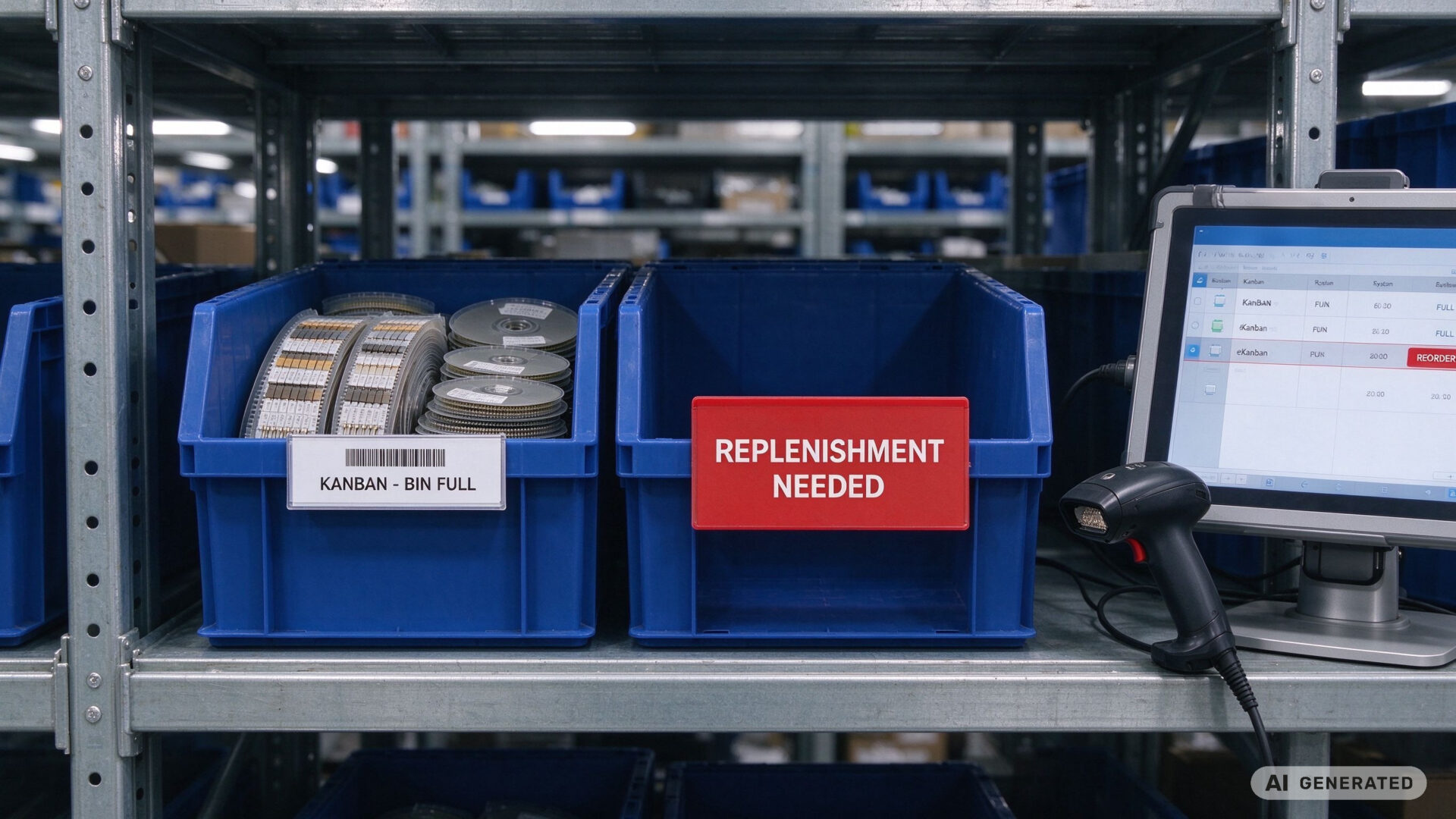
For OEMs that want tighter control, TPS can implement electronic Kanban (eKanban) with barcode or RFID scanning, providing real-time visibility into consumption rates and replenishment status. The data feeds directly into the customer’s ERP or MRP system for production planning alignment.
3.3 BOM kitting, incoming goods inspection, and inventory reporting
TPS’s contract warehousing extends beyond storage to include BOM kitting and incoming goods inspection. Components arriving from suppliers undergo incoming goods inspection—dimension verification, electrical parameter measurement, and documentation review—before entering the warehouse inventory. The incoming goods inspection for production line efficiency process ensures that only verified components used in BOM kits.
Kits assembled according to the production order and delivered to the line-side. This eliminates the line-stop risk associated with a single missing component: the kit is complete before it reaches production. And any shortage is identified at the warehouse staging point rather than at the SMT machine.
Inventory reporting includes real-time stock levels by component, Kanban trigger status, consumption history, and lead-time trend data. The incoming goods inspection report and inventory control documentation provides the traceability that ISO 9001 audits require.

4. Measuring ROI: line-stop prevention, expedite cost reduction, and cash flow
The commercial case for lean supply chain warehousing rests on three measurable outcomes.
Line-stop prevention. The cost of a line stop is not only the lost production hours. It includes the rescheduling cost, the labor idle time, the expediting premium for the missing component, and—in the worst case—the penalty or lost revenue from a delayed customer shipment. A buffer stock of long-lead-time components at a contract warehouse eliminates the most common cause of unplanned line stops.
Expedite cost reduction. Spot-market purchases during allocation events typically carry premiums of three to ten times contracted pricing. A buffer sized at 8 to 10 weeks of consumption for critical components costs the carrying cost of that inventory—typically 15–25% of component value per year—which is an order of magnitude lower than the expedite premium it prevents.
Cash flow optimization. Consignment stock arrangements shift the ownership of buffer inventory to the supplier until consumption, reducing the OEM’s working capital tied up in inventory while maintaining physical availability at the production line. This is particularly relevant for high-value components such as FPGAs, high-pin-count connectors, and automotive-grade ICs.
TPS’s inventory management customer case and incoming goods inspection additional services case document how these outcomes are measured and reported in live customer engagements.
5. RFQ checklist for contract warehousing services
To streamline quotation and evaluation, provide the following information when requesting a contract warehousing services quotation:
- Component list and consumption rates: BOM-level identification of components to be stored, with monthly and peak consumption rates
- Lead-time and allocation status: Quoted lead times, allocation status, and current supplier terms for each critical component
- Buffer sizing target: Desired weeks of buffer stock per component class (e.g., 4 weeks for commodity, 10 weeks for long-lead)
- Ownership model preference: Consignment stock, purchased buffer, or hybrid arrangement
- Delivery cadence: Required line-side delivery frequency (daily, twice-weekly, weekly)
- Kitting requirements: Whether TPS should assemble BOM kits or deliver bulk components
- Inspection requirements: Required incoming goods inspection scope and documentation format
- Reporting requirements: Inventory visibility level, ERP integration, and audit documentation needs
Providing these details reduces clarification cycles during evaluation. TPS’s engineering and procurement teams can support buffer sizing analysis, Kanban configuration, and consignment agreement structuring as part of the RFQ process.