

19-inch power cabinet | RFQ guide
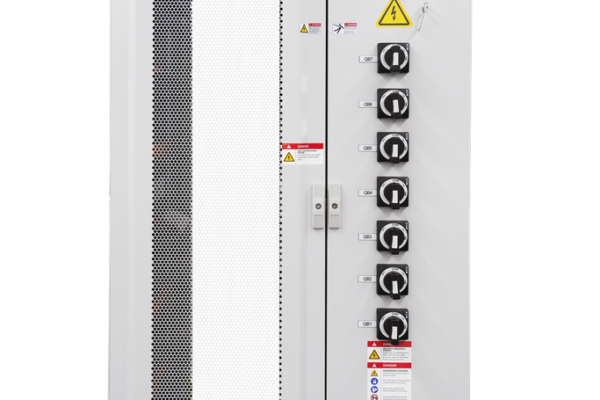
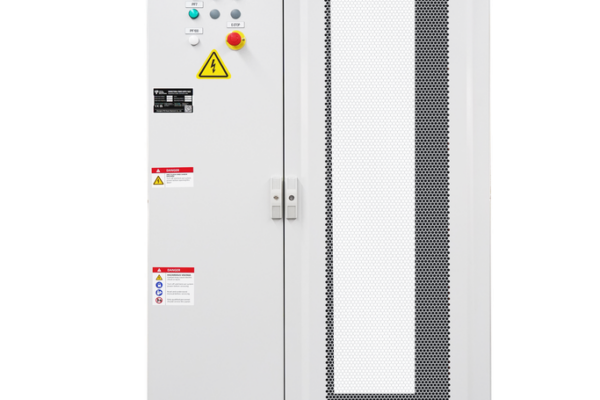
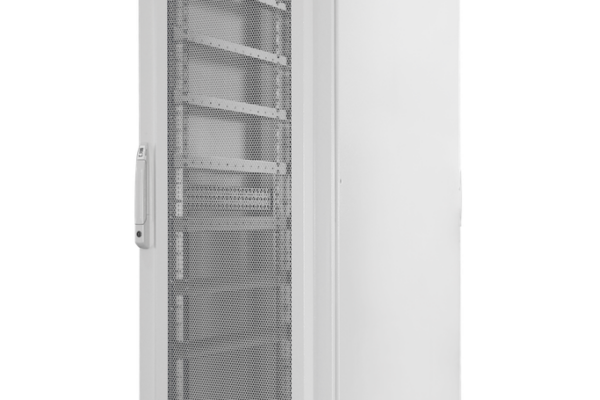
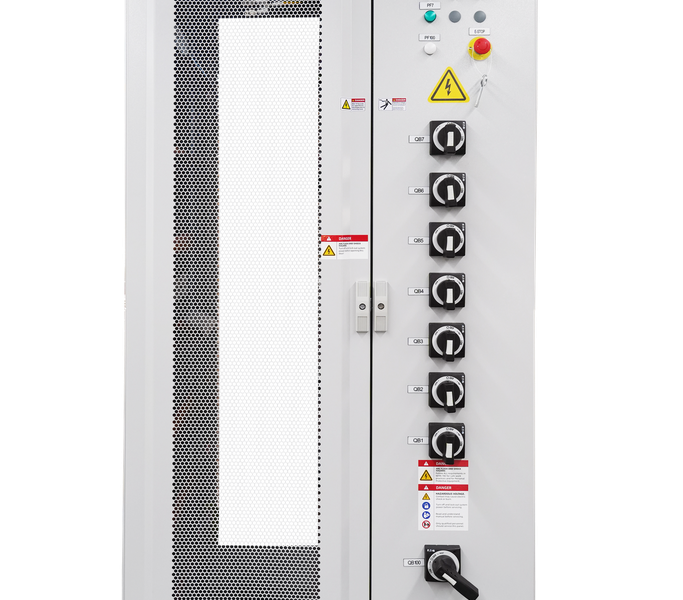
The Sentinel-X 48U Cabinet is a project-configurable 19-inch platform for high-density programmable power, regenerative test and industrial control systems. Its value is not simply 48U of rack space: it gives integrators a coordinated mechanical, power-distribution, thermal and safety architecture that can be specified, documented and quoted as a system.
Why choose a Sentinel-X 48U power cabinet?
At bottom-of-funnel stage, the decision is rarely “Do we need a rack?” The real decision is whether a cabinet can carry the selected modules, distribute high AC and DC currents safely, remove heat from every rack position, support commissioning and arrive with the documentation procurement needs. The Sentinel-X 48U addresses that broader scope. The datasheet identifies a 482.6 mm (19-inch) rack, 48U capacity and overall dimensions of 1000 × 2200 × 1000 mm (W × H × D). This makes it relevant where maximum usable height and a stable floor-standing footprint are more important than minimum enclosure size.
The series is designed for high-density programmable power systems. At series level, TPS describes scalable systems from 10 kW to 420 kW and up to seven 60 kW/6U modules in a 48U enclosure. Those figures are architectural limits, not an automatic rating for every RA1053 build. The deliverable rating depends on module choice, AC feeder, DC busbar, protection, cooling, ambient conditions and certification scope. That distinction is important: a credible supplier quotes the configured system, not the empty rack’s theoretical maximum.
For system integrators, this platform reduces interface fragmentation. Panel builders gain an organized structure for distribution, protection, cable segregation and safety functions. Electrical engineers can review fault current, thermal zoning, grounding and interlocks as one design. Procurement can request a defined scope, documentation set and acceptance plan. TPS can support this work globally with product selection, customization, integration and project engineering rather than supplying an enclosure without application context.
19-inch module layout
AC protection + DC busbars
Interlock + dual-channel E-stop
Airflow, sensing and derating
Key technical specifications for supplier evaluation
| Parameter | Datasheet value / reference configuration | RFQ check |
|---|---|---|
| Cabinet / rack | 1000 × 2200 × 1000 mm; 482.6 mm (19 in); 48U | Access route, floor loading, clearances |
| Input | 3L + PE; 400/480 VAC; 50/60 Hz; 600 A | Site voltage, feeder, disconnect and terminals |
| SCCR | 10 kA standard; series literature notes higher custom SCCR options | Available fault current at installation point |
| Safety | Door interlock, dual-channel E-stop, safety relay; ISO 13849 Cat. 4 / PL d reference | Risk assessment and required safety function |
| Components | UL 489 breaker, UL 508 / UL 60947 contactor, UL 1015 wiring | Final BOM and recognition requirements |
| Finish / supply | RAL 7035; eight power-bracket sets, four leveling feet, four lifting eyebolts, schematic and manual | Confirm exact RA1053 scope and options |
The 600 A input rating should not be read as permission to connect any 600 A load. Engineering must calculate continuous current, diversity, conductor ampacity, terminal temperature, protective-device coordination and applicable derating. The same discipline applies to the high-current DC side. Series literature describes custom busbars and very high system currents; the RFQ should state DC voltage, continuous current, peak profile, polarity/reversal behavior, acceptable temperature rise and termination geometry.
If the system combines high-power rack modules with low-voltage control rails, TPS can also coordinate auxiliary supplies. Relevant examples include the compact TPS010-100W GP DIN-rail supply and the TPS030-130W Pro Series. These links illustrate supporting power options; their suitability still depends on load, hold-up, EMC and safety requirements.
Selection logic: match the cabinet to the application
1. Start with the power-module map
List every rack device with U-height, depth, mass, AC demand, DC connection, airflow direction and maintenance envelope. A regenerative load such as the EA-PUL 10000 6U platform creates different grid and thermal questions from a unidirectional source. A 750 V bidirectional power module requires a DC safety and busbar concept suited to reversible energy flow. The cabinet must be selected around the real module set, not around U-count alone.
2. Choose the distribution architecture
Define whether power distribution is integrated in the rack or placed in a mechanically separate section. A dedicated distribution section can preserve rack space and improve segregation; an integrated arrangement can reduce footprint for simpler configurations. State main disconnect location, branch protection per module, contactor logic, pre-charge or soft-start sequencing, PE scheme, auxiliary supplies, service isolation and external I/O. For high-density systems, staged module energization can reduce inrush-related nuisance trips.
3. Size cooling from losses, not nameplate output
Provide maximum heat loss by operating mode, ambient temperature range, altitude, humidity, contamination level and room HVAC capacity. The series supports forced-air concepts and project-specific liquid-cooling integration. High-CFM fans, perforated doors, baffles and per-zone sensing can be considered, but no cooling configuration should be assumed until the loss map is reviewed. If air intake and exhaust share a room, recirculation and service clearances belong in the layout review.
U, mass, losses, interfaces
Feeder, branches, busbars
Loss map and airflow
SCCR, safety, acceptance
Safety, SCCR and standards: what the rating must mean
The datasheet lists UL 508A (with IEC 61439 reference), NFPA 79 (with IEC 60204 reference) and ISO 13849 as applicable engineering frameworks. For North American projects, the crucial procurement question is the certification and labeling scope of the delivered assembly. “UL-oriented” engineering, use of UL-recognized components and a listed/labeled industrial control panel are not interchangeable claims. Ask TPS to identify the intended build location, inspection route, nameplate data and documentation supplied for the destination market.
SCCR must be equal to or greater than the available fault current at the installation point, after considering the complete power path. The reference 48U data shows 10 kA. The series document also describes a custom 65 kA SCCR strategy. A higher result is project-specific and depends on the lowest-rated component, protective-device combination and tested or permitted calculation method. Send the site fault-current value with the RFQ; do not select SCCR by preference after the BOM is frozen.
The reference safety circuit includes output-side door monitoring, a dual-channel emergency-stop pushbutton and a safety relay, with ISO 13849 Category 4 and PL d stated in the table. The system-level achieved performance level must still be validated against the machine risk assessment, architecture, diagnostics, wiring, actuators and proof-test assumptions. TPS can adapt the interlock, contactor and remote shutdown interfaces, but the customer and responsible integrator must define the required safety function and validation boundary.
Integration, installation and commissioning considerations
Known input
Verified combination
At least site value
Project-specific rating
A 1000 × 2200 × 1000 mm cabinet requires logistics planning before purchase approval. Confirm dock and door dimensions, elevator capacity, turning radius, final anchoring, floor load and lifting method. The base supply includes leveling feet and lifting eyebolts according to the datasheet; transport packaging, casters, seismic anchoring and site rigging should be specified separately. The series frame is described as capable of high static loads, but the project drawing must show actual module masses and center of gravity.
Maintainability belongs in the design review. Confirm front/rear service access, removable module paths, touch-safe covers, test points, terminal access, cable bend radii and whether one branch can be isolated without de-energizing the entire system. Segregate AC, high-current DC, protective earth, safety and communication wiring. Decide where customer cables terminate and who supplies glands, connectors, mating parts and field labels.
Commissioning should be built into the commercial scope. Useful deliverables include approved general-arrangement drawings, single-line and detailed schematics, BOM, terminal plan, cable schedule, protective-device settings, I/O list, software or HMI description, thermal evidence, inspection records and an FAT protocol. TPS can supply a pre-wired cabinet architecture to shorten site work; however, the quotation should state which modules are installed, which interfaces are factory-tested and what remains for site acceptance.
layout, mass, access, anchoring
AC source, DC profile, fault current
losses, ambient, altitude, airflow
standards, FAT, files, destination
How to request a quote that engineering can close
Send TPS a concise requirements package: application and operating modes; destination country; module list; target system power; AC voltage/frequency and available fault current; DC voltage/current ranges; regenerative behavior; loss map; ambient/altitude; 19-inch layout; cable entry; cooling preference; safety functions; control interfaces; required standards; drawings and document format; FAT/SAT expectations; quantity; delivery target; and any approved-manufacturer constraints. Mark which items are mandatory and which are open to an equivalent TPS solution.
This lets TPS compare the RA1053 Sentinel-X 48U cabinet with alternative cabinet or chassis architectures. If 48U is more than the project needs, the Sentinel-Y 42U concept or a compact 6U 19-inch chassis may offer a better fit. The objective is not to force a catalog item into the project; it is to select a safe, maintainable and commercially defined integration path.
For early supplier screening, review TPS’s custom 19-inch cabinet and chassis capability. For the formal RFQ, include enough data to freeze boundaries and nameplate ratings. A technically complete request enables a more useful quotation, exposes integration risks sooner and gives procurement a defensible basis for comparing suppliers.
FAQ
Can every Sentinel-X 48U cabinet deliver 420 kW?
No. Up to 420 kW is a series-level architecture figure associated with a high-density seven-module configuration. The quoted rating depends on selected modules, feeder, protection, busbars, cooling, ambient conditions and certification scope.
Is the cabinet automatically UL 508A listed?
The literature describes UL 508A-compliant/oriented engineering. Ask TPS to confirm the exact delivered assembly’s listing, labeling, build and inspection scope for the destination project.
What SCCR should be specified?
The reference configuration states 10 kA. Specify an SCCR no lower than the available fault current at the installation point. Higher custom SCCR options require engineering confirmation.
What can TPS customize?
Depending on the project, TPS can adapt the module layout, distribution, busbars, cooling, temperature/humidity monitoring, alarms, remote control/display, safety interfaces, cable routing and documentation.
What is the minimum information for an RFQ?
Provide the module list, AC supply and fault current, DC operating profile, heat losses, ambient conditions, safety functions, destination standards, control interfaces, quantities and schedule. Drawings greatly improve quotation accuracy.