

System integrators, panel builders, and procurement teams in heavy equipment rarely fail because they lack a control concept. They lose time—and budget—when the power supply overheats in an undersized compartment, when cable ducts cannot carry the required fill. Or when the cabinet frame flexes during transport and the door no longer seals.
TPS Elektronik’s custom sheet metal fabrication services built to reduce that risk: integrated power supply compartments, engineered cable management zones, welded frame construction, and validated documentation from prototype through series production.
Discuss your control cabinet fabrication requirements with TPS →
1. Why power supply and cable management integration decides cabinet success
A heavy equipment control cabinet is not a sheet metal box with components bolted inside. It is a thermal system, an electrical distribution system. And a mechanical structure that must survive transport, installation, and years of vibration. The integration of the power supply and the cable management determines whether the cabinet passes factory acceptance testing and whether it remains reliable in the field.
Two failure patterns dominate field returns in heavy equipment cabinets. The first is power supply overheating: the supply mounted in a compartment with insufficient clearance, the internal temperature rises above the derating threshold, and the output drops or the unit fails prematurely. The second is cable congestion: the ducts undersized, the fill ratio exceeds the permissible limit. And heat cannot escape from the bundle—accelerating insulation ageing and creating a fire risk.
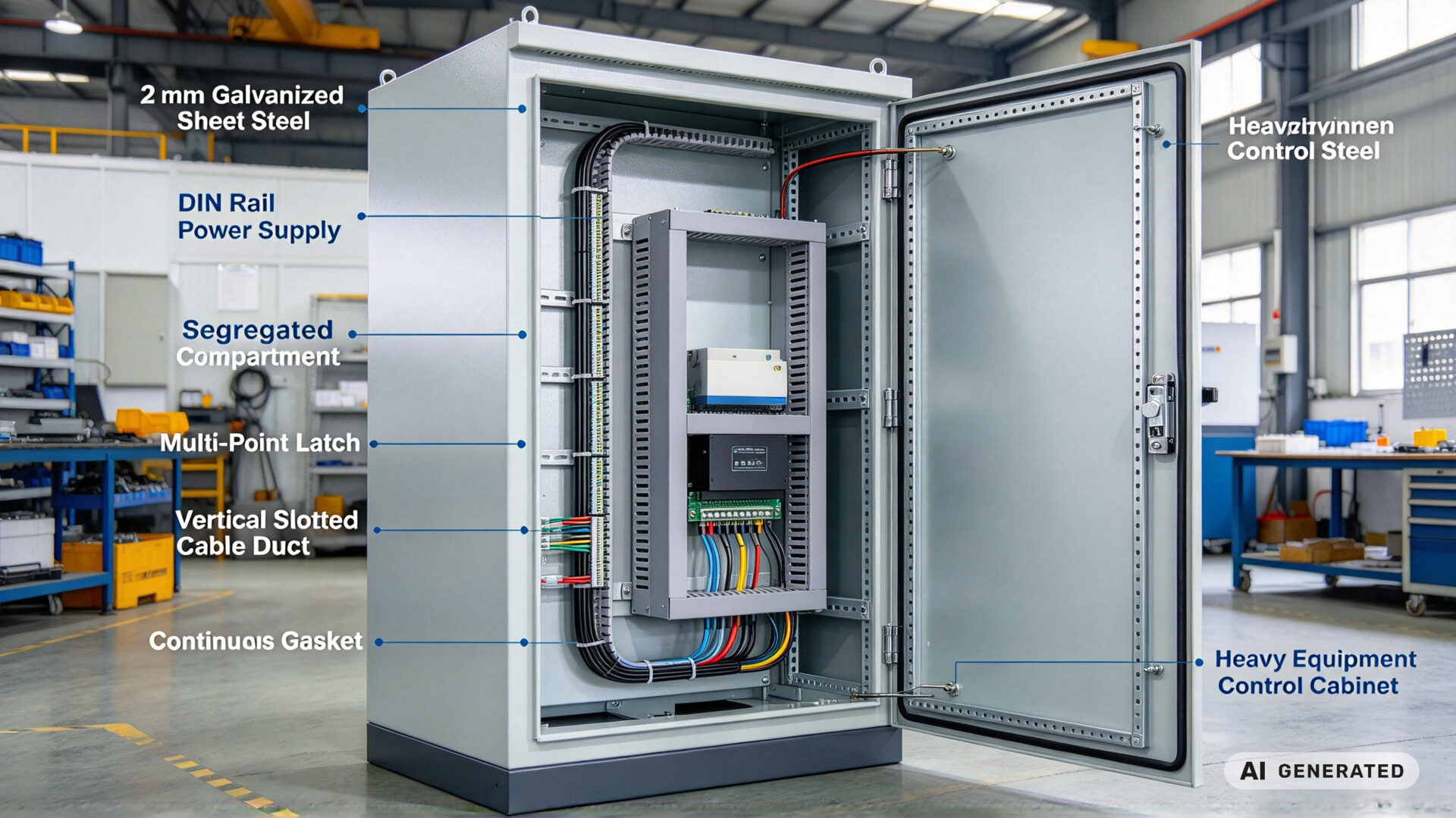
1.1 The power supply compartment: heat, clearance, and access
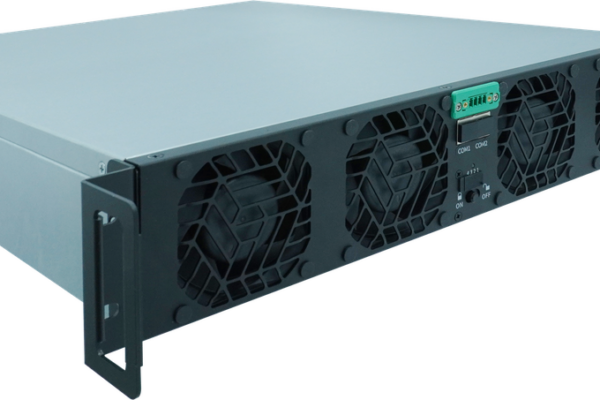
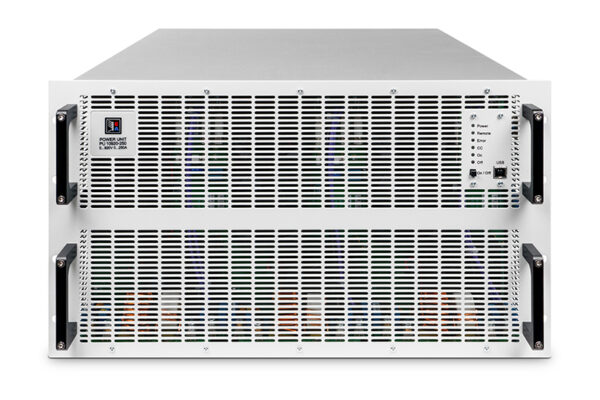
The power supply compartment must sized from the thermal calculation, not from the available space. The inputs are the supply’s dissipated power at full load, the maximum internal ambient temperature, the permitted surface temperature, and the airflow or convection path. For a convection-cooled compartment, the supply needs free space above and below for the chimney effect; for a fan-cooled supply, the intake and exhaust must not obstructed by cable ducts or terminal blocks.
Access is the second constraint. The supply must replaceable without dismantling the cable management system. In practice, this means the compartment should have its own removable cover or hinged panel. And the cable entry should be positioned so that the supply can be slid out with the wiring connected or with a service loop that allows disconnection.
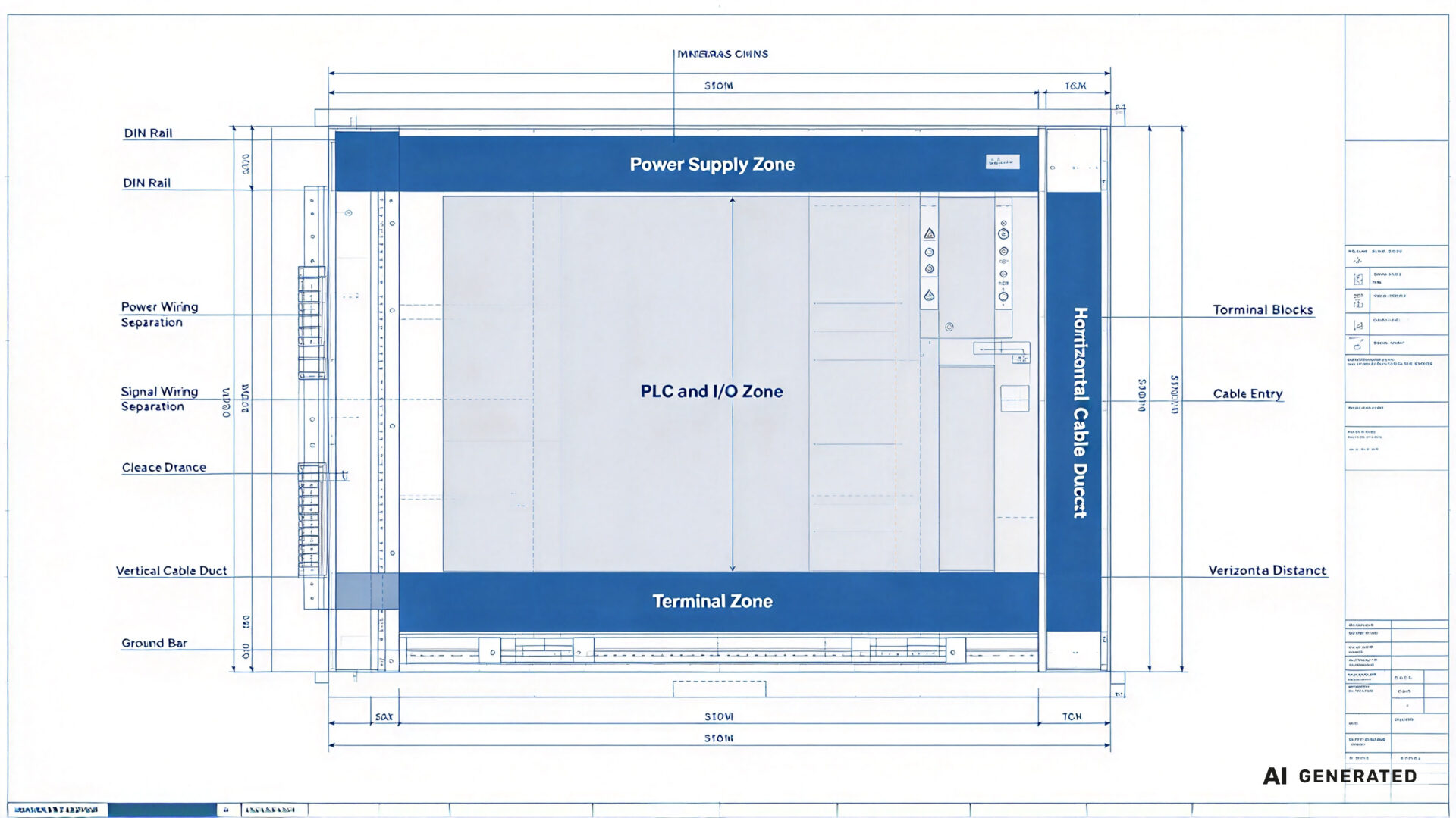
1.2 Cable management zones: fill ratio and separation
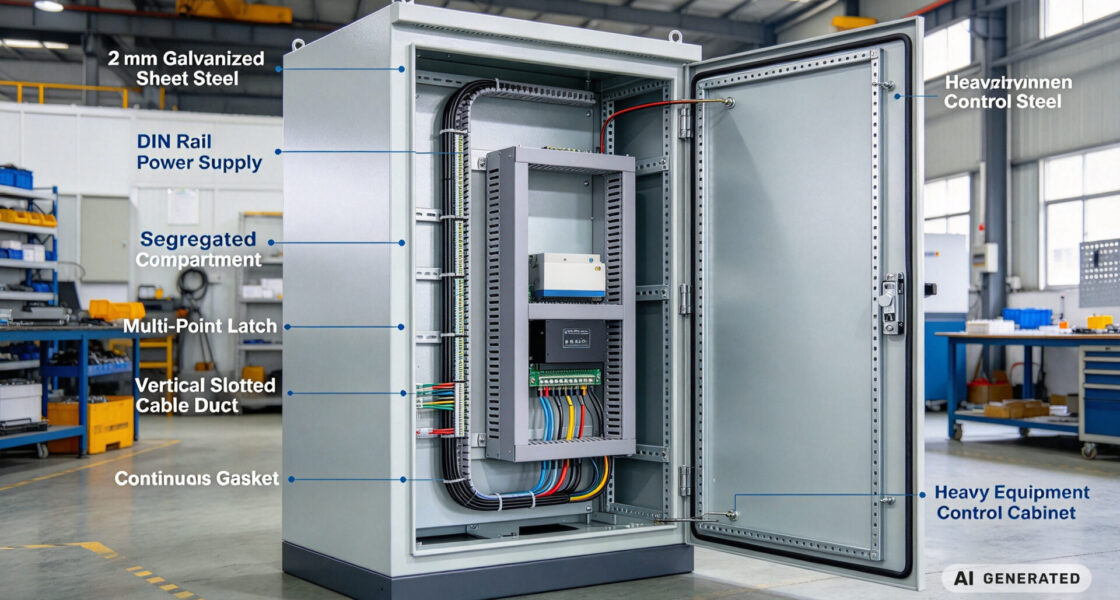
Cable ducts sized by fill ratio—the cross-sectional area of the cables divided by the internal area of the duct. A common design target is 40–50% fill for power cables and 50–60% for signal cables, with the exact value depending on the duct type and the applicable installation standard. Exceeding the fill ratio traps heat, makes future modification difficult, and can violate the derating of the cables inside.
Separation is the second requirement. Power cables carrying switching currents and signal cables carrying analog or encoder signals must be routed in separate ducts or separated by a defined distance. The separation distance depends on the cable type, the signal sensitivity, and the applicable EMC standard. In heavy equipment, where drives and motors are present, the separation between power and signal routing is often the single most important EMC measure in the cabinet.
2. Sheet metal fabrication requirements for heavy equipment cabinets
Heavy equipment cabinets subjected to loads that general-purpose enclosures never see: transport vibration, lifting and handling, on-site vibration from the machine, and in some cases seismic events. The sheet metal fabrication must provide the stiffness and the protection that these conditions demand.
2.1 Frame structure, welding, and transport stiffness
A welded frame is the standard construction for heavy equipment cabinets. The frame carries the load of the mounted components and resists the torsional loads applied during lifting and transport. The welding method matters: MIG welding is the productive choice for long seams and thicker sections, while TIG welding used where a smoother weld bead or a specific material is required. The MIG vs TIG welding comparison documents the selection criteria.
The sheet thickness determined by the frame design and the mounting loads, not by a default value. A 2 mm galvanized steel sheet is common for the body panels of heavy equipment cabinets, with thicker sections at the base and at the lifting points. The base must designed for the lifting method—forklift pockets, crane eyes, or a skid. And the lifting points must verified by calculation, not by experience alone.
Transport stiffness verified by the door alignment after transport: if the frame twists, the door no longer seals and the ingress protection is lost. Gussets at the corners, a continuous base frame, and a rigid top frame are the standard measures.
2.2 Surface protection and environmental sealing
The surface protection must match the installation environment. Powder coating over a phosphated or galvanized substrate is the standard for indoor heavy equipment. For outdoor or washdown installations, stainless steel or a hot-dip galvanized finish with a suitable coating system required. The coating thickness and the adhesion test are specified in the fabrication drawing and verified at incoming inspection.
Sealing is the second environmental requirement. The door gasket, the cable entry glands, and the joint between the body and the base must be designed as a continuous sealing system. The target ingress protection—IP54, IP65, or IP66—must be stated in the RFQ and verified by test, not assumed from the gasket specification.
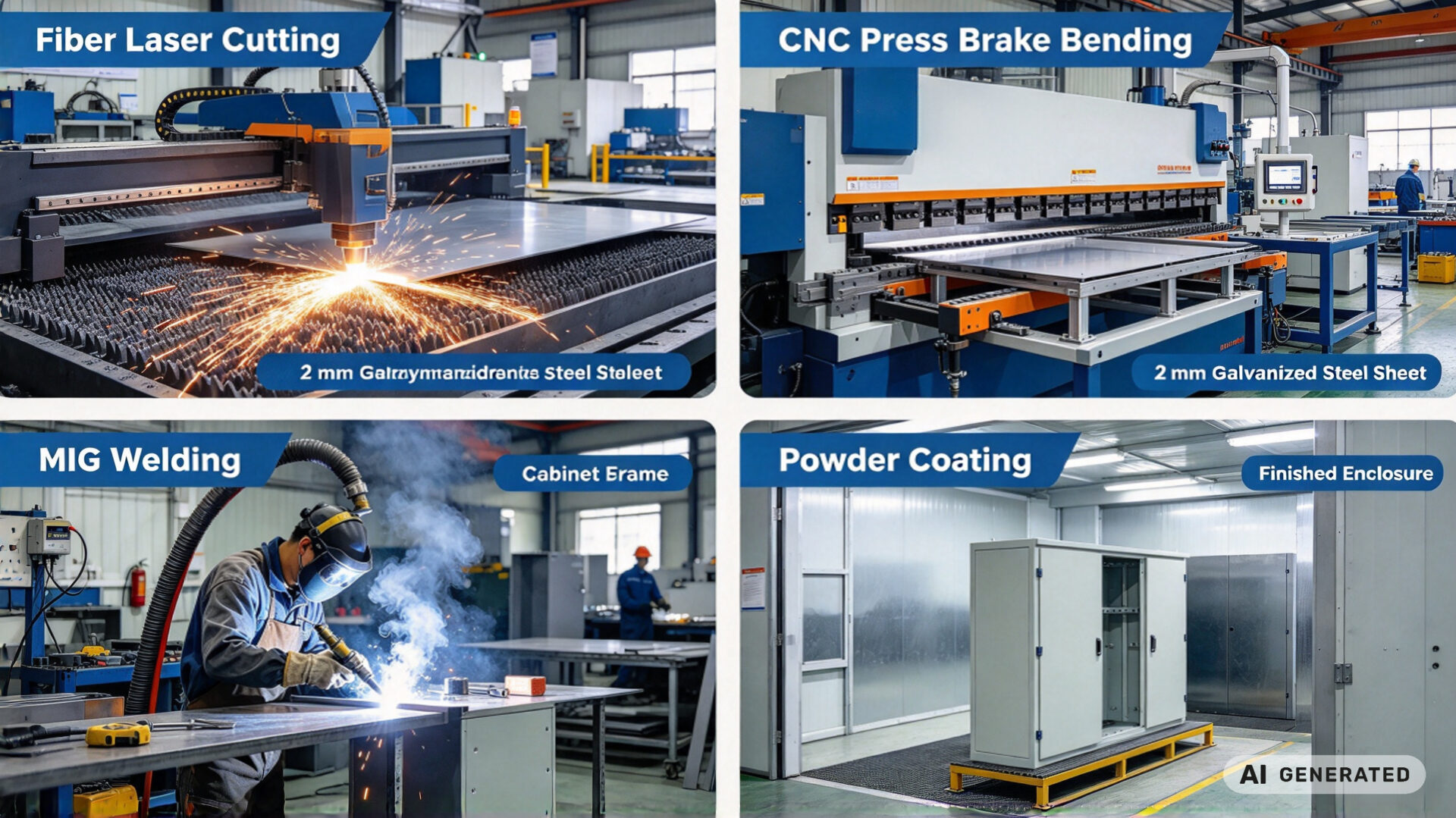
The custom sheet metal fabrication and precision manufacturing resource describes the process controls that apply to these steps.
3. How TPS integrates power and cabling into fabricated cabinets
TPS Elektronik treats the cabinet as an integrated system: sheet metal structure, power supply compartment, cable management, and component mounting are designed together. This is the same logic that TPS applies to electronics enclosures and to RFQ-ready CNC bending projects.
3.1 Design review and 3D layout
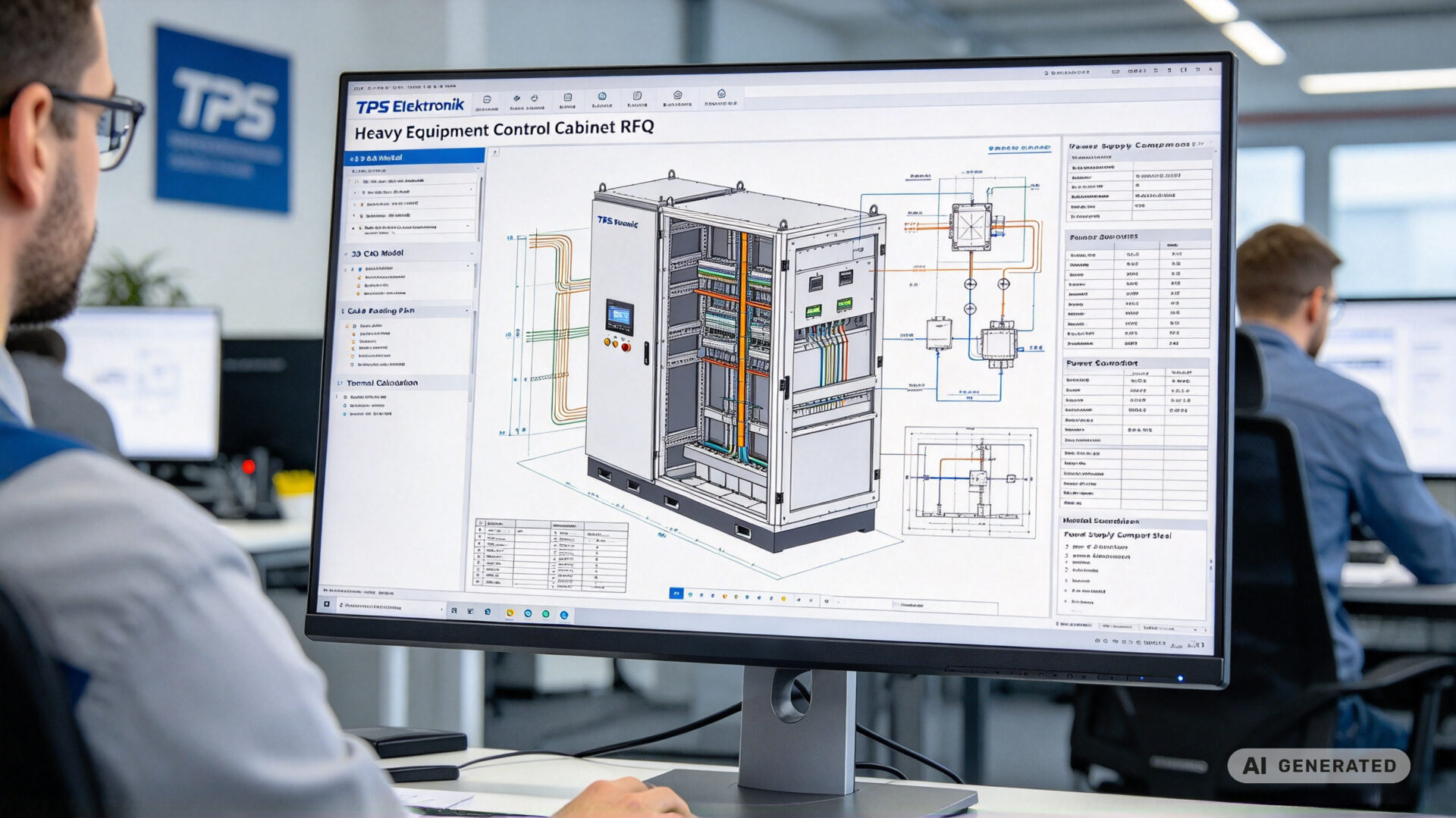
The design review starts with the component list and the thermal calculation. TPS engineers build a 3D layout that places the power supply, the PLC, the drives, the terminals, and the cable ducts in the available volume, and checks the clearance, the bend radius of the cables, and the access for service. The output is a fabrication drawing set that includes the sheet metal parts, the weld map, the coating specification, and the cable management bill of materials.
3.2 Fabrication, welding, and finishing
Fabrication follows the drawing set: laser cutting, CNC bending, welding, grinding, and surface finishing. The RFQ-ready CNC bending service covers the bending and forming steps, and the welding is performed to the weld map with the specified method and inspection. The finished cabinet is checked against the drawing before the coating step, so that dimensional issues are corrected before the surface is sealed.
3.3 Assembly validation and documentation
After coating, the cabinet assembled with the cable management system and the power supply. And the assembly is validated: door alignment, gasket compression, cable duct fill ratio, separation distances, and thermal measurement at full load. The validation report is issued with the cabinet and can be referenced during factory acceptance testing.
4. RFQ checklist for integrated control cabinets
To streamline quotation and evaluation for custom sheet metal fabrication services of heavy equipment control cabinets, provide the following information:
- Component list and layout: Power supply, PLC, drives, terminals, and cable management components with dimensions and mounting requirements
- Thermal data: Power supply dissipated power, maximum internal ambient temperature, and cooling method
- Cable schedule: Cable types, cross-sections, quantities, and the required separation between power and signal routing
- Mechanical requirements: Sheet thickness, frame construction, lifting method, and transport conditions
- Environmental requirements: Ingress protection target, indoor or outdoor installation, and coating specification
- Standards: Applicable assembly standard (for example IEC 61439-1) and any customer-specific panel standard
- Documentation: Fabrication drawings, weld inspection record, coating test report, and assembly validation report
- Quantity and schedule: Prototype quantity, series volume, and delivery milestones
Providing these details reduces clarification cycles. TPS’s engineering team can support the layout, the thermal calculation, and the cable management design as part of the RFQ process.