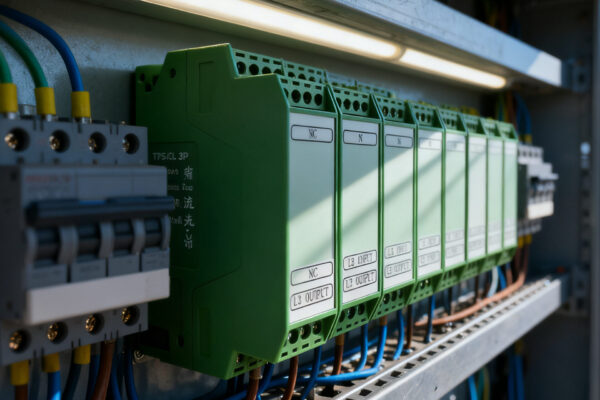


System integrators, panel builders, procurement teams, and electrical engineers often encounter problems not with steady-state power consumption, but during system startup. Circuit breakers may trip during initial energization, protection devices may need to be oversized, transformer branches can exhibit high magnetizing currents, and multiple power supplies may draw their peak input current simultaneously.
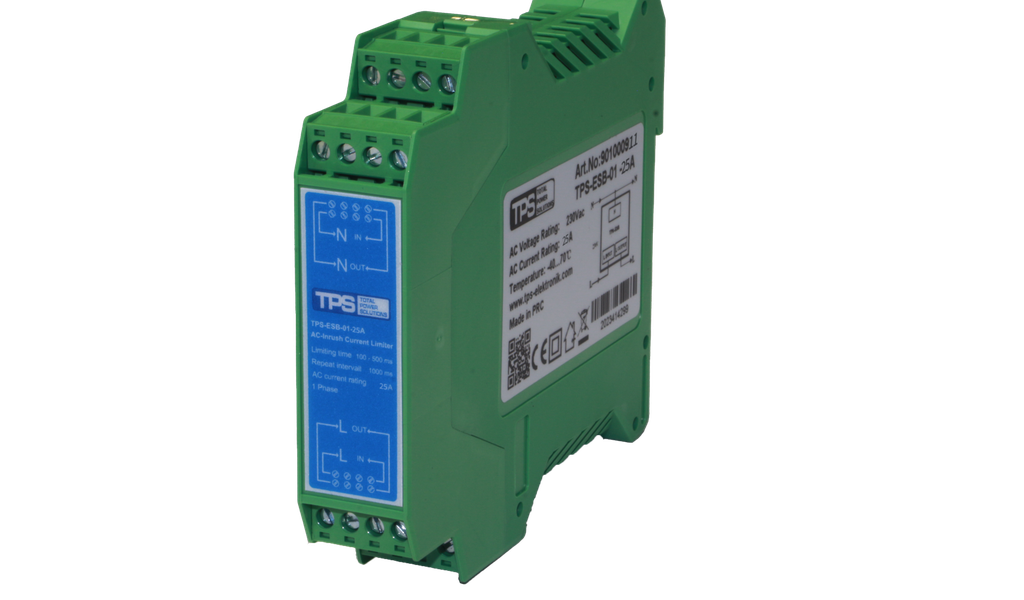
The TPS AC Inrush Current Limiter is designed to address these cabinet-level startup conditions. The DIN-rail-mounted devices combine controlled inrush current limiting with an integrated bypass relay and are available in 12 A, 16 A, and 25 A current classes.
1. Why AC Inrush Current Limiting Matters in Panel Design
In many industrial cabinets, steady-state current is not the primary challenge for branch protection. The critical period is often the first few milliseconds after power-on.
During energization, bulk capacitors charge, transformers can draw high magnetizing current, and multiple downstream devices may demand substantial line current simultaneously. A branch that appears acceptable based on nominal current can therefore cause nuisance tripping or require additional protection margin during commissioning.
For system integrators and panel builders, startup behavior affects several aspects of the electrical design:
- branch protection and coordination,
- cabinet wiring and conductor sizing,
- grouping of devices on a common feeder,
- startup behavior during commissioning, and
- operation following power cycling.
Procurement teams encounter the consequences when high inrush current leads to larger protective devices, additional branches, or other changes to the original cabinet architecture.
An AC inrush current limiter can help control these short-duration current peaks, allowing protection and wiring decisions to be based on a more predictable startup profile. Final coordination must nevertheless be verified for the complete system.
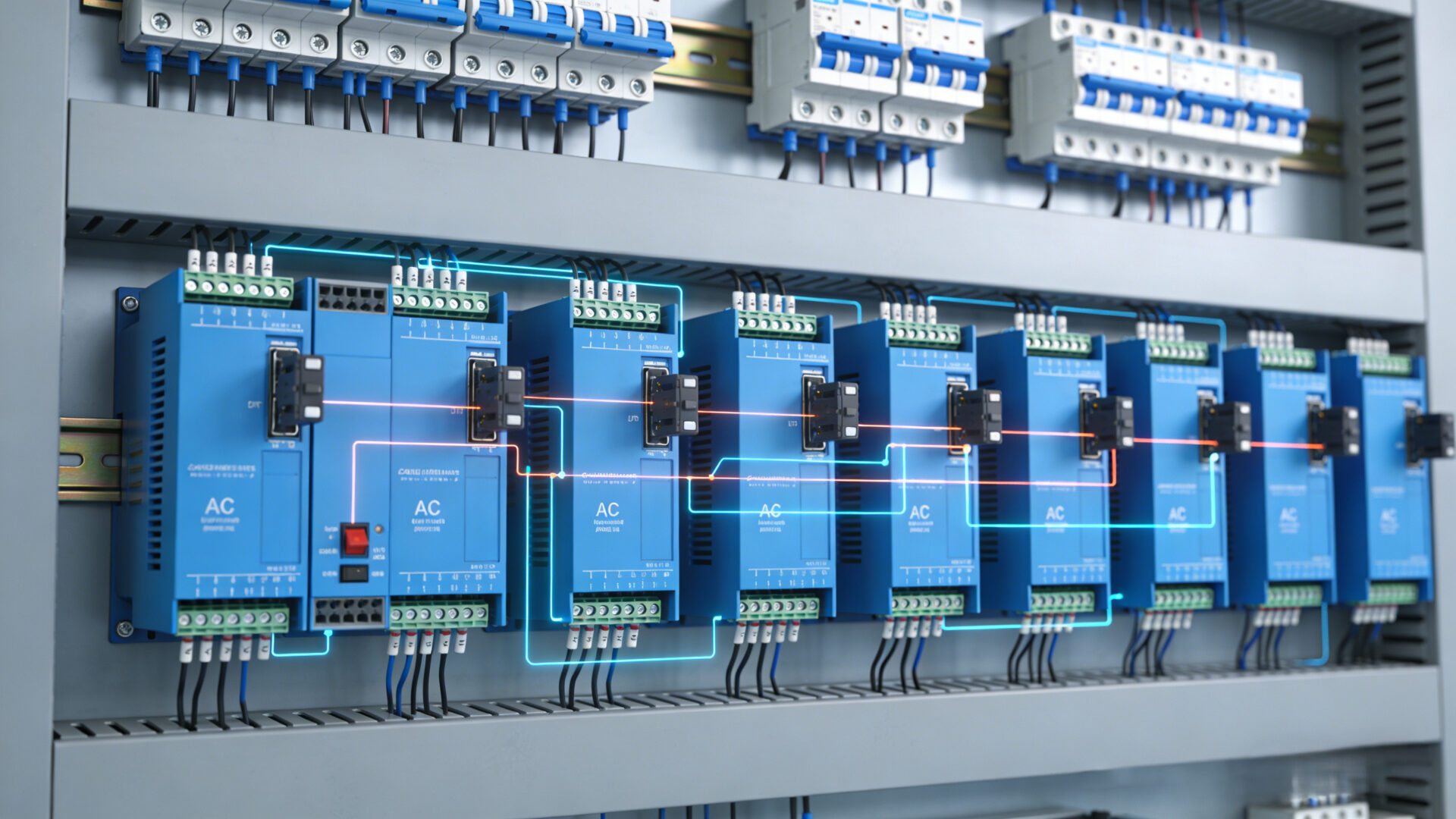
This can be particularly relevant when several DIN-rail power supplies, such as the TPS010-100W GP Series, TPS030-130W Pro Series, or TPS100-320W Peak DR Plus, are energized from the same feeder.
2. TPS Series Overview: DIN-Rail Startup Control for 230 VAC and 400 VAC Systems
The TPS AC Inrush Current Limiter family is designed for DIN-rail installation and is available in 12 A, 16 A, and 25 A current classes.
For single-phase applications, the available models include:
The broader product family also includes 400 VAC three-phase order variants, allowing engineering teams to consider a common inrush-limiting approach across different cabinet architectures.
Key documented characteristics include:
- DIN-rail mounting
- integrated bypass relay
- peak current limiting to 45 A
- limiting time of 100–500 ms
- IP20 protection
- convection cooling
- −40 °C to +70 °C operating temperature
- 300,000 h MTBF
These parameters address both electrical startup behavior and practical cabinet integration and should be considered together when specifying the appropriate model.
3. Integrated Bypass Relay vs. Simple NTC Limiting
A key design characteristic of the TPS family is its integrated bypass relay. This distinguishes its operating principle from basic inrush-limiting circuits that rely solely on an NTC thermistor.
NTC thermistors can provide effective inrush limitation in suitable applications, but their resistance depends strongly on temperature. After operation, a thermistor may remain warm and therefore have lower resistance during a subsequent restart. This behavior needs to be considered in applications with frequent or closely spaced power cycles.
With a bypass-relay architecture, the current-limiting element is used during startup and subsequently bypassed for normal operation. This approach can support:
- repeated switching applications,
- lower continuous thermal loading of the limiting element,
- more predictable startup behavior across operating cycles, and
- separation of the startup-limiting function from normal steady-state conduction.
The appropriate approach depends on the application. For industrial systems in which repeated startup behavior is an important design parameter, a relay-assisted limiter may offer advantages over a simple NTC-only circuit.
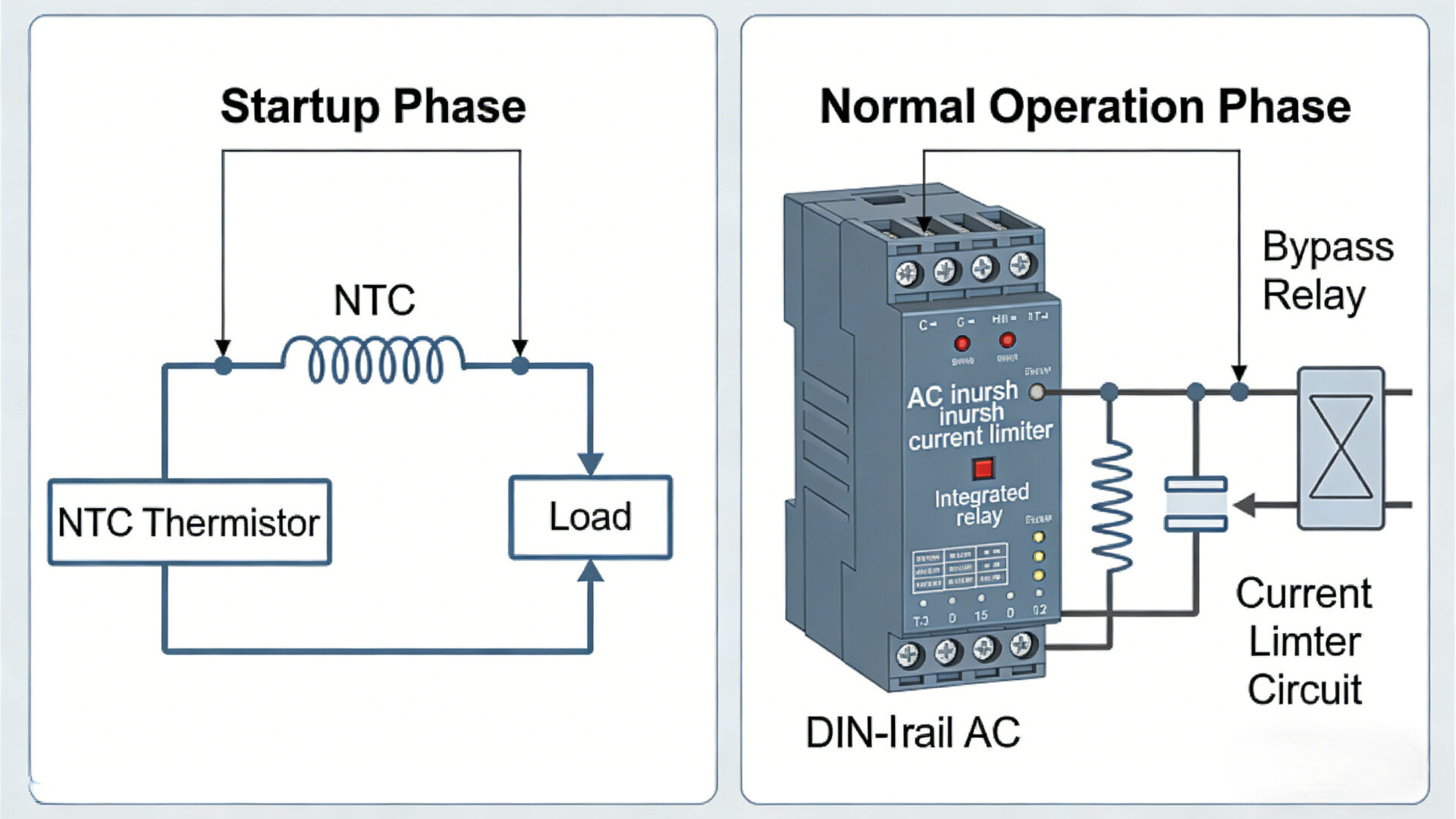
This can be particularly relevant where multiple AC/DC power supplies share a common feeder, including systems based on the TPS010-100W GP Series or TPS030-130W Pro Series.
4. Applications: Capacitive, Inductive, and Transformer Loads
The TPS limiter is specified for capacitive loads, inductive loads, and isolating transformers. These load types can produce startup currents substantially higher than their normal operating current.
4.1 Capacitive Loads
Many power-electronics systems contain significant input capacitance. At switch-on, discharged bulk capacitors can initially present a low-impedance load, producing a short but substantial current pulse.
This behavior is common in DIN-rail power supplies, industrial PC power supplies, ATX units, and open-frame power supplies. When several devices are connected to one branch and energized simultaneously, their combined inrush current can become relevant to breaker and fuse coordination.
Examples of power supplies that may form part of such system architectures include the FSP300-70PFL-SK, FSP700-80PSA-SK, FSP500-50FDB, and TPS-GSH180S.
4.2 Inductive Loads
Inductive loads present a different startup characteristic. Magnetizing current, switching phase, residual magnetic flux, and branch topology can result in current peaks that are not apparent from nominal operating-current calculations.
Limiting the initial current can therefore help make the energization behavior of these branches more predictable.
4.3 Isolating Transformers
Transformers are a common source of high inrush current. Depending on the point on the AC waveform at which energization occurs and the magnetic state of the core, the initial magnetizing current can significantly exceed the transformer’s normal operating current.
An appropriately selected inrush current limiter can help control this startup event during initial installation, routine switching, maintenance, or restart after a power interruption.
TPS documentation also identifies support for the use of smaller and faster circuit breakers and potential reduction of conductor cross-sections. These possibilities depend on the complete branch design and do not replace system-level calculations for conductor sizing, overload protection, short-circuit protection, or protective-device coordination.
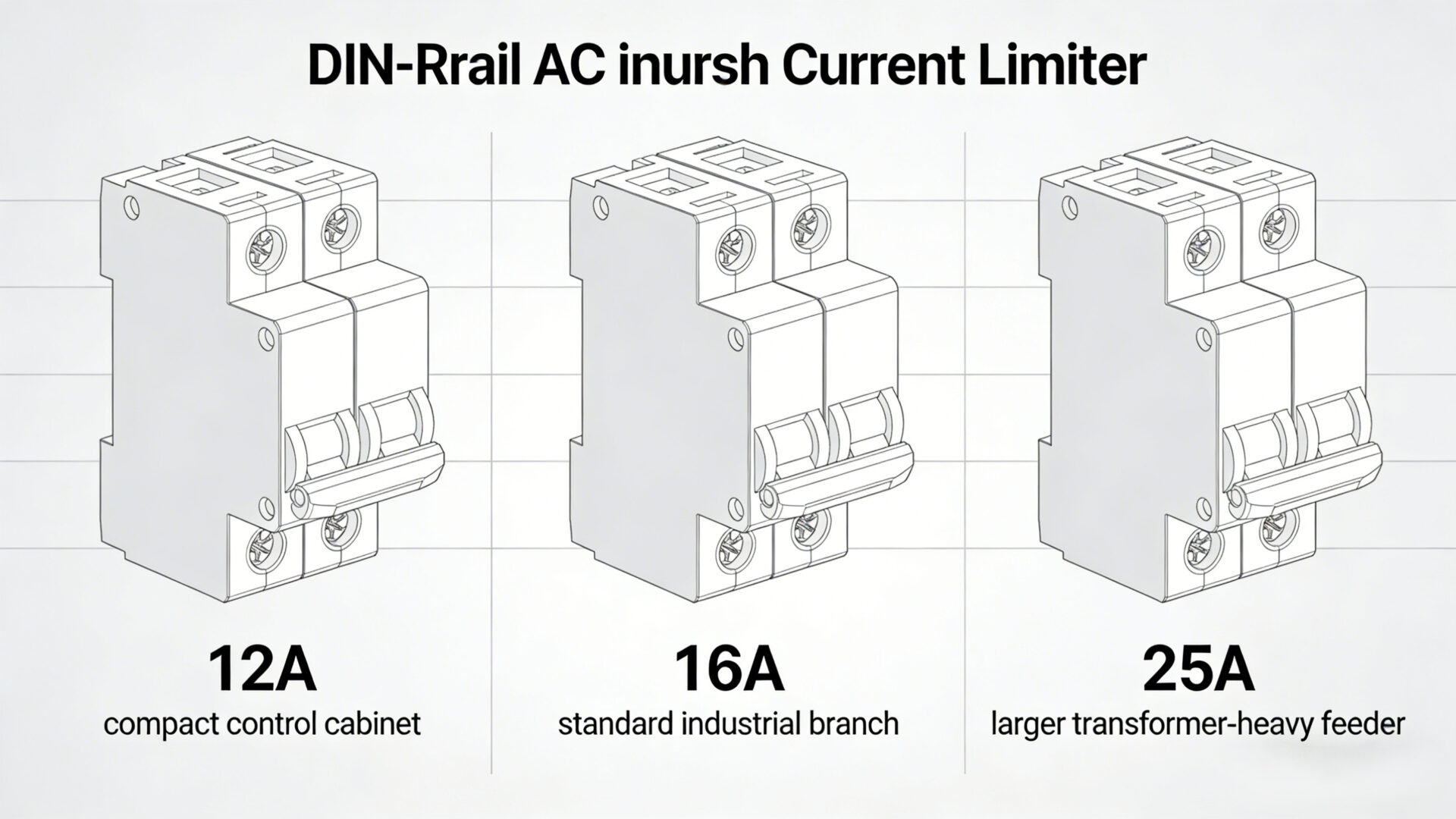
5. How to Select 12 A, 16 A, or 25 A
Selection should begin with the continuous branch current, followed by the type and number of downstream loads and their simultaneous startup characteristics.
5.1 TPS-ESB-01-12A
The TPS-ESB-01-12A may be suitable for compact single-phase branches with moderate continuous current but significant startup peaks, including grouped DIN-rail power supplies, smaller control cabinets, IPC branches, and transformer-fed auxiliary circuits.
5.2 TPS-ESB-01-16A
The TPS-ESB-01-16A provides a higher continuous-current class for single-phase branches where 12 A is insufficient.
Selection should be based on the actual feeder current and startup profile rather than treating 16 A as a universal default.
5.3 TPS-ESB-01-25A
The TPS-ESB-01-25A is intended for higher-current branches and may be appropriate where multiple capacitive loads, transformer loads, or a larger number of downstream devices share the same input segment.
Nominal branch current alone is not sufficient for model selection. Engineering teams should also consider:
- How many downstream devices energize simultaneously?
- What is the inrush behavior of each downstream device?
- Are large input capacitors present?
- Are transformers included in the branch?
- What upstream breaker or fuse characteristics are required?
- How frequently will the cabinet be power-cycled?
These parameters provide a more useful basis for selection than nameplate current alone.
6. Installation, Protection, and Panel Design Considerations
The TPS limiter is designed for DIN-rail mounting on TS 35/7.5 or TS 35/15 rails in the specified mounting orientation.
The family uses screw terminals for AWG 13–11 conductors and relies on convection cooling. Approximate dimensions are:
- Width: 22.5 mm
- Height: 100 mm
- Depth: 112 mm
The narrow 22.5 mm format can simplify installation near feeder protection or adjacent power-conversion equipment where DIN-rail space is limited.
An inrush current limiter does not replace correct fuse, circuit-breaker, conductor, or short-circuit protection design. Its function is to limit the startup current peak, which may support more appropriate coordination of upstream protective devices.
For panel design, two points are particularly important:
- Select the limiter as part of the complete branch architecture, rather than adding it only after nuisance tripping occurs.
- Document downstream load grouping and simultaneous energization, particularly where several power supplies or transformer-fed circuits share one branch.
For example, if a branch supplies devices such as the TPS100-320W Peak DR Plus or FSP350-70PFL-SK, their actual startup characteristics should be included in the branch-level assessment.
7. Compliance, Reliability, and Procurement Documentation
For engineering qualification and supplier approval, environmental, safety, EMC, and reliability information should be reviewed alongside the electrical characteristics.
The documented specifications include:
- IP20 protection
- 50 Hz input frequency
- up to 95% RH, non-condensing
- operating altitude up to 2,000 m
- operating temperature: −40 °C to +70 °C
- storage temperature down to −40 °C
- MTBF: 300,000 h
The product documentation references EN 60950-1, EN 61000-6-2, EN 61000-6-3, CE, and RoHS.
For procurement and engineering review, these references should be evaluated against the requirements of the final application and the applicable current standards. Component-level documentation alone does not establish compliance of the complete machine, cabinet, or system.
For additional standards and conformity background, engineering teams can consult ISO quality management resources, the IEC, and the European Commission’s CE marking guidance.

8. What to Include in an RFQ
An RFQ for an AC inrush current limiter should describe the electrical branch rather than specifying only a nominal current class.
Useful RFQ information includes:
- supply configuration and voltage, including single-phase 230 VAC or relevant 400 VAC family requirements,
- required continuous current class: 12 A, 16 A, or 25 A,
- downstream load type: capacitive, inductive, transformer-based, or mixed,
- number of power supplies or transformers energized simultaneously,
- available inrush-current data for downstream devices,
- upstream fuse or circuit-breaker type and rating,
- ambient temperature and enclosure ventilation,
- available DIN-rail space, and
- expected power-cycling frequency.
Providing this information allows the limiter to be evaluated as part of the complete startup and protection architecture rather than as an isolated component.
For applications where the required current class has already been established, the available single-phase models are:
FAQ
What is an AC inrush current limiter used for?
An AC inrush current limiter controls the short-duration current peak that can occur when capacitors charge, transformers are energized, or multiple AC-powered devices start simultaneously. In industrial panels, limiting this peak can help reduce nuisance tripping and support more predictable startup behavior.
Why use a bypass-relay limiter instead of a simple NTC?
An NTC thermistor may be suitable for some applications, but its resistance depends on temperature. If the NTC remains warm after operation, its ability to limit current during a rapid restart can differ from a cold start.
A limiter with an integrated bypass relay performs the limiting function during startup and then bypasses the limiting element during normal operation. This architecture can be useful where repeated startup behavior and continuous thermal loading are important design considerations.
How do I choose between 12 A, 16 A, and 25 A?
Start with the branch’s continuous current and then evaluate the downstream load mix, simultaneous startup behavior, transformer loads, available inrush-current data, and upstream protection.
The limiter should not be selected solely from the nominal current ratings of the connected devices.
Can an inrush current limiter help with breaker and fuse coordination?
Limiting startup current can help reduce nuisance operation of upstream protective devices and may support more appropriate breaker or fuse coordination. The final protection concept must still be validated for the complete electrical system.
Which applications are suitable for AC inrush current limiting?
Typical applications include capacitive loads, inductive loads, isolating transformers, grouped DIN-rail power supplies, industrial IPC power systems, and other cabinet branches where startup current is high relative to normal operating current.