

Product Blog | TPS ELEKTRONIK
For system integrators, panel builders, procurement teams and electrical engineers, a 6U programmable DC power unit is not selected by headline wattage alone. The real decision is whether the power platform can reduce test-bench risk, simplify cabinet integration, support automation interfaces and give purchasing a clear, supportable path from model selection to delivery. The EA-PUB 10000 6U class available through TPS addresses these requirements with 60 kW bidirectional source/sink operation, regenerative energy recovery, wide DC voltage coverage and scalable parallel operation.
Why this 6U bidirectional DC power category matters in RFQs
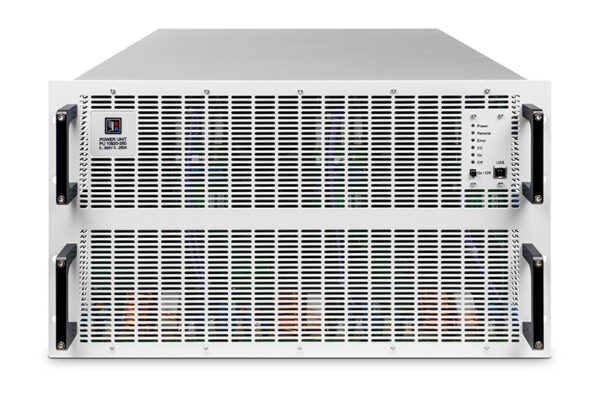
When a test system, battery lab, inverter validation bench or high-power DC platform reaches the RFQ stage, the question usually changes from “Can we buy a programmable power supply?” to “Can we specify a complete, reliable and serviceable power architecture?” A standard bench supply may be adequate for engineering exploration, but production validation and automated testing need higher power density, defined interfaces, predictable thermal design and clear protection behavior. The EA-PUB 10000 6U bidirectional programmable DC power unit is relevant because it combines source and sink capability in a single 19-inch, 6U power unit rated at 60 kW per device.
In source mode, the unit supplies controlled DC power to a device under test. In sink mode, it behaves as a regenerative electronic load and feeds recovered energy back into the local grid instead of turning most of it into heat. This matters for BoFu buyers because energy recovery is not only a sustainability argument. It can reduce cooling load, room HVAC requirements, heat-management risk and long-cycle test operating cost. For procurement, this can support a better total-cost-of-ownership discussion than a price-only comparison.
TPS supports global B2B customers with programmable power products and project-level solution capability. That means the RFQ discussion can cover more than a single article number: voltage class, current headroom, cooling concept, industrial communication interface, parallel operation, cabinet impact, delivery route and application fit. If your team is comparing a 60 kW programmable DC source/load platform for battery, DC bus or power electronics testing, TPS can help translate the requirement into a practical model shortlist and next-step quotation via the TPS programmable power consultation page.
380-480 V, 3-phase
Source + regenerative sink
Battery, inverter, OBC, DC bus
Key specifications engineers should verify first
The first engineering checkpoint is AC compatibility. The 60 kW 6U units are designed for a wide 380-480 V, ±10%, three-phase AC input range with 45-65 Hz frequency and active power factor correction with a typical power factor of approximately 0.99. For global test systems, this helps simplify deployment across many industrial grid environments. It also gives panel builders clearer input-current, protection and site-readiness discussions before the cabinet is built.
The second checkpoint is DC range. The 6U platform covers model classes from 0-360 V / 0-480 A up to 0-2000 V / 0-80 A, each with a 0-60 kW power range. Because the output/input stage uses an autoranging constant-power characteristic, one unit can cover a broader voltage-current operating window than a rectangular-output device. Electrical engineers should define not only nominal DUT voltage and current, but also the minimum voltage at maximum sink current, transient profile, cable voltage drop and whether remote sense compensation is needed.
The third checkpoint is regulation and measurement. The platform supports CV, CC, CP and CR operating modes with fast crossover, digital regulation, high-resolution 16-bit ADCs and DACs, and selectable voltage-controller speed. This is useful when the test setup includes another active control loop, for example an on-board charger, inverter DC link or battery management test environment. Protection functions such as adjustable OVP, OCP and OPP up to 110% of nominal values, plus overtemperature shutdown behavior, should be included in the test safety concept.
RFQ-critical specification summary
| RFQ field | Engineering value | Why it matters |
|---|---|---|
| Power per unit | 60 kW | Determines rack density, AC supply sizing and expansion plan. |
| DC range | 0-360 V to 0-2000 V; 0-480 A to 0-80 A | Defines battery, inverter, DC bus and high-voltage test fit. |
| Modes | CV, CC, CP, CR | Supports flexible source/load test sequences. |
| Interfaces | USB, Ethernet, analog, Master-Slave, Share-Bus; optional fieldbus interfaces | Reduces automation and PLC integration risk. |
| Cooling | Front-to-rear forced air; optional stainless-steel water cooling | Affects cabinet layout, noise, HVAC and continuous-duty operation. |
For teams moving from low-power development into high-power validation, TPS can also help place the 6U unit within a wider programmable power roadmap. Smaller lab or desktop needs may be covered by products such as the EA-PS 3200-02 C desktop programmable DC power supply or the EA-PSI 9000 DT desktop programmable DC power supply, while high-power regenerative load requirements can be compared with the EA-PUL 10000 6U regenerative DC load.
Model selection logic: voltage, current, cooling and scalability
A strong RFQ should define the use case in electrical terms before it asks for a part number. Start with maximum DC voltage, continuous and peak current, required power, source/sink direction, test duration and automation protocol. Then select the voltage class that provides enough operating headroom without forcing unnecessary current limitation. The seven 60 kW 6U model classes allow buyers to select from lower-voltage, higher-current operation through high-voltage, lower-current operation.
For example, a 360 V battery-module or DC bus test may prioritize current capability and therefore point toward the 0-360 V / 480 A model. A high-voltage inverter, pack, PV or DC-link simulator may require the 750 V, 920 V, 1000 V, 1500 V or 2000 V classes. Procurement should avoid treating these as interchangeable 60 kW units. The right class is the one that fits the actual operating envelope, insulation requirements, DUT protection plan and future scaling path.
Cooling is the next major decision. Standard forced-air cooling is suitable for many cabinet and lab environments when airflow and room heat extraction are planned correctly. The water-cooled versions are attractive when the installation must limit heat release into the room, increase cabinet density or support demanding continuous-duty test cycles. TPS can help review whether the standard or water-cooled model is more appropriate before the RFQ is locked.
480 A
360 A
240 A
250 A
160 A
120 A
80 A
Target model links for RFQ shortlisting
The following TPS Shop links help engineers and buyers move from specification review to a concrete shortlist. Use them as a starting point; for multi-unit systems or cabinet-level integration, contact TPS through the programmable power solution page before releasing the final purchase specification.
| Voltage / current class | Standard air-cooled model | Water-cooled model |
|---|---|---|
| 0-360 V / 0-480 A | EA-PUB 10360-480 6U 60000W | EA-PUB 10360-480 6U WC |
| 0-500 V / 0-360 A | EA-PUB 10500-360 6U 60000W | EA-PUB 10500-360 6U WC |
| 0-750 V / 0-240 A | EA-PUB 10750-240 6U 60000W | EA-PUB 10750-240 6U WC |
| 0-920 V / 0-250 A | EA-PUB 10920-250 6U 60000W | EA-PUB 10920-250 6U WC |
| 0-1000 V / 0-160 A | EA-PUB 11000-160 6U 60000W | EA-PUB 11000-160 6U WC |
| 0-1500 V / 0-120 A | EA-PUB 11500-120 6U 60000W | EA-PUB 11500-120 6U WC |
| 0-2000 V / 0-80 A | EA-PUB 12000-80 6U 60000W | EA-PUB 12000-80 6U WC |
Application fit: batteries, OBC, PV, fuel cell and high-power DC test
The EA-PUB 10000 6U category is especially relevant where the DUT both consumes and returns energy, or where the test sequence must move repeatedly between sourcing and loading. Battery test is a typical example: cell, module and pack testing may require controlled charge, discharge, State-of-Health classification, End-of-Line validation and reproducible current/voltage profiles. A bidirectional source/sink platform can reduce the number of separate power instruments in the cabinet and make energy recovery part of the test concept.
Battery simulation is another strong fit. The unit can operate as a programmable DC source that simulates cells, modules or packs for downstream components. Overcurrent protection can act as a controlled safety boundary, and voltage monitoring can help trigger warnings or shutdown sequences. For EV and e-mobility test benches, these functions can support safer and more repeatable validation than improvised source/load combinations.
On-board charger testing benefits from adjustable control behavior because the charger and the programmable power unit may each have their own control loops. The selectable voltage regulation speed helps the test setup adapt to the DUT rather than forcing the DUT into an unstable interaction. PV inverter and solar array simulation can also benefit from the wide operating window and high-resolution control, especially when efficiency, dynamic setpoints and documented test data matter. Fuel cell and fuel cell stack testing can use the platform for accurate and reproducible electrical loading, including higher-current systems built through parallel operation.
TPS also supports adjacent power-electronics architectures. For projects that require module-level bidirectional conversion rather than a rack power unit, review TPS resources such as AC/DC bidirectional power modules for cell formation and the TPS-BM75053KTIF-S 750 V bidirectional power module. This helps RFQ teams decide whether the requirement is best solved by a complete programmable power unit, a regenerative load, a power module or a project-specific combination.
Charge, discharge, SOH, EOL
Dynamic DC source/sink profiles
Solar array simulation
Stack and system loading
Integration, cabinet and interface considerations
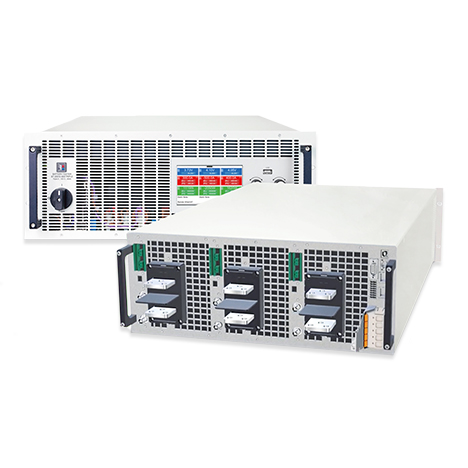
Panel builders and integrators should treat a 60 kW 6U bidirectional unit as a cabinet-level subsystem. Mechanical data, airflow, service access and cable routing must be reviewed early. The unit is a 19-inch, 6U enclosure with a depth that requires careful cabinet planning, rear access for DC copper rail connection, AC input and communication wiring. Standard cooling uses front-to-rear forced airflow with temperature-controlled fans. Water-cooled versions add water inlet and outlet connections and change the cabinet-services discussion.
For high-power systems, the platform supports parallel operation through a galvanically isolated Share-Bus and Master-Slave bus. Up to 64 units in the 10000 series can be combined when the voltage class remains consistent, allowing multi-unit systems to behave as one unit. In practical RFQs, this means the purchaser should define not only the initial power requirement, but also whether the site may later require 120 kW, 180 kW, 240 kW, 300 kW or larger architectures. TPS can support this discussion at the solution level rather than simply quoting a single device.
Automation is equally important. Built-in USB, Ethernet, analog, Master-Slave and Share-Bus interfaces support many test-bench architectures. Optional interfaces such as CAN, CANopen, RS232, Profibus, EtherCAT, Profinet, Modbus and additional Ethernet variants help align the system with PLC, industrial PC, lab automation or test executive environments. Command languages and drivers such as SCPI, ModBus, LabVIEW and IVI are useful for reducing software integration effort. When preparing the RFQ, list the required protocol, data logging need, remote-control architecture and whether analog monitoring must be used for safety or legacy equipment.
Safety and EMC are part of supplier screening. The datasheet references safety standards including EN/IEC/UL 61010-1 and CSA C22.2 No. 61010-1, EMC standards such as EN 55011 / CISPR 11 class A group 1, FCC 47 CFR part 15B class A and EN 61326-1 related immunity tests. The unit is Appliance Class I, IP20, designed for controlled industrial or laboratory environments, with 0-50 °C operating temperature and non-condensing humidity conditions. For cabinet projects that also need auxiliary power rails, TPS can support related DIN rail power supply selection, including the TPS010-100W GP compact switching power supply, TPS030-130W Pro 24 V DIN rail supply and TPS100-320W Peak DR+ with 170% power boost.
Rear DC copper rails
AC input
Remote sense
Ethernet, USB, analog, fieldbus options
Master-Slave and Share-Bus for parallel systems
Procurement checklist for a clean RFQ
Procurement teams can accelerate supplier evaluation by asking for the right technical and commercial information in the first RFQ. Include the required voltage class, maximum current, continuous power, expected duty cycle, source/sink operation, cooling preference, AC supply condition, communication interface, software or driver expectations, cabinet constraints, delivery timing and documentation needs. If the system will be installed in multiple regions, include site voltage, compliance requirements and service expectations for each market.
For system integrators, a clean RFQ should also define the integration boundary. Is TPS expected to supply only the power unit, or is support needed for equivalent alternatives, cabinet planning, interface selection, testing accessories, auxiliary power, cable and busbar planning, or a broader programmable power solution? TPS can support both product supply and solution-oriented selection, helping customers avoid late-stage changes after mechanical design, automation software or procurement approval has already begun.
For electrical engineers, specify the actual test profile rather than only maximum ratings. Include rise/fall expectations, measurement accuracy, setpoint resolution, remote sense use, protection thresholds, data logging and expected interaction with the DUT control loop. For panel builders, include dimensions, airflow path, service clearance, rear connection access, water-cooling requirements if applicable and installation environment. For buyers, include required delivery window, quantity breaks, global project location and whether phased purchasing is expected.
Move from datasheet review to RFQ confirmation
Share your voltage range, current range, DUT type, cooling concept, required interface and target delivery schedule with TPS. Our team can help shortlist the correct EA-PUB 10000 6U variant, review equivalent options, and align the power platform with the wider test or cabinet project.
FAQ
What does bidirectional operation mean for the EA-PUB 10000 6U class?
It means the unit can operate as a DC power source and as an electronic load. In sink mode, it can regenerate energy back into the local grid, which helps reduce heat and operating cost in long or high-power tests.
Which model should we choose: 360 V, 500 V, 750 V, 920 V, 1000 V, 1500 V or 2000 V?
Select the voltage class based on the DUT operating envelope, not only the 60 kW rating. A lower-voltage class provides higher current, while higher-voltage classes support pack, inverter, PV or DC-link use cases. TPS can help validate the operating point before you issue the RFQ.
When does water cooling make sense?
Water cooling is useful when the project needs higher cabinet density, lower heat release into the room, reduced HVAC load or demanding continuous-duty operation. Air-cooled versions remain appropriate when airflow and thermal planning are sufficient.
Can multiple units be combined for more power?
Yes. The 10000 series supports parallel operation using Master-Slave and Share-Bus connections. For large systems, the voltage class must be planned consistently and cabinet, AC supply, DC busbar and safety design should be reviewed early.
Why involve TPS before finalizing the RFQ?
TPS can support product selection, equivalent solution review, interface planning, integration considerations and global B2B project coordination. This helps reduce specification risk and makes the quotation more useful for engineering and procurement approval.