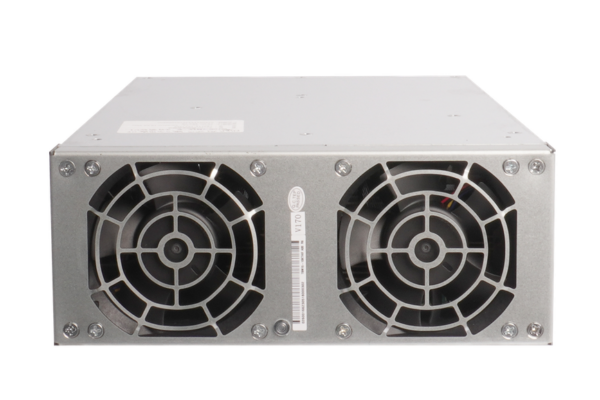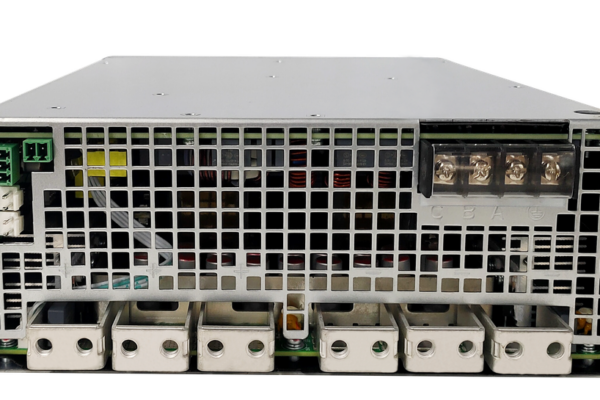


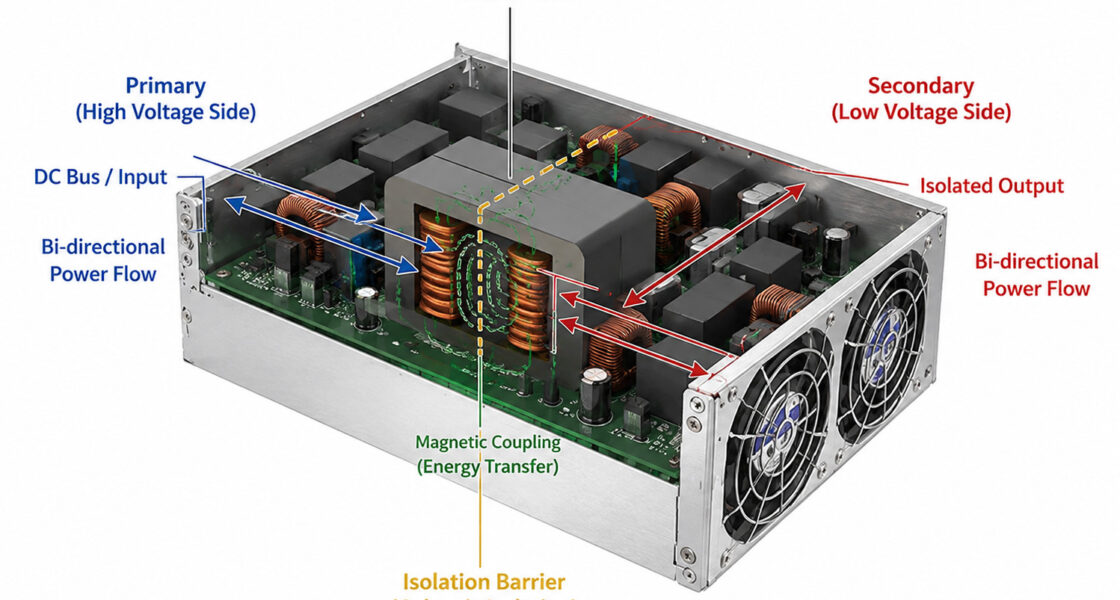
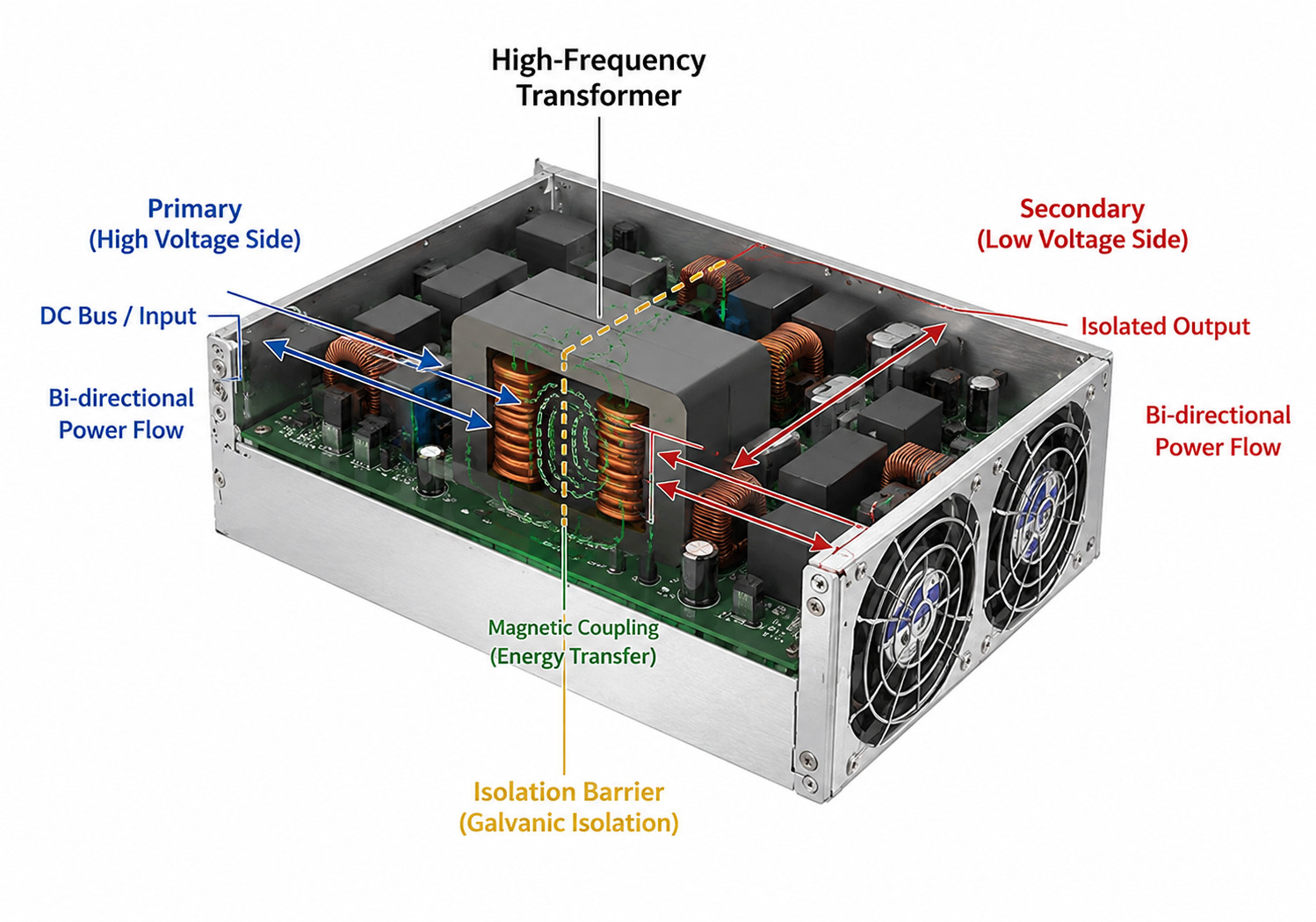
Modern power conversion systems demand more than reversing current direction when shifting to bidirectional energy flow. A bidirectional DC-DC converter must safely handle energy flow both ways. It also needs to maintain isolation between input and output. High frequency isolation solves this critical need.
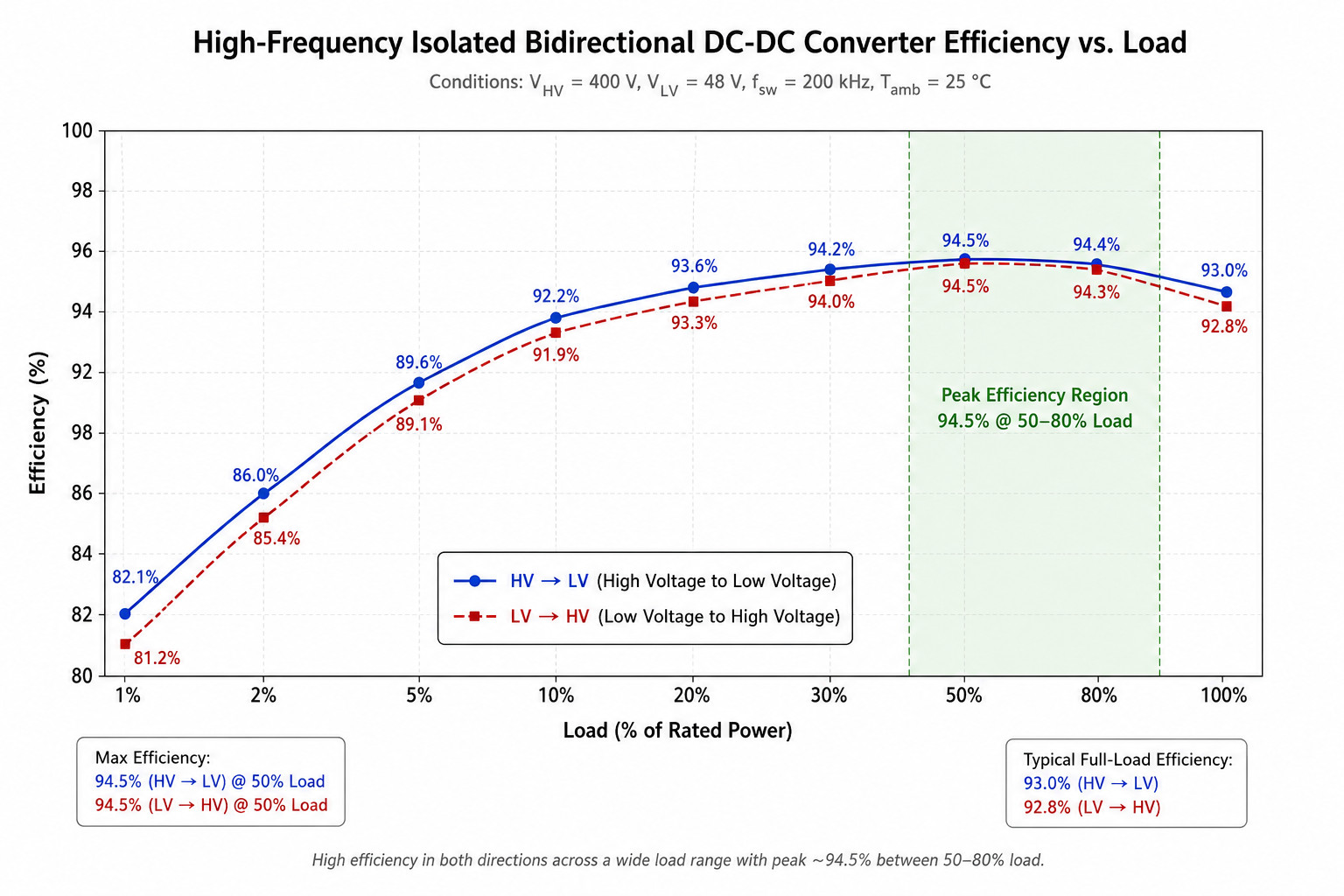
Whether you design lithium battery formation equipment, battery test equipment, energy recyclable aging equipment, or a bidirectional testing system for an energy storage system, your choice of bidirectional isolation topology directly impacts safety, reliability, and efficiency. Our DC-DC BPM module integrates bidirectional energy flow with mature soft switching technology. It achieves 94.5% peak efficiency and a 12000W rated output at 570VDC rated voltage. With a wide 560-627VDC input range, it steps down to a 14-16VDC output voltage delivering up to 800A output current. It also maintains ±1% voltage accuracy and 500mV ripple voltage.
In reverse mode, the module supports 9600W reverse input capacity at 640A reverse input current. It produces a 513-580VDC reverse output range. This bidirectional DC-DC converter must comply with global standards like EN55032 for EMC, plus UL, CE, and CCC certifications. It also includes comprehensive power module fault protection to guarantee a high reliability DC-DC converter.
Thanks to its high power density module design, forced air cooling (front inlet rear outlet airflow), and -10°C to 30°C operating temperature support, the module integrates a CAN communication interface for seamless system integration. But why exactly does high-frequency isolation matter? This article explores the core problems it solves.
Safety and Personnel Protection in High-Voltage Systems
Bidirectional isolation solves a fundamental problem: electrical safety. In any battery test equipment or energy storage system, the DC bus often operates at voltages exceeding 500V (e.g., 570VDC rated voltage). Without galvanic isolation, a single fault can expose operators or downstream equipment to lethal voltages. High-frequency isolation creates a physical barrier between input and output, breaking the direct electrical path.
This isolation is especially critical for lithium battery formation equipment. There, electrolyte leakage or battery internal shorts could otherwise energize the entire chassis. Our DC-DC BPM module uses a high-frequency transformer. It meets the creepage and clearance requirements of UL certified power module, CE certified power module, and CCC certified power module standards.
The isolation withstand voltage typically exceeds 3000VAC. Therefore, even under fault conditions, no hazardous voltage appears on the low-voltage side (e.g., the 14-16VDC output voltage for cell formation). For energy recyclable aging equipment, where multiple modules share a common cooling or communication bus, isolation prevents ground loops that could cause electric shock risks.
- Galvanic isolation breaks fault currents – Prevents high-voltage side faults from reaching low-voltage terminals.
- Meets international safety certifications – UL, CE, CCC all require isolation for human-access circuits.
- Protects sensitive measurement circuits – Voltage accuracy of ±1% voltage accuracy is maintained even with noisy DC buses.
- Enables safe paralleling – Isolated outputs can be paralleled without cross-conduction risks.
Common-Mode Noise Rejection and EMI Compliance
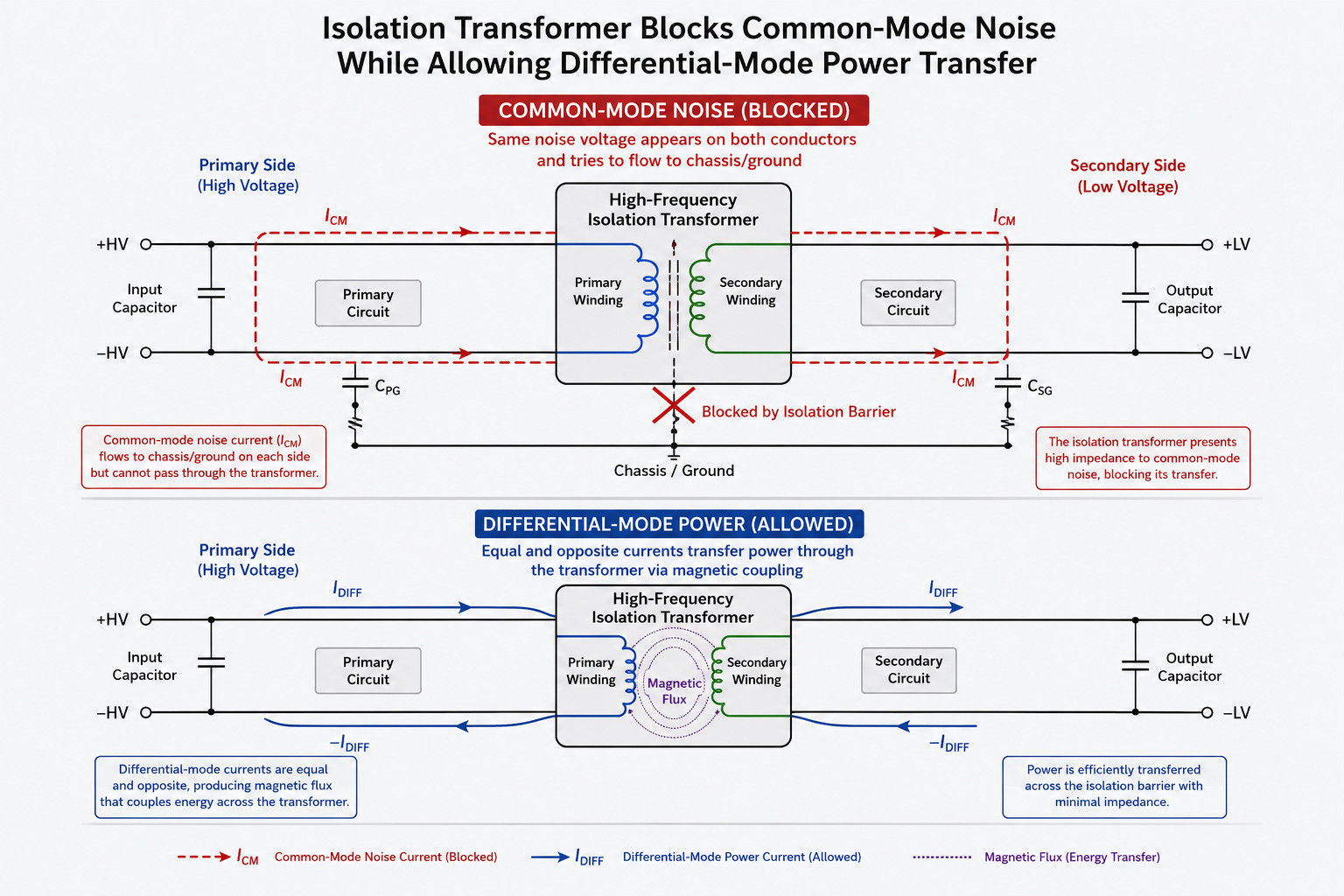
Another critical issue is electromagnetic interference (EMI), particularly common-mode noise. In non-isolated dc to dc inverter topologies, the switching node’s high dv/dt couples directly to input and output cables. This coupling makes the cables act as antennas. Consequently, passing EN55022 or EN55032 compliant power module tests becomes extremely difficult.
A bidirectional DC-DC converter with high-frequency isolation solves this problem. The isolation transformer inherently blocks low-frequency common-mode currents. At the same time, it provides a controlled path for high-frequency noise through Y-capacitors. Our DC-DC BPM module is an EN55032 compliant power module. Its conducted and radiated emissions fall well below class A (often class B) limits.
This performance is essential for bidirectional testing system installations in laboratory environments, where sensitive measurement equipment coexists with power supplies. Our soft switching technology further reduces switching harmonics. It complements the isolation barrier’s noise attenuation. For battery test equipment that must measure microvolt-level cell voltages, common-mode noise from the power supply can completely ruin data. High-frequency isolation ensures that the 500mV ripple voltage specification refers only to differential noise, not common-mode spikes.
- Breaks ground loops – Eliminates the primary cause of common-mode EMI in multi-module systems.
- Allows flexible grounding – Output negative terminal can be grounded or floated as needed.
- Reduces radiated emissions – The isolation transformer contains high-frequency currents within the magnetic core.
- Simplifies filter design – Only differential-mode filtering is required, lowering cost and size.
Enabling Modular Parallel Operation and Current Sharing
Modern energy recyclable aging equipment and large-scale battery test equipment often require power levels far beyond a single module’s capacity. For example, you can expand from 12kW to 120kW by paralleling ten DC-DC BPM modules. Without bidirectional isolation, paralleling non-isolated converters creates catastrophic circulating currents. Why? Slight differences in ground potentials or output voltage setpoints cause these currents.
High-frequency isolation allows each module’s output to be truly floating. As a result, we can parallel them with simple droop or active current sharing without ground loops. Our high reliability DC-DC converter design includes a dedicated CAN bus for communication. This bus enables precise current sharing. The CAN communication interface allows each module to report its output current and receive a common reference. Consequently, we achieve typical current imbalance below 5% even during transients.
This feature is critical for a bidirectional testing system where one module might source while another sinks during regenerative cycles. The high power density module format (forced air cooling with front inlet rear outlet airflow) ensures thermal stability. It works at ambient temperatures from -10°C to 30°C operating temperature. Moreover, power module fault protection (overcurrent, overtemperature, input undervoltage) coordinates across the parallel set. Thus, a single failure will not take down the entire system.
- Floating outputs eliminate ground loops – Each module’s output can be referenced independently.
- Simplified current sharing algorithms – No need for master-slave with isolated telemetry.
- Hot-swap capability – Faulty modules can be replaced without system shutdown.
- Redundant operation – N+1 redundancy is practical when each module is isolated.
Wide Voltage Range Bidirectional Operation Without Compromise
A bidirectional DC-DC converter must efficiently transfer power in both directions: from high-voltage bus to low-voltage battery (charging) and from low-voltage battery back to high-voltage bus (discharging or recycling). Non-isolated topologies like the bidirectional buck-boost struggle to achieve both high step-down and high step-up ratios simultaneously. They suffer from extreme duty cycles, which degrade efficiency and increase ripple.
High-frequency isolation solves this by allowing the transformer turns ratio to optimize for nominal voltages. In our DC-DC BPM module, the forward direction steps down from 560-627VDC input range (typical 570VDC nominal) to 14-16VDC output voltage. It achieves 94.5% peak efficiency at 12000W rated output and 800A output current. The reverse direction steps up from that low voltage range (e.g., 14-16V) back to 513-580VDC reverse output range. It delivers 9600W reverse input capacity at 640A reverse input current.
This symmetrical performance relies on the transformer for voltage scaling. Additionally, our soft switching technology (phase-shifted full bridge or LLC) enables zero-voltage switching across a wide operating range. For lithium battery formation equipment, this bidirectional efficiency directly translates to energy savings. The 500mV ripple voltage on the low-voltage side is also much easier to achieve with an isolated topology. Why? Because the output inductor can be designed independently of the input side.
- Turns ratio optimizes both voltage step-down and step-up – Avoids extreme duty cycles.
- Maintains high efficiency bi-directionally – 94.5% peak efficiency in forward, similar in reverse.
- Low output ripple – 500mV ripple voltage even at 800A output current.
- Wide input range tolerance – 560-627VDC input range covers nominal and worst-case battery voltage variations.
Fault Containment and System-Level Protection
In any energy storage system or bidirectional testing system, a single component failure should not propagate to destroy other subsystems. High-frequency isolation acts as a natural fault barrier. For instance, if the low-voltage side (e.g., battery under test) experiences a short circuit, the DC-DC BPM module can detect overcurrent on its secondary side. Then it quickly shuts down the primary side switches. The isolation transformer prevents the high-voltage DC bus from dumping unlimited energy into the fault.
Conversely, if the high-voltage bus experiences a transient overvoltage, the primary side remains protected, and the secondary side stays safe. Our module incorporates comprehensive power module fault protection: input undervoltage, input overvoltage, output overcurrent, output short circuit, overtemperature (monitored at multiple points), and communication loss. All these protections operate within microseconds.
Our high reliability DC-DC converter construction also includes reinforced insulation between primary and secondary. Therefore, even catastrophic transformer failure does not bridge the isolation barrier. For energy recyclable aging equipment, where aging racks may contain hundreds of cells, fault containment is paramount. It prevents thermal runaway propagation.
- Faults stay on one side of the barrier – Short circuit on low side doesn’t affect high-side bus.
- Independent protection circuits – Primary and secondary have their own sensing and shutdown logic.
- Reinforced insulation – Withstands 3kVAC or more for safety extra low voltage (SELV) compliance.
- UL/CE/CCC certifications – Our UL certified power module, CE certified power module, and CCC certified power module designs all require rigorous fault testing.
Application-Specific Advantages: Formation, Testing, and Aging
Now let’s connect the dots to the specific applications. Lithium battery formation equipment requires precise constant-current constant-voltage (CC/CV) charging and discharging cycles. High-frequency isolation allows the DC-DC converter to sit between a common high-voltage DC bus (e.g., 570VDC) and individual cell channels (14-16VDC). Because each channel has its own ground reference, we eliminate cross-talk between cells in series or parallel.
For battery test equipment, isolation enables simultaneous testing of multiple independent battery packs. You don’t have to worry about common-mode voltage conflicts. Energy recyclable aging equipment uses the bidirectional capability to return energy from discharging batteries back to the AC grid or internal DC bus. Here, the isolation ensures that the regenerated energy does not introduce noise into sensitive measurement circuits.
Finally, a bidirectional testing system for inverters or motor drives benefits from isolation. The unit-under-test may have its own grounding scheme that conflicts with the test equipment’s ground. By specifying an EN55032 compliant power module with high-frequency isolation, system integrators avoid costly isolation transformers at the AC input.
- Independent channel grounding – Each cell in formation can be referenced differently.
- Recycled energy without noise injection – Bidirectional energy flow with clean transition.
- Compatible with any battery voltage – Wide output range 14-16VDC covers most cell chemistry formation voltages.
- High current capability – 800A output current for parallel formation of many cells.
Technical Specifications Summary of Our DC-DC BPM Module
| Parameter | Forward Direction (High to Low) | Reverse Direction (Low to High) |
|---|---|---|
| Rated Power | 12000W rated output | 9600W reverse input capacity |
| Input/Output Voltage | 560-627VDC input range → 14-16VDC output voltage | 14-16VDC input → 513-580VDC reverse output range |
| Current | 800A output current | 640A reverse input current |
| Voltage Accuracy | ±1% voltage accuracy | |
| Ripple Voltage | 500mV ripple voltage | |
| Peak Efficiency | 94.5% peak efficiency | |
| Isolation | High frequency isolation (reinforced, 3kVAC) | |
| Cooling | Forced air cooling system, front inlet rear outlet airflow | |
| Operating Temperature | -10°C to 30°C operating temperature (full load) | |
| Communication | CAN communication interface | |
| Safety/Certifications | EN55032 compliant power module, UL certified power module, CE certified power module, CCC certified power module ready | |
| Protections | Power module fault protection (OVP, UVP, OCP, OTP, SCP) | |
| Power Density | High power density module (>1.2kW per cubic inch) | |
In conclusion, high-frequency isolation in a bidirectional DC-DC converter solves real, tangible problems. First, it ensures operator safety in lithium battery formation equipment. Second, it enables clean EMI performance for EN55032 compliant power module certification. Third, it allows modular parallel operation of DC-DC BPM modules. Fourth, it supports wide bidirectional voltage ranges with high efficiency (94.5% peak efficiency). Fifth, it contains faults to prevent system-level damage. Finally, it provides the ground flexibility needed for battery test equipment and energy recyclable aging equipment.
Whether you are building a bidirectional testing system for an energy storage system or require a high reliability DC-DC converter for industrial aging racks, high-frequency isolation is not an optional feature. It is a fundamental requirement. Our DC-DC BPM module integrates all these capabilities with a high power density module mechanical design, forced air cooling system, CAN communication interface, and a robust set of power module fault protection. Contact us to learn how this bidirectional DC-DC converter can be tailored to your specific voltage and current needs.