

For system integrators, panel builders, and procurement teams in the aerospace industry, avionics rack backplane wiring is not just about making electrical connections. It is about ensuring signal integrity across miles of wiring, reducing every possible gram of weight, and meeting the stringent quality requirements of AS9100 and MIL‑STD‑1553B—all while delivering to flight-critical schedules.
TPS Elektronik’s electrical cable assembly service for aerospace avionics rack backplanes and ARINC 600 connector harnesses is built to address these challenges: shielded twisted pair wiring for data bus integrity, lightweight materials for SWaP optimization, and AS9100-compliant documentation from prototype to production.
1. The Avionics Rack Backplane Challenge: Density, Integrity, and Weight
Modern aircraft avionics systems are built around line-replaceable units (LRUs) mounted in equipment racks. These LRUs—flight computers, navigation systems, communication transceivers, radar processors—must connect to a central backplane that provides power, data, and control signals. The backplane is the electrical backbone of the avionics bay, and the cable harnesses that connect it to each LRU must meet three competing demands simultaneously: density, signal integrity, and weight.
Density is driven by the limited real estate in an avionics rack. Modern aircraft can contain literally miles of wiring harnesses, and every cubic inch of rack space is precious. Connectors must pack hundreds of contacts into minimal space while remaining serviceable.
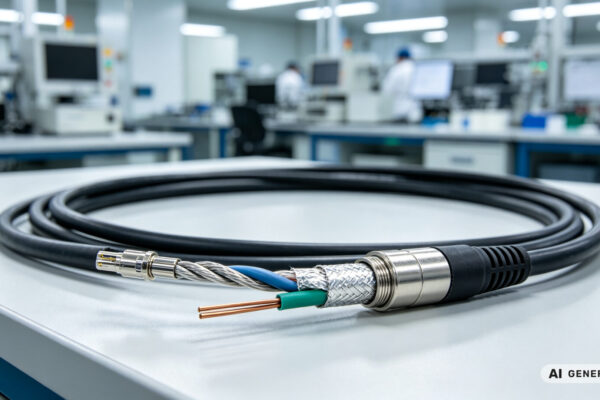
Signal integrity is non-negotiable in flight-critical systems. Data buses such as MIL-STD-1553B and ARINC 429 must maintain signal fidelity across long cable runs in electrically noisy environments. Shielded twisted pair construction is the foundation of avionics data bus wiring—twisted pairs reduce magnetic field induction by up to 60 dB, while shielding minimizes electric field coupling by 30 dB or more.
Weight is the third imperative. Every gram of wiring in an aircraft has a direct impact on fuel consumption over the life of the airframe. The aerospace industry operates under SWaP (Size, Weight, and Power) constraints, and cable assembly design must optimize for all three.
TPS Elektronik’s electrical cable assembly service addresses all three demands through precision manufacturing, material selection, and rigorous quality control.
2. ARINC 600 Connectors: The Standard for Rack-and-Panel Avionics
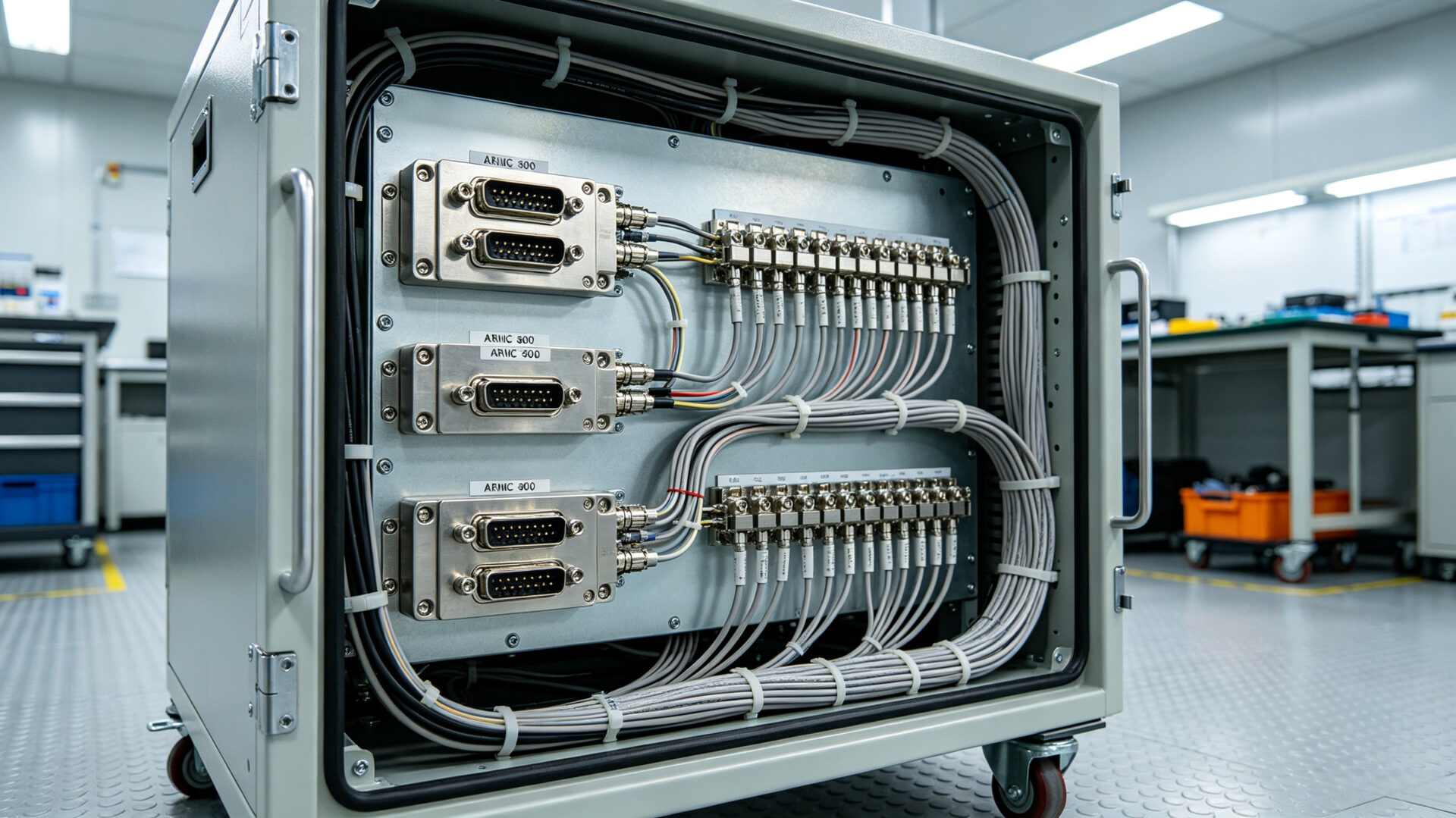
ARINC 600 is a recognized standard rack-and-panel connector for aircraft applications, succeeding the ARINC 404 for many new avionic designs. It defines rectangular, multi-contact connectors for avionics equipment that need to be easily swappable and compliant with line-replaceable unit (LRU) infrastructure.
Key features of ARINC 600 connectors include:
- High contact density: Up to 800 size 22 contact positions in a single connector
- Lower mating force contacts: Reduced insertion force compared to legacy designs
- Mixed contact types: Accommodates signal, power, coaxial, twinax, quadrax, and fiber optic contacts within a single connector layout
- Front release floating keying system: Enables blind mating and field serviceability
- Environmental and non-environmental versions: Available in sealed and unsealed variants
- Wide temperature range: -65°C to +125°C, suitable for extreme aerospace environments
- High durability: 500 mating cycles minimum
For ARINC 600 cable assembly applications, the cable harness must be designed to interface with these high-density connectors while maintaining signal integrity across the backplane. TPS’s electrical cable assembly service includes precision termination of ARINC 600 connectors, with controlled impedance matching for high-speed data lines and proper strain relief for vibration-prone environments.
ARINC 600 goes beyond connector shell definition—it standardizes connector insert layout and mounting dimensions, setting it apart from other avionic standards. This standardization means that cable harnesses designed to ARINC 600 specifications are interoperable across different LRU manufacturers, reducing supply chain complexity for system integrators and procurement teams.
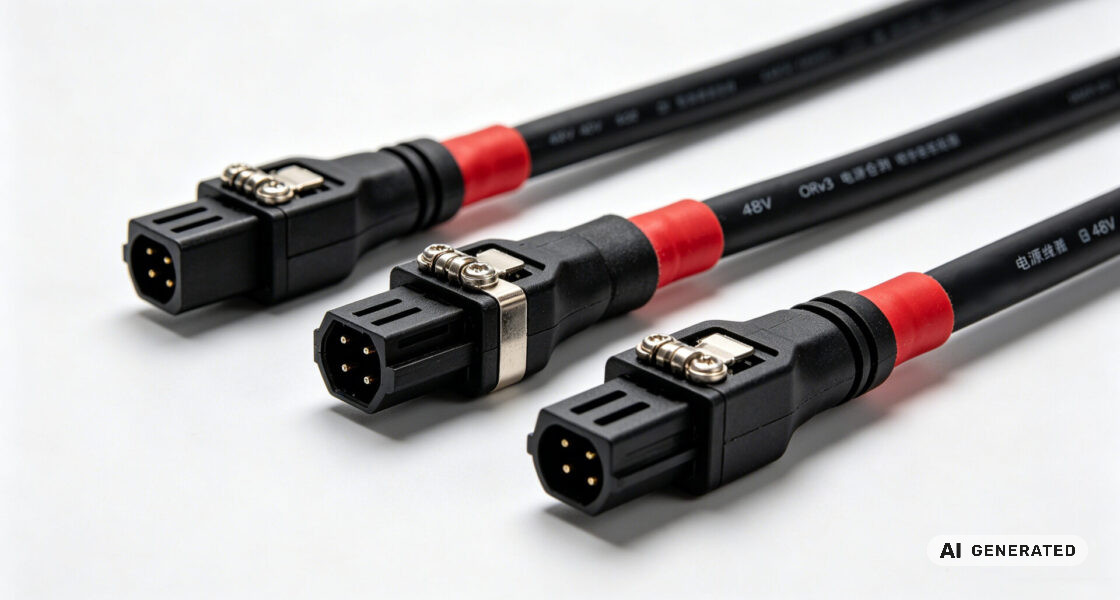
TPS Elektronik’s avionics backplane harness capability includes ARINC 600 connector termination, cable assembly, and full electrical testing per aerospace requirements.
3. Signal Integrity: Shielded Twisted Pair and MIL-STD-1553B
Avionics data buses are the nervous system of modern aircraft. MIL-STD-1553B is the dominant data bus standard for military and civil aerospace, defining a 78Ω twinaxial shielded twisted pair cable with specific impedance, capacitance, and shielding requirements.
The building blocks of avionics signal wiring quality are threefold:
- Twisted pair for minimum magnetic field induction—down by 60 dB
- Shielding for minimum electric fields—down by 30 dB or more
- Balanced isolated design for minimum common impedance—down by 40 dB
For MIL-STD-1553B cable assembly applications, the cable must meet strict electrical specifications: 78Ω characteristic impedance, maximum capacitance of 30 pF/ft (wire to wire), and dielectric withstanding voltage of 1000 Vrms.
TPS’s electrical cable assembly service for avionics applications includes:
- Precision twinax cable termination for MIL-STD-1553B data bus connections
- Controlled impedance matching to maintain signal integrity across the harness
- 100% continuity testing of every conductor in every assembly
- Dielectric withstand voltage testing per applicable standards
- Shield termination with proper grounding strategies for EMI/RFI suppression
For shielded twisted pair avionics cable applications, the shield must be terminated correctly—typically grounded at both ends to an aircraft ground close to the rack connector. Improper shield termination can create ground loops that degrade signal integrity, making precision assembly and testing essential.
TPS’s avionics rack wiring assembly capability extends beyond MIL-STD-1553B to include ARINC 429, Ethernet, and other aerospace data bus standards, with custom cable assemblies engineered to meet specific impedance, attenuation, and crosstalk requirements.
4. Weight Reduction: Materials and Design for Aerospace SWaP
In aerospace, every gram lifted costs fuel across the life of the airframe. A mil-spec wire harness looks nothing like its industrial equivalent. Mass reduction starts at the insulation and runs through every connector and contact.
Insulation materials for aerospace cable assemblies prioritize lightweight, high-temperature performance:
- PTFE (Polytetrafluoroethylene) and ETFE (Tefzel) replace heavier PVC insulation, allowing thinner walls and service temperatures of 150–260°C
- PFA (Perfluoroalkoxy) offers weight advantages under typical aerospace operating conditions
- Thin-wall construction reduces overall harness weight while maintaining dielectric strength
Conductor materials are evolving to reduce weight:
- Aluminum alloy conductors are increasingly used in place of copper, offering significant weight savings
- ARACON fiber combines the conductivity of a metal coating (nickel or silver) with the exceptional light weight, strength, and flexibility of Kevlar fibers
- Metal-clad aramid fibers (MCAF) and other advanced materials are used for shielding and harness overbraid
Connector selection also impacts weight:
- Composite connectors replace heavy stainless or aluminum housings
- MIL-DTL-38999 circular connectors in composite materials offer significant weight reduction
- High-density contacts (26, 28, or 30 AWG) reduce wire gauge and overall harness weight
For lightweight aircraft cable harness applications, TPS works with customers to select the optimal combination of conductor, insulation, and connector materials. TPS’s aerospace cable assembly service includes material selection guidance, prototype validation, and series production with full material traceability.

TPS’s composite aircraft cable assembly capability supports both development and production programs, with design-for-manufacturing feedback to optimize weight without compromising reliability.
5. AS9100 Quality and Aerospace Regulatory Compliance
Aerospace cable assemblies operate in a regulatory environment that civilian manufacturers never encounter. AS9100 is the aerospace extension of ISO 9001, adding configuration management for revision control and FOD (Foreign Object Debris) handling. It is a prerequisite for any supplier working with flight hardware.
Key AS9100 requirements for cable assembly manufacturers include:
- Configuration management: Rigorous revision control for every drawing and assembly
- FOD control: Systematic prevention of foreign object debris in assemblies
- Traceability: Full material traceability from raw materials to finished assemblies
- Supplier risk assessment: Robust evaluation and management of supply chain risks
- Counterfeit control: Sourcing only from franchised distributors with Certificates of Conformance traceable to every component lot
For defense applications, additional compliance requirements apply:
- ITAR (International Traffic in Arms Regulations): Technical data marked “ITAR Restricted” cannot be shared with non-US persons; facilities must be registered with the DDTC
- DFARS 252.225-7014: Governing domestic sourcing and counterfeit-part avoidance
- IPC/WHMA-A-620 Class 3: The highest workmanship class for cable and harness assemblies, requiring 100% inspection of every termination
- SAE AS50881: Aerospace vehicle wiring installation and workmanship requirements
TPS Elektronik’s aircraft electrical harness AS9100 capability includes AS9100D certification, ITAR compliance, and IPC/WHMA-A-620 Class 3 workmanship standards. Every cable assembly is built and inspected to the highest reliability class, with documentation packages that support FAA and EASA certification.
For space grade electrical assembly applications, TPS also supports outgassing requirements per NASA specifications and radiation-hardened material selection.
Request an AS9100-compliant aerospace cable assembly quote →
6. TPS Electrical Cable Assembly Capabilities for Aerospace
TPS Elektronik’s electrical cable assembly service for aerospace applications combines precision manufacturing, rigorous testing, and full regulatory compliance in a single integrated workflow.
Engineering and Design Support:
- DFM (Design for Manufacturing) feedback during the design phase
- Material selection guidance for SWaP optimization
- Impedance-controlled design for high-speed data bus applications
- 3D harness routing and formboard development
Manufacturing Capabilities:
- Precision cutting, stripping, and termination of wires from 30 AWG to 4/0 AWG
- Crimping, soldering, and insulation displacement terminations
- Shielded twisted pair and twinax cable assembly
- ARINC 600 connector termination—signal, power, coaxial, and fiber optic contacts
- Over-molding, strain relief, and environmental sealing
- Harness lacing, tying, and protective sleeving
Testing and Quality Assurance:
- 100% continuity testing on every conductor
- Dielectric withstand voltage (DWV) testing
- Insulation resistance testing
- Impedance and insertion loss testing for data bus cables
- First Article Inspection (FAI) per AS9100 requirements
- PPAP (Production Part Approval Process) available on request
Documentation and Compliance:
- AS9100D quality management system
- IPC/WHMA-A-620 Class 3 workmanship
- ITAR-compliant facility
- Full material traceability with Certificates of Conformance
- FAA/EASA certification support documentation
TPS supports both prototype and production volumes, with scalable manufacturing capacity for avionics harness programs of any size. TPS’s aerospace cable assembly service is integrated with broader EMS capabilities—including PCB assembly, box build, and system integration—reducing supply chain complexity for system integrators and procurement teams.