

System integrators, panel builders, and procurement teams in the automotive electronics industry rarely fail because they lack a product design. They lose time—and budget—when CISPR 25 radiated emissions testing reveals failures at an accredited laboratory, forcing costly redesigns, re-testing fees, and delayed vehicle program milestones.
TPS Elektronik’s EMC laboratory services are built to reduce that risk: pre-compliance testing for CISPR 25 radiated emissions, conducted emissions evaluation, immunity testing, shielding assessment, and close integration with automotive development teams so that issues resolved before formal certification begins.
1. What Is CISPR 25 Radiated Emissions Testing?
CISPR 25 is the international standard published by the International Special Committee on Radio Interference (CISPR), a subcommittee of the International Electrotechnical Commission (IEC). Its full title is “Vehicles, boats and internal combustion engines – Radio disturbance characteristics – Limits and methods of measurement for the protection of on-board receivers.”
CISPR 25 defines the limits and measurement methods for radio-frequency disturbances generated by automotive components and vehicles that could interfere with on-board radio receivers. The standard covers both conducted emissions (disturbances propagating through power and signal cables) and radiated emissions (electromagnetic fields radiated through space).
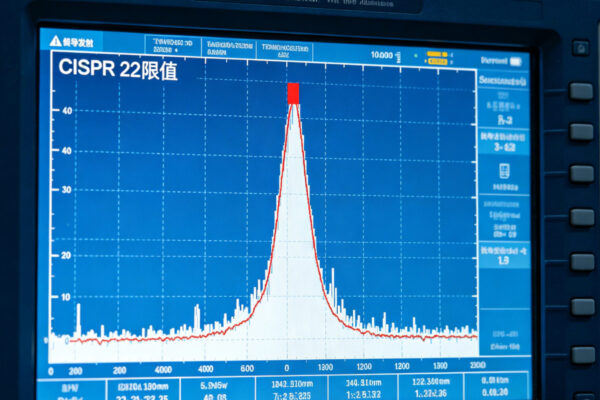
CISPR 25 radiated emissions testing specifically measures the electromagnetic fields radiated by a component—such as an ECU, sensor module, motor driver, or infotainment unit—across a defined frequency range. These emissions can couple into vehicle antennas (AM/FM, DAB, GPS, cellular, Wi-Fi) and degrade receiver performance, causing audible noise, data loss, or loss of signal entirely.
The standard applies to components intended for installation in vehicles, boats, and internal combustion engine-driven devices. It referenced by major automotive OEMs worldwide, including Volkswagen, BMW, Daimler, Ford, General Motors, Toyota, and Hyundai, and closely aligned with regional standards such as:
- UNECE Regulation No. 10 (ECE R10) – European vehicle EMC regulation
- ISO 11452 series – Immunity testing for automotive components
- SAE J1113 series – North American automotive EMC standards
- VDA 270 – German automotive industry EMC requirements
For automotive Tier 1 suppliers and OEMs, CISPR 25 compliance is not optional—it is a prerequisite for component approval and vehicle type approval. A component that fails CISPR 25 radiated emissions cannot be installed in a production vehicle.
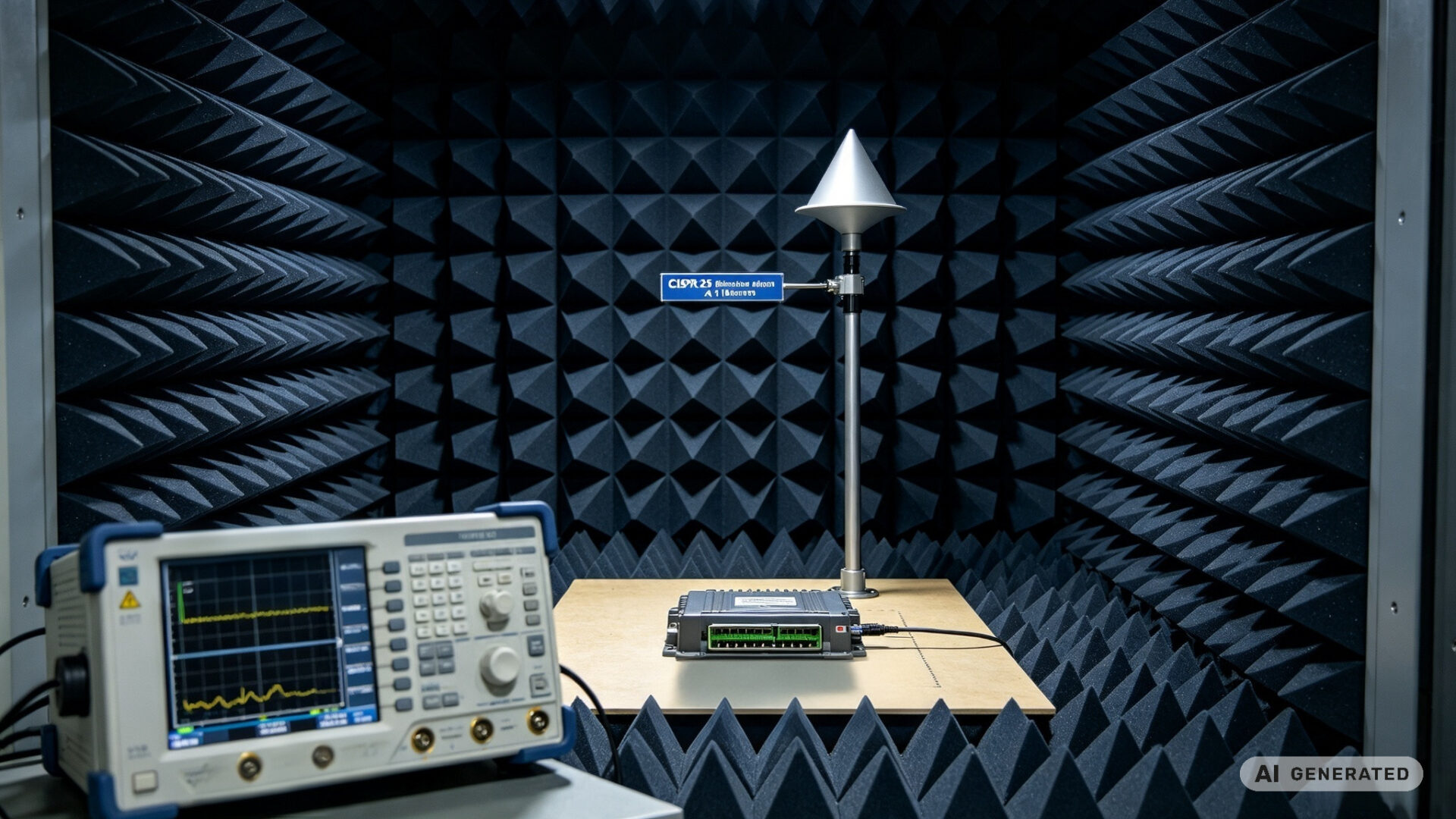
2. Why CISPR 25 Is Critical for Automotive Component Compliance
Modern vehicles contain dozens of electronic control units (ECUs), sensors, actuators, and communication modules. Each of these components generates electromagnetic emissions at its switching frequencies and harmonics. In a confined vehicle environment, these emissions can couple into sensitive receivers—AM/FM radio, DAB, GPS, cellular, Wi-Fi, Bluetooth, and vehicle-to-everything (V2X) communication systems.
CISPR 25 radiated emissions testing is critical for three reasons:
1. Regulatory Requirement: Vehicle type approval in Europe requires compliance with UNECE R10, which references CISPR 25 for component-level emissions. In North America, OEM-specific requirements (Ford, GM, Stellantis) are based on CISPR 25 or SAE J1113. Without CISPR 25 compliance, a component cannot be legally installed in a production vehicle.
2. Vehicle Performance: Radiated emissions from one component can degrade the performance of another. For example, emissions from a DC-DC converter can couple into the AM radio antenna, causing audible buzz. Emissions from a motor driver can interfere with GPS reception, affecting navigation accuracy. CISPR 25 testing verifies that each component is compatible with the vehicle’s receiver systems.
3. Cost and Schedule Risk: Discovering a CISPR 25 failure during formal testing at an accredited laboratory triggers a costly redesign cycle. The component must be modified, re-tested, and re-validated—delaying vehicle program milestones and increasing development costs. Pre-compliance testing at TPS Elektronik’s EMC laboratory identifies these issues early, when they are still inexpensive to fix.
For procurement teams and electrical engineers, understanding CISPR 25 is essential for evaluating component suppliers and ensuring that purchased components will pass vehicle-level EMC requirements. TPS’s EMC compliance guide provides additional context on automotive EMC requirements.
3. Test Setup and Measurement Methodology
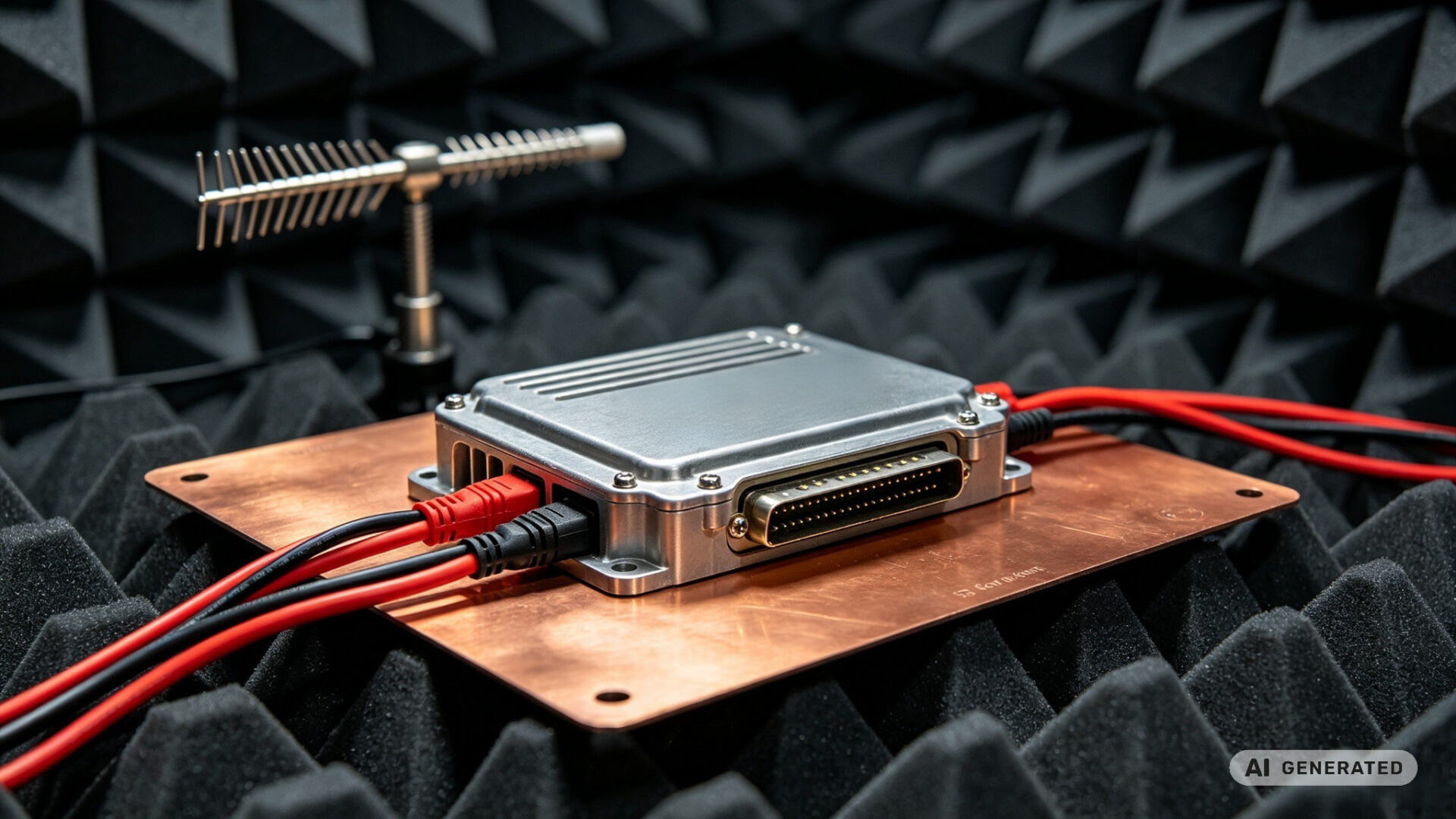
CISPR 25 radiated emissions testing performed in a controlled electromagnetic environment to ensure accurate, repeatable measurements. The standard defines several test methods, with the ALSE (Absorber Lined Shielded Enclosure) method being the most widely used for component-level testing.
ALSE Test Setup:
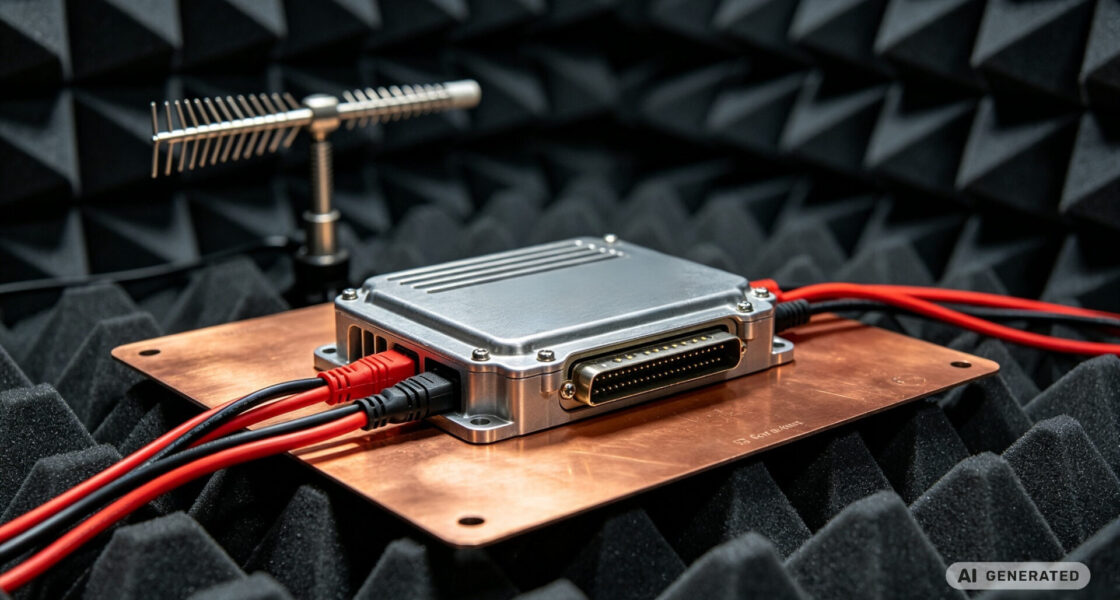
The ALSE method uses a shielded enclosure lined with radio-absorbing material to simulate free-space conditions. Key elements include:
- Ground plane: A conductive ground plane (typically copper or galvanized steel) that provides a defined reference for the test setup and simulates the vehicle chassis.
- Antennas: Calibrated broadband antennas positioned at specified distances (typically 1 meter for component testing) from the device under test (DUT). Antenna types include biconical, log-periodic, and horn antennas, selected based on the frequency range.
- Low-noise amplifier: Used to amplify weak signals and improve measurement sensitivity.
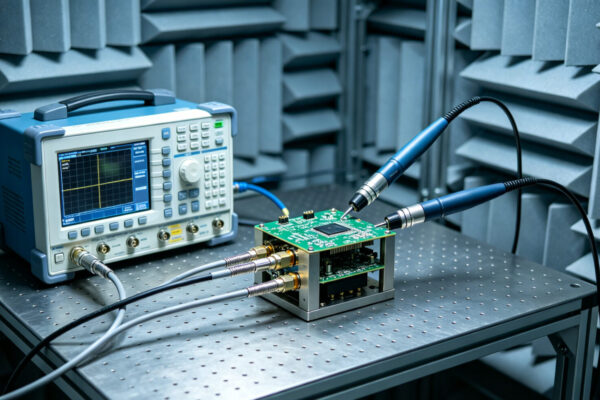
- Spectrum analyzer or EMI receiver: Used to measure the amplitude of emissions at each frequency. Modern receivers comply with CISPR 16-1-1 requirements for quasi-peak, peak, and average detection.
- DUT positioning: The component placed at a defined height and orientation relative to the ground plane and antenna, typically 50mm above the ground plane for component testing.
- Cable routing: Power and signal cables routed in a defined manner to ensure repeatable measurement conditions.
Alternative Test Methods:
In addition to ALSE, CISPR 25 defines other methods for specific applications:
- Stripline method: Uses a stripline transmission line to create a uniform electromagnetic field around the DUT. Suitable for small components and frequency ranges up to 1 GHz.
- TEM cell method: Uses a transverse electromagnetic cell to create a defined field. Suitable for small components with dimensions compatible with the cell.
- Near-field measurement: Uses probes to measure near-field emissions close to the DUT. Useful for diagnostic purposes and identifying emission sources.
For most automotive components, the ALSE method is the reference method and required for formal certification. TPS Elektronik’s EMC laboratory performs pre-compliance ALSE testing to prepare components for formal certification.
4. Frequency Ranges, Classes, and Limits
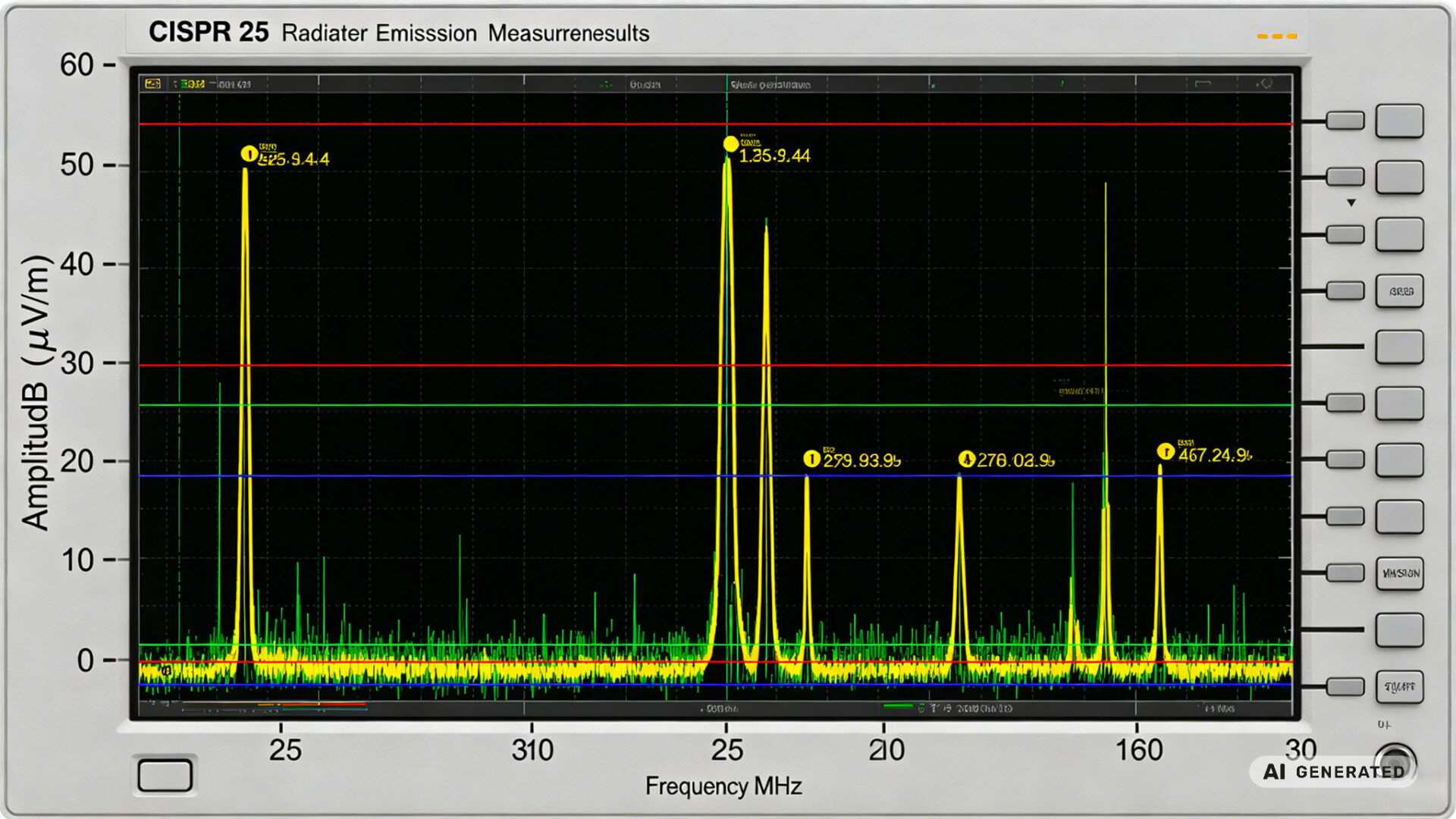
CISPR 25 defines radiated emissions limits across several frequency bands, from 150 kHz to 2.5 GHz. The standard specifies different limits depending on the frequency range, the type of vehicle, and the component’s location relative to the vehicle antenna.
Frequency Bands for Radiated Emissions:
| Frequency Range | Antenna Type | Typical Applications |
|---|---|---|
| 150 kHz – 30 MHz | Rod antenna / Loop | AM broadcast, long/medium wave |
| 30 MHz – 300 MHz | Biconical antenna | FM broadcast, VHF |
| 300 MHz – 1 GHz | Log-periodic antenna | UHF, cellular, GPS |
| 1 GHz – 2.5 GHz | Horn antenna | Wi-Fi, Bluetooth, V2X |
CISPR 25 Classes:
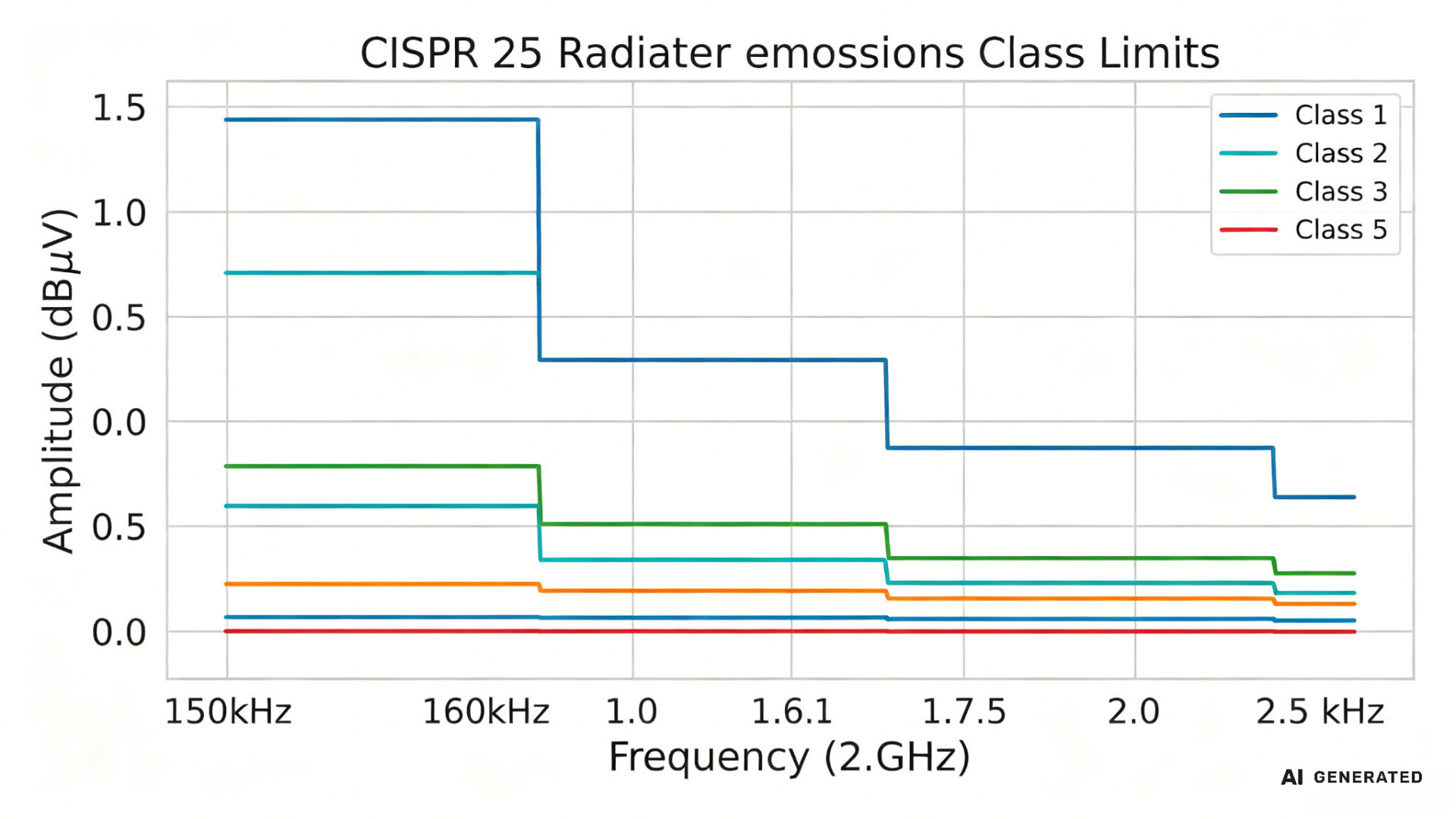
CISPR 25 defines five classes (Class 1 through Class 5) based on the severity of the emission limits. Class 5 is the most stringent, providing the highest level of protection for on-board receivers. The class selection depends on the vehicle manufacturer’s requirements and the component’s proximity to sensitive antennas.
- Class 1: Least stringent, typically used for components located far from antennas
- Class 2: Moderate requirements for general automotive components
- Class 3: Standard requirements for most vehicle components
- Class 4: Stringent requirements for components near sensitive receivers
- Class 5: Most stringent, used for critical components in close proximity to antennas
TPS Elektronik’s EMC laboratory performs pre-compliance CISPR 25 radiated emissions testing for Class 1 through Class 5, using calibrated equipment and standard-compliant methods to identify issues before formal certification.
5. Vehicle EMC: From Component to System-Level Compliance
CISPR 25 component-level testing is one part of a broader vehicle EMC compliance strategy. Vehicle manufacturers must also perform vehicle-level testing to verify that the complete vehicle meets radiated emissions requirements.
Component-level testing (CISPR 25): Performed on individual ECUs, sensors, and modules in a controlled laboratory environment. Verifies that each component meets its specified emission limits when tested in isolation.
Vehicle-level testing (CISPR 12 / UNECE R10): Performed on the complete vehicle in an open-area test site (OATS) or semi-anechoic chamber. Verifies that the vehicle as a whole meets radiated emissions limits.
Component-level compliance does not guarantee vehicle-level compliance. Interactions between components—such as coupling through shared power and ground networks, cable harness resonances, and antenna proximity effects—can cause vehicle-level failures even when individual components pass. However, component-level pre-compliance testing significantly reduces the risk of vehicle-level failures by ensuring that each component has adequate margin.
TPS Elektronik supports both component-level and system-level EMC testing through its EMC laboratory services. For automotive customers, TPS provides:
- CISPR 25 pre-compliance testing: Radiated and conducted emissions testing for components
- Design review and DFM feedback: Identifying EMC risk factors in schematics, PCB layout, and mechanical design
- Filter design support: Recommending filter topologies and component values to meet emission limits
- Shielding evaluation: Assessing shielding effectiveness and recommending improvements
- Pre-compliance test reports: Documentation that supports formal certification
For additional insights on automotive EMC, see TPS’s EMC compliance guide and EMC testing customer case study.
6. The Pre-Compliance Advantage for Automotive Programs
Formal CISPR 25 testing at an accredited laboratory is expensive and time-sensitive. A single failure can cost thousands in re-test fees and weeks in schedule delays. Pre-compliance testing at TPS Elektronik’s EMC laboratory is the countermeasure.
How TPS Pre-Compliance Testing Works:
TPS performs CISPR 25 radiated emissions pre-compliance testing using the same methods and standards as accredited laboratories, but with the flexibility to iterate quickly and provide engineering feedback. The process includes:
- Design review: TPS engineers review schematics, PCB layout, and mechanical design for EMC risk factors before testing begins. This identifies potential issues—such as poor grounding, inadequate filtering, or cable routing problems—that can addressed before the first test run.
- Pre-compliance measurement: The component tested in TPS’s EMC laboratory using calibrated antennas, low-noise amplifiers, and CISPR 16-1-1 compliant receivers. Emissions measured across the full frequency range and compared to the applicable CISPR 25 class limits.
- Root cause analysis: If emissions exceed limits, TPS engineers identify the source—whether it is a switching converter, clock harmonic, cable resonance, or shielding gap—and recommend specific corrective actions.
- Iterative improvement: After modifications, the component is re-tested to verify that emissions are reduced below the required limits. This iterative process continues until the component has adequate margin for formal certification.
- Documentation: TPS provides a pre-compliance test report documenting the measurement setup, results, and any modifications made. This report can be referenced during formal certification and shared with OEM customers.
For automotive Tier 1 suppliers and OEMs, pre-compliance testing reduces the risk of formal test failures and accelerates vehicle program milestones. TPS’s EMC testing collaboration case study illustrates how TPS works with automotive customers to resolve EMC issues.
7. Common Failure Modes and Design Guidance
Based on TPS’s experience with automotive CISPR 25 pre-compliance testing, the following are common failure modes and design recommendations.
Common Failure Modes:
- Switching converter harmonics: DC-DC converters and motor drivers generate emissions at their switching frequency and harmonics. These can extend well into the FM and VHF bands if not properly filtered.
- Clock harmonics: Microcontrollers, FPGAs, and communication interfaces generate clock harmonics that can radiate from PCB traces and cables.
- Cable resonances: Power and signal cables can act as antennas, radiating emissions at frequencies where their length approaches a quarter wavelength.
- Shielding gaps: Inadequate enclosure shielding—such as gaps around connectors, ventilation slots, or seams—allows emissions to escape.
- Grounding issues: Poor grounding creates common-mode currents that drive cables and enclosures, increasing radiated emissions.
Design Recommendations:
- Filter at the source: Place differential and common-mode filters as close as possible to the noise source—typically at the input of a DC-DC converter or the output of a motor driver.
- Minimize loop areas: Keep power and return paths close together to minimize radiating loop areas.
- Use shielded cables: Shielded cables with properly terminated shields reduce radiated emissions from cable harnesses.
- Ensure continuous grounding: Provide a low-impedance ground plane and avoid splits or slots that force return currents to detour.
- Design for shielding: Use conductive gaskets, continuous seams, and screened ventilation to maintain enclosure shielding effectiveness.
For more on EMC design, see TPS’s EMC and electrical safety testing guide.