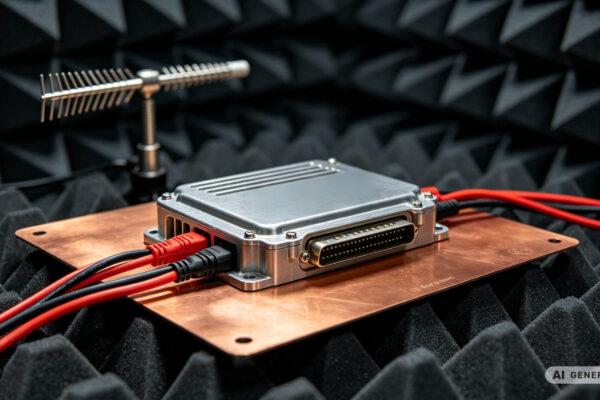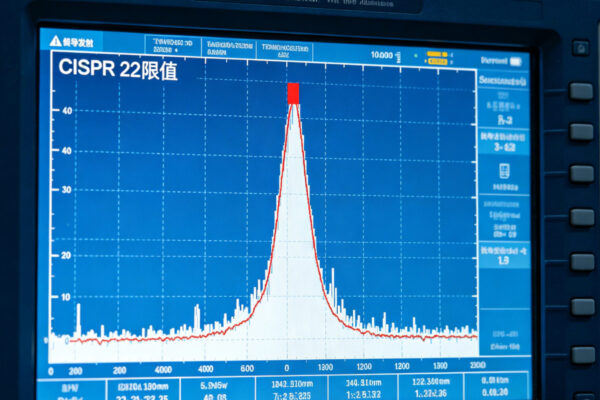


System integrators, panel builders, and procurement teams in industrial automation rarely fail because they lack a control cabinet design. They lose time—and budget—when CISPR 11 emissions limits exceeded during formal certification, forcing costly filter redesigns and delaying factory acceptance testing.
TPS Elektronik’s EMC laboratory services are built to reduce that risk: CISPR 11 pre-compliance testing for conducted and radiated emissions, immunity evaluation, and close integration with industrial equipment development so that issues are resolved before accredited certification begins.
1. What is CISPR 11 pre-compliance testing?
CISPR 11 pre-compliance testing is the process of evaluating industrial, scientific, and medical (ISM) equipment against the emissions limits defined in CISPR 11 before submitting the product to an accredited laboratory for formal certification. The goal is not to replace formal testing. It is to enter formal testing with confidence, using measured data rather than assumptions.
CISPR 11:2024 Edition 7.0 applies to ISM electrical equipment operating in the frequency range 0 Hz to 400 GHz and defines both limits and methods of measurement for radio-frequency disturbances. For industrial equipment manufacturers, CISPR 11 is the primary emissions standard referenced by the EU EMC Directive 2014/30/EU and by the FCC for ISM equipment operating in North America.
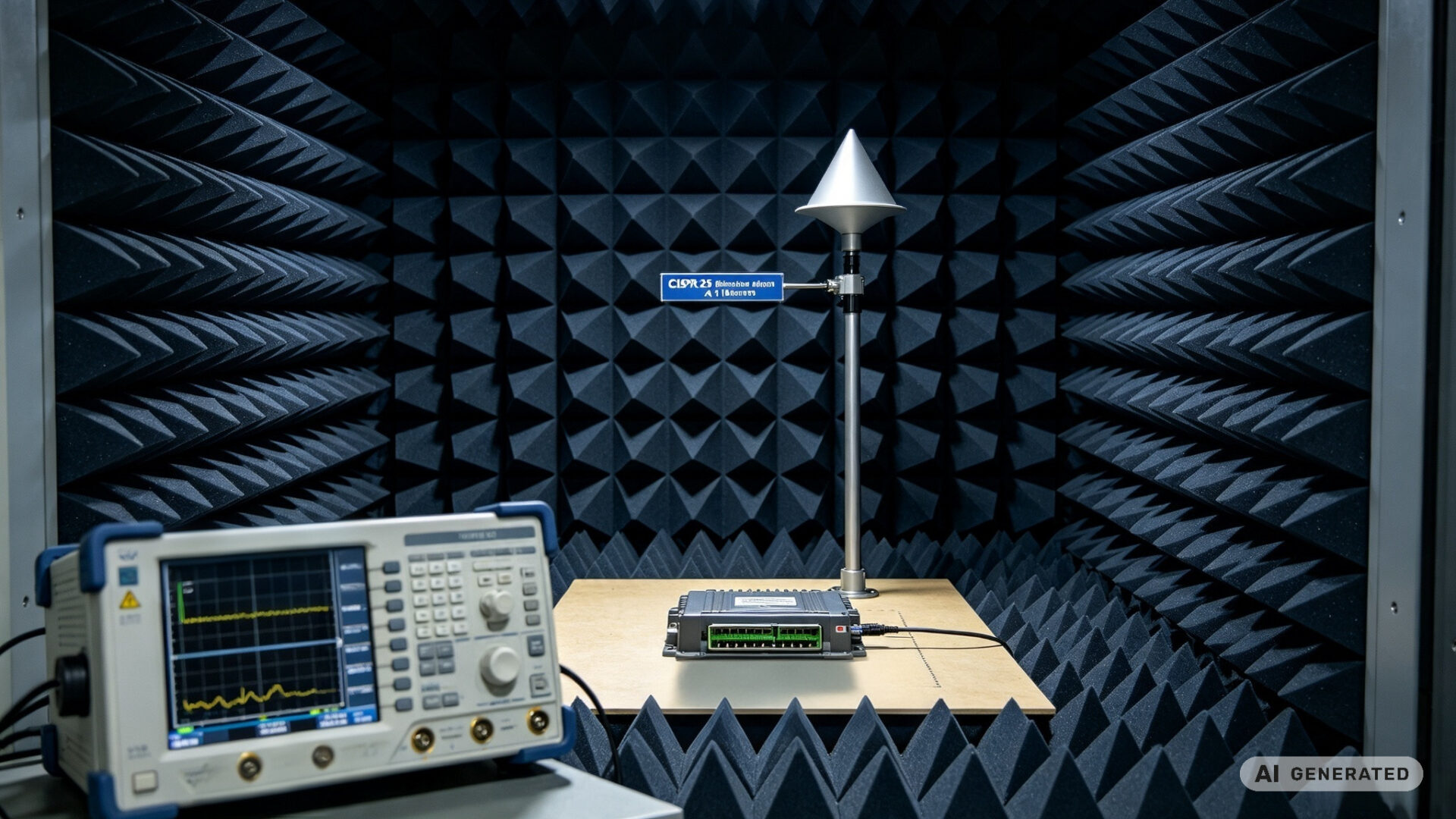
1.1 Group 1 vs. Group 2 and Class A vs. Class B: what applies to your equipment
CISPR 11 divides equipment into two groups and two classes. Group 1 applies to equipment that does not intentionally generate radio-frequency energy for material treatment or analysis. Group 2 applies to equipment that intentionally generates and uses radio-frequency energy. Such as induction heating systems or certain welding equipment. Class A applies to equipment intended for use in industrial environments; Class B applies to equipment intended for residential environments and carries stricter limits.
Most industrial control cabinets, PLCs, variable frequency drives, and factory automation equipment fall under Group 1, Class A. This classification determines the applicable limit lines for both CISPR 11 conducted emissions pre-test and CISPR 11 radiated emissions pre-compliance. Misidentifying the group or class is a common and expensive error: it leads to testing against the wrong limits and, ultimately, to re-testing at the accredited stage.
1.2 Conducted and radiated emissions: what CISPR 11 actually measures
CISPR 11 specifies two measurement domains:
- Conducted emissions (150 kHz – 30 MHz): Measured at the mains port using a line impedance stabilization network (LISN) between the power supply and the equipment under test. Switching power supplies, motor drives, and clock harmonics are the dominant contributors. The LISN provides a defined 50 Ω impedance and isolates the measurement from the mains supply.
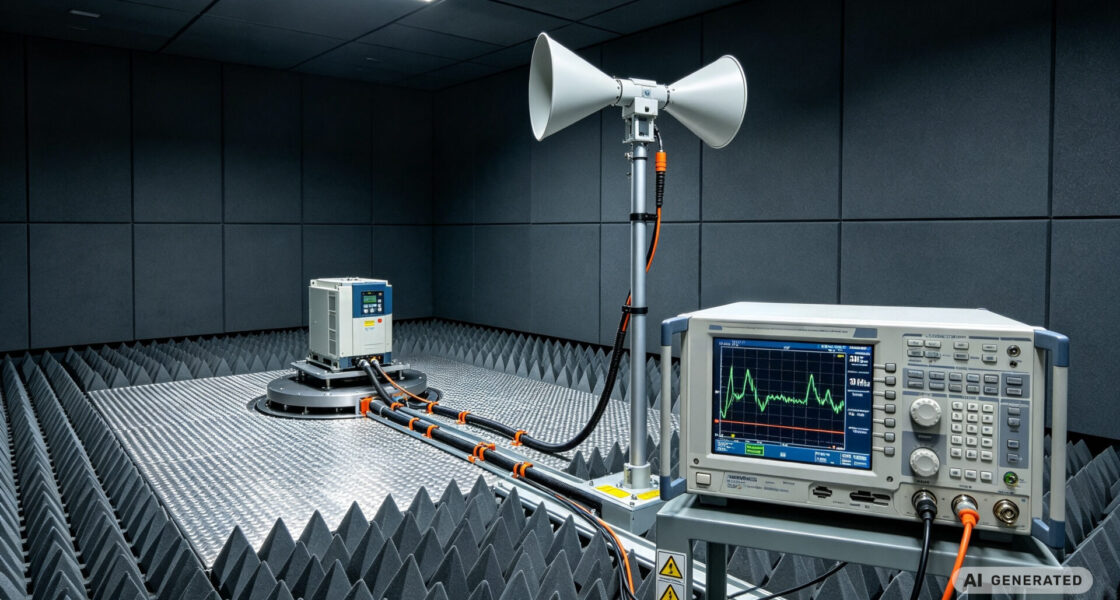
- Radiated emissions (30 MHz – 1 GHz, with Edition 7 extensions above 1 GHz for Group 1): Measured in a semi-anechoic chamber with calibrated antennas at specified distances. Cable routing, enclosure shielding, and grounding architecture determine whether radiated emissions pass or fail. CISPR 11:2024 introduced limits above 1 GHz for Group 1 equipment, aligning with generic emission standards and reflecting the increasing clock speeds and wireless interfaces in industrial systems.
For a deeper methodological reference, see TPS’s how to test electromagnetic compatibility guide.
2. Why industrial EMC pre-compliance matters for RFQ outcomes
Formal EMC testing at an accredited laboratory is expensive and schedule-critical. A single CISPR 11 failure can trigger weeks of filter redesign, enclosure modification, and re-test fees. For procurement teams evaluating suppliers, this is not an engineering detail—it is a supply chain risk.
The data supports this: industry surveys consistently show that a majority of industrial machinery fails EMC testing on the first attempt. The failure modes are rarely exotic—insufficient common-mode filtering on motor drive output cables, poor shield termination on control lines. Or inadequate grounding of variable frequency drives are recurring causes. Each is detectable during pre-compliance testing with standard instrumentation.
Industrial EMC pre-compliance changes the economics of certification. By performing conducted and radiated emissions measurements during development. Not after the design is frozen—industrial equipment EMC validation becomes an iterative engineering activity rather than a binary pass/fail event.
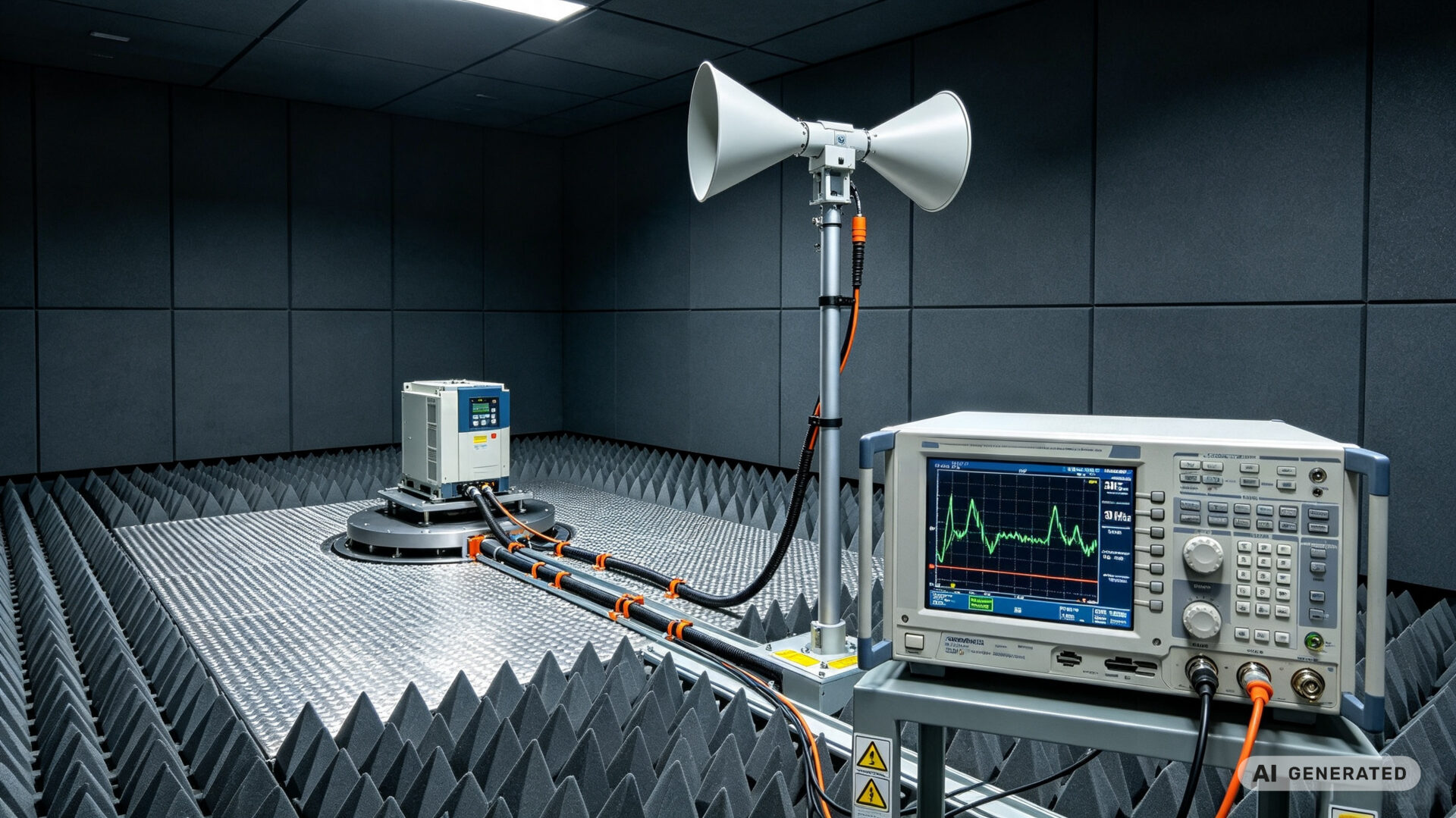
For system integrators and panel builders, the operational dimension is equally important. A variable frequency drive that passes CISPR 11 at the component level may still produce unacceptable emissions when integrated into a control cabinet with long motor cables and multiple drives operating in parallel. Factory automation EMC validation at the system level—not just the component level—is what determines whether the installation performs reliably on the factory floor.
TPS’s experience with industrial power equipment compliance is documented in the EMC testing customer case and the EMC compliance guide.
3. Typical CISPR 11 failure points in industrial equipment
Pre-compliance testing is most valuable when it targeted. The following failure points recur across industrial equipment categories—from PLC cabinets to servo drive systems.
- Motor drive output cables: Unshielded or improperly shielded motor cables act as antennas. Common-mode currents on the output phases radiate efficiently above 30 MHz. Shield termination at both ends, with 360° bonding, is the standard countermeasure.
- Switching power supply input filtering: A power supply that meets CISPR 11 in isolation may fail when loaded by downstream motor drives. The input filter must be sized for the system-level conducted emissions, not just the PSU’s standalone performance.
- Grounding architecture: High-frequency currents follow the path of least impedance, not the path of least resistance. Cabinet grounding bars, PE connections, and shield terminations must be designed for RF impedance, not just safety grounding.
- Cable routing inside cabinets: Mixing motor cables, signal cables, and power supply cables in the same duct creates coupling paths that no amount of filtering can fully suppress. Physical separation and shielding are architectural requirements, not afterthoughts.
- PLC and communication interfaces: Ethernet, CAN, and serial interfaces introduce high-frequency signals that can radiate from cable shields. PLC EMC pre-compliance must evaluate these interfaces as part of the system, not as isolated components.
TPS’s EMC testing news and EMC and electrical safety testing guide provide additional technical context for these failure modes.
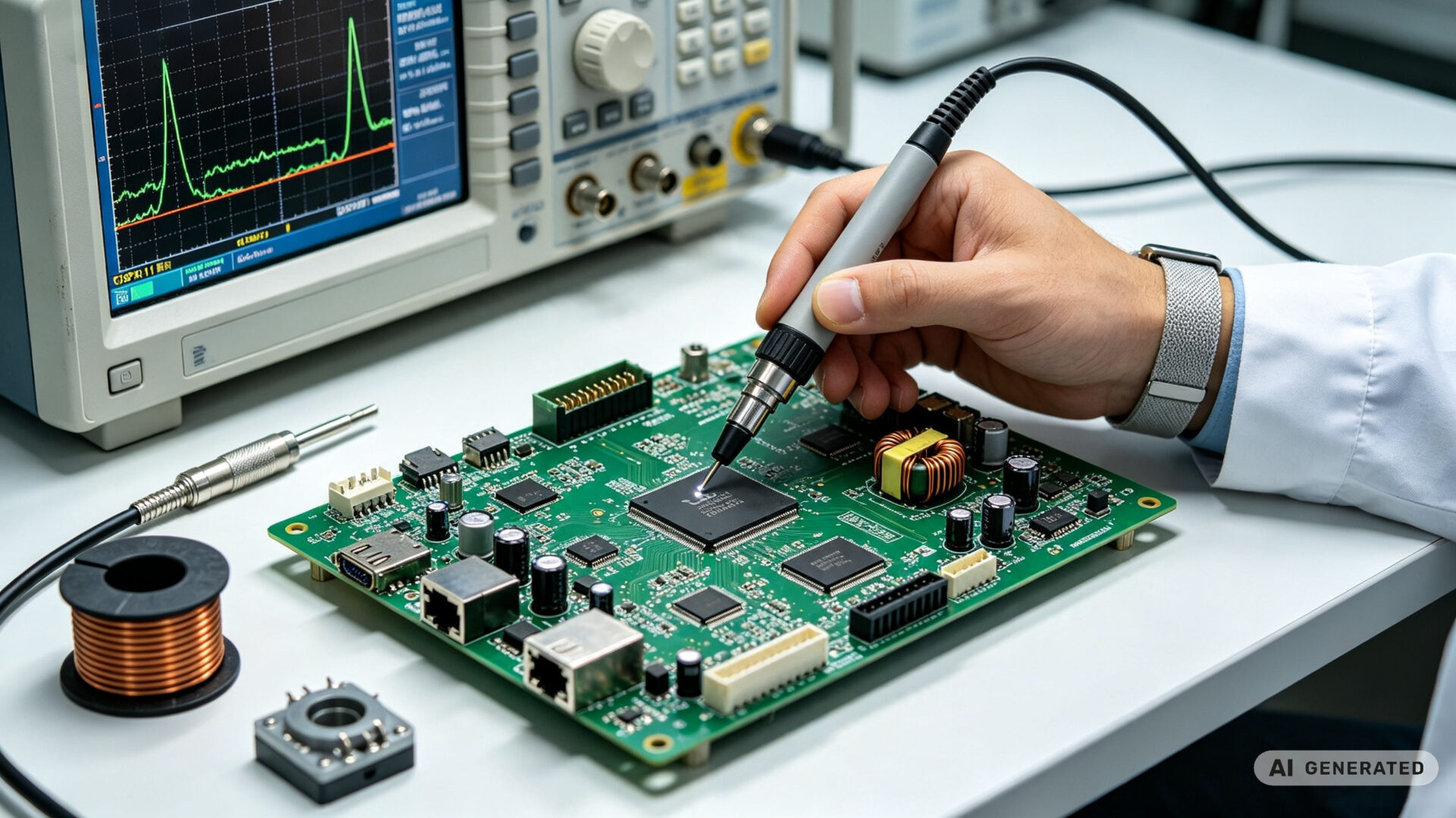
For a worked example of how these failure points are resolved in practice, see the EMC testing collaboration case study.
4. How TPS Elektronik supports CISPR 11 pre-compliance
TPS Elektronik operates an EMC laboratory that provides structured pre-compliance testing for industrial, medical, and automotive equipment. For industrial manufacturers, the service model built around three principles: measure against the correct limits, identify the dominant failure mechanism, and document results that support the formal certification process.
The TPS pre-compliance workflow includes:
- Classification review: Confirming Group 1/2 and Class A/B classification against the intended use environment, preventing the most common and costly pre-test error.
- Conducted emissions measurement: LISN-based testing from 150 kHz to 30 MHz with real-time spectrum analysis and limit-line comparison.
- Radiated emissions measurement: Semi-anechoic chamber testing from 30 MHz to 1 GHz (with above-1 GHz capability for Edition 7 requirements). Which including cable and enclosure contribution analysis.
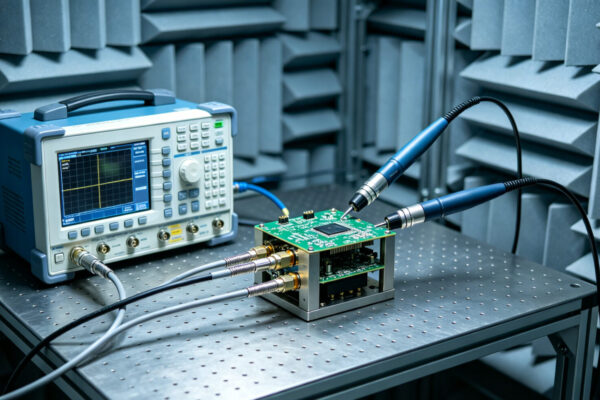
- Debugging support: Near-field probing, current probe measurements, and filter evaluation to isolate the emission source.
- Documentation: Test reports that reference CISPR 11 clauses and can be submitted alongside formal accredited test results.
For industrial equipment destined for the European market, pre-compliance testing under CISPR 11 also provides a direct path to documenting compliance with the EMC Directive 2014/30/EU. TPS’s resources on the European EMC Directive and product certification and integrated EMC and electrical safety testing reflect this alignment.