

System integrators, panel builders, and procurement teams in building automation rarely fail because they lack a control system design. They lose time—and operating budget—when the DIN rail power supply in a smart building control cabinet consumes more energy in no-load and part-load conditions than the entire control system it powers.
TPS Elektronik’s DIN rail power supply solutions for building automation built to eliminate that risk: high-efficiency 24V DC outputs, low no-load power consumption, KNX bus compatibility, and compliance documentation aligned with EU Ecodesign requirements.
Discuss your building automation power requirements with TPS →
1. What is a DIN rail power supply for building automation?
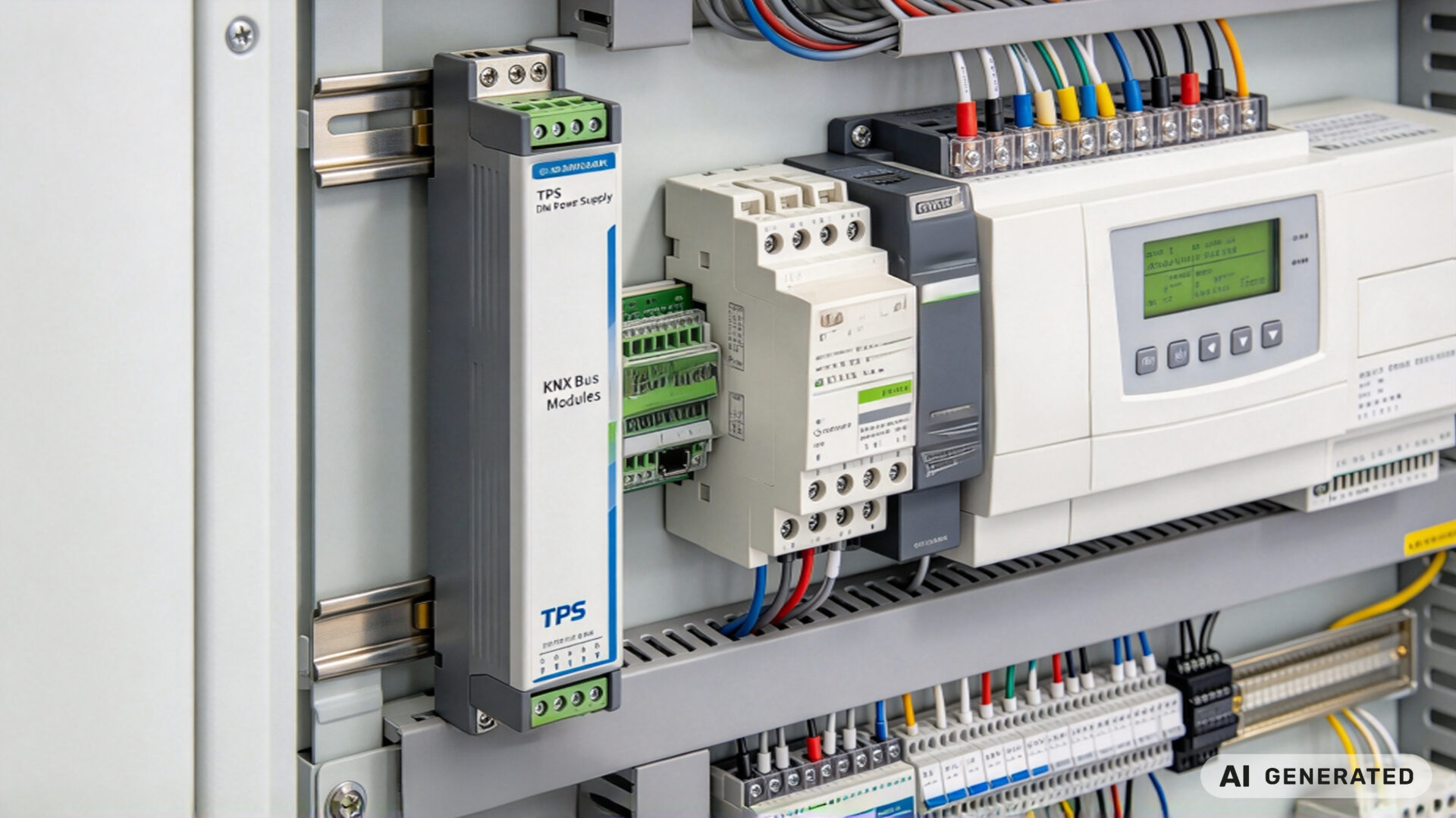
A DIN rail power supply for building automation is a compact, rail-mounted AC/DC converter that delivers regulated DC voltage—typically 24V DC—to building control systems including HVAC controllers, lighting control modules, KNX bus devices, and access control systems. It mounts on standard 35mm DIN rail inside building control panels, occupying minimal cabinet space while providing the power backbone for the entire automation system.
Buildings account for nearly 40% of global energy consumption, with approximately 40% of that consumed by HVAC systems and 15% by lighting. This concentration of energy demand means that every percentage point of efficiency improvement in building control infrastructure has a measurable impact on operating costs.
1.1 Why building automation PSUs differ from general industrial supplies
Building automation power supplies must satisfy requirements that general industrial DIN rail supplies often overlook:
- DIN 43880 compliance: Building automation panels frequently use standardized enclosure dimensions defined by DIN 43880. Which requiring power supplies with specific height and width profiles that fit alongside circuit breakers and bus modules.
- EN 61558-2-16 certification: This safety standard for switch mode power supply units with built-in transformers allows the PSU to be used without an external isolation transformer in control circuits, simplifying panel design and reducing component count.
- Household approval (EN 60335): For residential building automation applications, the power supply must be certified for household use. A requirement that industrial-only supplies do not meet.
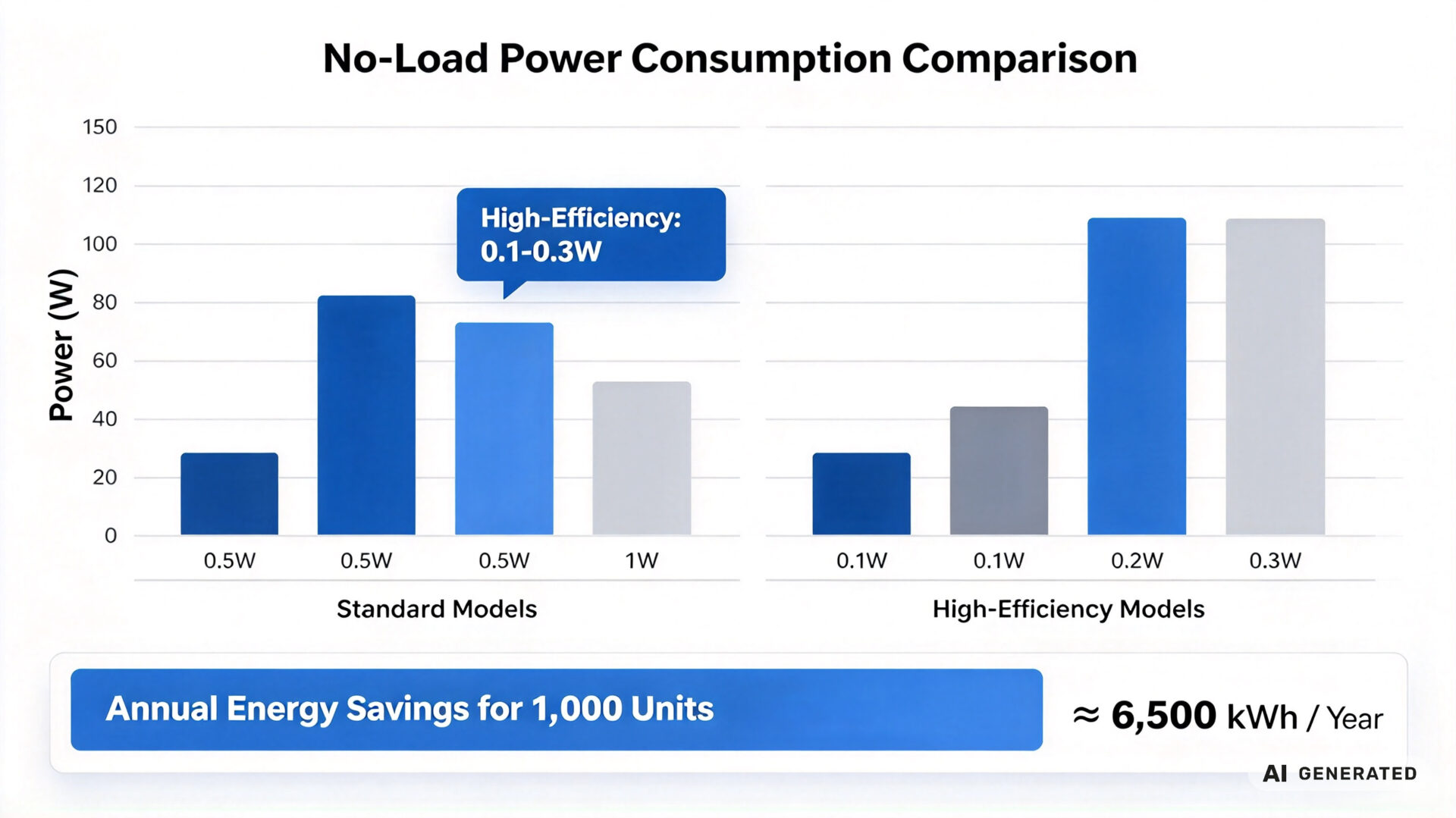
- Low no-load power consumption: Building automation systems operate continuously for years, often at low load. A power supply drawing 1W at no-load across 1,000 installed units wastes 8,760 kWh annually—enough energy to power an average home for several months.
1.2 KNX bus power supply requirements
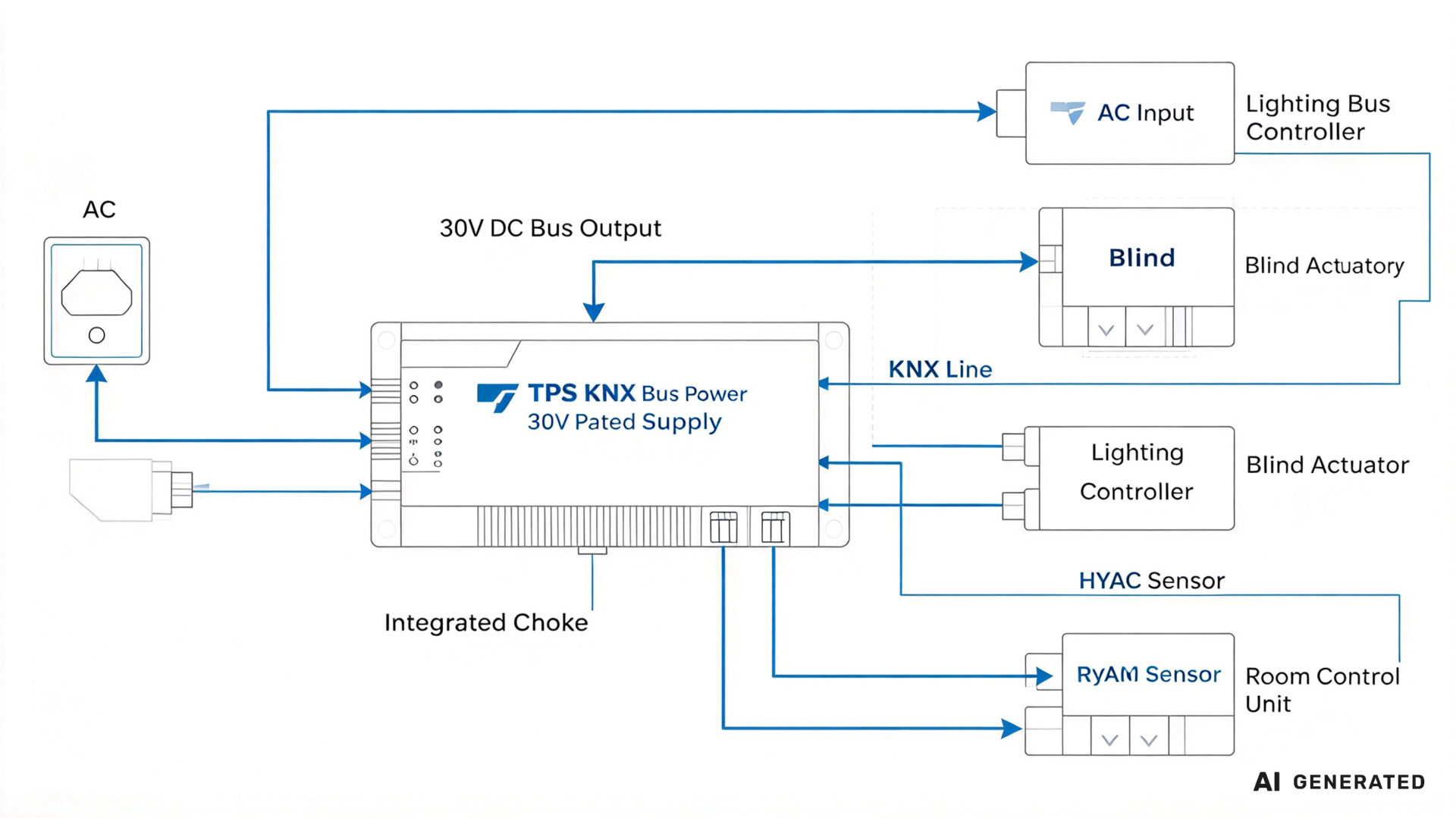
KNX is a widely adopted open standard for building automation, enabling seamless integration of lighting, heating, air conditioning, blinds, security, and energy management systems. The KNX power supplies generate the 30V DC SELV bus voltage and must incorporate an integrated choke to allow data communication on the same pair of conductors that carries power.
KNX power supply variants are specified by their rated output current: 160mA, 320mA, 640mA, and 1,280mA. The 640mA and 1,280mA variants are most common in commercial building installations where a single line segment powers up to 64 KNX devices. Advanced KNX power supplies with active chokes dynamically adapt to the connected load. Which increasing bus efficiency and supporting transmission rates up to 1,900mA without magnetic saturation affecting communication.
2. Why high efficiency reduces energy costs in smart buildings
The energy cost of a building automation power supply is not limited to its rated output power. It includes the energy consumed at no-load, the losses during part-load operation (which dominates building automation duty cycles). And the heat generated inside the control cabinet that must be removed by additional cooling.
2.1 No-load and standby losses: the hidden operating cost
Building automation power supplies spend the majority of their operational life at low load. HVAC controllers may draw full power only during peak demand periods; lighting controllers are largely idle during daylight hours; access control systems are intermittent. Yet the power supply itself operates continuously, and its no-load power consumption accumulates relentlessly.
The difference between a power supply with 1W no-load consumption and one with 0.1W no-load consumption is 0.9W per unit. Across a building with 50 control panels, that is 45W of continuous wasted power—394 kWh per year. Across a portfolio of 100 buildings, the waste exceeds 39 MWh annually. High-efficiency DIN rail power supplies achieve no-load losses as low as 0.1W to 0.3W, reducing this waste by 70% to 90%.
Part-load efficiency is equally important. A power supply that achieves 90% efficiency at full load but only 75% at 20% load—a typical operating condition for building automation—wastes more energy over a year than one rated at 88% full-load efficiency but 85% at 20% load. The EU Ecodesign Regulation 2019/1782 addresses this by defining efficiency requirements across the load range, not just at full load.
2.2 EU Ecodesign Regulation 2019/1782 and Efficiency Level VI
Commission Regulation (EU) 2019/1782 lays down ecodesign requirements for external power supplies, establishing maximum no-load power consumption and minimum average active efficiency thresholds. While the regulation formally applies to external power supplies, its efficiency framework has been adopted as the de facto benchmark for DIN rail power supplies in building automation.
The equivalent U.S. standard is DOE Level VI, which sets similar requirements for external power supplies. DIN rail PSUs meeting Efficiency Level VI and Ecodesign requirements typically achieve:
- No-load power consumption ≤0.3W, with leading models achieving ≤0.1W
- Average active efficiency ≥87% across 25-100% load range
- Efficiency at 10% load ≥75%
TPS’s DIN rail power supply portfolio is designed to meet these requirements, with models achieving efficiency levels that reduce both operating cost and internal cabinet heat generation.
For a deeper examination of custom power supply design, see the custom power supply resource and the custom power supply design case study.
3. TPS DIN rail power supply solutions for building automation
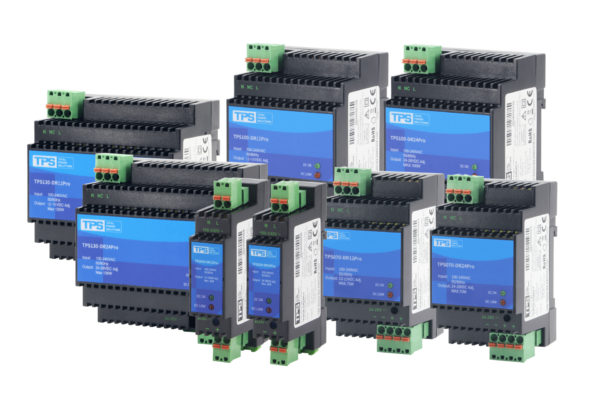
TPS Elektronik operates as a DIN rail power supply supplier with a portfolio specifically configured for building automation and smart building applications. The product range includes the GP Series (10-100W), Pro Series (30-130W), and Peak-DR+ Series (100-320W), all supporting wide temperature operation.
Building Automation Controllers
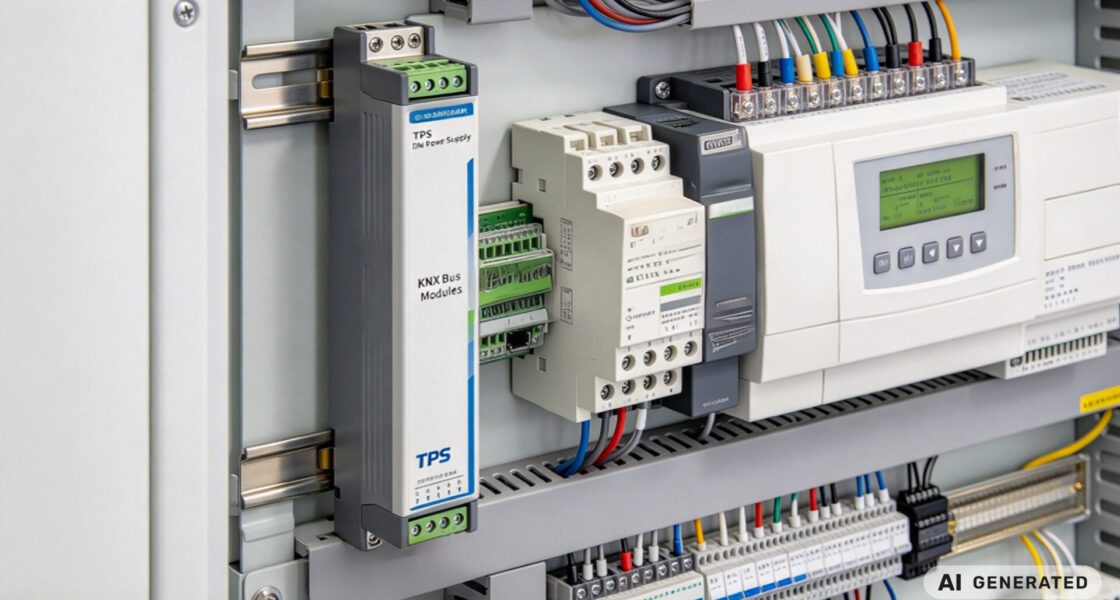
TPS DIN rail power supplies for building automation controllers deliver 24V DC with efficiency up to 87% and no-load consumption below 0.3W. The compact housing dimensions fit standard DIN 43880 enclosures alongside KNX modules and circuit breakers. Models are available with EN 61558-2-16 certification for direct control circuit use without external isolation transformers.
For related custom power supply and control system design resources, see the buck-boost converter design guide and the circuit breaker panel design resource.
To streamline quotation for DIN rail power supply supplier requirements, provide the following information:
- Application type: Building automation controller, KNX bus, HVAC, lighting control, or access control
- Output voltage and current: Required voltage (12V, 24V, 48V) and continuous current rating
- Efficiency requirements: Target no-load consumption and part-load efficiency
- Certification needs: EN 61558-2-16, EN 60335 (household), KNX compatibility, UL/CE
- Mounting and dimensions: DIN 43880 compatibility, available cabinet width
- Quantity and project scale: Prototype, pilot, and series production volumes