

For system integrators, panel builders, and procurement teams deploying solar, battery storage, and V2G infrastructure, selecting a power module is no longer about unidirectional wattage.
It involves bidirectional energy flow between AC grid and DC battery, mode switching speed, grid code compliance, thermal margins under continuous operation, and whether the system can recycle energy instead of dissipating it as heat.
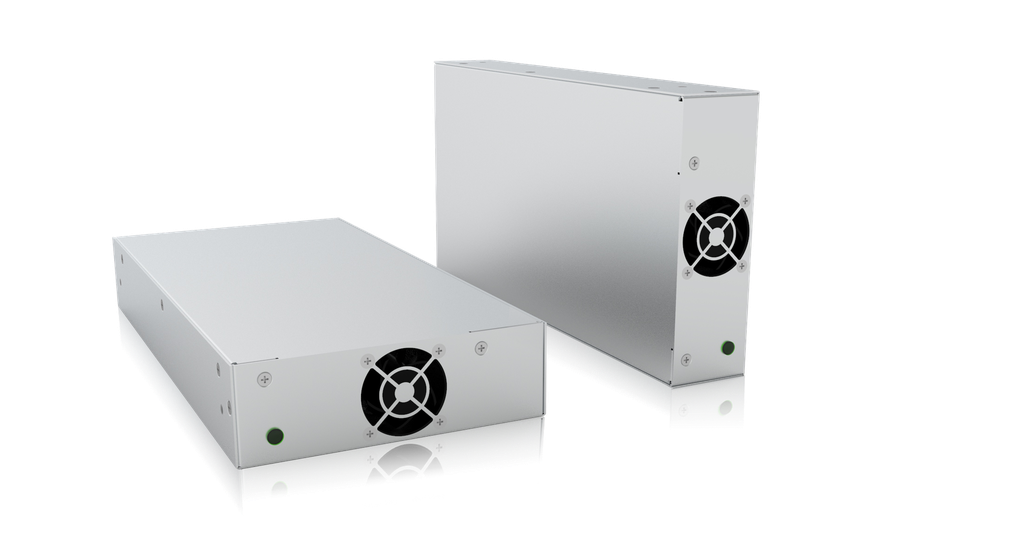
The TPS-BM142250SIR is a 2250W bidirectional AC-DC power module with 93.5% AC-DC efficiency and 86% DC-AC efficiency, <10ms mode switching, PF>0.99, and THDi<5%. It operates from 176-264VAC input, delivers 14VDC at 161A with 0.5% voltage accuracy and 500mV ripple, and supports up to 8 parallel units with ≤5% current sharing imbalance.
Typical applications include solar battery storage, V2G charging infrastructure, cell formation testing, and energy-recyclable power aging systems.
1. What a bidirectional power module is (and why unidirectional supplies fall short)
A bidirectional power module is a power conversion device that can operate as both an AC-DC converter (rectifier) and a DC-AC inverter within a single hardware unit. Unlike a traditional unidirectional power supply—which takes AC input and produces DC output only—a bidirectional module enables energy to flow in both directions: from the grid to the battery during charging, and from the battery back to the grid during discharging.
This bidirectional capability is the foundational building block for solar and battery energy storage systems. The U.S. Department of Energy’s Office of Electricity emphasizes that energy storage is a key enabling technology for grid modernization and resilience, providing flexibility to the grid. The European Commission’s Fit for 55 package and REPowerEU mandates are accelerating the adoption of bidirectional energy infrastructure across Europe.
In practical terms, a solar battery storage converter with bidirectional capability does three things that a unidirectional supply cannot:
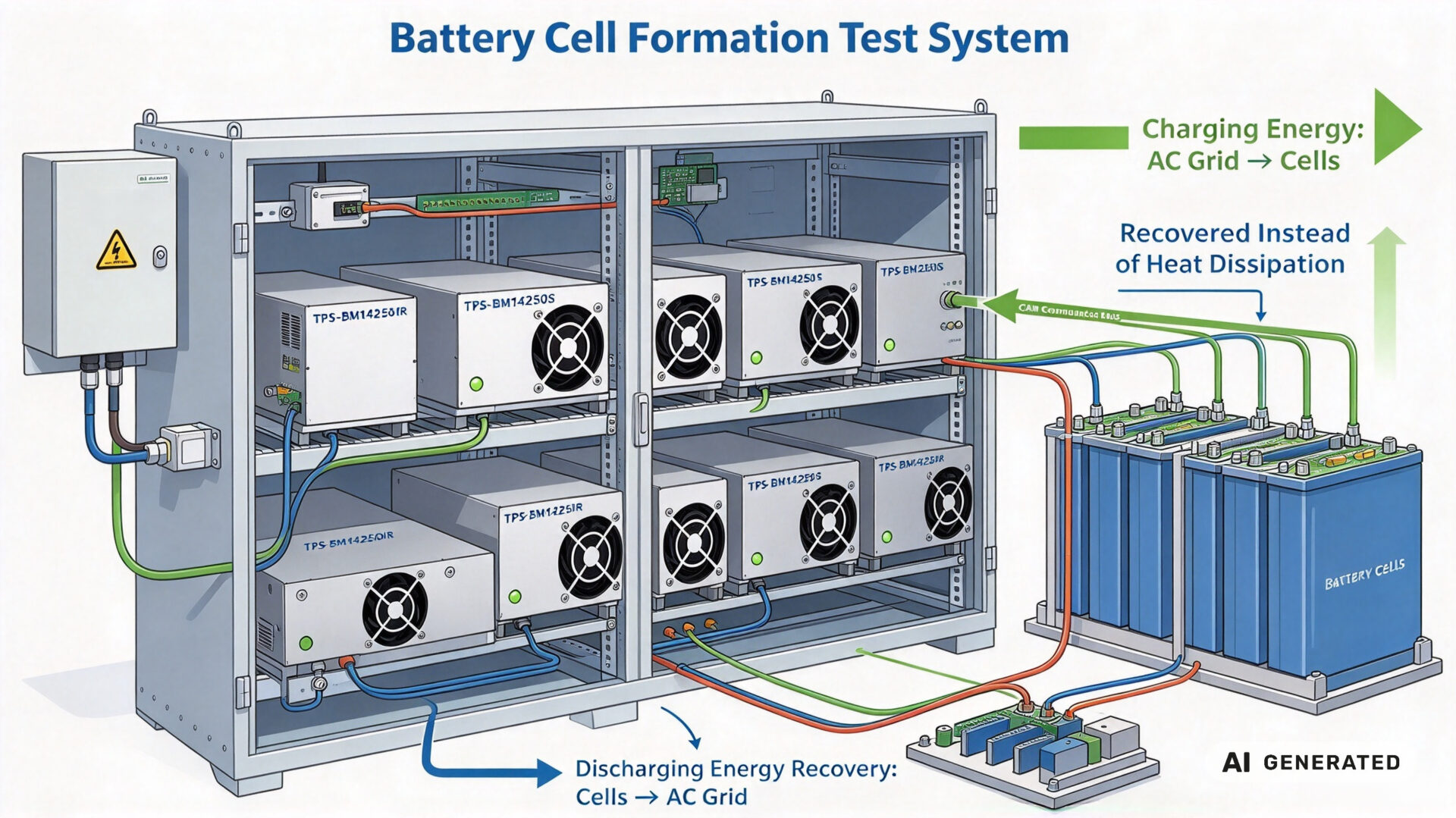
- Energy recycling: During battery discharge or cell formation testing, the energy released is returned to the grid instead of being dissipated as heat through resistive loads. This reduces operational cost and thermal load simultaneously.
- Grid support: When the grid needs power, the module inverts DC battery energy to AC and feeds it back—contributing to grid stability and enabling V2G services.
- Mode flexibility: The same hardware handles charging, discharging, and grid-tied operation, reducing component count and cabinet space.
For a deeper technical foundation on bidirectional converter architectures, ScienceDirect provides a comprehensive review of converter topologies for V2X-enabled energy storage chargers, covering operating principles, performance trade-offs, and grid-interactive control strategies.
2. Electrical performance: efficiency, PFC, and mode switching
The TPS-BM142250SIR is specified for the electrical performance parameters that determine system-level economics in solar and battery storage deployments.
Efficiency. The module achieves 93.5% AC-DC efficiency and 86% DC-AC efficiency (tested at 220VAC full load, power grid THDu ≤2%). For a 2250W module, this means approximately 146W of heat dissipation in AC-DC mode and 315W in DC-AC mode. The higher DC-AC efficiency figure reflects the additional conversion stages required for grid-tied inversion.
Power factor and harmonics. The module delivers PF>0.99 and THDi<5% at rated load. These values are critical for grid-connected applications: a power factor below 0.95 can trigger utility penalties in commercial installations, and excessive current harmonic distortion can cause voltage waveform distortion that affects other equipment on the same feeder.
Mode switching. The <10ms mode switching time between rectifier and inverter operation is a key differentiator. In V2G applications, the transition from charging to discharging (or vice versa) must be fast enough that the grid sees it as a controlled response rather than a disturbance. For systems providing frequency regulation or demand response, this switching speed directly affects the value of the service provided.
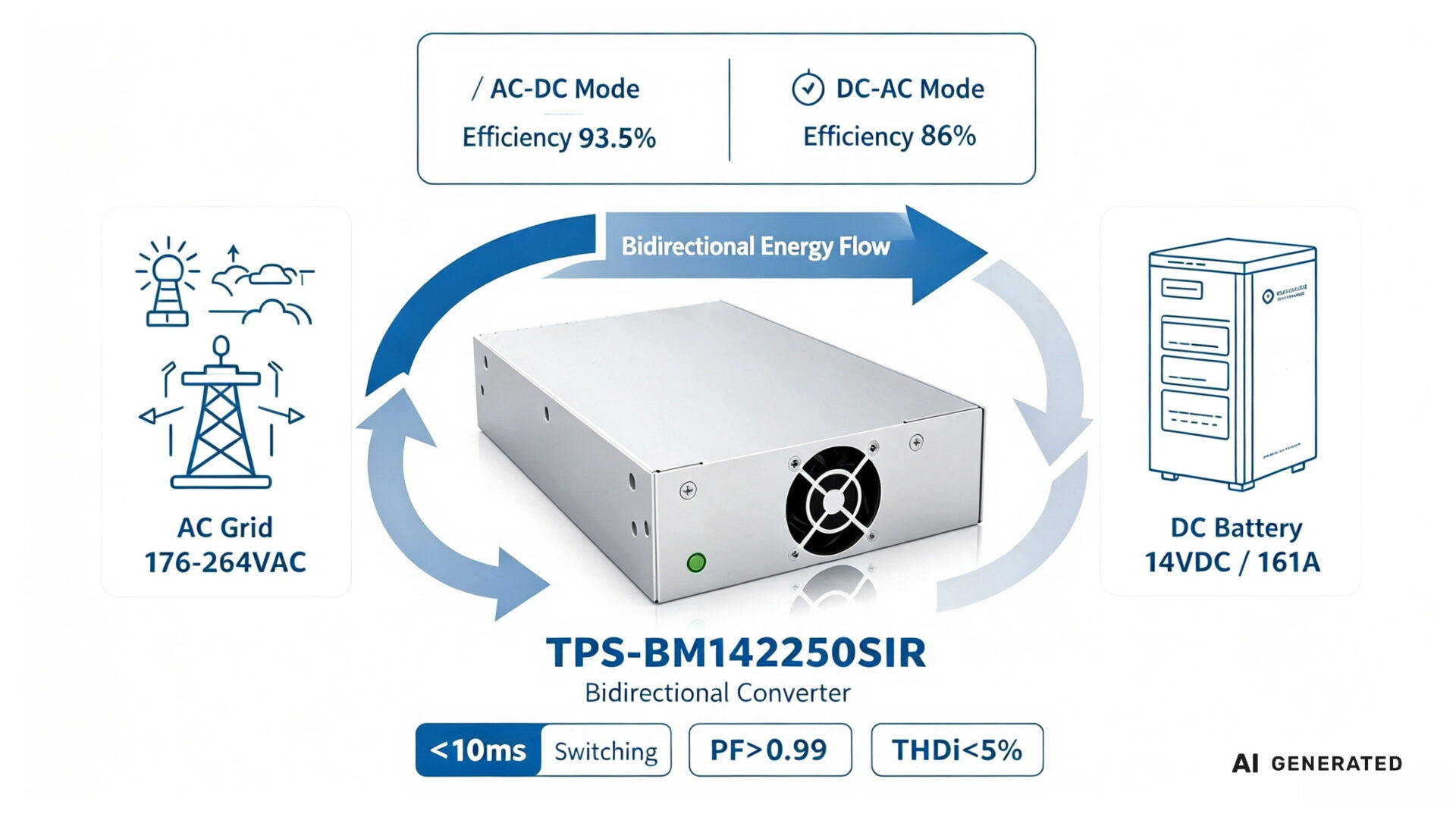
Output precision. The 14VDC output is regulated to 0.5% voltage accuracy with 500mV ripple voltage. For battery formation and cell testing applications, this precision is essential: voltage error directly affects the cell’s state of charge and cycle life.
For comparison, published research on bidirectional resonant converters reports peak charging efficiencies of 96.3-96.4% at lower power levels (25-100W) and 95.7% at 15kW. The TPS-BM142250SIR’s 93.5% at 2250W represents a practical balance between efficiency, cost, and the thermal constraints of forced-air cooling.
3. Thermal strategy and derating for continuous operation
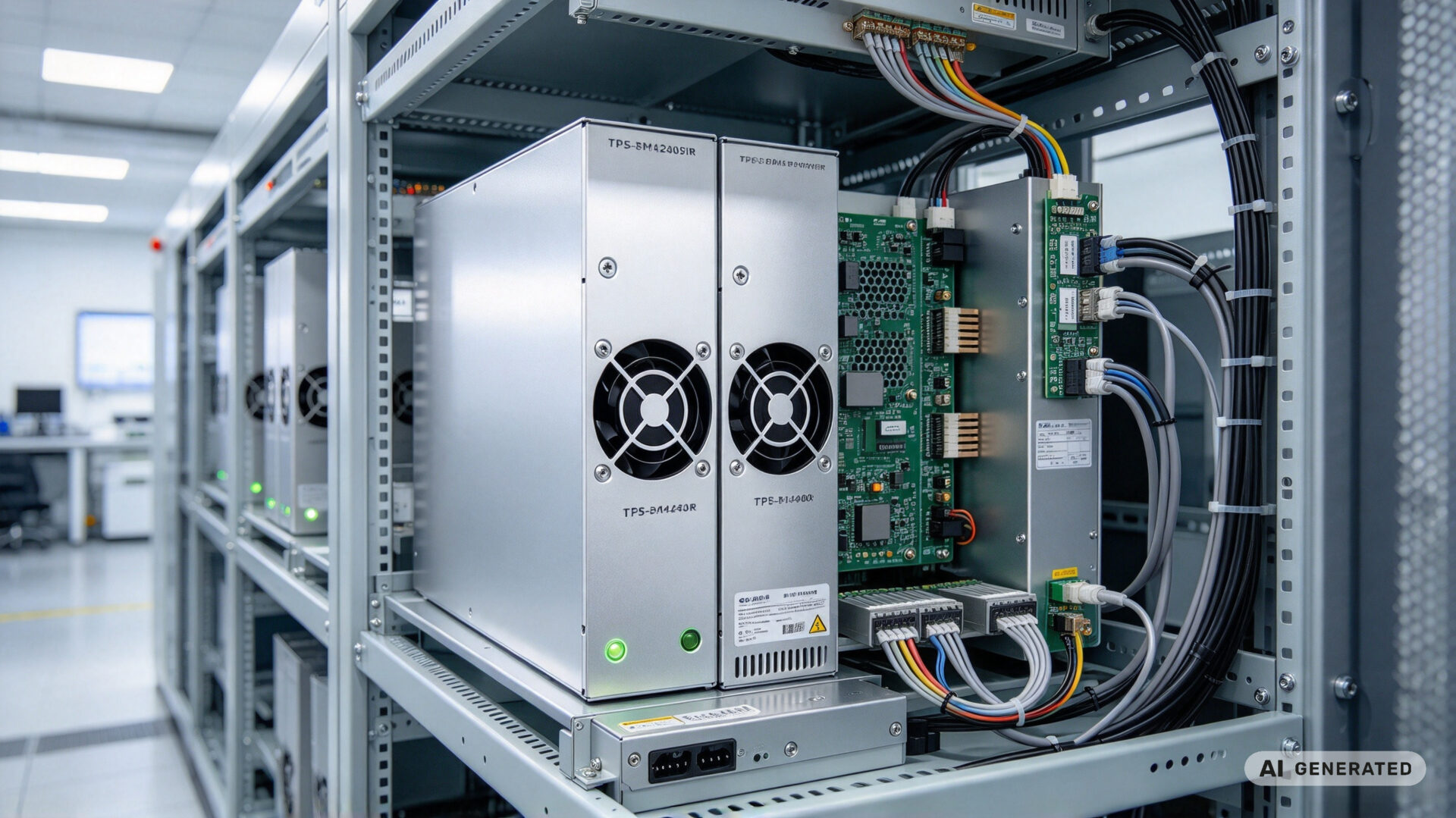
The TPS-BM142250SIR uses forced-air cooling with intelligent control, with a default airflow direction of front inlet and rear outlet. This configuration is compatible with standard 19-inch cabinet airflow architectures.
The module is specified for full-load operation from 10°C to 45°C. Above 45°C, the module derates: at 55°C to 60°C, the output is limited to 80% of rated power. This derating curve must be considered during cabinet thermal design—if the internal cabinet temperature exceeds 45°C due to adjacent heat sources or restricted airflow, the effective power capacity of each module is reduced.
Two thermal considerations are critical for integration:
- Airflow path definition: The front-inlet/rear-outlet airflow requires unobstructed paths at both the front and rear of the module. Cable bundles routed across the front intake will reduce cooling effectiveness and may trigger thermal derating.
- Heat load calculation: At 2250W output and 93.5% efficiency, the module dissipates approximately 146W in AC-DC mode and 315W in DC-AC mode. Multiple modules in a single cabinet multiply this heat load. The cabinet cooling system must be sized for the total dissipation of all installed modules, not just one.
TPS provides thermal derating documentation and can support cabinet airflow analysis as part of the RFQ process.
4. Parallel operation and scalability
The TPS-BM142250SIR supports up to 8 parallel units with ≤5% current sharing imbalance. This parallel capability is what enables the module to scale from a single 2250W channel to an 18kW system without changing the fundamental system architecture.
Current sharing imbalance of ≤5% means that in an 8-unit parallel configuration, the difference between the highest-loaded and lowest-loaded module is limited to 5% of the average output. This prevents one module from bearing a disproportionate share of the load—a common failure mode in poorly designed parallel systems that leads to premature module failure.
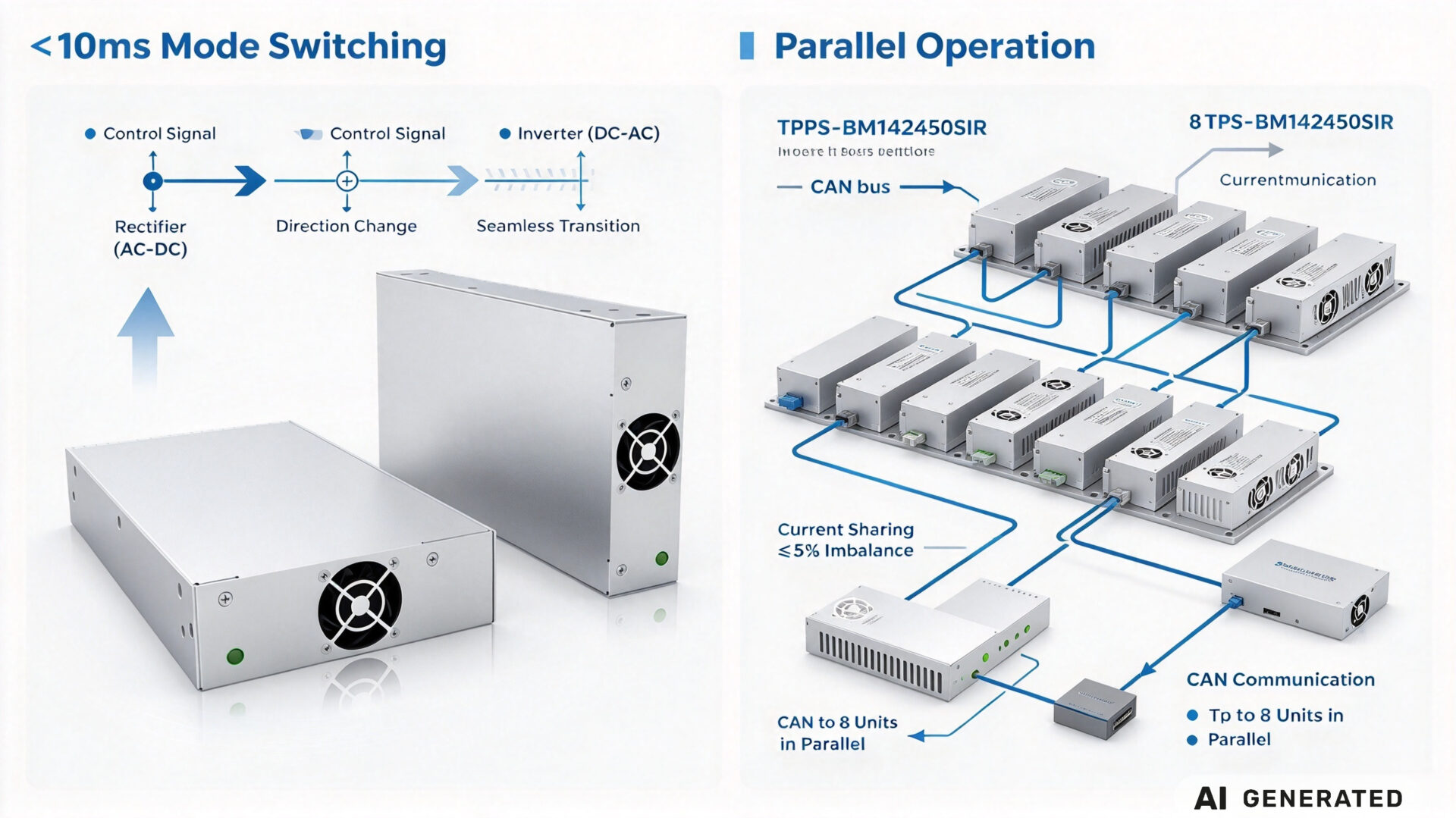
For battery formation and grading systems, parallel operation allows the integrator to build a test channel with the exact power rating required for the cell chemistry and formation profile. For grid-scale storage, it provides N+1 redundancy: if one module fails, the remaining modules continue to operate, and the failed unit can be replaced without shutting down the entire system.
5. Compliance: EN55032 EMC and grid-connected standards
The TPS-BM142250SIR meets EN55032 EMC standards for multimedia equipment emissions and is eligible for UL, CE, and TUV certifications.
For grid-connected applications, additional standards apply depending on the target market:
- IEEE 1547 (USA): Standard for interconnecting distributed energy resources with electric power systems. This standard defines requirements for voltage regulation, power quality, islanding detection, and ride-through capability for grid-connected inverters.
- VDE-AR-N 4105 (Germany): The German low-voltage grid connection standard for distributed generation systems. It specifies requirements for feed-in management, active power reduction during over-frequency, provision for reactive power, and dynamic grid support (fault ride-through).
- IEC 61851-23 (EV charging): This standard provides requirements for bidirectional power transfer EV supply equipment, with rated maximum voltage up to 1000V AC or 1500V DC. It defines bidirectional power transfer (BPT) requirements for system A configurations.
- ISO 15118 (V2G communication): The communication protocol for vehicle-to-grid energy transfer. All new or renovated EVSE units are required to support ISO 15118-20 for bidirectional charging.
For a deeper examination of V2G standards and interoperability, the SAE Technical Paper on V2G and Plug & Charge provides a comprehensive review of IEC 61851, IEC 62196, and ISO 15118 series standards and their commercial maturity.
6. Application guidance: solar storage, V2G, and cell formation
Solar & Battery Energy Storage
In a solar-plus-storage system, the bidirectional module sits between the AC grid and the battery bank. During solar generation, excess energy is stored in the battery (AC-DC mode). During peak demand or grid outage, the battery discharges back to the grid or to local loads (DC-AC mode). The 14VDC output and 161A current capability are suited for low-voltage battery architectures and DC-coupled solar systems. The high efficiency in AC-DC mode (93.5%) is particularly valuable during the charging phase, where energy losses directly reduce the round-trip efficiency of the storage system.
For additional application-specific guidance, see the TPS resources on TPS-DM570T1512KIF and TPS-DM570T1512KIRF bidirectional DC-DC modules for lithium battery formation. For broader product context, see the TPS production category and TPS blog content.
7. RFQ checklist
To streamline quotation and evaluation, provide the following information when requesting a bidirectional power module quotation:
- Power rating and channel count: Required continuous power per channel and total number of channels (parallel configuration)
- DC voltage and current: Battery voltage range and maximum charge/discharge current
- Mode switching requirement: Required transition time between charging and discharging, and how frequently mode changes occur
- Grid connection standard: IEEE 1547, VDE-AR-N 4105, IEC 61851-23, or other applicable standard for the target market
- Thermal conditions: Expected cabinet ambient temperature and airflow constraints for derating calculation
- Communication interface: CAN, Modbus, or other protocol for system integration
- Certification documentation: Required UL, CE, TUV, or other certification scope
- Project scale: Prototype quantity, series production volume, and delivery schedule
Providing these details reduces clarification cycles during evaluation. TPS’s engineering team can support parallel configuration design, thermal analysis, and grid code compliance review as part of the RFQ process.
8. FAQ
What is the difference between a bidirectional power module and a unidirectional power supply?
A unidirectional power supply converts AC to DC (or DC to DC) in one direction only. A bidirectional power module can operate as both a rectifier (AC-DC) and an inverter (DC-AC) within the same hardware, enabling energy to flow in both directions. This is essential for battery storage, V2G, and energy-recycling test systems.
What standards apply to bidirectional power modules for grid-connected applications?
Grid-connected bidirectional modules must comply with the interconnection standards of the target market. In the USA, IEEE 1547 defines the requirements for interconnecting distributed energy resources. In Germany, VDE-AR-N 4105 applies. For EV charging applications, IEC 61851-23 defines bidirectional power transfer requirements, and ISO 15118-20 covers V2G communication.
How does cell formation testing benefit from a bidirectional module?
During cell formation, cells are charged and then discharged. A unidirectional system dissipates the discharge energy as heat through resistive loads. A bidirectional module returns that energy to the grid instead—reducing electricity cost, lowering cooling load, and improving the overall energy efficiency of the test system.
Can the TPS-BM142250SIR operate in parallel for higher power?
Yes. The module supports up to 8 parallel units with ≤5% current sharing imbalance, enabling system power up to 18kW. This parallel capability also provides N+1 redundancy for uptime-critical applications.
What certifications does the TPS-BM142250SIR hold?
The module meets EN55032 EMC standards and is eligible for UL, CE, and TUV certifications. Certification documentation can be provided as part of the RFQ process. Contact TPS for market-specific compliance requirements.