

System integrators, panel builders, procurement teams and electrical engineers rarely lose RFQs because a DC/DC converter cannot be sourced.
In practice, issues arise when the selected converter introduces avoidable system risks, such as:
- limited input range
- unclear protection behavior
- insufficient documentation
- challenging thermal integration
- too many variants across output voltages
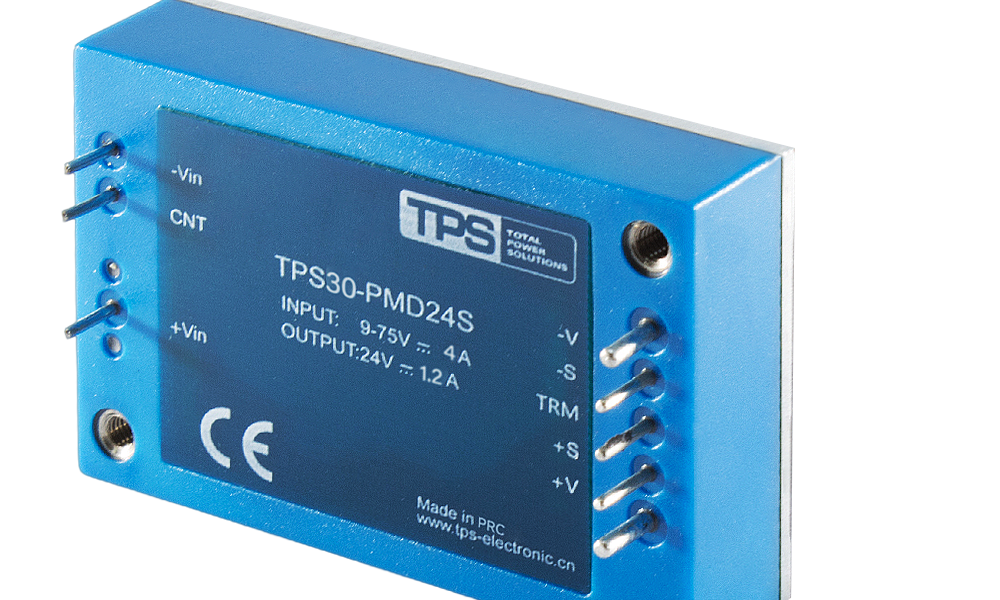
The TPS030–150W series is designed to address these integration challenges. It covers power levels from 30W to 150W, supports a wide 9–75VDC input range, and uses standardized 1/4-brick to 1/2-brick packages for consistent system design.
1. Why the TPS030–150W Series Matters in RFQs
In later-stage (BoFu) procurement, the key question is not whether a converter can deliver 12V or 24V under ideal conditions.
More relevant is whether the module:
- integrates reliably into a variable DC bus
- behaves predictably during startup and transient events
- allows standardized selection across multiple system variants
The TPS030–150W series provides a single platform covering 30W, 75W and 150W with a shared 9–75VDC input range. This can simplify qualification and reduce the need to switch between different converter families as power requirements change.
From a commercial perspective, this can support:
- shorter approval cycles
- simplified BOM structures
- more predictable system behavior
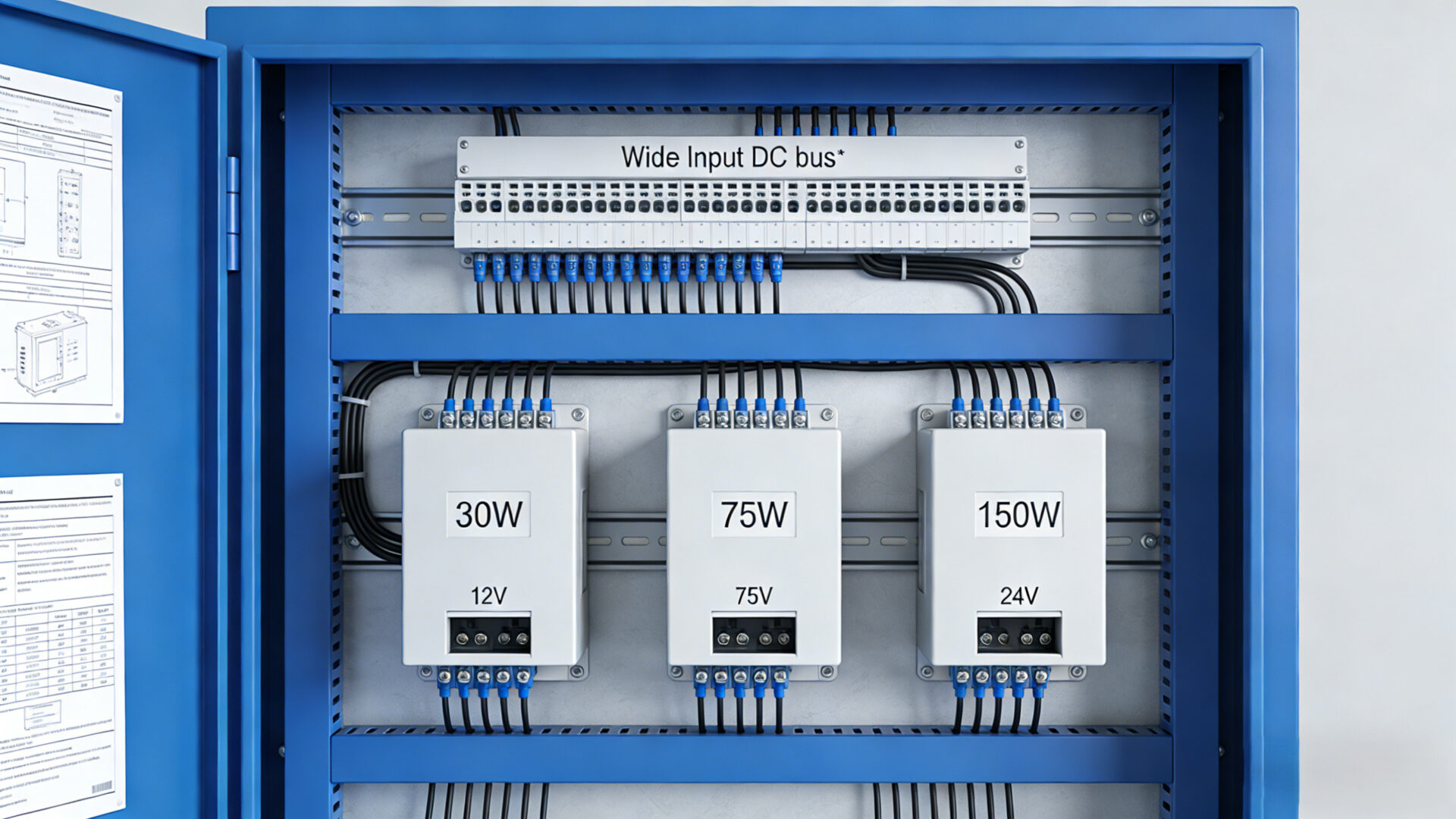
In typical cabinet architectures, the DC/DC module operates downstream of an AC/DC front end (e.g., DIN-rail power supplies) and supplies isolated rails for sensitive subsystems.
If you already know the output voltage you need, you can go directly to the product pages for the TPS030-PMD12S, TPS030-PMD24S, TPS075-PMD12S, TPS075-PMD24S, TPS150-PMD12S or TPS150-PMD24S.
2. Series Overview
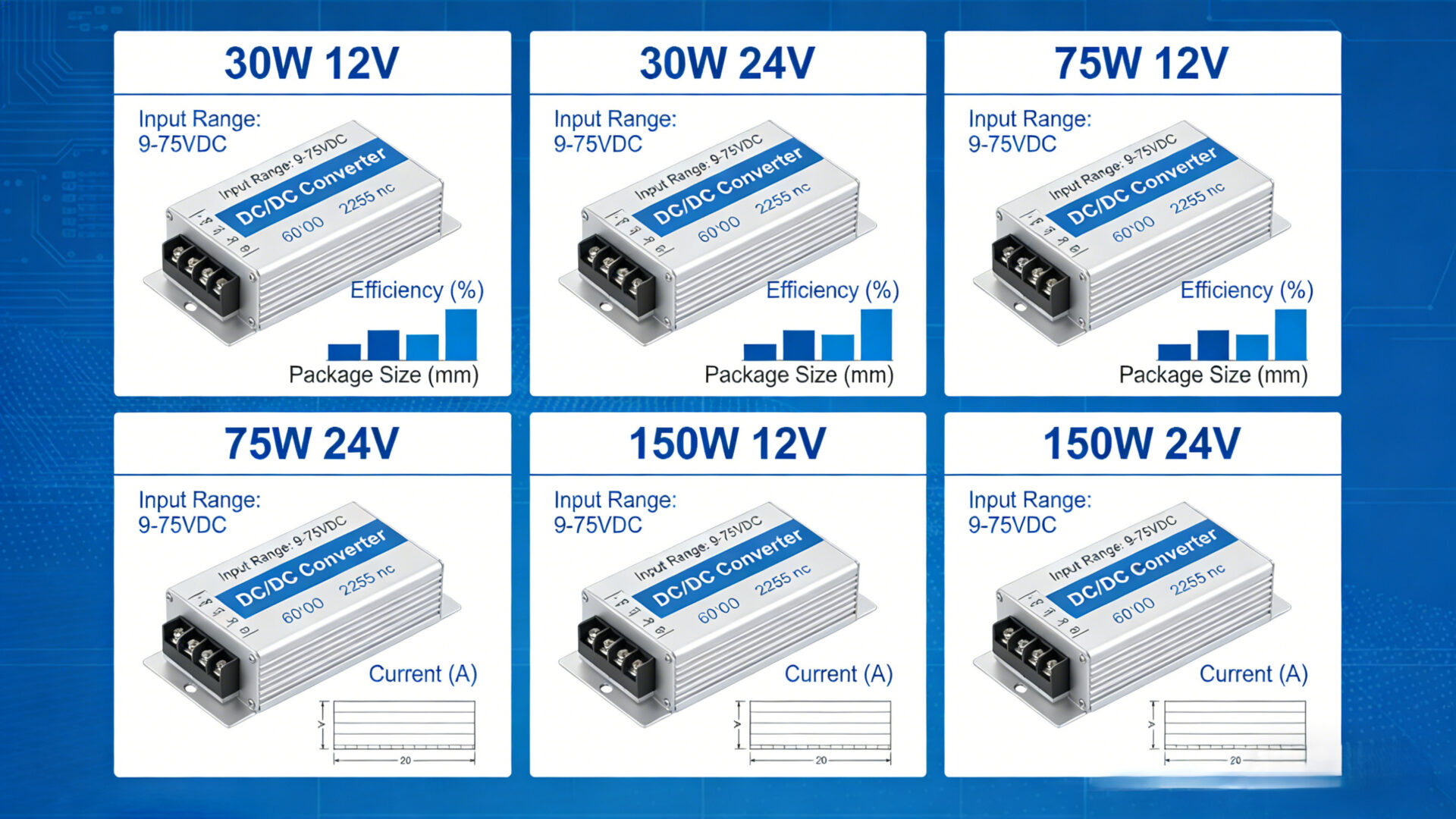
The series follows a clear structure:
- Output voltages: 12V and 24V
- Power classes: 30W, 75W, 150W
- Packages: 1/4-brick (30W, 75W), 1/2-brick (150W)
Key models
| Model | Output | Current | Efficiency | Max. capacitive load | Package |
|---|---|---|---|---|---|
| TPS030-PMD12S | 12V | 0–2.5A | 85% | 1000 µF | 1/4-brick |
| TPS030-PMD24S | 24V | 0–1.2A | 85% | 500 µF | 1/4-brick |
| TPS075-PMD12S | 12V | 0–6.2A | 89% | 2000 µF | 1/4-brick |
| TPS075-PMD24S | 24V | 0–3.1A | 89% | 1000 µF | 1/4-brick |
| TPS150-PMD12S | 12V | 0–12.5A | 88% | 5000 µF | 1/2-brick |
| TPS150-PMD24S | 24V | 0–6.2A | 89% | 2000 µF | 1/2-brick |
This structure can support consistent design decisions across different machine variants.
3. Electrical Performance
The electrical characteristics are defined to support stable system integration.
Input behavior
- Wide input range: 9–75VDC
- Surge capability: up to 100VDC (100 ms max.)
- Undervoltage lockout:
- startup: 9VDC
- shutdown: 7.5VDC
Output performance
- Voltage accuracy: ±1.5% max.
- Line/load regulation: ±0.2% max.
- Transient response: <500 µs (25% load step)
- Trim range: ±10%
Ripple & noise
- 12V: 60 mV RMS / 120 mV pk-pk max.
- 24V: 100 mV RMS / 280 mV pk-pk max.
Switching
- Fixed frequency: 200 kHz (typ.)
- Input filter: LC type
These parameters can support predictable EMI behavior and repeatable test conditions.
Isolation
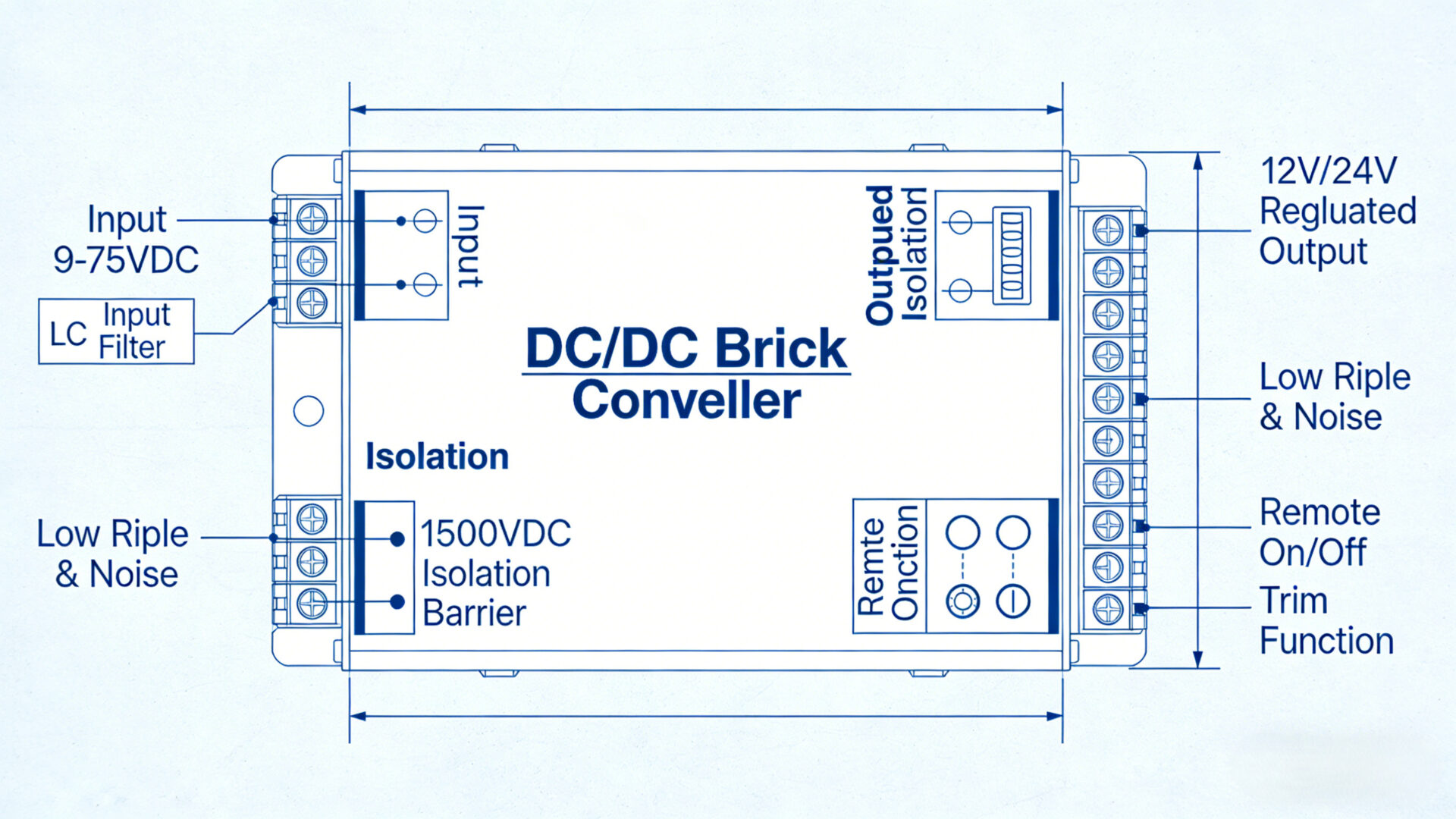
- 1500VDC minimum (input/output, input/case, output/case)
- Isolation resistance: ≥10⁷ Ω
Compliance (per datasheet)
- CE, RoHS
- EU Low Voltage Directive (2014/35/EU)
- RoHS Directive (2011/65/EU)
- Safety references: UL62368-1, UL60950-1, EN60950-1
4. Protection and Control
The series includes commonly required protection and control features:
Protection
- Overvoltage protection: 115–140%
- Overcurrent protection: 105–200%
- Continuous short-circuit protection
- Thermal shutdown: ~100°C case temperature
Temperature range
- Operating: −40°C to +100°C (case)
- Storage: −55°C to +105°C
Control
- Remote on/off (positive logic)
- ON: >3.5VDC or open
- OFF: <1.2VDC
- Output voltage trim (±10%)
These functions support integration into controlled power architectures rather than standalone use.
5. Mechanical and Thermal Considerations
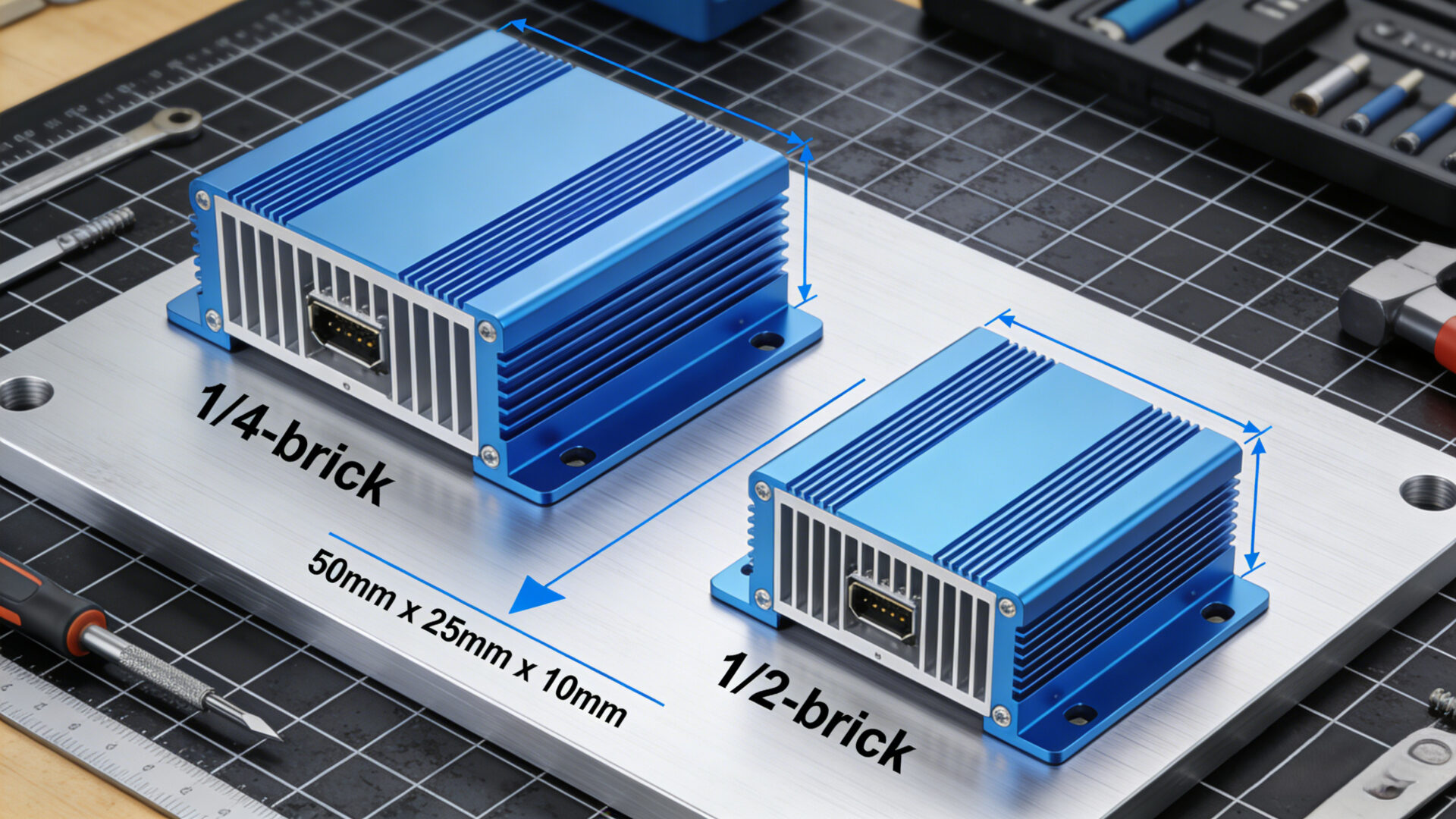
Mechanical integration is based on standardized brick formats:
- 1/4-brick: 30W / 75W
- 1/2-brick: 150W
- Construction: aluminum baseplate, plastic case
- Weight: approx. 110 g
Thermal considerations
- Design based on case temperature, not ambient only
- Derating depends on input voltage and cooling conditions
- Validation is required for low-input or high-density designs
Cooling options
- Optional heat sinks (Alu-6061) available for all power classes
Early consideration of thermal design can reduce rework during validation.
6. Application Areas
The TPS030–150W series is intended for use as a DC/DC conversion stage within existing DC systems.
Typical use cases include:
- Industrial control cabinets (isolated rails for controllers, I/O, communication)
- Telecom systems with variable DC input
- Measuring and test equipment
- Modular automation subsystems
The series supports architectures where a central DC bus feeds multiple isolated loads.
7. Selection and RFQ Structuring
A well-defined RFQ should go beyond output voltage.
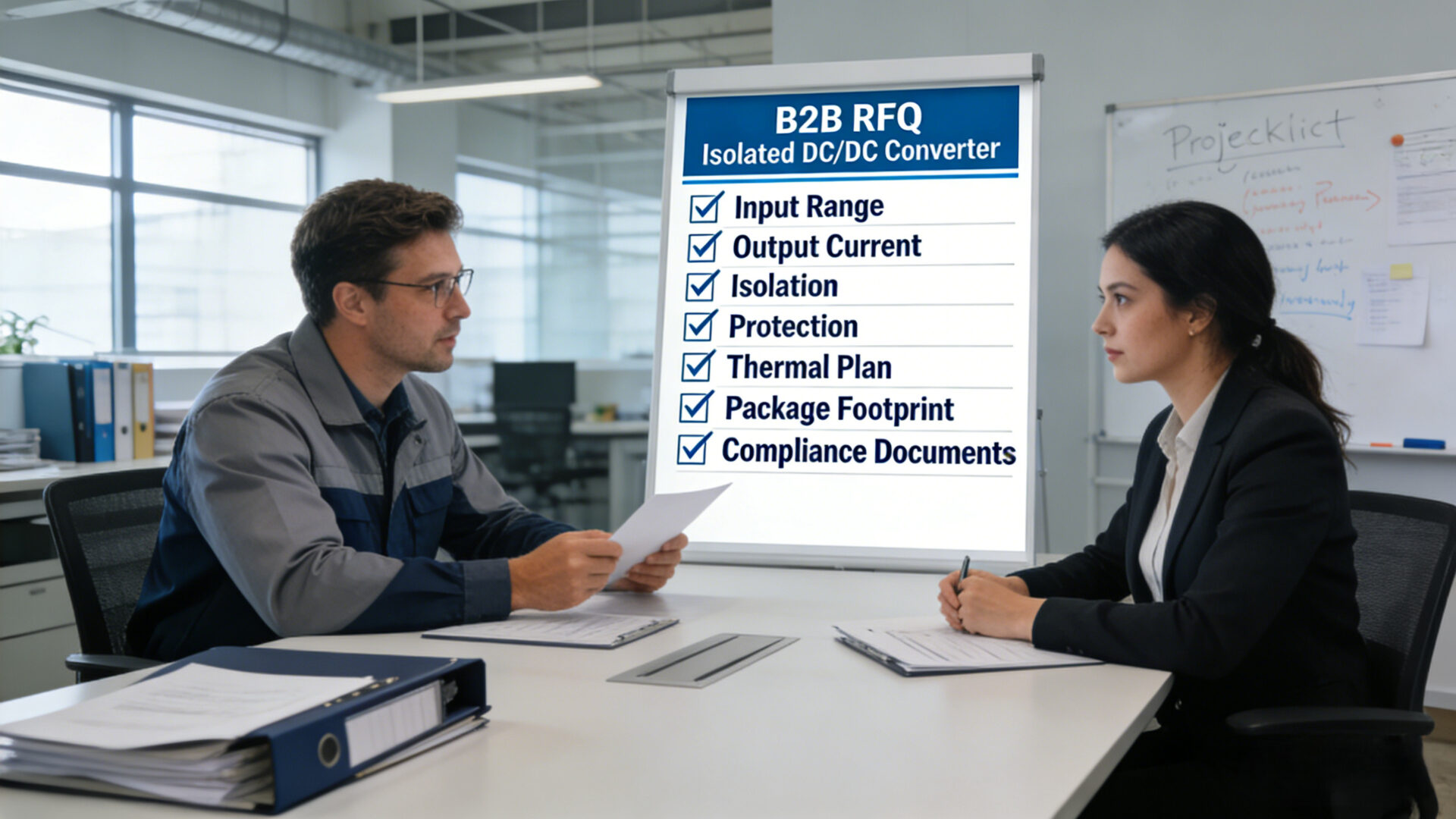
Key questions include:
- What is the actual input bus behavior (startup, dips, surges)?
- What is the continuous and peak load profile?
- How much output capacitance is present?
- What is the thermal condition at the module case?
- Is remote control required?
- Are there footprint constraints (1/4 vs. 1/2 brick)?
- What compliance documentation is required?
Selection guidance
- 30W → low-power, space-constrained designs
- 75W → mid-power within 1/4-brick footprint
- 150W → higher current or increased thermal margin
Comparing adjacent variants during RFQ can support better trade-off decisions.
Review the TPS030-150W product options and move to RFQ-ready selection →
FAQ
What is the benefit of the 9–75VDC input range?
It allows use across different DC bus levels and operating conditions without changing converter families.
Is the series isolated?
Yes. The datasheet specifies 1500VDC isolation between input, output and case.
How to choose between 12V and 24V?
Select based on the actual load requirements. 12V is common for control electronics, while 24V is widely used in industrial systems.
What is the difference between 1/4-brick and 1/2-brick?
1/4-brick is more compact for lower power. 1/2-brick supports higher power and thermal capacity.