

For system integrators, panel builders, and electrical engineers, DIN rail space is a key design constraint. PLCs, relays, contactors, I/O modules, protection devices, and motor-control components all compete for limited space inside the control cabinet. Selecting an industrial DIN rail power supply therefore involves more than matching output voltage and rated power. Mechanical footprint, conversion efficiency, thermal behavior, load characteristics, and applicable approvals all need to be considered.
TPS Elektronik offers ultra-slim, single-phase DIN rail power supplies for industrial control and automation applications. The portfolio includes 24 V DIN rail power supplies as well as 12 V variants in several power classes, allowing designers to select a unit according to load requirements and available cabinet space.
1. Space constraints: Why a slim DIN rail power supply matters
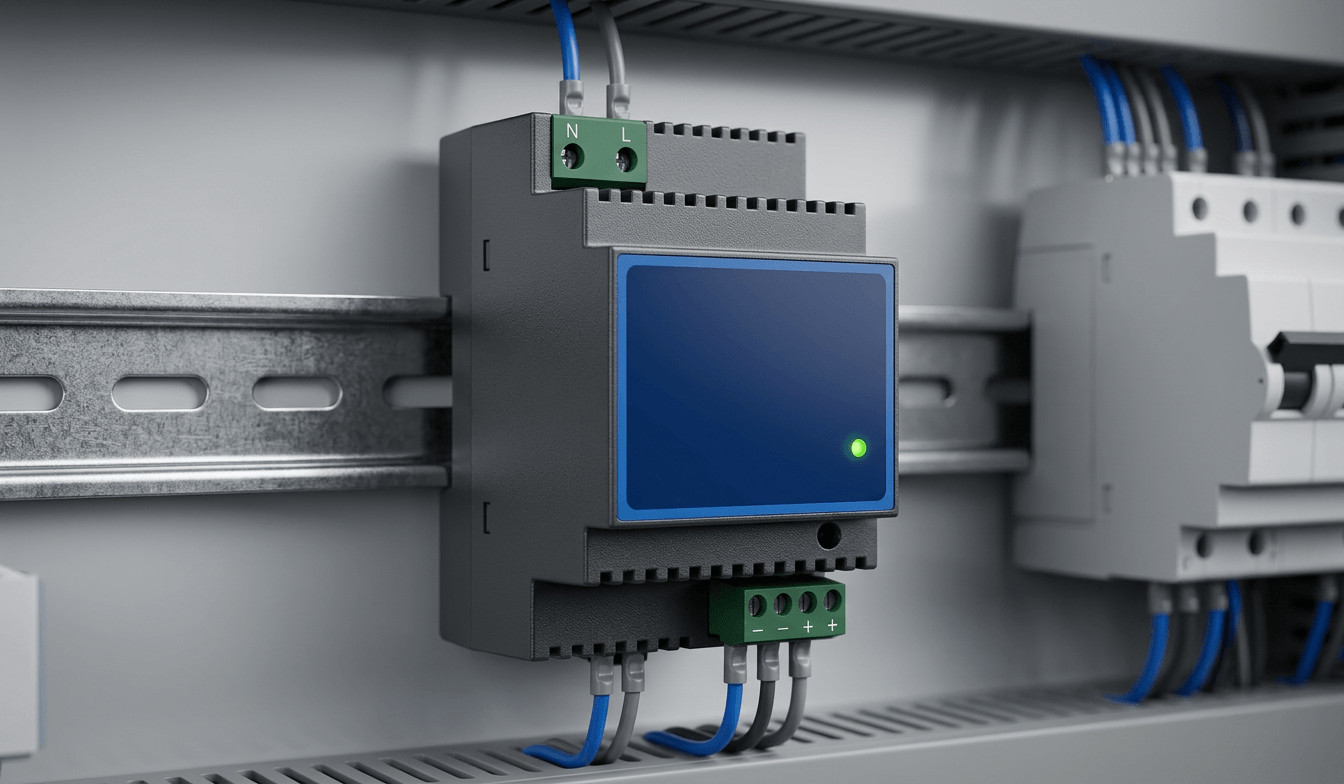
Control cabinets are increasingly required to accommodate more functionality within a limited enclosure volume. Conventional power supplies with relatively wide housings can occupy valuable DIN rail space that might otherwise be used for additional I/O modules, relays, protection devices, or other control components.
A slim DIN rail power supply can help increase the available mounting space without requiring a larger enclosure. Compact switching designs and high-frequency power-conversion components make it possible to achieve higher power density than with traditional, bulkier designs. Lower-power models such as the TPS010-GP24V 10 W unit are designed with a narrow profile for installations where DIN rail width is a significant constraint.
Power density must, however, be considered together with thermal management. Reducing component width does not eliminate heat generation. Adequate spacing, ventilation, ambient-temperature limits, derating requirements, and the installation instructions specified for the selected model remain important when designing densely populated control cabinets.
2. Electrical performance: Efficiency, Ripple and Noise, and Hold-up Time
The electrical characteristics of an industrial DIN rail power supply influence both system reliability and the behavior of connected loads. Input range, efficiency, output regulation, Ripple and Noise, transient response, and Hold-up Time should therefore be evaluated against the requirements of the application rather than considering rated power alone.
TPS single-phase models are available with wide AC input ranges, including units designed for operation from 85–264 V AC. A wide input range can simplify deployment across different mains environments by eliminating the need for manual input-voltage selection.
High Efficiency and Active PFC
Efficiency directly affects the amount of heat generated inside the control cabinet. A more efficient power supply converts a larger proportion of the input power into usable DC output power and dissipates less energy as heat.
Selected TPS models achieve efficiencies above 90%. In thermally constrained enclosures, reduced power loss can simplify thermal management and decrease the heat load imposed on neighboring components.
Higher-power models may also incorporate Active Power Factor Correction (PFC). Where applicable, PFC improves the input power factor and can support compliance with harmonic-current requirements such as EN 61000-3-2.
Low Ripple and Noise
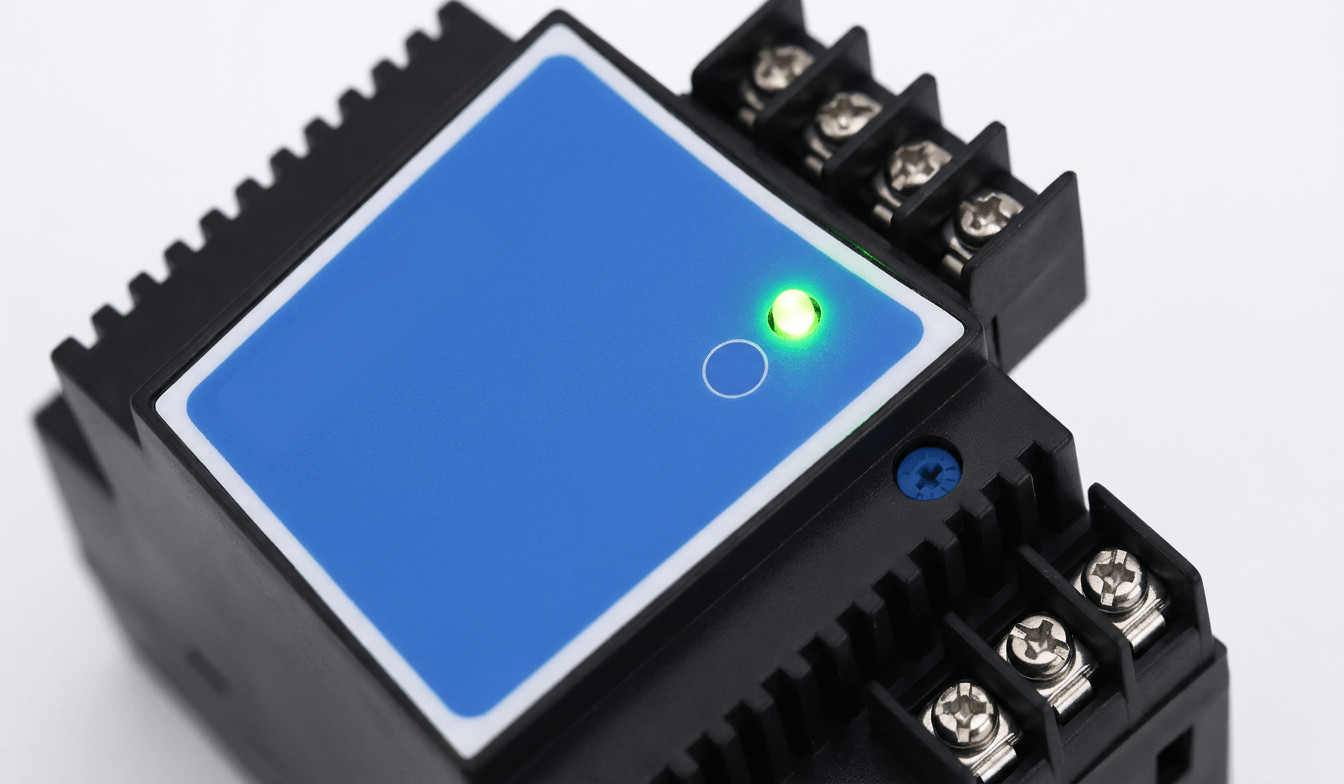
Ripple and Noise are particularly relevant when a DIN rail power supply for sensors, instrumentation, analog I/O, or other noise-sensitive electronics is required. Excessive switching noise on the DC supply can affect measurement integrity or interfere with low-level analog and digital signals.
Selected TPS power supplies specify Ripple and Noise values below 100 mV p-p. The required limit should be evaluated against the sensitivity of the connected equipment, cable routing, grounding concept, and overall EMC design.
Hold-up Time
Hold-up Time defines how long the output remains within its specified operating range after the AC input is interrupted. This parameter can be important for PLCs, controllers, and other electronic loads exposed to short mains interruptions.
Selected models provide a Hold-up Time of at least 20 ms at full load. Depending on the application and controller requirements, this may help bridge very short input interruptions. Whether the available Hold-up Time is sufficient should be verified against the minimum DC input requirements of the connected equipment.
3. Mechanical integration: 35 mm DIN rail mounting and vibration considerations
Mechanical integration affects installation time, serviceability, and long-term operation. TPS DIN rail power supplies are designed for mounting on standard 35 mm DIN rails, including TS35/7.5 and TS35/15 profiles, depending on the model.
The mounting mechanism should provide secure retention while allowing practical installation and replacement during cabinet assembly or maintenance. Terminal accessibility is equally important, particularly where larger conductor cross-sections or densely routed wiring are used.
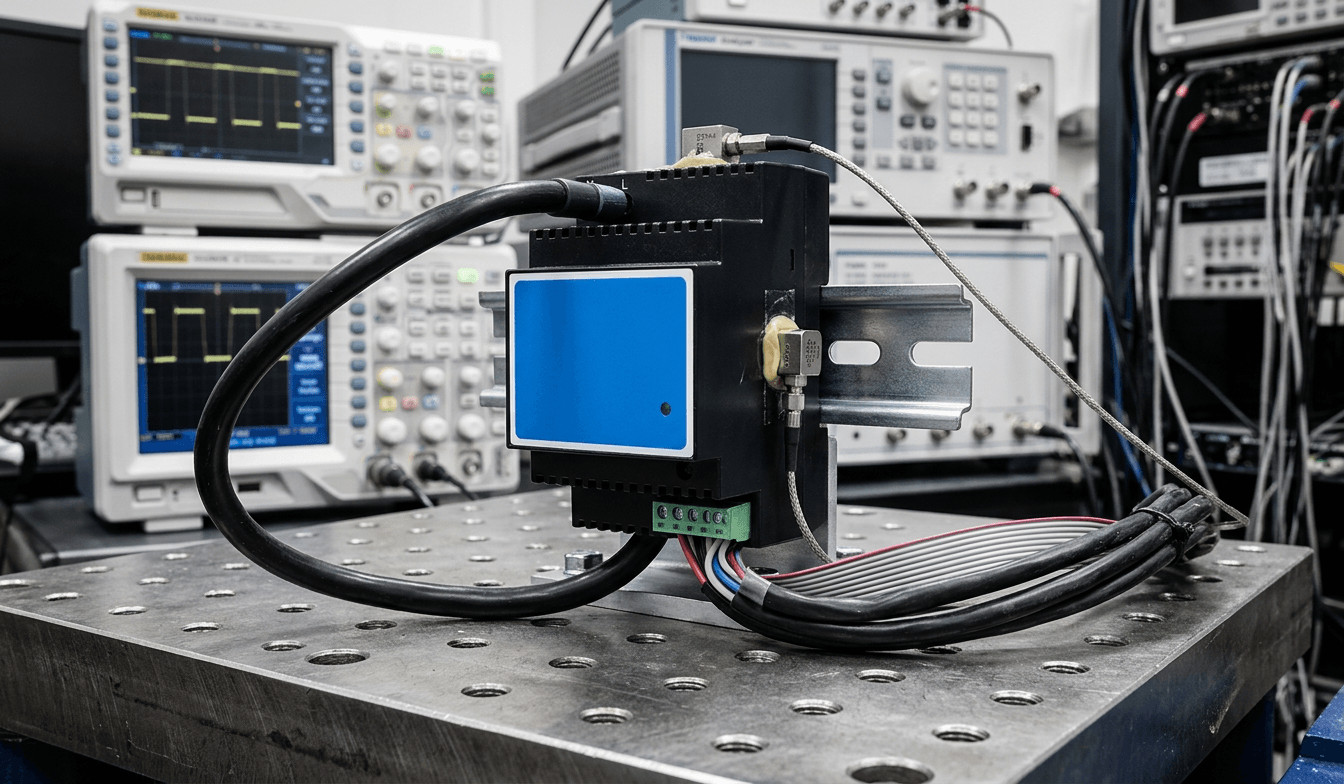
Vibration and mechanical shock can also be relevant in industrial machinery. Applications such as CNC equipment, presses, mobile machinery, and automated handling systems can subject cabinet components to repeated mechanical loads.
Where elevated shock or vibration levels are expected, the power supply’s specified environmental ratings should be checked against the actual installation conditions. Internal component fixation, PCB design, mounting construction, and the installation method can all influence mechanical robustness.
For wiring recommendations and installation considerations, refer to our DIN rail power supply installation and wiring guide.
4. Applications: From sensors to machine automation
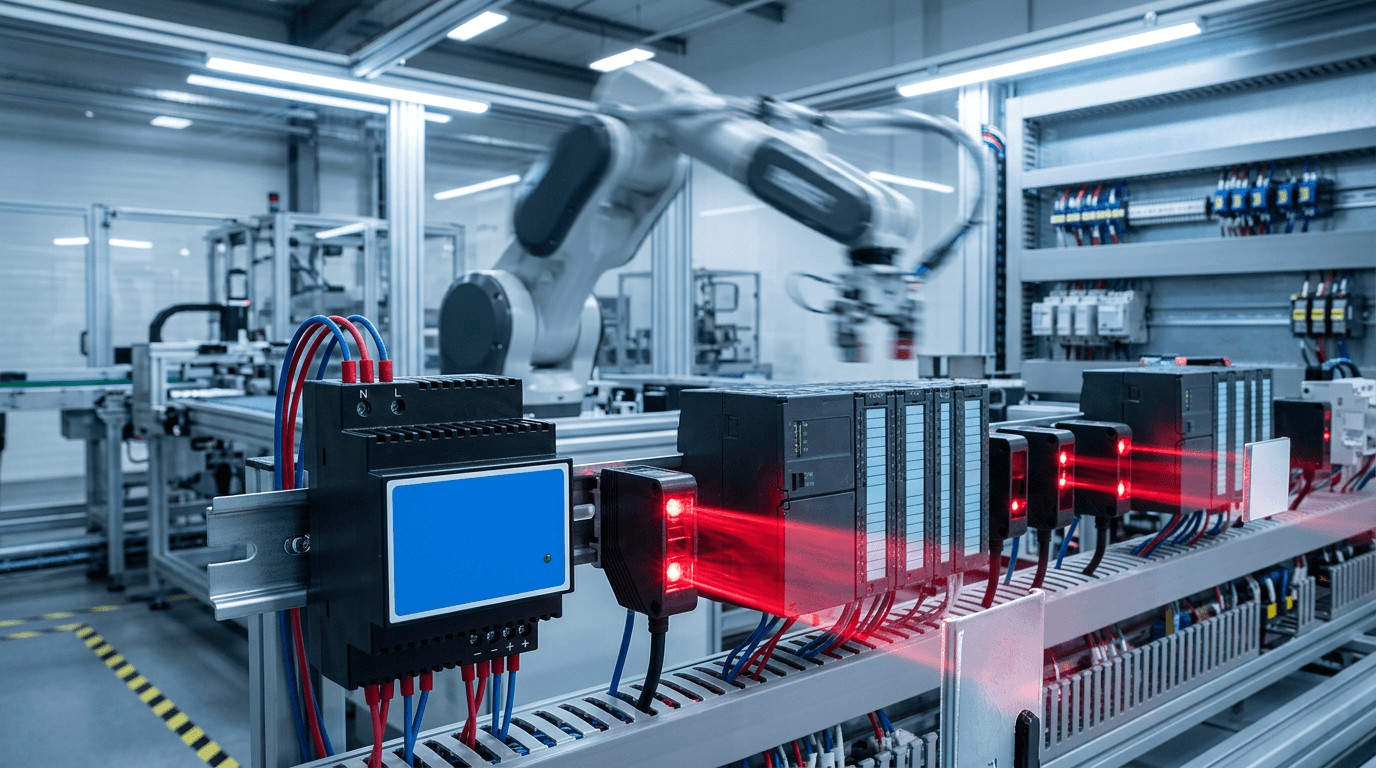
The 24 V DC supply level is widely used throughout industrial automation, but different load types place different demands on the power supply. Selection should therefore be based on both continuous consumption and dynamic load behavior.
Machine Automation and Inductive Loads
Machine-control systems may include PLCs, HMIs, relays, solenoids, valves, contactors, and DC motors. Some of these loads can require substantially more current during switching or startup than during steady-state operation.
For applications with short-duration peak loads, a power supply with a suitable Power Boost capability may be appropriate. Models such as the TPS100 DR-Plus series provide short-duration output capability above their continuous rating, depending on the specific model and operating conditions.
This additional capacity can support loads with temporary current peaks without requiring the power supply to be oversized solely on the basis of a short-duration startup demand. Peak-current magnitude, duration, repetition rate, ambient temperature, and protection behavior should nevertheless be checked against the relevant datasheet.
Sensors and Instrumentation
For sensors, analog instrumentation, and remote I/O, voltage stability and Ripple and Noise can be more important than short-duration overload capability.
An adjustable output can also be useful where cable resistance produces a measurable voltage drop between the power supply and the load. The adjustment should remain within both the power supply’s specified range and the permissible input-voltage range of all connected devices.
5. Compliance and protection functions
Power-supply compliance should be assessed at model level because applicable standards and approvals may differ across a product family. For equipment intended for international projects, procurement and engineering teams should verify the required safety, EMC, and market-access documentation before specifying a particular unit.
TPS DIN rail power supplies are available with CE marking and model-specific safety approvals. Where UL 60950-1 or IEC/EN/UL 62368-1 is relevant to a project, the applicable certification and standard edition should be confirmed for the individual part number rather than assumed for the complete product family.
Protection functions also play an important role in coordinating the power supply with downstream loads. Depending on the model, these may include:
- Overvoltage Protection (OVP): Limits or interrupts the output if an internal fault causes the output voltage to exceed the specified threshold.
- Overcurrent Protection (OCP): Limits the output when the load current exceeds the permitted operating range.
- Short-Circuit Protection (SCP): Provides controlled behavior during an output short circuit. The recovery method may vary by model.
- Overtemperature Protection (OTP): Available on applicable models to protect the power supply when internal temperatures exceed the specified operating limit.
Protection thresholds and recovery behavior should always be checked in the relevant datasheet, particularly where the power supply is coordinated with electronic circuit protection, fuses, or selective distribution modules.
For general information on international electrotechnical standards, refer to the International Electrotechnical Commission (IEC).
6. Product selection guide: 12 V and 24 V variants
Selecting a DIN rail power supply requires balancing continuous load, peak demand, environmental conditions, available mounting space, and future expansion.
Excessive oversizing can increase cost and consume unnecessary cabinet space. Insufficient capacity, on the other hand, can cause the supply to operate continuously near its limit and leave inadequate margin for transient loads or system expansion.
24 V DC Series
The 24 V DC range addresses common industrial control and automation requirements:
- TPS010-GP24V (10 W): Compact supply for low-power 24 V DC loads.
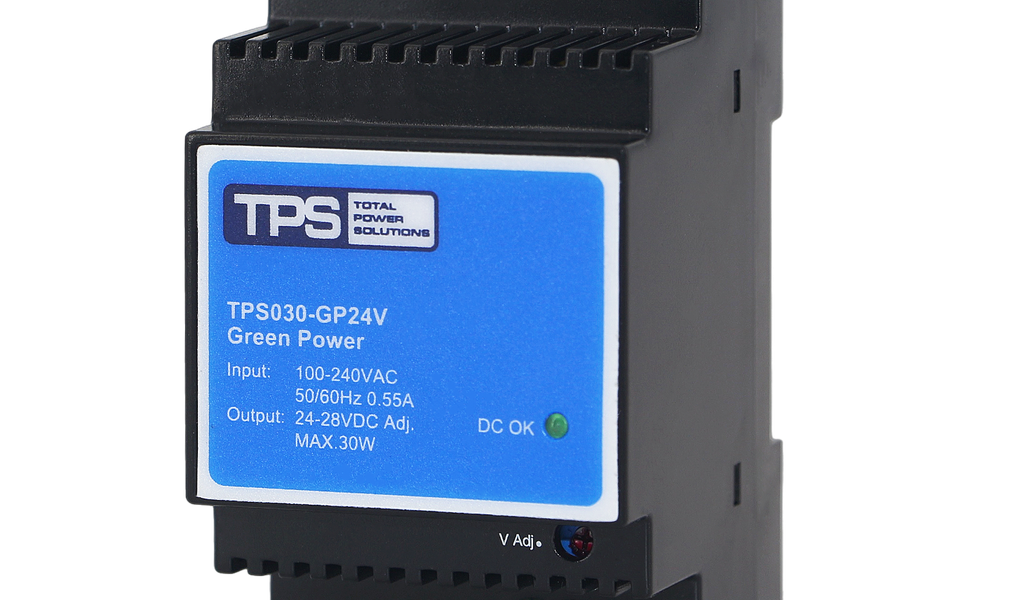
- TPS030-GP24V (30 W): Suitable for smaller control circuits and distributed automation applications. See also the TPS030 Pro Series.
- TPS060-GP24V (60 W): Intended for medium-power control and automation loads.
- TPS100-GP24V (100 W) and TPS100-DR1S24A: Higher-power options for systems with increased 24 V DC demand.
12 V DC Series
For equipment based on a 12 V DC bus, equivalent product options include:
- TPS010-GP12V (10 W)
- TPS030-GP12V (30 W)
- TPS060-GP12V (60 W)
- TPS100-GP12V (100 W)
- TPS100-DR1S12A
- TPS150-DR1S12A (150 W): Higher-output option for 12 V DC applications.
Before selecting a model, verify the detailed electrical, environmental, mechanical, and approval specifications against the requirements of the application.
7. RFQ and procurement checklist
A technically complete RFQ makes it easier to identify an appropriate industrial DIN rail power supply and compare alternatives on a consistent basis.
Include the following information where applicable:
- Nominal output voltage and current: For example, 24 V DC at 5 A.
- Continuous and peak load: Specify steady-state consumption as well as startup or transient current requirements.
- Load type: Identify motors, solenoids, contactors, capacitive loads, PLCs, sensors, or other equipment with relevant dynamic characteristics.
- Input voltage range: Specify the available AC or DC input range and mains frequency where applicable.
- DIN rail space: State the maximum permitted device width and any required installation clearances.
- Ambient conditions: Include operating temperature, altitude, humidity, shock, and vibration requirements where relevant.
- Thermal conditions: Identify restricted ventilation, high cabinet temperatures, or other conditions that may require derating.
- Required protection behavior: Consider OCP, SCP, OVP, OTP, and coordination with downstream protection devices.
- Required approvals and standards: Specify CE, UL, CB, or application-specific requirements such as railway or marine approvals where necessary.
- Quantity and delivery requirements: Include forecast volume, requested delivery date, and any project-specific procurement requirements.
8. FAQ
What is the advantage of a slim DIN rail power supply?
A slim DIN rail power supply occupies less horizontal space on a 35 mm DIN rail. This can provide additional mounting capacity for PLCs, I/O modules, relays, circuit protection, and other control components.
The mechanical benefit should be considered together with thermal requirements. Installation clearances, airflow, derating, and maximum ambient temperature remain important in densely populated cabinets.
Can DIN rail power supplies be used in applications with shock and vibration?
Industrial DIN rail power supplies may be designed for environments where mechanical shock and vibration occur. However, the permitted levels vary by model.
For machinery, mobile automation, or other mechanically demanding installations, compare the specified shock and vibration ratings of the selected power supply with the actual application requirements and installation conditions.
Are TPS DIN rail power supplies UL approved and CE marked?
Approvals and applicable standards should be verified for the individual model. TPS DIN rail power supplies are available with CE marking and model-specific safety approvals. Where UL 60950-1, IEC/EN/UL 62368-1, or another standard is required, confirm the relevant documentation for the specific part number before specifying it for a project.
How can voltage drop over long sensor cables be compensated?
Where the selected power supply provides an adjustable output, the output voltage can be increased within its specified adjustment range to compensate for part of the resistive voltage drop along the cable.
The voltage should be measured at the load under representative operating conditions. Any adjustment must remain within the permitted input-voltage range of the connected sensor and all other devices supplied by the same DC bus.
What happens if there is a short circuit on the 24 V DC line?
Depending on the model, Short-Circuit Protection (SCP) and Overcurrent Protection (OCP) may use mechanisms such as hiccup operation or constant-current limiting. The specific behavior determines how the power supply interacts with the fault and whether it automatically recovers after the short circuit is removed.
For systems requiring selective protection or predictable restart behavior, the protection characteristic should be checked in the model-specific datasheet.