

For system integrators, test engineers, and procurement teams equipping general purpose RF test benches, the quality of coaxial test cables is not a minor detail—it is the difference between reliable, repeatable measurements and wasted hours chasing phantom signals. A test cable with poor phase stability, high VSWR, or inconsistent insertion loss can turn a simple verification into a debugging nightmare.
TPS Elektronik’s coaxial cable assembly services provide high quality phase stable test cables and adapters for general purpose RF test benches—from SMA and BNC to N-type interfaces, with precision termination and documented testing that ensures measurement confidence from prototype validation to production test.
1. The RF Test Bench Challenge: Why Cable Quality Matters
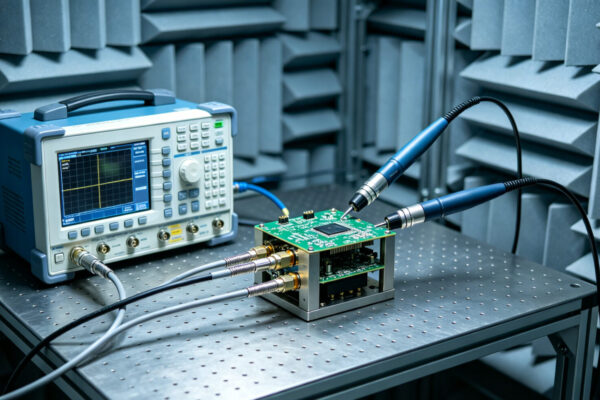
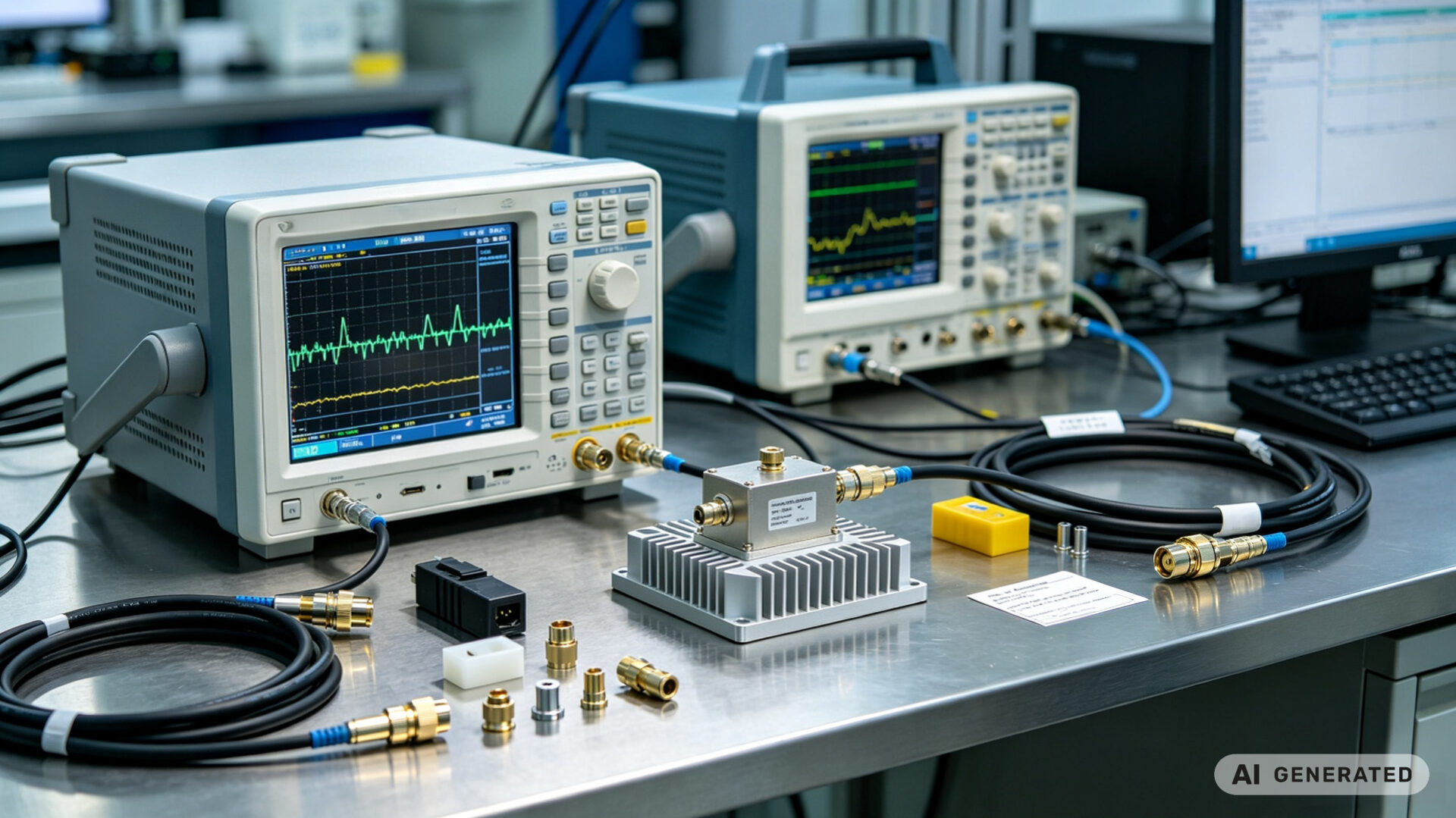
General purpose RF test benches are the workhorses of electronics development and production testing. They support a wide range of applications—from validating wireless modules and characterizing amplifiers to testing filters, antennas, and complete RF subsystems. At the heart of every test bench are the coaxial cables that connect the device under test (DUT) to the test equipment.
For test engineers and system integrators, the choice of test cables has a direct impact on measurement accuracy and repeatability. Poor quality cables can introduce errors that mask true DUT performance, leading to:
- Inconsistent measurements: Cables with high insertion loss or poor VSWR (Voltage Standing Wave Ratio) attenuate signals and create reflections that distort measurements
- Wasted debugging time: When engineers cannot trust their test setup, they waste hours chasing phantom problems that turn out to be cable-related
- Production yield issues: Marginal cables in production test can reject good units or pass bad ones, impacting quality and cost
- Calibration drift: Cables that change phase or loss with flexure require frequent recalibration
The solution is to equip the test bench with high quality phase stable coaxial test cables that maintain consistent electrical performance over time, temperature, and mechanical flexure. TPS Elektronik’s coaxial cable assembly services deliver exactly that—precision-terminated cables with documented performance that engineers can trust.
2. Phase Stability: The Key to Repeatable RF Measurements
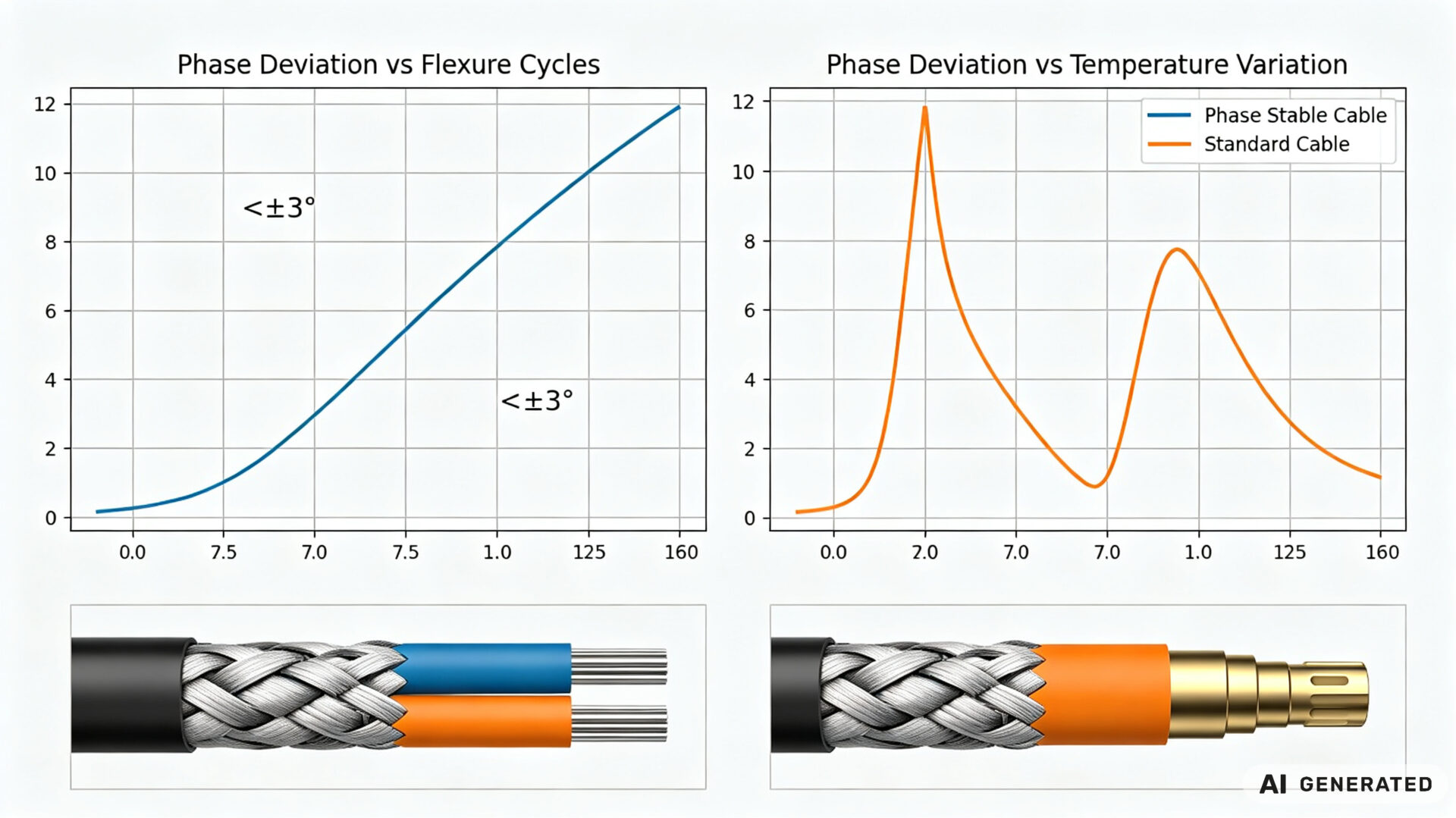
Phase stability is the most critical performance parameter for RF test cables used on general purpose test benches. When a cable is flexed—as it inevitably is during test setup, connection, and adjustment—its electrical length changes slightly. This change in electrical length translates to a phase shift at the measurement frequency.
For vector network analyzer (VNA) measurements, phase stability is particularly critical. A VNA measures both amplitude and phase to characterize a DUT’s S-parameters. If the test cables change phase when flexed, the measurement error can be significant—particularly at higher frequencies where a small phase error translates to a large measurement uncertainty.
Phase stable test cables minimize this effect through specialized construction:
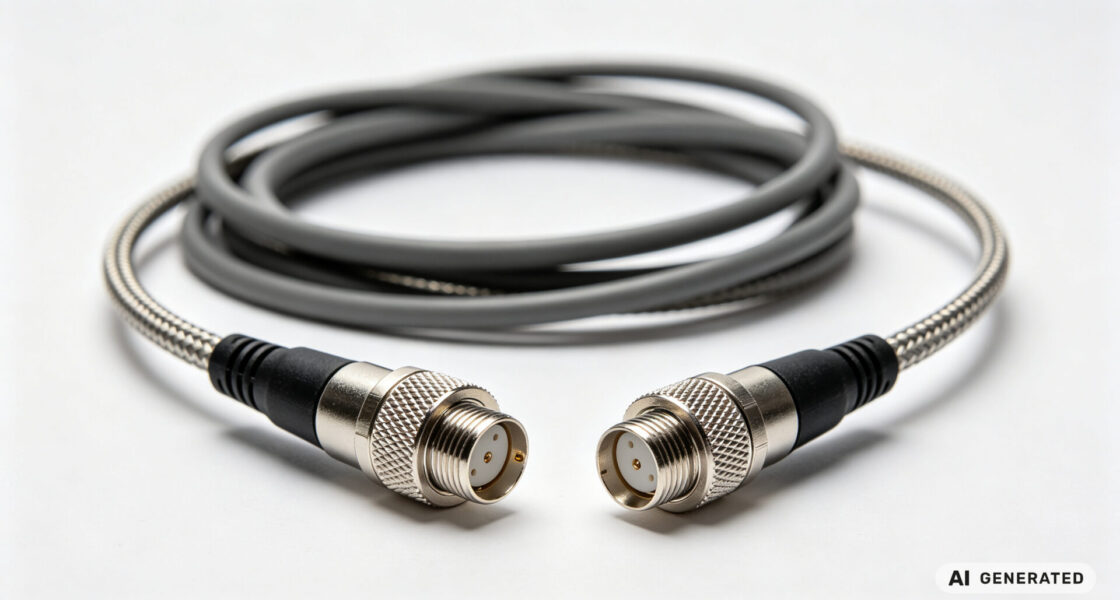
- Solid PTFE dielectric: Provides stable electrical properties over temperature and flexure
- Low-loss center conductor: Silver-plated copper or copper-clad steel reduces attenuation
- SPC ribbon braid shielding: Maintains consistent impedance during flexure
- Precision connector termination: Ensures consistent impedance at the interface
Typical phase stable test cables maintain phase deviation within ±3° up to 18 GHz and ±3° up to 27 GHz under flexure. By contrast, standard cables can exhibit phase drift of 10° or more with the same flexure—enough to invalidate critical measurements.
For lab grade coaxial cable applications, TPS Elektronik offers phase stable test cables designed for daily bench use, with performance validated per IEC 61196-1-111 for phase stability with bending and twisting.
3. Connector Options: SMA, BNC, and N-Type for General Purpose Testing
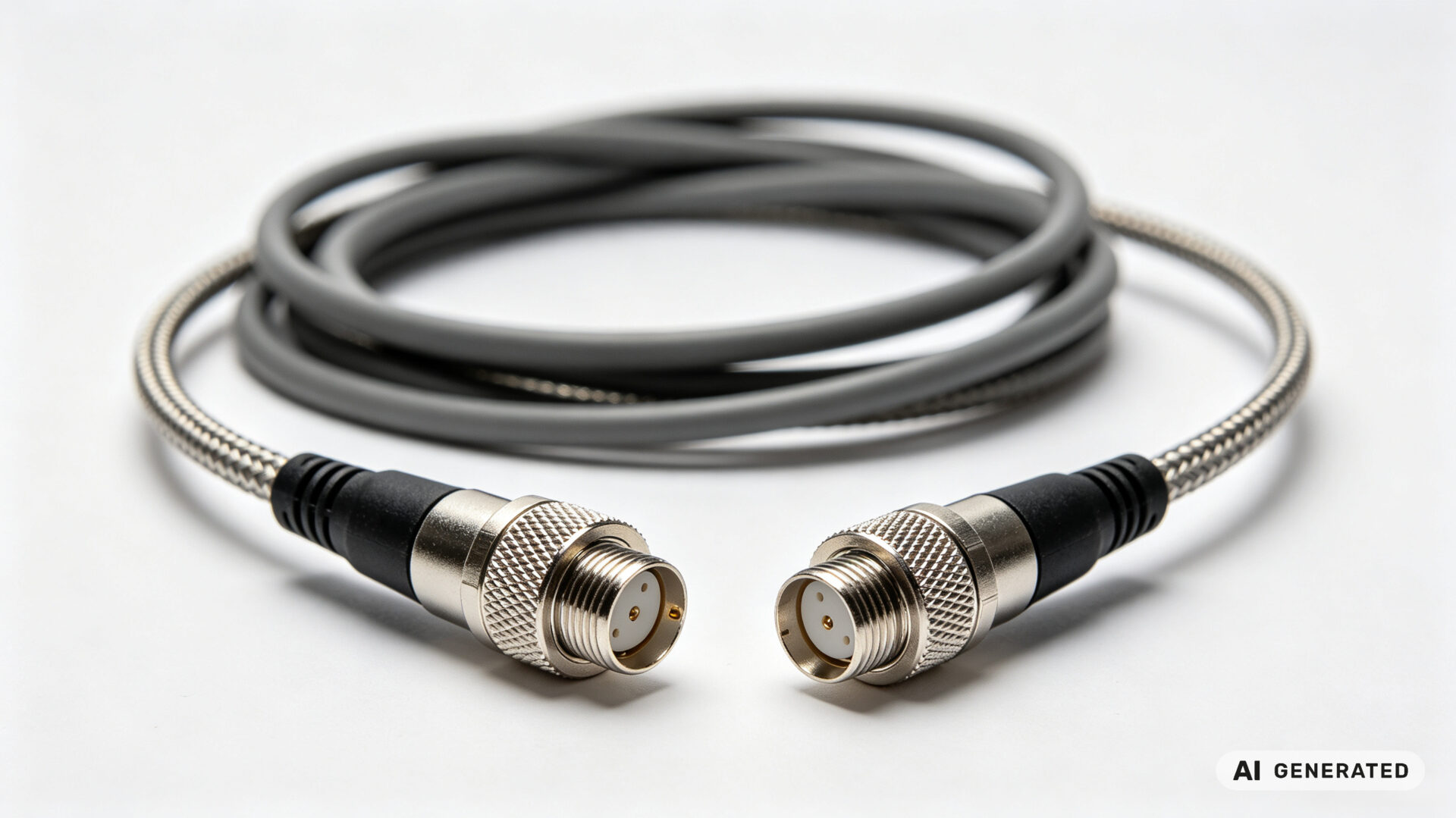
A general purpose RF test bench must accommodate a wide variety of DUTs with different connector interfaces. TPS Elektronik’s coaxial cable assembly services support the three most common connector families for bench testing: SMA, BNC, and N-type, plus adapters to bridge between them.
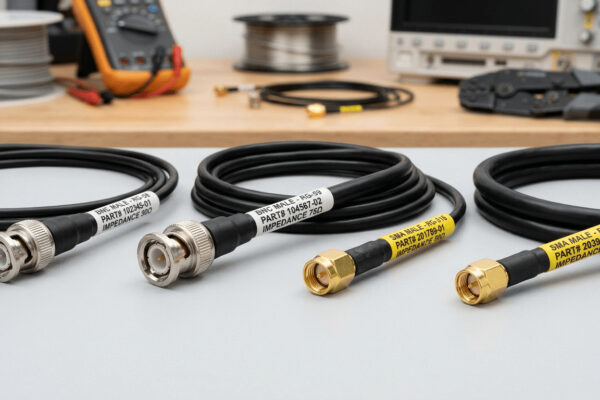
SMA Connectors (SubMiniature version A): SMA connectors are the workhorse of high-frequency bench testing, providing excellent electrical performance up to 18 GHz (or 26.5 GHz with precision versions). The threaded interface provides superior mechanical stability and reliable connections that withstand frequent mating cycles. Common configurations include SMA male to SMA male cable assemblies, as well as SMA to BNC adapters for mixed-interface requirements.
BNC Connectors (Bayonet Neill–Concelman): BNC connectors are standard for RF applications up to 4 GHz, featuring a bayonet locking mechanism that provides quick connection and reliable mechanical retention. They are widely used for video signals, general purpose RF measurements, and test equipment connections. TPS manufactures BNC assemblies using precision crimping and soldering techniques, with both 75-ohm and 50-ohm variants available.
N-Type Connectors: N-type connectors provide robust, weatherproof connections for applications up to 11 GHz and beyond. The threaded interface and larger physical size make them ideal for higher-power applications and environments where durability is required. TPS offers N-type cable assemblies for test benches that need to handle higher power levels or more demanding mechanical conditions.
For RF adapter cable assembly applications, TPS can provide custom adapter cables that bridge different connector types—SMA to N-type, BNC to SMA, and other combinations—allowing a single test bench to accommodate diverse DUTs without multiple custom cables.
4. TPS Coaxial Cable Assembly Capabilities for RF Test Benches
TPS Elektronik’s coaxial cable assembly services for general purpose RF test benches combine precision manufacturing, comprehensive testing, and integration with broader EMS capabilities.
Engineering & Design Support:
- Connector selection guidance based on frequency range, power level, and mechanical requirements
- Cable type selection for phase stability, low loss, or flexibility as needed
- Length optimization to minimize loss while maintaining bench flexibility
- Custom adapter configurations for mixed-interface DUTs
Manufacturing Capabilities:
- Precision termination: Crimping and soldering of SMA, BNC, and N-type connectors with strict process control
- Phase stable cable construction: SPC ribbon braid and tri-shielding for stable performance under flexure
- RF adapter cables: SMA to SMA, SMA to N-type, BNC to SMA, and other configurations
- Custom lengths: From short jumper cables to longer bench runs
- Labeling and documentation: Clear identification for bench organization and traceability
Integration with EMS:
Unlike sourcing cables from a pure cable shop, TPS delivers cable assemblies that are verified to fit into your broader electronic assembly workflow. For bench RF coaxial cable applications in production test environments, this integration ensures that test cables are coordinated with the test fixtures, DUT interfaces, and system integration requirements—reducing the risk of last-minute surprises.
5. Quality and Testing: Ensuring Measurement Confidence
For RF test bench applications, quality assurance is not a final step—it is embedded throughout the manufacturing process. A cable assembly that passes visual inspection but fails electrical testing can still compromise measurements.
TPS Elektronik’s quality process for RF test cable assemblies includes:
- Impedance verification: Ensuring 50-ohm characteristic impedance for proper matching
- Insertion loss testing: Verifying that loss meets specification across the operating frequency range
- VSWR testing: Ensuring return loss meets specified limits for minimal signal reflection
- Phase stability validation: Testing per IEC 61196-1-111 methods for phase stability with bending and twisting
- Visual inspection: Checking connector terminations, strain relief, and shielding integrity
- Documentation: Providing test reports that can be referenced for quality records and audits
TPS references IEC 61169 series standards for coaxial connector performance and IEC 61196-1-111 for phase stability test methods. This commitment to recognized standards ensures that TPS cable assemblies meet the performance expectations of demanding RF test applications.
For precision coax test lead applications, the combination of precision termination, documented testing, and traceable quality records provides the confidence that engineers need to trust their measurements—whether in R&D characterization or production test.