

For system integrators, panel builders, and electrical engineers designing industrial robot control cabinets, the power supply is not an afterthought—it is the foundation upon which automation reliability is built. A single power failure in a robot control cabinet can halt an entire production line, costing thousands per hour in downtime. In environments where temperatures fluctuate from freezing to sweltering and vibration from adjacent machinery is constant, standard commercial power supplies simply cannot deliver the required reliability.
TPS Elektronik’s industrial DIN rail power supply portfolio is engineered specifically for these demanding conditions: wide operating temperature ranges from -25°C to +70°C, shock and vibration resistance per IEC 60068-2-6, and robust protection features that keep robot cells running—from KUKA and ABB to FANUC and beyond.
1. The Robotics Power Challenge: Why Robot Control Cabinets Need Specialized Power Supplies
Industrial robots are among the most demanding loads in factory automation. A typical robot cell consists of the robot arm itself, a control cabinet housing the robot controller, servo drives, PLC, I/O modules, safety relays, and communication interfaces—all powered by a 24V DC DIN rail power supply. The control cabinet is the brain of the robot cell, and its power supply must deliver clean, stable DC power to every component within.
What makes robot control cabinets uniquely challenging for power supplies?
- Temperature extremes: Robot cells operate in environments ranging from cold storage facilities at -25°C to foundries exceeding 60°C
- Continuous vibration: The robot arm itself generates vibration during high-speed movements, and adjacent machinery transmits shock loads to the control cabinet
- Peak power demands: Servo drives and motors draw high inrush currents during acceleration, requiring power supplies with significant peak power capability
- Unattended operation: Robot cells run 24/7 with minimal human intervention, demanding high MTBF and robust protection
- Space constraints: Control cabinets are densely packed with components, leaving little room for bulky power supplies
Standard commercial power supplies—designed for office or light industrial environments—fail in one or more of these dimensions. They derate significantly at elevated temperatures, their mechanical connections loosen under vibration, and they lack the peak power capability to start servo drives reliably.
TPS Elektronik’s industrial DIN rail power supply solutions are designed from the ground up for these harsh conditions, with engineering support available through TPS’s development services for custom requirements.
2. Wide Temperature Range: From Freezing Factories to Sweltering Foundries
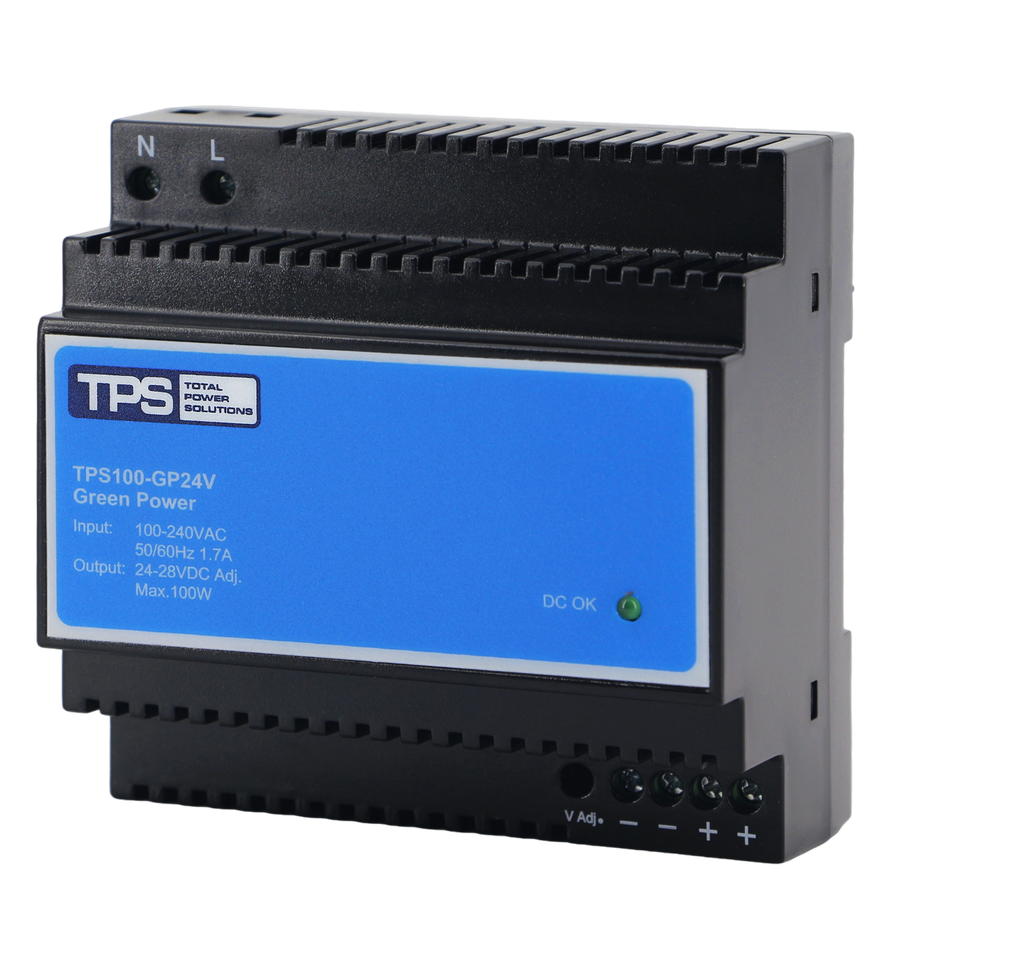
Industrial robot installations span an extraordinary range of ambient temperatures. Cold storage facilities with automated palletizers operate at -25°C. Automotive body shops reach 50°C. Foundries and forging operations can exceed 60°C inside the control cabinet.
A power supply’s temperature specification is not just about survival—it is about performance under load. Many power supplies that claim a wide temperature range actually derate significantly at high temperatures, meaning they cannot deliver their full rated power when the cabinet is hottest.
TPS wide temperature DIN PSU solutions are designed with:
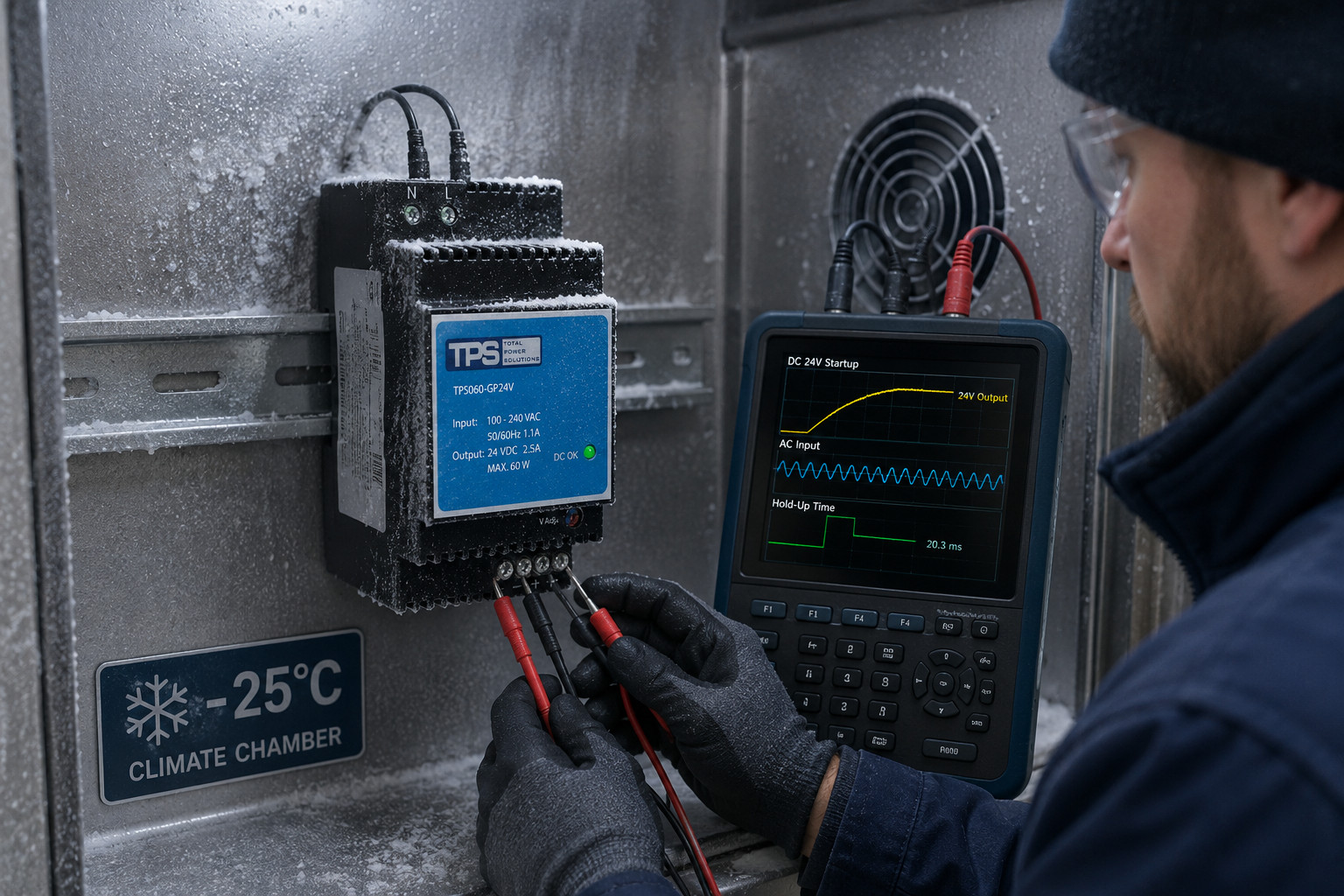
- Operating temperature ranges: -25°C to +70°C for standard models, with extended-range options available
- Minimal derating: Full load capability maintained through the majority of the operating range
- Convection cooling: Fanless designs eliminate moving parts that can fail, reduce dust ingress, and ensure quiet operation
- 105°C long-life electrolytic capacitors: Extended component ratings for long service life in high-temperature environments
- Thermal management: Optimized PCB layouts and component placement for even heat distribution
For industrial robot DIN rail power applications, the wide temperature capability ensures that the power supply delivers consistent voltage to the robot controller regardless of ambient conditions. This is particularly critical for robots operating in unheated warehouses or adjacent to heat-generating processes.
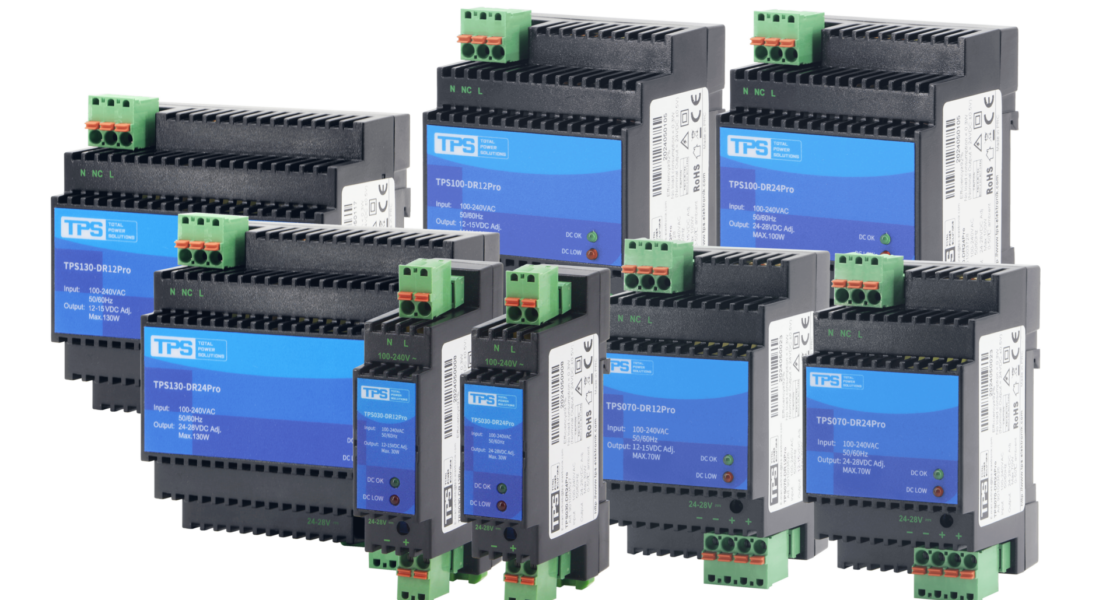
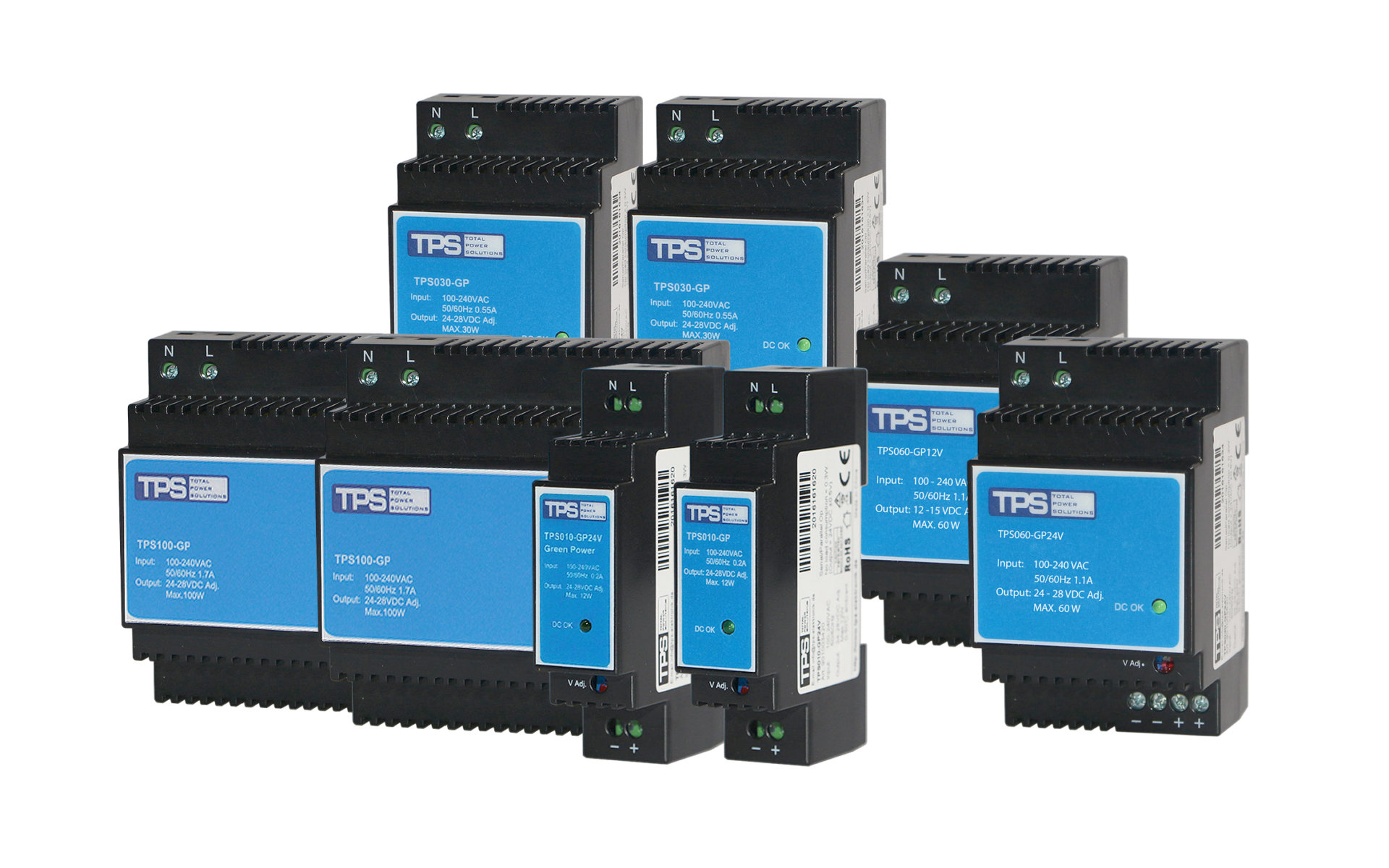
The TPS portfolio includes the GP Series (10–100W), Pro Series (30–130W), and Peak DR+ Series (100–320W), all with wide temperature support. TPS’s custom power supply capabilities also enable tailored thermal solutions for unique application requirements.
3. Vibration Resistance: Withstanding the Shake of Adjacent Machinery
Robot cells are environments of constant mechanical energy. The robot arm moves at high speeds, generating vibration that transmits through the floor and into the control cabinet. Adjacent machinery—presses, conveyors, and other robots—adds additional vibration and shock loads.
Vibration affects power supplies in several ways:
- Connector loosening: Repeated vibration can cause terminal screws and connectors to back out
- Component fatigue: Solder joints and component leads can fail under cyclic stress
- Contact fretting: Micro-motion between contacts can cause intermittent failures
- Mechanical resonance: Mounting hardware can resonate at specific frequencies
TPS vibration resistant power supply solutions address these failure modes through:
- IEC 60068-2-6 compliance: Tested and qualified for vibration resistance per the international standard
- Robust DIN rail clips: Metal clips and wall brackets provide secure mounting that resists loosening
- Soldered connections: Critical connections are soldered, not press-fit, for vibration resistance
- Component securing: Heavy components are secured with adhesive or mechanical retention
- Shock resistance: Tested to withstand shocks from adjacent machinery and handling
For robot control cabinet power applications, vibration resistance translates directly to uptime. A power supply that maintains connection and continues delivering clean DC power despite constant vibration prevents the nuisance trips and intermittent faults that plague poorly designed systems.
TPS’s industrial automation DIN rail supply portfolio includes models that have been validated for use in high-vibration environments, including CNC machining and mobile automation applications.
4. Handling Peak Loads: Motor Starts and Inrush Currents
Robot control cabinets are not constant-power loads. The power draw varies dramatically as robots accelerate, decelerate, and hold position. Servo drives, in particular, draw significant inrush current during motor starts—often 150% to 200% of their steady-state current.
A power supply that cannot handle these peaks will trip its overcurrent protection (OCP) and shut down, causing the robot to fault and the production line to stop. This is why peak power capability is as important as continuous power rating for robot control cabinet applications.
TPS DIN rail power supplies address this with:
- 170% power boost for 10 seconds: The Peak DR+ series provides up to 170% of rated power for dynamic loads such as motor starts and actuator peaks
- Capacitive load support: Designed to handle the high inrush currents of capacitive loads without nuisance tripping
- Fast transient response: Maintains voltage regulation during rapid load changes
- Short-circuit protection with auto-recovery: Protects the power supply without requiring manual reset
For 24V DIN rail robot controller applications, the peak power capability ensures that servo drives can start reliably even when multiple axes accelerate simultaneously. The 170% boost provides enough headroom to handle the worst-case startup scenario without oversizing the power supply for the continuous load.
5. Protection Features for Unattended Operation
Robot cells operate around the clock with minimal human supervision. When a fault occurs, the power supply must protect itself and the downstream equipment, then recover automatically when the fault clears.
TPS industrial DIN rail power supplies include comprehensive protection features:
- Overcurrent protection (OCP): Protects against short circuits and overloads with hiccup-mode or auto-recovery behavior
- Overvoltage protection (OVP): Prevents voltage excursions that could damage sensitive electronics
- Overtemperature protection (OTP): Reduces output or shuts down if internal temperature exceeds safe limits
- Overload protection (OLP): Safely handles sustained overload conditions
- Indefinite short-circuit protection: Protects against short circuits without damage
For factory robot power supply applications, these protection features are essential for unattended operation. When a fault occurs—a shorted sensor, a locked motor, or a wiring error—the power supply protects itself and the downstream equipment, then automatically restores power when the fault is cleared. This minimizes downtime and eliminates the need for manual intervention.
TPS’s high MTBF DIN rail power designs, with MTBF >350,000 hours specified at 25°C, provide the long-term reliability that 24/7 robotic operations demand.
For applications requiring custom protection profiles or unique form factors, TPS’s engineering and development services can design and manufacture tailored power solutions.
6. TPS Development Capabilities for Custom Power Solutions
While TPS offers a comprehensive standard portfolio of industrial DIN rail power supplies, some robot control cabinet applications require custom solutions—unique voltage rails, specialized protection profiles, or form factors tailored to specific cabinet layouts.
TPS Elektronik’s development services provide end-to-end custom power solution capabilities:
- Hardware design: Single- and three-phase power supplies, DC/DC converters, rectifiers, and inverter-based systems
- Software and firmware: Embedded firmware for MCU- and FPGA-based systems, including control logic and interface programming
- PCB design: Schematic capture and PCB layout using Altium Designer and Cadence Allegro
- Mechanical design: 3D modeling and simulation using SolidWorks and AutoCAD
- EMC and safety: Knowledge of European, U.S., and Chinese EMC and electrical safety standards, with development-accompanying consideration of EMC and safety requirements
- Interface integration: RS-232, RS-485, RS-422, SPI, I²C, CAN, Ethernet/TCP-IP, Modbus, and CAN-based protocols
- Turnkey manufacturing: From prototype to series production, including assembly and test
For DIN rail power for KUKA, ABB, FANUC and other robot brands, TPS can develop custom power supplies that integrate seamlessly with specific robot controller requirements. Whether the need is a non-standard voltage output, enhanced thermal performance, or specialized communication interfaces, TPS’s development team can deliver.
TPS’s custom power supply case studies demonstrate the company’s track record in delivering tailored power solutions for demanding industrial applications.