

For system integrators, electrical engineers, and procurement teams supporting R&D environments, the benchtop power supply is not just a source of DC power—it is the foundation of every test sequence, every validation run, and every design verification. When testing embedded systems, power supplies that require manual adjustment for every test condition waste engineering hours and introduce human error into repeatable test sequences.
The EA-PSI 5040-40A, distributed by TPS Elektronik, is a high-performance programmable desktop DC power supply engineered for demanding laboratory and industrial testing environments. It delivers 0–40V DC at 0–40A with 640W output power through an auto-ranging power stage, features <0.08% voltage load regulation, <10mV RMS ripple, and <1ms load regulation time, and supports USB, Ethernet, and galvanically isolated analog control interfaces with full SCPI and LabVIEW compatibility—making it the ideal programmable lab power supply for automating voltage and current profiling in embedded system development.
1. The R&D Test Challenge: Why Manual Power Supply Adjustment Is No Longer Acceptable
Embedded system development is a process of constant iteration—design, prototype, test, debug, refine, repeat. Each iteration requires testing the device under test (DUT) across multiple voltage and current conditions: power-on sequencing, brown-out detection, overvoltage tolerance, current consumption profiling, and boundary testing across the full operating range.
For engineers on the bench, the traditional approach to power supply control is manual: turn a knob, read a display, note a value, repeat. And For a simple test sequence with three voltage steps, this might take seconds. For a comprehensive validation run with dozens of test points, it can consume hours—hours that could be spent analyzing data, debugging code, or designing the next revision.
The limitations of manual power supply control in R&D are significant:
- Inconsistent test conditions: Manual adjustments introduce variability between test runs, making it difficult to compare results
- Wasted engineering time: Skilled engineers spending time turning knobs instead of analyzing data
- Limited test coverage: Time constraints force engineers to run fewer test points than ideal
- No data logging: Manual setups cannot capture voltage and current data synchronized with test execution
- Repetitive motion injuries: Hours of manual adjustment take a physical toll
The solution is automated voltage and current profiling—programming the power supply to execute test sequences automatically, with precise timing, consistent conditions, and synchronized data capture. TPS Elektronik’s programmable lab power supply solutions, led by the EA-PSI 5040-40A, are engineered to deliver exactly this capability.
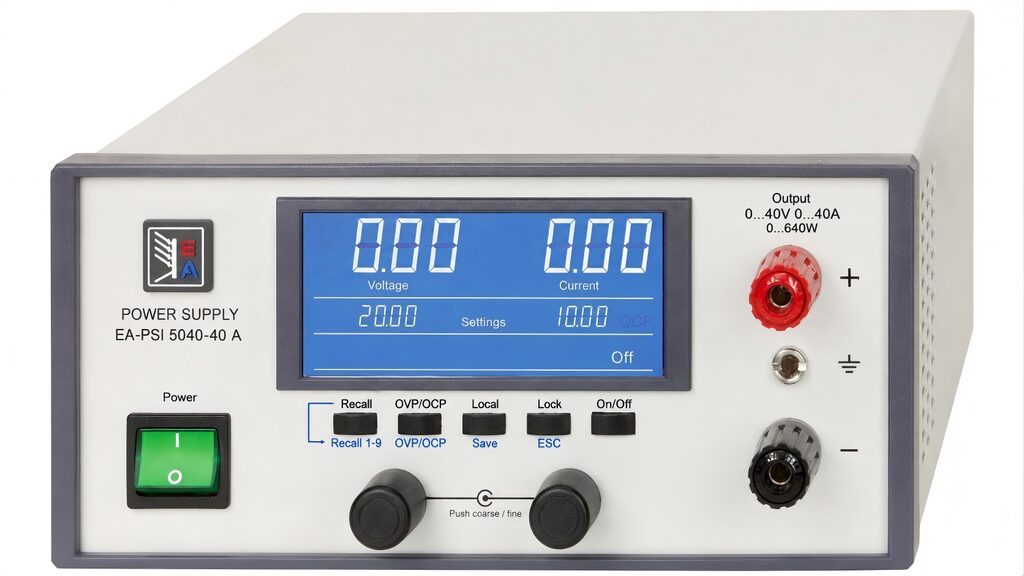
2. Product Overview: EA-PSI 5040-40A Programmable Lab Power Supply
The EA-PSI 5040-40A is a microprocessor-controlled programmable desktop DC power supply from the EA-PSI 5000 A series, manufactured by EA Elektro-Automatik and distributed by TPS Elektronik. It is engineered for demanding laboratory and industrial testing environments where precision, programmability, and reliability are essential.
Key specifications at a glance:
- Output: 0–40V DC, 0–40A, 0–640W (auto-ranging)
- Input: 90–264V AC, 45–65Hz with active PFC >0.99
- Efficiency: Up to 92%
- Voltage load regulation: <0.08%
- The Voltage line regulation: <0.02%
- Voltage ripple: <80mV PP, <10mV RMS
- Load regulation time: <1ms
- Voltage accuracy: <0.2%
- Current accuracy: <0.2%
- Display: Blue LCD showing set values, actual values, and status simultaneously
- Preset memories: 9 groups for instant recall of frequently used configurations
- Interfaces: Galvanically isolated analog, USB, Ethernet
- Command support: SCPI, LabView VIs, Windows control software
- Cooling: Temperature-controlled fan for quiet operation under full load
- Dimensions: 200×87×331mm, weight 4.3kg
- Compliance: SELV (EN 60950) for 40V models, EMC EN 55022 Class B
The EA-PSI 5040-40A combines the precision of a laboratory-grade instrument with the programmability required for automated testing, making it an ideal lab power supply for R&D applications across embedded systems, automotive electronics, medical devices, and industrial control.
3. Auto-Ranging Output: Flexible Power for Diverse Embedded Systems
One of the defining features of the EA-PSI 5040-40A is its auto-ranging output stage. Unlike traditional power supplies with a fixed voltage-current curve, auto-ranging technology allows the power supply to deliver full rated power across a wide range of voltage and current combinations. The auto-ranging output supports constant voltage, constant current, constant power, and constant resistance modes with fast crossover.
For a 640W power supply with auto-ranging:
- At 40V, the supply can deliver up to 16A (640W)
- When At 20V, the supply can deliver up to 32A (640W)
- At 16V, the supply can deliver up to 40A (640W)
This flexibility is invaluable for embedded system test power applications where the load may vary significantly. A single power supply can be used to test devices with different voltage and current requirements—from 3.3V microcontrollers drawing milliamps to 24V motor drivers drawing tens of amps—reducing the need for multiple power supplies on the bench.
The auto-ranging capability also ensures that the power supply can handle the dynamic current demands of modern embedded systems, which often draw brief but significant current spikes during operation. The <1ms load regulation time ensures that voltage remains stable even during these rapid load changes.
4. Automated Voltage and Current Profiling with 9 Memory Presets
For engineers running repetitive test sequences—power-on testing, brown-out verification, voltage margining, and current consumption profiling—the ability to recall and execute test configurations quickly is essential. The EA-PSI 5040-40A features 9 preset memory groups that store complete output configurations. Which including voltage, current, and protection settings.
This capability enables automated voltage profiling for embedded system testing:
- Power-on sequencing: Program multiple voltage steps to simulate real-world power-up conditions
- Brown-out testing: Automatically cycle voltage through the brown-out threshold to verify device behavior
- Voltage margining: Step through voltage limits to test device tolerance
- Current consumption profiles: Measure current draw across different operating modes
For embedded system development, the ability to automate these test sequences delivers tangible benefits:
- Faster validation: Complete test runs in minutes instead of hours
- Repeatable results: Every test run follows the exact same sequence
- Broader coverage: Run more test points in the same time
- Less operator error: Eliminate manual adjustment mistakes
For embedded development power supply applications, the combination of 9 memory presets and remote control capabilities means that engineers can develop test sequences once and run them repeatedly—with consistent, repeatable results.
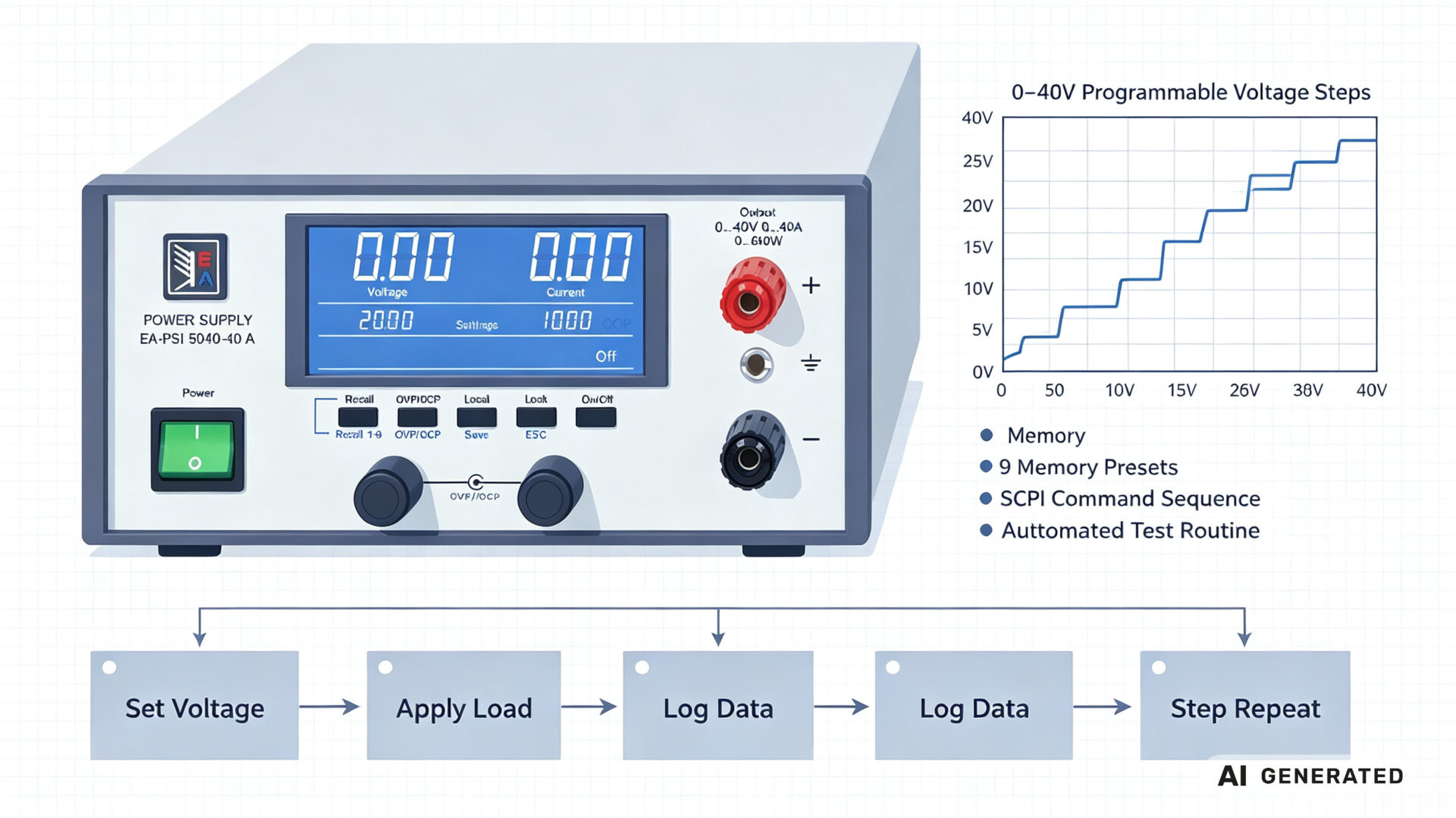
5. Remote Control and Automation: USB, Ethernet, and SCPI
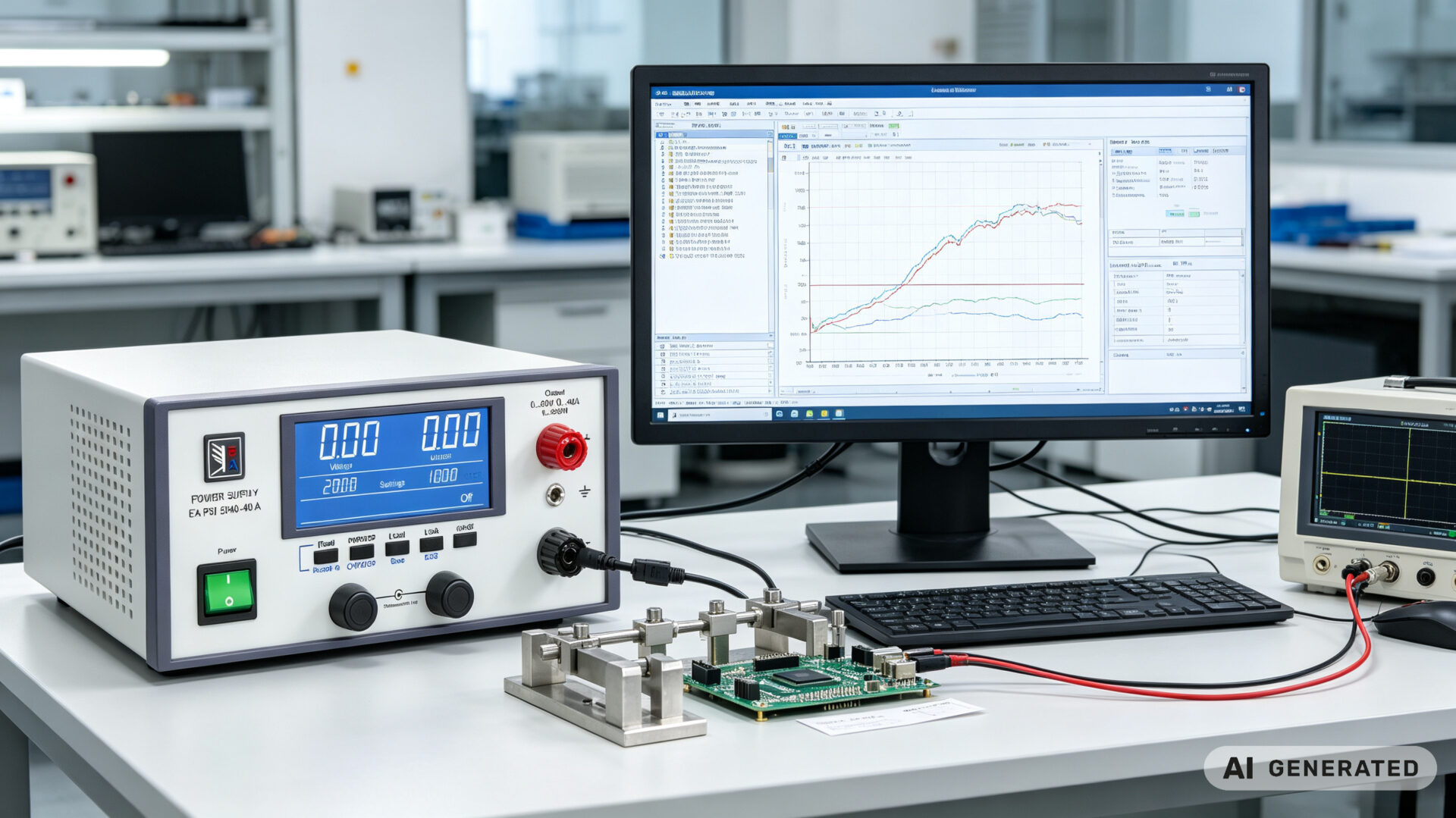
The EA-PSI 5040-40A is designed for seamless integration into automated test systems. With USB, Ethernet, and galvanically isolated analog interfaces standard on-board, the power supply can be controlled from a PC, test controller, or automated test equipment.
Key automation capabilities for R&D environments include:
- SCPI command support: Standard Commands for Programmable Instruments enable integration with virtually any test automation software
- LabView VIs included: Ready-to-use virtual instruments for National Instruments LabVIEW
- Windows control software: EA Power Control software for manual and automated operation
- Galvanically isolated analog interface: 0–5V / 0–10V control signals for integration with analog test systems
- Built-in supervision: Reduces test equipment requirements and eliminates external monitoring hardware
For automated test sequences, the combination of SCPI commands and USB/Ethernet connectivity enables:
- Scripted test sequences: Write Python, C#, or LabVIEW scripts that control the power supply, DUT, and measurement instruments in a coordinated sequence
- Data logging: Capture voltage, current, and power readings synchronized with test execution
- Remote monitoring: Monitor test status from anywhere on the network
- Continuous integration: Integrate power supply control into automated test frameworks
For programmable power for prototyping applications, the remote control capabilities mean that engineers can design, test, and refine power supply sequences without ever touching the front panel—freeing them to focus on analysis rather than adjustment.
6. Precision and Stability for Sensitive Embedded Electronics
Embedded systems are increasingly sensitive to power supply quality. A 3.3V microcontroller expects 3.3V—not 3.25V, not 3.35V. Voltage fluctuations that would be invisible to a power-hungry motor driver can cause logic errors, ADC reading errors, or communication failures in a sensitive embedded system.
The EA-PSI 5040-40A delivers the precision that programmable bench power supply applications require:
- <0.08% voltage load regulation: Output voltage changes by less than 0.08% from no load to full load, ensuring stable operation of sensitive circuits
- <0.02% voltage line regulation: Output voltage remains stable even as input AC voltage fluctuates
- <10mV RMS voltage ripple: Ultra-low ripple ensures clean DC power that does not introduce noise into sensitive analog or digital circuits
- <0.2% voltage and current accuracy: Precise setpoint accuracy for repeatable test results
- <1ms load regulation time: Fast transient response maintains voltage stability during rapid load changes
For programmable DC bench supply applications in embedded development, these specifications ensure that the power supply does not introduce artifacts that could mask true device behavior. Engineers can confidently validate power-on sequences, measure current consumption, and test brown-out detection without worrying about power supply-induced errors.
The 16-bit microprocessor-controlled architecture provides the resolution and stability required for precision measurements, while the blue LCD display shows set values, actual values, and status information simultaneously for real-time monitoring.
7. Comprehensive Protection for Device-Under-Test Safety
In R&D environments, the device under test (DUT) is often a one-of-a-kind prototype worth thousands of dollars. Protection against electrical faults is not optional—it is essential.
The EA-PSI 5040-40A includes comprehensive protection features:
- OVP (Overvoltage Protection): Protects the DUT from voltage excursions beyond set limits
- OCP (Overcurrent Protection): Prevents damage from excessive current draw
- The OPP (Overpower Protection): Shuts down the output if power exceeds safe limits
- OTP (Overtemperature Protection): Reduces output or shuts down if internal temperature exceeds safe operating limits
For R&D bench power supply applications, these protection features are essential—prototypes represent significant development investment, and protection against electrical faults prevents costly delays and rework.
The unit is SELV compliant according to EN 60950 for 40V models and meets EMC EN 55022 Class B standards for electromagnetic compatibility, ensuring safe operation in laboratory environments.
8. Technical Specifications at a Glance
| Parameter | Specification |
|---|---|
| Model | EA-PSI 5040-40A (PN: HEA3588 / 05100406) |
| Output Voltage | 0–40V DC |
| Output Current | 0–40A |
| Output Power | 0–640W (auto-ranging) |
| Input Voltage | 90–264V AC, 45–65Hz |
| Power Factor | >0.99 (active PFC) |
| Efficiency | Up to 92% |
| Voltage Load Regulation | <0.08% |
| Voltage Line Regulation | <0.02% |
| Voltage Ripple (RMS) | <10mV |
| Voltage Ripple (PP) | <80mV |
| Load Regulation Time | <1ms |
| Voltage/Current Accuracy | <0.2% |
| Display | Blue LCD |
| Preset Memories | 9 |
| Interfaces | USB, Ethernet, Galvanically Isolated Analog |
| Protocols | SCPI, LabView VIs |
| Protection | OVP, OCP, OPP, OTP |
| Cooling | Temperature-controlled fan |
| Dimensions (W×H×D) | 200×87×331 mm |
| Weight | 4.3 kg |
| Compliance | SELV (EN 60950), EMC EN 55022 Class B |