

For system integrators, panel builders, and engineering-focused procurement teams, selecting a DIN rail power supply involves more than matching output voltage and wattage.
Efficiency, thermal behavior, EMC performance, available installation space, peak-load capability, and applicable safety documentation can all influence system design and component selection.
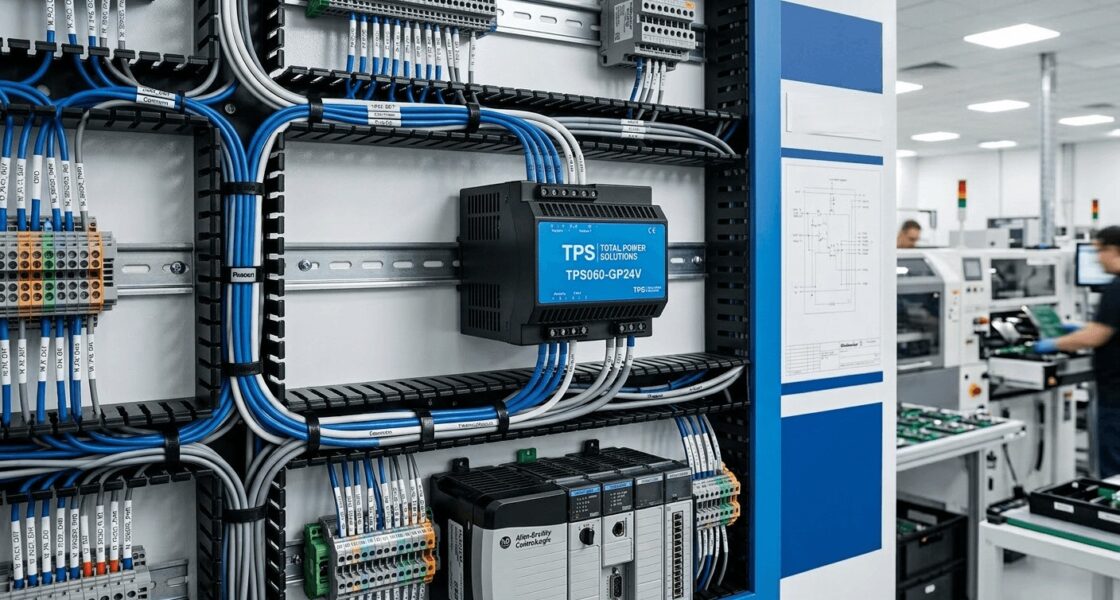
The TPS-DR Series of high-efficiency DIN rail power supplies is intended for industrial applications where energy efficiency, compact dimensions, and low heat dissipation are important design considerations.
Why Efficiency Matters in DIN Rail Power Supplies
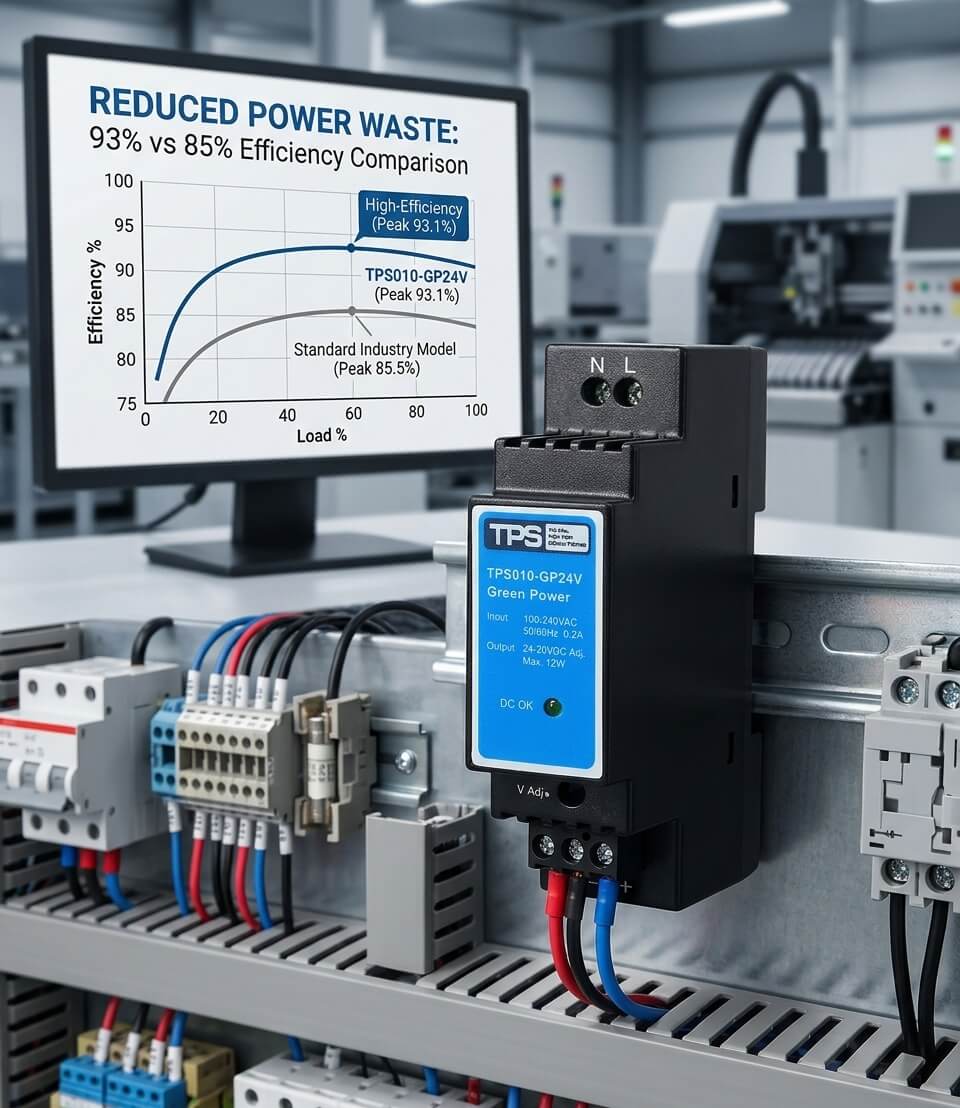
In an industrial control cabinet, conversion losses are dissipated as heat. These losses contribute to internal cabinet temperature and may affect cooling requirements, component derating, and overall energy consumption.
A high-efficiency DIN rail power supply converts a greater proportion of its input power into usable DC output, reducing the amount of energy dissipated as heat. Depending on the overall cabinet design, this can support lower thermal loading and simplify thermal management.
For example, a power supply operating at 80–85% efficiency dissipates a larger proportion of its input power than a unit operating above 90% efficiency. Selected TPS-DR models achieve efficiencies of up to 93%, depending on the model and operating point.
Efficiency should therefore be evaluated together with load profile, ambient temperature, enclosure design, required output power, and available cooling.
Technical Highlights of the TPS-DR Series
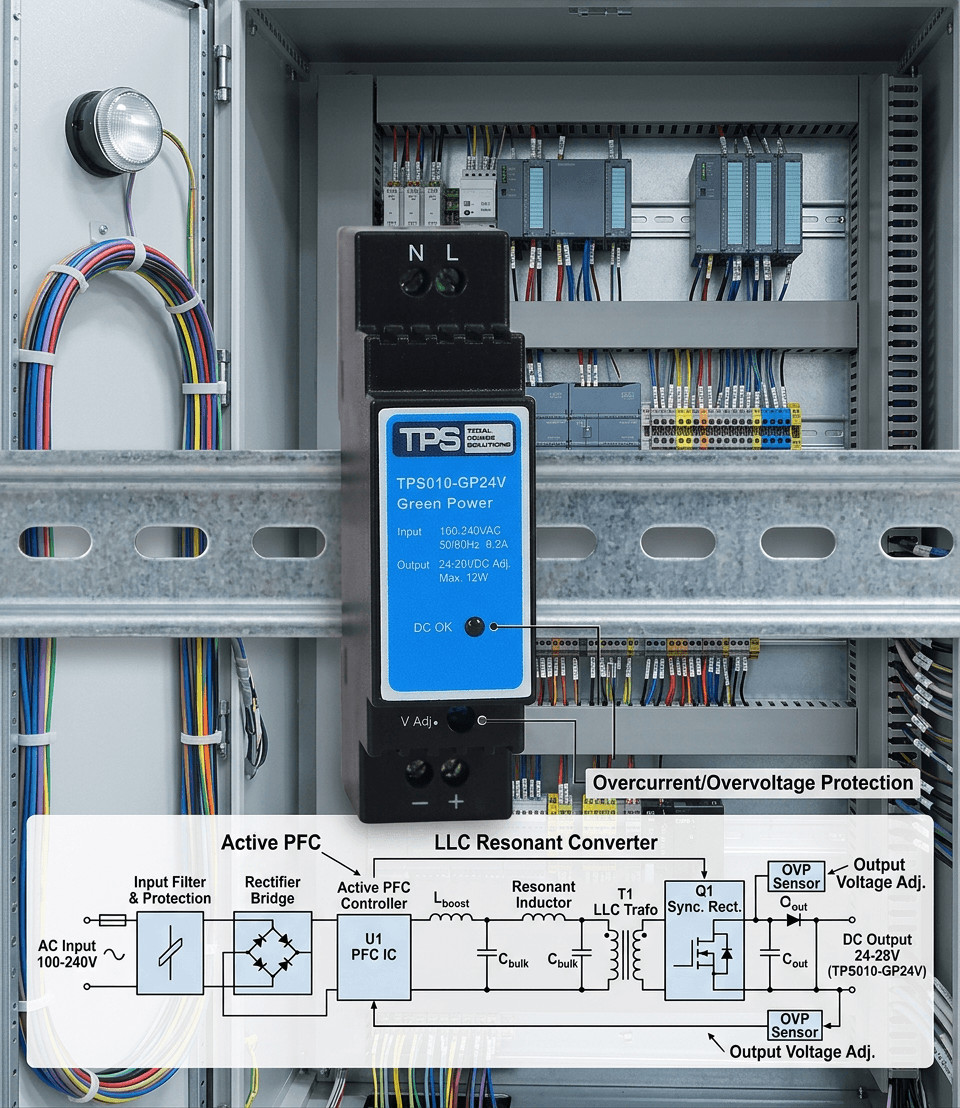
The TPS-DR Series uses a resonant LLC topology intended to support efficient power conversion. Depending on the specific model, key characteristics include:
- Compact DIN rail design: widths down to approximately 23 mm for selected 30 W models can help conserve installation space.
- Electrical isolation: selected models provide reinforced insulation rated at 4000 Vac.
- Active Power Factor Correction (PFC): available on applicable models to reduce input-current harmonics and support compliance with relevant requirements such as EN 61000-3-2.
- Wide input range: selected versions support 85–264 Vac and 120–370 Vdc input for use across different supply infrastructures.
- Low heat dissipation: higher conversion efficiency reduces internal power losses compared with less efficient designs.
Applicable safety, EMC, isolation, and approval requirements should always be checked against the datasheet and certification documentation for the specific model.
Power Ratings and Output Voltages
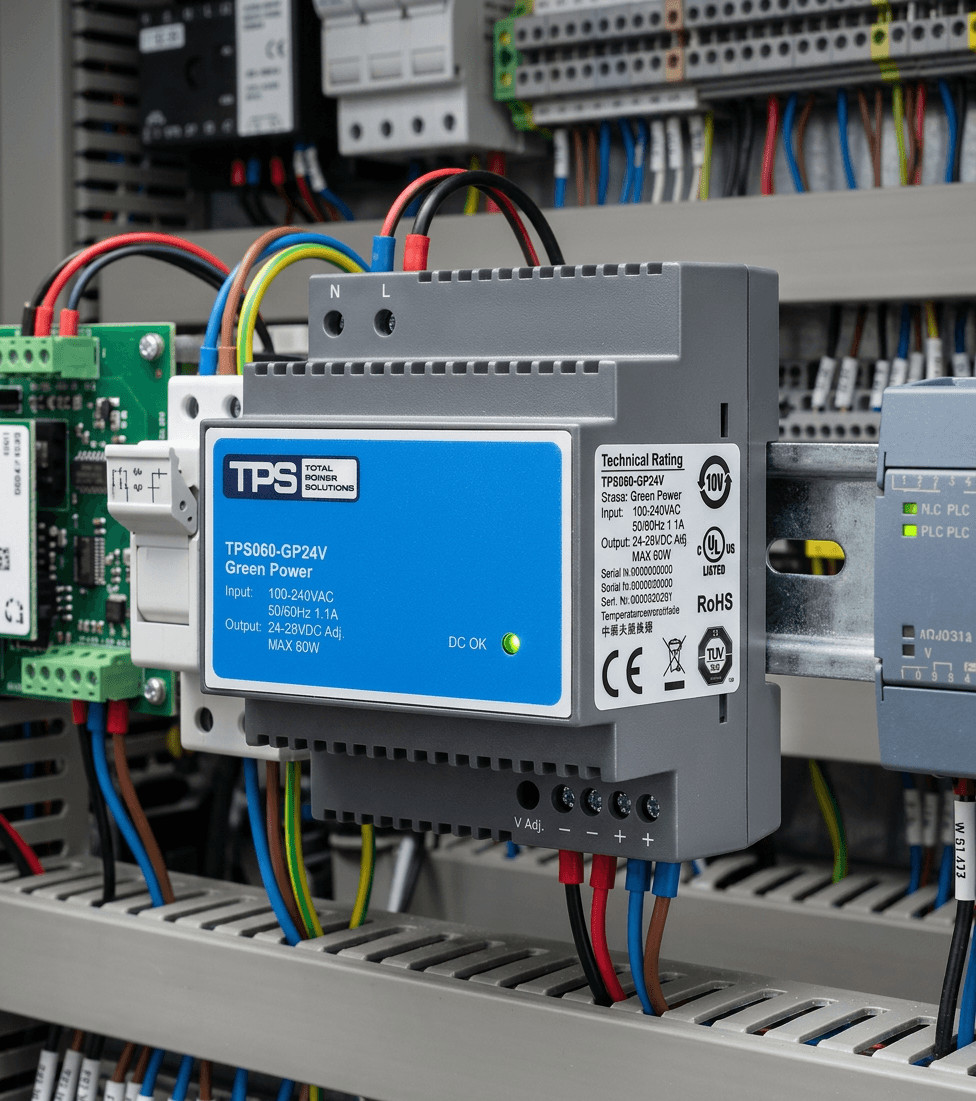
The TPS-DR product range includes commonly used industrial output voltages such as 12 V and 24 V, with several power classes available for different load requirements.
Available models include:
- 24 V / 10 W DIN rail power supply for low-power loads such as sensors and compact controllers.
- 24 V / 30 W DIN rail power supply for applications such as PLCs, HMIs, and small I/O systems.
- 24 V / 60 W DIN rail power supply for medium-power automation loads.
- 24 V / 100 W DIN rail power supply for larger control systems or multiple connected loads.
- 12 V variants: 10 W, 30 W, 60 W, and 100 W.
- Higher-power models include 100 W / 12 V and 100 W / 24 V versions with a stated peak capability of up to 150 W for up to 4 s.
- 150 W / 12 V DIN rail power supply for higher-power applications.
When selecting a power rating, engineers should consider not only the continuous load but also transient conditions such as motor starting currents, charging of capacitive loads, and short-duration peak demand.
For applications with higher temporary load requirements, the TPS100-DR+ Series provides additional short-term peak-power capability. The permissible duration and operating conditions should be verified in the relevant product documentation.
Heat Dissipation and Thermal Integration
Power-supply efficiency directly affects thermal losses. At a given output power, a more efficient converter dissipates less energy inside the enclosure.
Selected TPS-DR models reach efficiencies of up to 93%. This can reduce heat generation compared with lower-efficiency designs and may support more compact cabinet layouts or lower cooling requirements.
Relevant thermal characteristics include:
- natural-convection cooling on applicable models;
- reduced conversion losses at higher efficiency;
- compact housing dimensions for space-constrained installations;
- model-specific derating characteristics based on ambient temperature and load.
For example, a 100 W power supply with power losses below 5 W introduces substantially less heat into a cabinet than a comparable unit with significantly higher conversion losses.
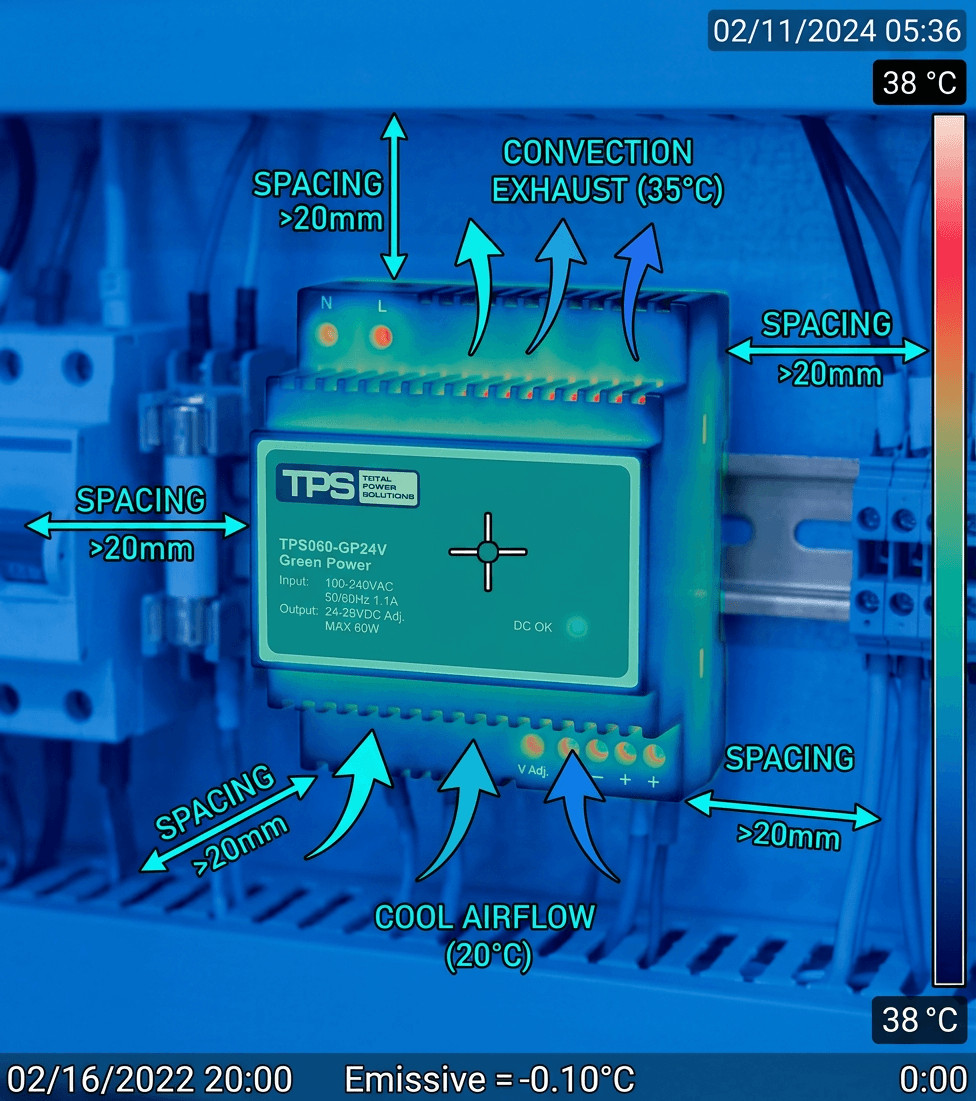
Compact installation, however, does not remove the need for airflow. Adjacent components, enclosure temperature, mounting orientation, spacing, and load profile should all be considered during thermal validation.
The DIN rail installation and wiring guide provides additional information on installation, spacing, and airflow considerations.
PFC, SELV, EMC, and International Requirements
For equipment intended for international markets, power-supply selection should include a review of the standards and approvals required for the complete end product.
Depending on the specific TPS-DR model, relevant characteristics and approvals may include:
- Active Power Factor Correction (PFC) in accordance with applicable requirements such as EN 61000-3-2.
- SELV output characteristics in accordance with the applicable safety standard and model configuration.
- Safety evaluation based on standards such as IEC 62368-1.
- Industrial control equipment approvals such as UL 508 for applicable models.
- Reinforced insulation rated at up to 4000 Vac on specified versions.
- EMC performance assessed against applicable standards such as CISPR 32 / EN 55032.
- CE, RoHS, and UKCA conformity or marking where applicable.
Because approvals can differ between models and product variants, certification status should be confirmed using the current datasheet, declaration, and approval documentation before the power supply is specified for a particular project.
Using a power supply with the required approvals can simplify component-level documentation during system development, but conformity of the complete machine or equipment remains dependent on the final design and applicable regulatory requirements.
Typical Applications
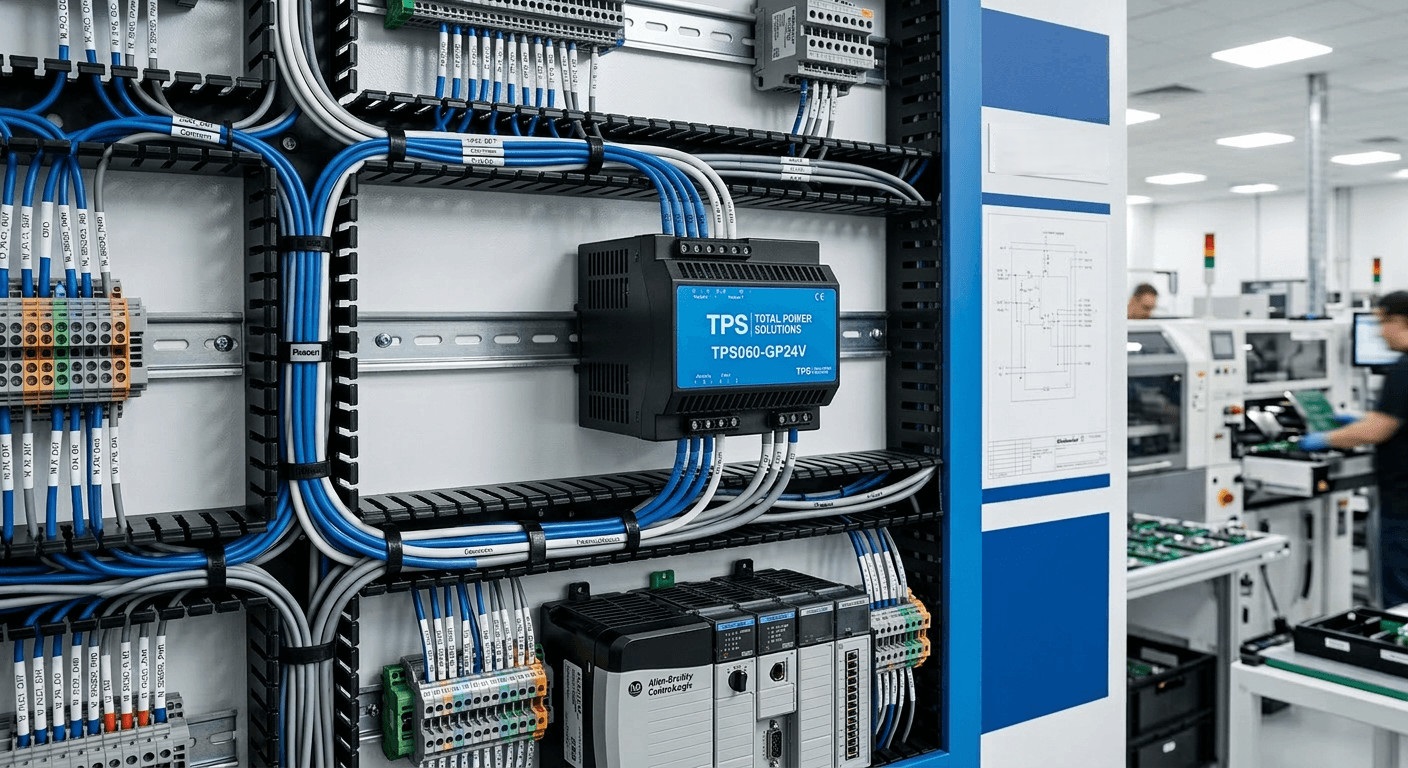
The combination of compact dimensions, industrial DC output voltages, and high conversion efficiency makes the TPS-DR Series suitable for a range of control and automation applications.
Typical use cases include:
- Industrial automation: PLCs, HMIs, I/O modules, sensors, and control electronics. For higher-demand applications, see the TPS PRO Series.
- Building automation: HVAC controllers, access-control systems, lighting controls, and building-management equipment.
- Test and measurement: auxiliary DC rails for measuring instruments, test fixtures, and automation systems.
- Embedded and control systems: 12 V and 24 V supply rails for industrial electronics.
- Renewable-energy and monitoring systems: control, communication, and monitoring equipment where DIN rail installation is required.
For applications with special safety requirements, including medical equipment, the exact power-supply variant and required approvals should be evaluated separately. Medical applications generally require application-specific documentation and safety approvals that should not be assumed from a standard industrial model.
Installation Considerations for Panel Builders
Correct mechanical and electrical installation is important for thermal performance, EMC behavior, and serviceability.
When integrating a high-efficiency DIN rail power supply, consider the following:
- Mount the power supply on the specified DIN rail, such as TS35, using the intended mounting mechanism.
- Maintain the minimum clearances stated in the product documentation to support natural convection.
- Select conductor cross-sections according to load current, wiring method, applicable standards, and terminal specifications.
- Tighten terminals to the manufacturer-specified torque.
- Route AC input and DC output wiring appropriately to limit unwanted electromagnetic coupling.
- Consider inrush current when selecting upstream protection devices.
- Evaluate transient and peak-load requirements separately from continuous output power.
- Observe the specified ambient-temperature derating curve.
- Verify protective-earth requirements and grounding arrangements for the selected model.
Where temporary peak demand is expected, such as during motor starting or capacitive charging, a model with defined short-term Power Boost capability may avoid unnecessary oversizing. The permissible peak current, duration, repetition rate, and thermal conditions should be checked in the datasheet.
For additional guidance, see the DIN rail installation and wiring guide.
RFQ Checklist for Procurement
A technically complete RFQ helps engineering and procurement teams identify the appropriate power-supply variant without unnecessary clarification cycles.
Include the following information where available:
- required output voltage;
- continuous output current or power;
- peak current or peak-power requirement;
- duration and frequency of peak loads;
- input-voltage range;
- ambient operating-temperature range;
- enclosure type and expected thermal conditions;
- available DIN rail space;
- required safety and EMC approvals;
- specific isolation or SELV requirements;
- expected annual or project quantity;
- required delivery schedule.
For product information and available models, visit the DIN rail power supply category.
Frequently Asked Questions
What is the efficiency of the TPS-DR Series?
Efficiency depends on the model, input voltage, and operating load. Selected TPS-DR models reach efficiencies of up to 93%. The relevant efficiency curve or operating-point data should be checked in the model-specific datasheet.
Can TPS-DR power supplies be connected in parallel?
Parallel operation depends on the specific model. Where parallel operation is supported, the required wiring configuration and any external components should be implemented according to the manufacturer’s documentation.
For redundancy applications, the complete power architecture—including current sharing, OR-ing, protection, and fault behavior—should be evaluated at system level.
Are medical-grade versions available?
Medical applications require power supplies with the appropriate safety architecture and certification for the intended equipment.
Where TPS medical power-supply variants are available, characteristics such as 2 MOPP, leakage current, and IEC 60601-1 compliance should be confirmed for the specific model before specification.
What is the peak-power capability?
Peak capability varies by model. Selected products provide short-duration output above their continuous rating.
For example, specified 100 W models provide up to 150 W for up to 4 s, while the TPS100-DR+ Series is designed for applications requiring higher temporary output.
The permitted peak power, duration, repetition rate, and operating-temperature conditions should always be checked in the relevant datasheet.
Do these power supplies meet ErP requirements?
Ecodesign requirements depend on the product category and application. Where ErP or other energy-efficiency requirements apply, compliance should be verified against the documentation for the specific power-supply model and the requirements applicable to the final equipment.
How can I request a quotation for larger quantities?
Provide the required output voltage, continuous and peak load, environmental conditions, required approvals, quantity, and requested delivery schedule.
For current product information and pricing, visit the TPS DIN rail power supply range.