

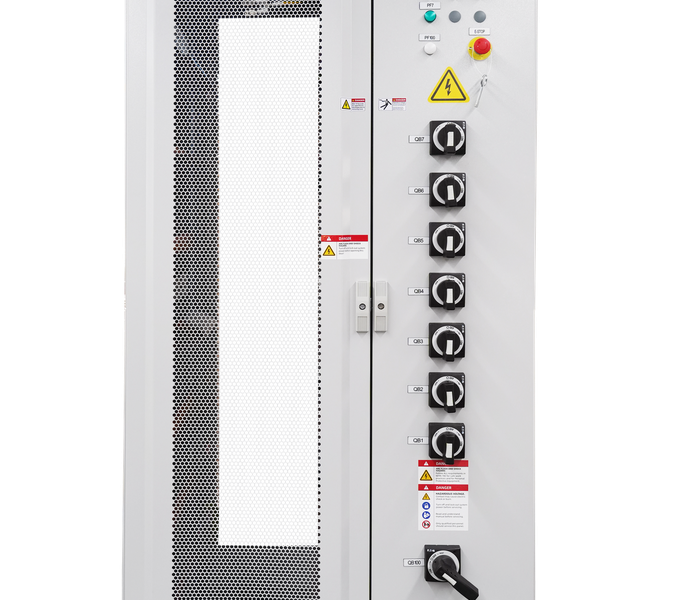
For system integrators, panel builders, and procurement teams deploying high-density data center infrastructure, the control cabinet is not a commodity. It is the physical foundation where power distribution, thermal management, and equipment security converge. A cabinet that cannot handle the power density of modern AI workloads or fails to manage the thermal load of 100kW+ racks becomes a bottleneck that compromises reliability and scalability.
TPS Elektronik’s precision cabinet manufacturing service was engaged by an anonymous hyperscale data center operator to design and produce high-density control cabinets for a next-generation AI cluster deployment. Which combining 420kW power distribution capacity, redundant thermal management with over 2000 CFM airflow, and UL 508A certification in a single integrated solution from prototype to volume production.
1. The Challenge: Power Density and Thermal Load in AI Data Centers
The customer—an anonymous hyperscale data center operator deploying AI training clusters—faced a critical infrastructure challenge: their existing control cabinets could not accommodate the power density and thermal load of next-generation GPU servers. A single NVIDIA B200 GPU operates at 1,000W TDP, and a fully populated rack can exceed 100kW of power consumption—making traditional air cooling and power distribution inadequate.
For system integrators and electrical engineers, high-density data center control cabinets present three interconnected challenges:
- Power density: AI clusters demand 40kW to over 100kW per rack, requiring high-current busbars and modular power distribution capable of scaling with demand
- Thermal load: Dense power electronics generate significant heat—over 100kW per rack must be managed continuously under 100% duty cycle
- Regulatory compliance: Control cabinets for data center infrastructure must meet UL 508A and NEC requirements, with proper SCCR ratings and component selection
A data center cabinet is more than a steel box. It is the structural platform for power distribution, cable management, thermal control, and equipment security. For this customer, the fragmented supply chain they had previously used for cabinet fabrication created tolerance mismatches, delayed deployment, and compromised thermal performance.
TPS Elektronik was engaged to develop a precision control cabinet solution that would integrate high-density power distribution, advanced thermal management. And UL 508A compliance into a single, deployable platform.
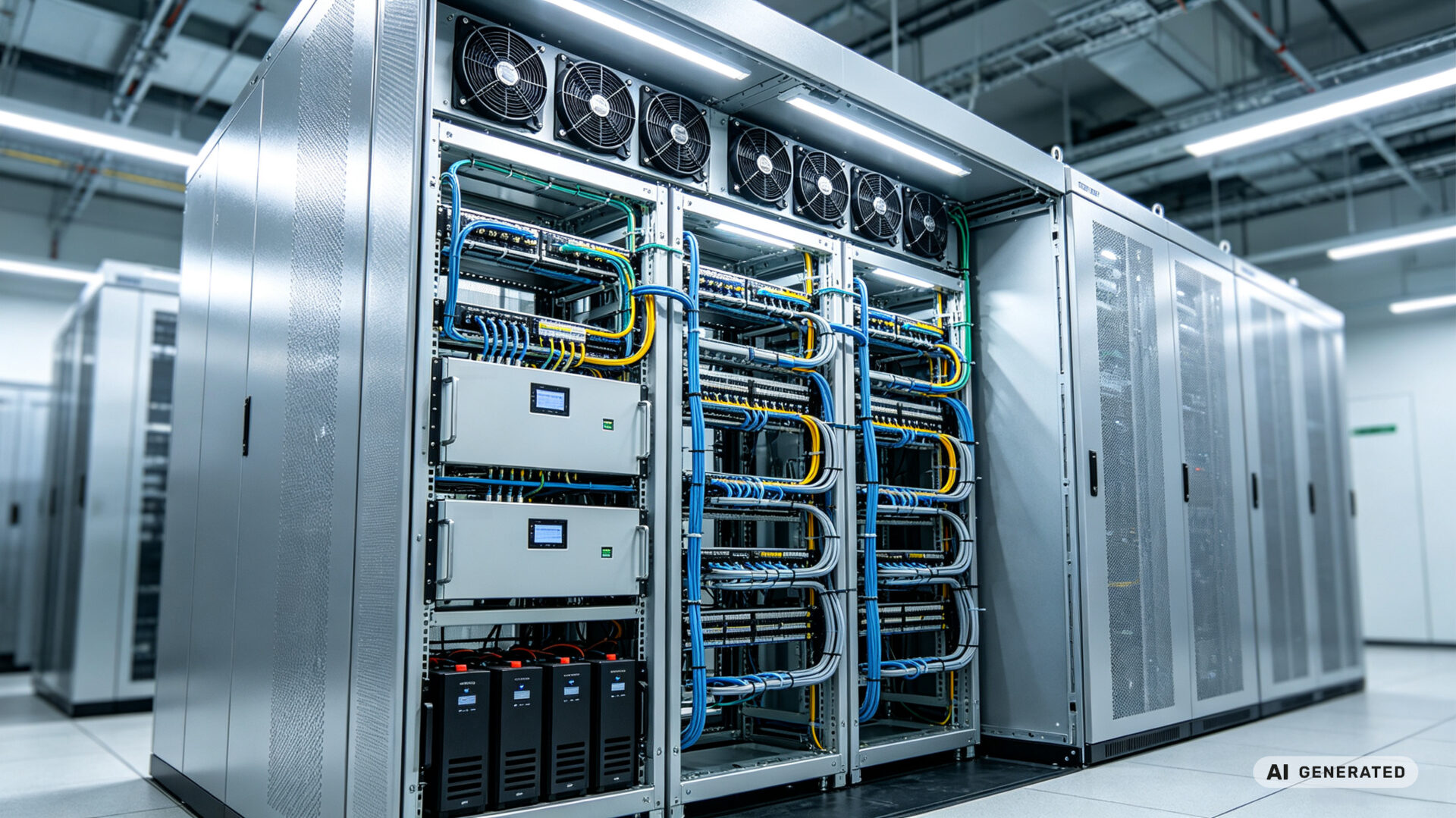
2. The TPS Solution: Integrated Precision Cabinet Manufacturing
TPS Elektronik’s approach combined precision sheet metal fabrication, mechatronics integration, and comprehensive quality assurance to deliver data center control cabinets that met all customer requirements.
Integrated Fabrication:
Unlike fragmented supply chains where cutting, bending, welding, and finishing are handled by separate suppliers, TPS consolidated the entire cabinet fabrication chain into a single EMS workflow. Under a unified quality management system certified to ISO 9001 and IATF 16949, TPS eliminated the interface risks that caused rework and delays.
Key fabrication capabilities included:
- Fiber laser cutting: ±0.1–0.2 mm tolerance on cold-rolled steel sheets from 0.8 mm to 8 mm thickness
- CNC press brake forming: Precision bending with bend angles maintained within ±0.5°
- MIG and TIG welding: Precision welding for structural integrity and dimensional stability
- Powder coating: RAL 7035 finish for corrosion resistance and durability
Thermal and Mechanical Engineering:
TPS’s mechatronics approach—integrating mechanical engineering, electronics, and control software. Which ensured that the cabinet design addressed both structural and thermal requirements from the outset. TPS industrial cabinets are designed with mechanical stability (supporting up to 1000 kg static loads), thermal behavior, and system integration in mind.
3. High-Density Power Distribution: 420 kW in a 48U Footprint
The Sentinel Power Cabinet Series 48U, delivered as part of TPS’s mechatronics solution, is a high-density industrial control panel purpose. Which built for ultra-high-power applications. Available in Sentinel-X 48U and Sentinel-Y 48U configurations, this pre-wired power cabinet integrates AC input distribution, high-current DC busbars, and modular power modules into a single 48U enclosure.
Key power distribution capabilities for the customer’s AI cluster included:
- Scalable power: 10 kW up to 420 kW total power, supporting up to seven 60 kW power modules
- High-current DC busbars: Infrastructure exceeding 2000A for efficient power distribution
- UPS battery backup integration: Standardized 19-inch rack mounting for UPS modules, battery packs, and PDUs
- Pre-wired deployment: Factory pre-wired AC input distribution and high-current DC busbars, drastically reducing field wiring time and on-site commissioning
- Reinforced frame: Supporting 1600 kg weight capacity for heavy battery modules
The modular approach enabled the customer to start with the power capacity needed for initial deployment and scale incrementally as demand grew—without replacing the entire cabinet infrastructure. For data center power cabinet applications, this scalability is essential for managing the unpredictable growth of AI workloads.
4. Advanced Thermal Management for 100kW+ Racks
High-density power systems generate significant heat. A cabinet delivering 420 kW of power within a 48U footprint requires advanced thermal management to maintain component temperatures within safe operating limits and ensure long-term reliability under 100% duty cycle.
TPS Elektronik engineered a comprehensive thermal management system for the customer’s control cabinets:
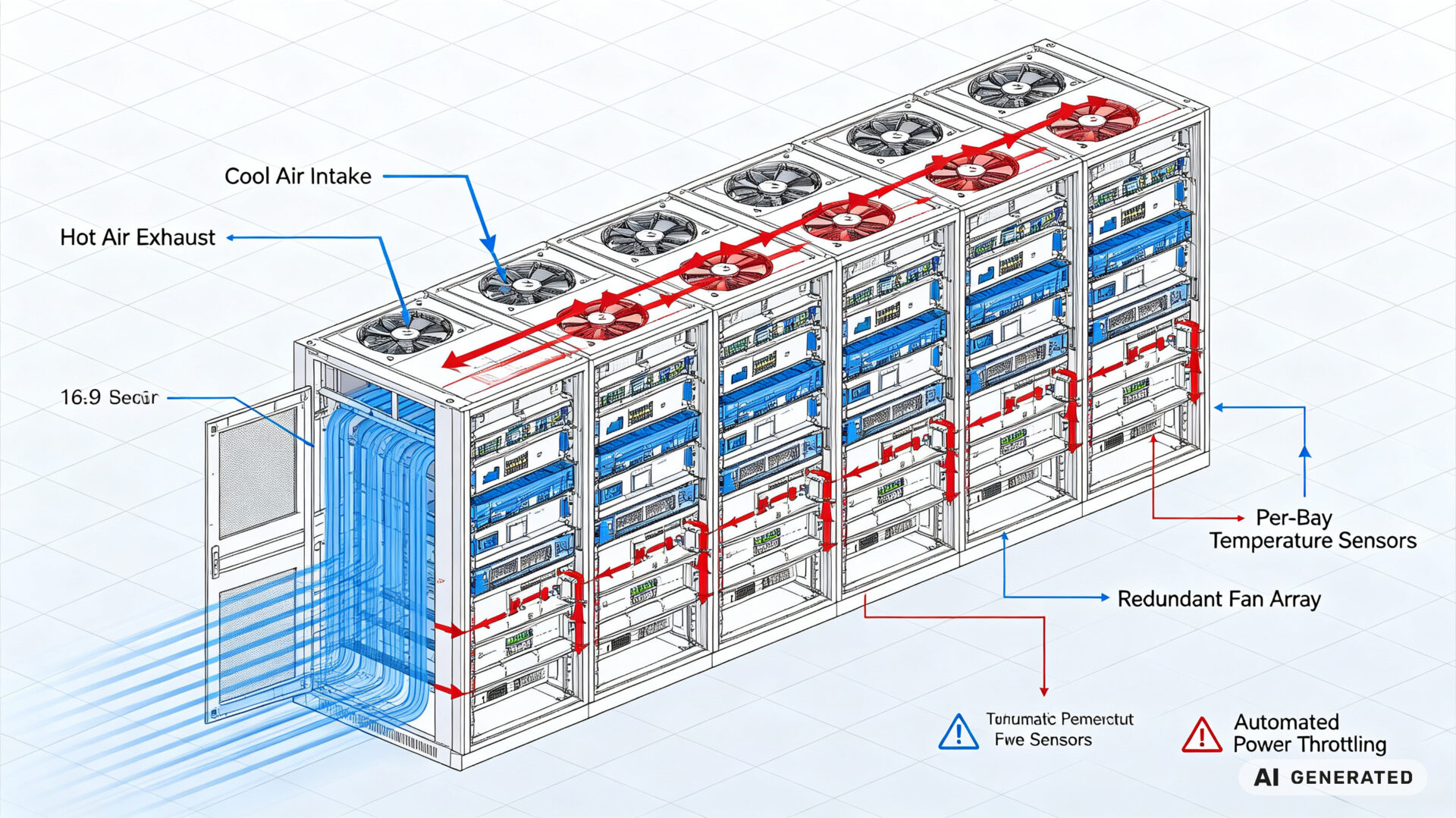
- Redundant high-pressure fan matrix: Over 2000 CFM combined airflow for reliable cooling
- 85% open perforated doors: Minimal intake resistance and maximum airflow
- Per-bay temperature sensors: Real-time thermal monitoring across every equipment bay
- Automated emergency power throttling: Reliable overheat protection that prevents thermal runaway
- Precision thermal engineering: Calibrated for 30K to 50K temperature rise above ambient
This cooling architecture ensures that UPS modules, battery packs, and power supplies operate within their specified temperature ranges even under maximum load conditions. The redundant fan design provides fault tolerance—if one fan fails, the remaining fans maintain adequate airflow, preventing thermal shutdown.
For thermal optimized control cabinet applications, the cabinet layout was designed to support controlled airflow. Removable panels and defined cable routing paths reduce airflow obstructions and support effective heat dissipation.
5. Regulatory Compliance: UL 508A and NEC Requirements
Data center control cabinets must meet stringent safety and regulatory requirements. In North America, electrical equipment must be approved by the relevant Authority Having Jurisdiction (AHJ) before it can be put into operation. UL 508A is the most widely accepted standard for industrial control panels in North America.
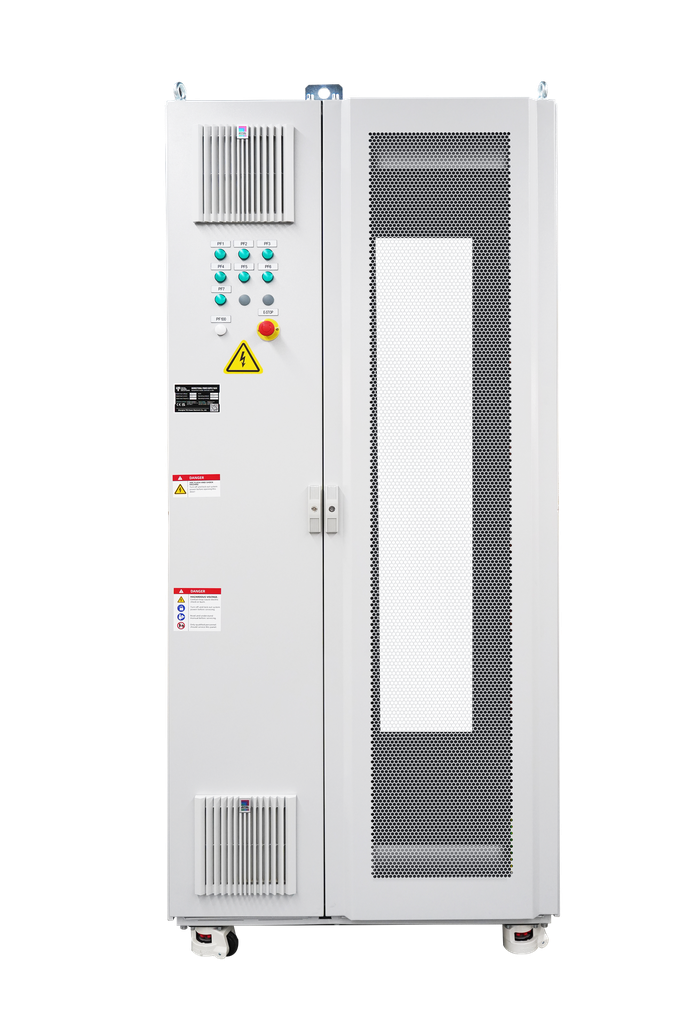
The Sentinel Power Cabinet 48U is fully compliant with UL 508A standards, providing:
- Certified industrial control panel safety for general industrial use at voltages of 1000V or less
- Proper component selection and usage per UL 508A requirements
- Short Circuit Current Rating (SCCR) validation—standard 10kA SCCR with optional 65kA SCCR upgrade
- Compliance with NEC (NFPA 70) requirements for electrical installations
NEC Article 645 addresses electrical installations for Information Technology Equipment (ITE), covering equipment, power-supply wiring, equipment interconnecting wiring, and grounding. Power distribution units used for IT equipment are permitted to have multiple panelboards within a single cabinet—a requirement that the Sentinel Cabinet meets with its integrated busbar and PDU infrastructure.
Additional safety features include:
- Safety door interlock for secure access during operation
- Dual-channel emergency stop function for rapid system shutdown
- Reinforced frame with 1600 kg weight capacity for heavy equipment
For industrial control cabinet applications in data centers, UL 508A certification is essential for regulatory compliance and insurance requirements. TPS’s certification ensures that every cabinet meets the highest standards of safety and reliability.
6. The Integration Advantage: From Fabrication to Deployment
What distinguishes TPS Elektronik’s precision cabinet manufacturing from conventional sheet metal fabrication is integration. TPS EMS mechatronics approach combines electro-mechanical assemblies, control panels, harnessing, PLC/IPC integration, and documentation within a unified workflow.
For the customer’s data center deployment, this integration delivered several key benefits:
- Supply chain consolidation: A single partner took responsibility for steel plate cutting, CNC bending, welding, surface finishing, assembly, and documented inspection—eliminating the tolerance mismatches that had plagued previous deployments
- Electronics and mechanics alignment: The integrated approach ensured that electronics and mechanics perfectly matched, from individual metal parts to complete turnkey control cabinets
- Reduced deployment time: Pre-wired cabinets with documented quality eliminated the need for field rework, reducing installation time by approximately 40%
- Single-source accountability: One partner managed the entire cabinet fabrication chain under documented quality processes per ISO 9001 and IATF 16949
TPS supports projects from concept to commissioning, providing architecture concepts, risk assessment, and phased budgets—from a single pilot cabinet to a full deployment of hundreds of units. This scalability ensures that precision cabinet manufacturing capabilities can grow with data center infrastructure demands.
Get your precision cabinet manufacturing RFQ in 24–48 hours →