

For system integrators, panel builders, and procurement teams in the networking industry, the internal cabling of switches and routers is not just about connecting point A to point B—it is about maintaining signal integrity at data rates exceeding 25 Gbps while fitting into ever-shrinking chassis footprints. A single poorly routed or improperly terminated cable harness can degrade signal quality, fail EMC testing, and delay product launches.
TPS Elektronik’s custom cable assembly services were engaged by an anonymous networking OEM to design and manufacture compact, high-speed internal cable harnesses for their next-generation data center switches and routers—from prototype validation to volume production.
1. The Challenge: High-Speed Interconnects in Compact Networking Equipment
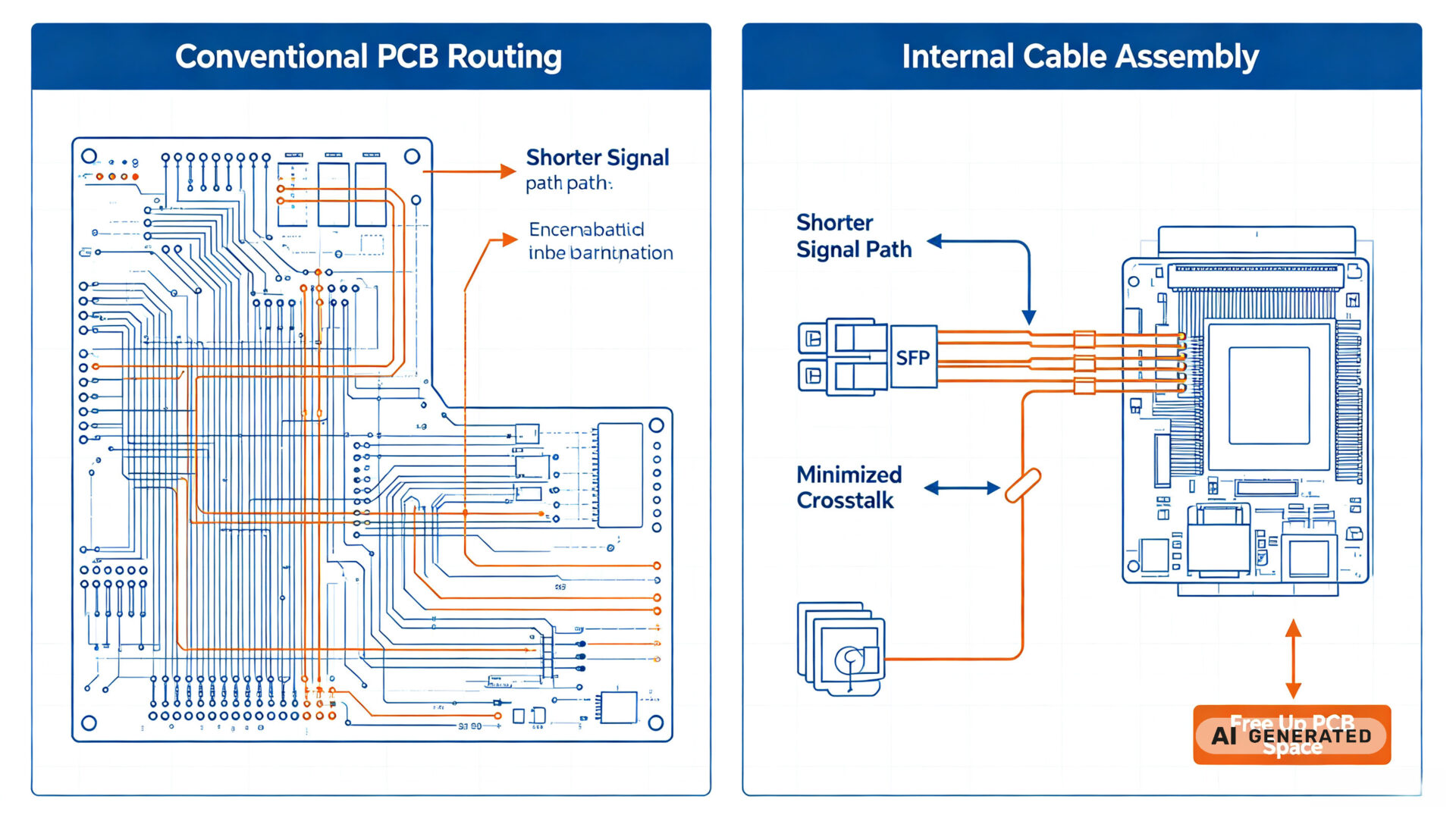
The customer—an anonymous networking OEM developing next-generation data center switches and routers—faced a critical design challenge: their new platform required internal cable harnesses that could carry high-speed signals with minimal loss and crosstalk, while fitting within the limited internal space of a 1U or 2U chassis. Traditional PCB routing was no longer sufficient; signal paths were becoming too long, and board space was at a premium.
Internal cabled interconnects offer significant advantages over PCB-only routing for high-speed networking equipment. By using cable assemblies to route high-speed signals from processors to other locations on the board, designers can reduce host system board trace lengths, lower PCB costs, and improve signal integrity. For high-density networking applications, flexible interconnect solutions with high-speed cable assemblies support aggregate data rates of 100 Gbps and 200 Gbps.
Key challenges for the customer included:
- Signal integrity: Maintaining impedance control and minimizing crosstalk at data rates exceeding 25 Gbps per lane
- Space constraints: Routing multiple high-speed differential pairs within the limited internal volume of a 1U chassis
- Thermal management: Ensuring cables and connectors could withstand operating temperatures inside densely packed equipment
- Reliability: Achieving the mechanical durability required for field service and equipment handling
TPS Elektronik was engaged to develop custom cable assemblies that would deliver the required signal integrity and mechanical reliability while meeting the customer’s aggressive production timeline.
2. The TPS Solution: Custom Cable Assembly for Networking Applications
TPS Elektronik’s approach combined precision cable assembly manufacturing with design-for-manufacturability (DFM) feedback to deliver internal cable harnesses that met the customer’s performance and reliability requirements.
Engineering and Design Support:
- Cable type selection: High-speed twinaxial cables with 100Ω differential impedance for data rates up to 25 Gbps
- Connector selection: SFP, SFP+, and QSFP interfaces matching the customer’s board-level connector footprints
- Routing optimization: Cable routing paths designed to minimize bend radius violations and maintain signal integrity
- DFM feedback: Review of designs to optimize for manufacturability and reduce assembly time
Custom Cable Configurations:
- Differential pair harnesses: Four to eight differential pairs per cable assembly for high-bandwidth data transmission
- SFP/QSFP cable assemblies: Custom length and connector configurations to match chassis layouts
- Breakout cables: QSFP to four SFP+ fan-out harnesses for connecting 40 GbE switches to existing 10 GbE infrastructure
- Shielded assemblies: Foil and braid shielding options for EMI control in dense chassis environments
For networking cable assembly applications, TPS’s in-house DFM support ensured that cable designs were optimized for manufacturing, with proper AWG selection, strain relief, and labeling integrated into the design from the start. TPS also referenced IEC 61196-1-111 and IEC 61169 series standards for coaxial connector performance and phase stability test methods.
3. Manufacturing Approach: Precision and Process Control
TPS Elektronik’s custom cable assembly manufacturing process was designed to deliver consistent quality across prototype and production volumes, with full traceability and documentation.
Manufacturing Processes:
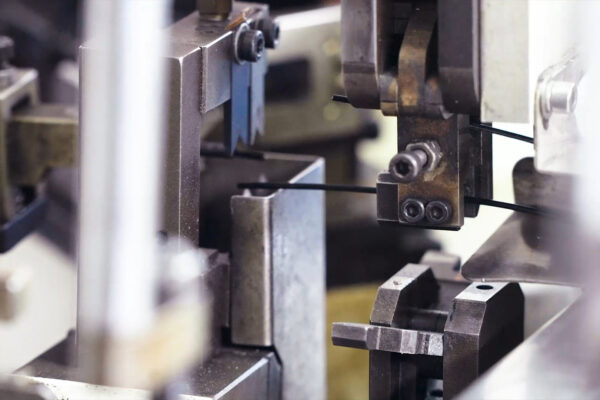
- Precision cutting and stripping: Automated cutting and stripping of high-speed twinaxial cables to exact lengths
- Crimping and soldering: Controlled crimping and soldering processes for reliable electrical connections
- Shielding termination: Consistent termination of foil and braid shields for EMI control
- Labeling and identification: Laser marking, shrink labels, and barcodes for traceability and installation clarity
- Strain relief: Over-molding and booting for mechanical durability
Quality Control:
- 100% continuity testing: Every conductor in every assembly verified for continuity and correct pin mapping
- Impedance verification: Ensuring 100Ω differential impedance for high-speed data transmission
- Dielectric withstand testing: Per applicable specifications for insulation integrity
- IPC/WHMA-A-620 Class II/III compliance: Workmanship standards for cable and harness assemblies
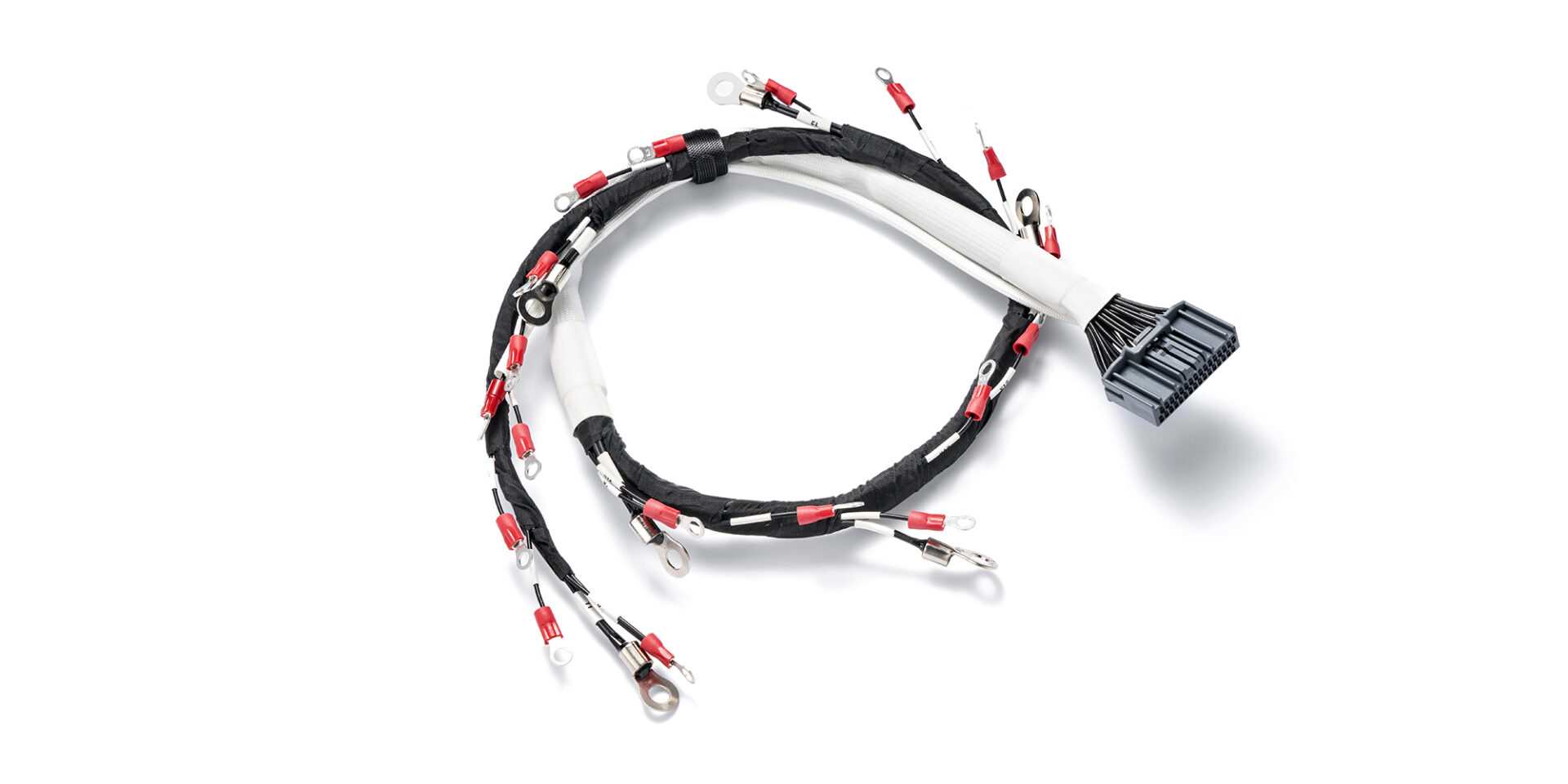
TPS Elektronik supports custom cable assemblies with full documentation, including BOMs, revision control, and serialized outputs for traceability. For server router internal wiring and data center switch wire harness applications, the combination of precision manufacturing and rigorous testing ensures that every cable harness meets the required specifications.
4. Outcomes: Signal Integrity, Space Savings, and Supply Chain Consolidation
The custom cable harnesses delivered by TPS Elektronik exceeded the customer’s performance targets while simplifying their supply chain and reducing assembly time.
Key Outcomes:
- Signal integrity: Internal cable assemblies maintained impedance control and signal integrity at 25 Gbps data rates, enabling the switch platform to meet its performance specifications
- Space savings: The compact cable harness design freed up valuable PCB space for additional functionality
- Reduced assembly complexity: Pre-assembled harnesses with labeling and strain relief reduced chassis assembly time by approximately 25% compared to manual point-to-point wiring
- Supply chain consolidation: A single partner provided cable assembly, testing, and documentation, eliminating the need for multiple suppliers
- Documented quality: 100% continuity testing and inspection reports provided traceable quality evidence for each production batch
Operational Benefits:
- Reduced field failures: Consistent manufacturing processes and rigorous testing eliminated cable-related field failures that had plagued previous platforms
- Faster time-to-market: DFM feedback and rapid prototype turnaround accelerated the development cycle
- Scalable production: The validated manufacturing process supported volume production without quality variation
This case study demonstrates how TPS Elektronik combines expertise in custom cable assembly, precision manufacturing, and quality assurance to deliver integrated solutions for high-speed networking equipment. By providing a single accountable source for complex interconnect needs, TPS helps system integrators and procurement teams reduce supply chain complexity and accelerate time-to-market.
5. TPS Custom Cable Assembly Capabilities for Networking Equipment
TPS Elektronik’s custom cable assembly services for networking switches and routers combine precision manufacturing, engineering support, and comprehensive quality assurance in a single integrated workflow.
Manufacturing Capabilities:
- High-speed twinaxial cable assembly: Differential pair cables for data rates up to 25 Gbps and beyond
- SFP/QSFP cable assemblies: Custom length and connector configurations for networking applications
- Breakout harnesses: QSFP to four SFP+ fan-out assemblies
- Shielded cable assemblies: Foil and braid shielding for EMI control
- RF/coax cable assemblies: SMA, BNC, and TNC connectors for networking applications
- Precision termination: Controlled crimping and soldering processes for reliable connections
Engineering Support:
- DFM feedback: Design optimization for manufacturability and reliability
- Cable and connector selection: Guidance based on electrical, mechanical, and environmental requirements
- Routing optimization: Cable routing paths designed to maintain signal integrity
- Prototype development: Rapid turnaround for design validation
Quality and Testing:
- 100% continuity testing: Every conductor in every assembly
- Impedance verification: 100Ω differential impedance for high-speed data
- Dielectric withstand and insulation resistance testing: Per applicable standards
- IPC/WHMA-A-620 Class II/III compliance: Workmanship standards
- Documentation: BOMs, revision control, serialized outputs, and test reports
TPS supports both prototype and production volumes, with quotes provided in 24–48 hours and prototypes available in 1–2 weeks.