

TPS Elektronik’s high efficiency DIN rail power supplies built to eliminate that risk: up to 94% conversion efficiency, minimal waste heat generation, and capacitor life extension that reduces replacement frequency and operating costs across factory automation deployments.
Discuss your control cabinet thermal requirements with TPS →
1. The customer challenge: PSU failures caused by control cabinet overheating
A European system integrator specializing in factory automation for the food and beverage industry (name withheld under NDA) approached TPS Elektronik with a recurring problem: DIN rail power supplies inside their sealed stainless steel control cabinets were failing at a rate of 8-12% per year, well above the manufacturer’s specified 7-year service life.
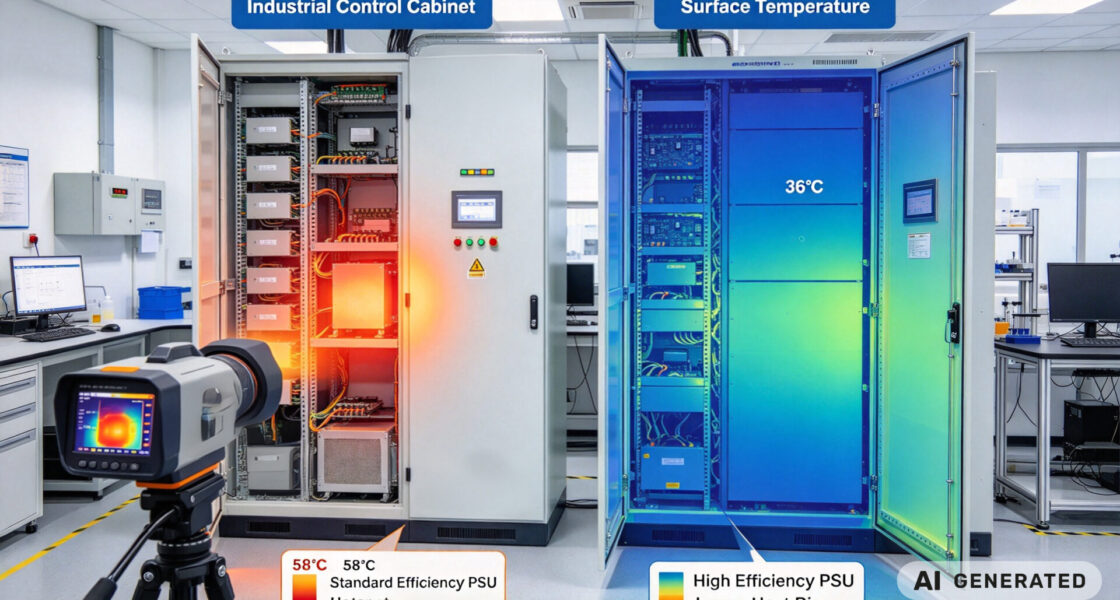
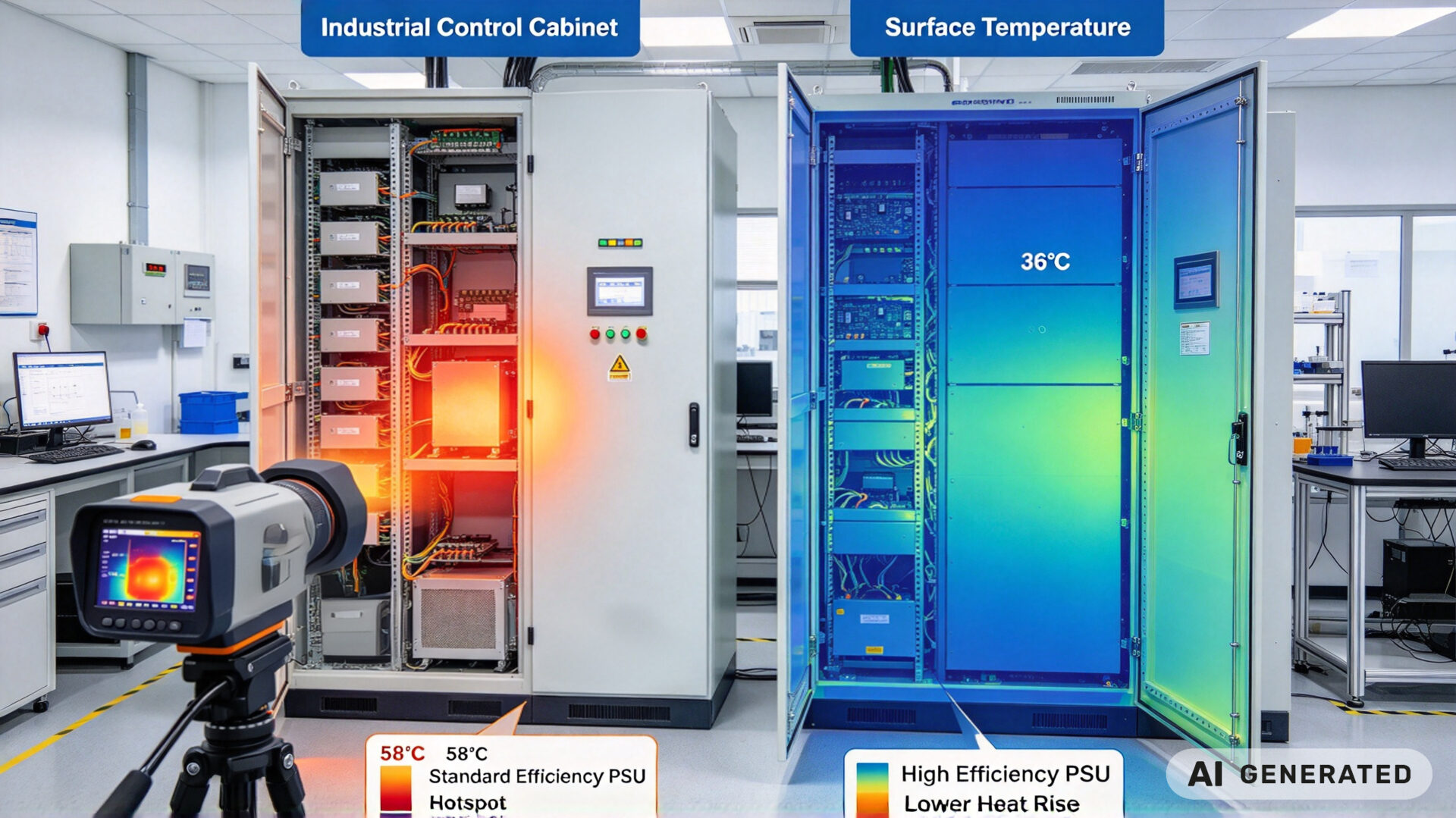
The cabinets installed in a high-ambient-temperature production hall where summer temperatures regularly exceeded 35°C. Because the cabinets sealed to IP66 for washdown protection, internal heat could not escape through ventilation. The power supplies—standard 88% efficiency models—generating 58W of waste heat each at full load, creating internal cabinet temperatures 20-25°C above ambient.
For the procurement team, the consequence was clear: each unplanned PSU failure cost an estimated 4-6 hours of production downtime, plus the emergency replacement cost and the risk of collateral damage to adjacent PLC modules. Across 45 production lines, the annual cost of PSU failures exceeded €180,000.
2. Why waste heat destroys capacitor life in DIN rail power supplies
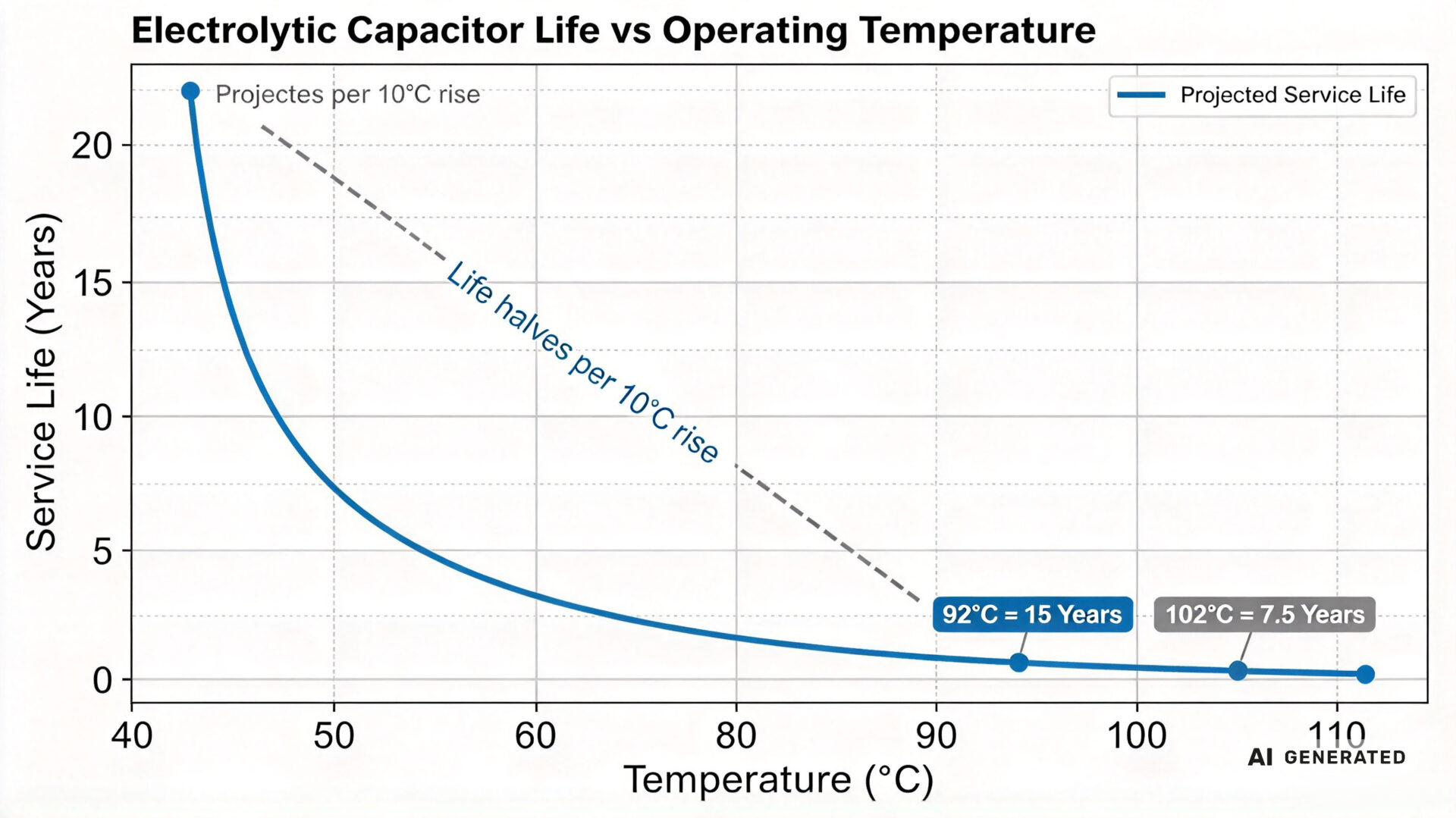
The relationship between waste heat and power supply failure is not linear—it is exponential. Minimum lifetime of a DIN rail power supply is determined by the lifetime of its electrolytic capacitors, and capacitor life halves for every 10°C increase in operating temperature.
Relationship defined by the Arrhenius equation and documented in the IPC-9592B standard: operating temperature increases of 10°C reduce capacitor service life by 50%. The practical implication is that a seemingly small difference in PSU efficiency produces a disproportionately large difference in service life.
2.1 The 10°C rule: every degree matters
Consider a DIN rail power supply with electrolytic capacitors rated for 5,000 hours at 105°C. At an internal capacitor temperature of 85°C, the calculated life extends to approximately 80,000 hours (over 9 years at continuous operation). When 95°C—just 10°C higher—the life drops to 40,000 hours (approximately 4.5 years). At 105°C, it returns to the rated 5,000 hours.
In control cabinet applications, the capacitor’s operating temperature is the sum of the ambient temperature inside the cabinet plus the self-heating from ripple current and power losses. When a power supply operates at 88% efficiency, the waste heat it generates raises the internal cabinet temperature and, consequently, the capacitor temperature. A 94% efficiency power supply generates approximately half the waste heat for the same output power—directly reducing capacitor temperature and extending service life.
2.2 The efficiency-to-heat calculation that determines PSU lifetime
The calculation is straightforward. For a 480W DIN rail power supply operating at full load:
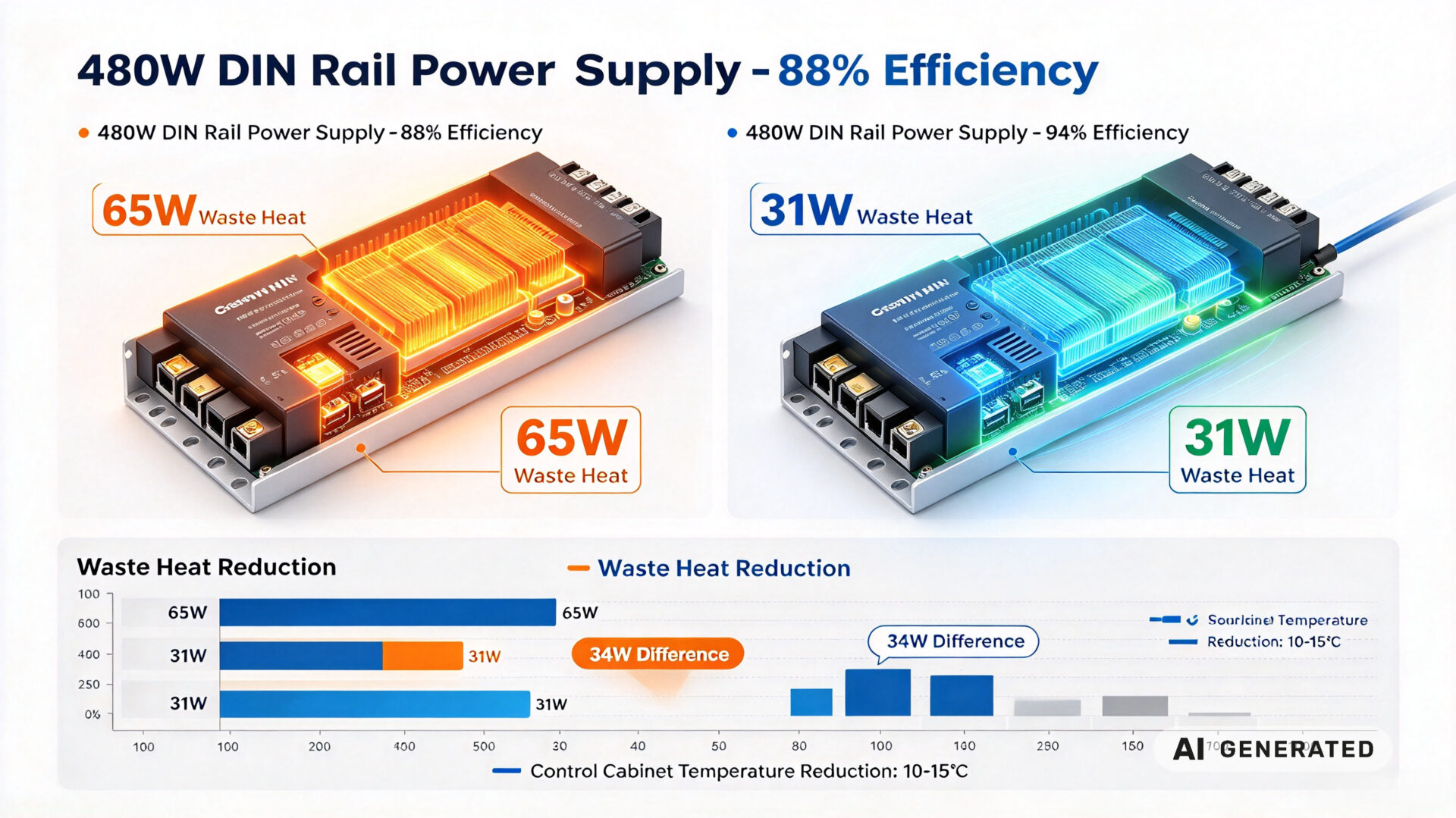
- 88% efficiency: Input power = 480W ÷ 0.88 = 545W. Waste heat = 545W − 480W = 65W
- 94% efficiency: Input power = 480W ÷ 0.94 = 511W. Waste heat = 511W − 480W = 31W
The difference is 34W per power supply. In a sealed cabinet, that 34W translates to a temperature reduction of approximately 10-15°C, depending on cabinet surface area and thermal resistance. Based on the 10°C rule, that temperature reduction extends capacitor life by a factor of 2-2.8×.
TDK-Lambda’s DRB480-48-1 achieves a verified 7-year life at 40°C ambient and 75% load, explicitly attributed to the design ensuring that electrolytic capacitor temperature rises are minimized. PULS power supplies achieve up to 95.6% efficiency, with the remaining 4.4% of input power lost as heat that must be managed through the cooling concept.
For a deeper understanding of the component technology behind these efficiency gains, see TPS’s element and material technology resource and element testing laboratories guide.
3. How TPS high efficiency DIN rail power supplies solved the problem
TPS Elektronik approached the customer’s challenge as a system-level thermal problem, not a component replacement exercise. The solution combined PSU specification, cabinet thermal analysis, and a phased deployment plan across the customer’s 45 production lines.
3.1 Efficiency specifications across the TPS portfolio
The TPS DIN rail power supply portfolio includes multiple efficiency tiers suited to different application requirements:
TPS100-320W Peak DR+ Series
The TPS100-320W Peak DR+ Series achieves up to 93% efficiency at 220VAC input and full load, with built-in over-temperature protection. Available in 100W, 150W, 240W, and 320W ratings with 12-15V and 24-28V output groups. The 170% power boost for up to 10 seconds handles inductive load start-up without triggering protection shutdown, reducing unnecessary thermal cycling of internal components.
3.2 Measured results: temperature reduction and capacitor life extension
TPS conducted a controlled thermal comparison on two identical production line cabinets. Cabinet A retained the existing 88% efficiency PSU; Cabinet B was equipped with a TPS Peak DR+ Series 240W unit at 93% efficiency. Both cabinets were monitored over a 30-day period during summer production.
- Cabinet A (88% PSU): Internal temperature averaged 56°C at 35°C ambient; peak internal temperature reached 61°C during maximum load periods
- Cabinet B (93% PSU): Internal temperature averaged 43°C at the same ambient; peak internal temperature reached 47°C
- Temperature delta: 13°C average reduction in internal cabinet temperature
Applying the 10°C capacitor life rule, the 13°C temperature reduction extends electrolytic capacitor service life by approximately 2.5×. For a power supply originally expected to last 4 years at the elevated temperature, the projected service life extends beyond 10 years—exceeding the typical production line lifecycle.
For related case studies on material testing and component reliability, see the quality assurance customer case and the metal testing and compliance guide.
4. Customer outcome: energy savings and reduced downtime
The phased deployment across 45 production lines delivered measurable results within the first year:
- PSU failure rate: Reduced from 8-12% per year to zero unplanned failures in the first 12 months post-deployment
- Energy cost reduction: 34W waste heat reduction per PSU × 45 lines × 8,760 hours/year × €0.15/kWh = €2,010 annual energy savings directly attributable to reduced losses, plus additional savings from reduced cooling load
- Downtime elimination: Zero production hours lost to PSU failures, compared to an average of 36 hours per year previously
- Capacitor life extension: Projected 10+ year service life, eliminating the need for planned PSU replacement during the production line lifecycle
This engagement reflects TPS’s broader approach to power supply integration for factory automation. The supply chain optimization resource and the global sales partner guide document similar projects.