

System integrators and procurement teams know that a data center’s physical backbone is not the servers it houses, but the steel enclosures that hold, protect, and cool them. As demand for cloud and AI infrastructure continues its double‑digit growth, the need for precision‑manufactured, easily scalable rack cabinets has never been greater. TPS Elektronik’s sheet metal manufacturing services for data center cabinets provide a critical foundation for this expansion. Which delivering high‑accuracy steel enclosures through an integrated fabrication process that spans laser cutting, CNC bending, MIG/TIG welding, and powder coating — all under one quality‑managed roof.
1. Why precision sheet metal manufacturing matters for scalable IT infrastructure
Data center cabinets must meet rigorous mechanical standards. The widely adopted EIA‑310‑D specification defines the 19‑inch mounting width, 465 mm hole spacing, and 44.45 mm rack unit height that ensure equipment from any manufacturer will fit. Without precisely fabricated sheet metal components, these tolerances cannot maintained across large production batches. A cabinet door that does not close squarely or mounting rails that are misaligned by even 1.5 mm can cause server installation failures. Which compromised airflow, and expensive on‑site rework.
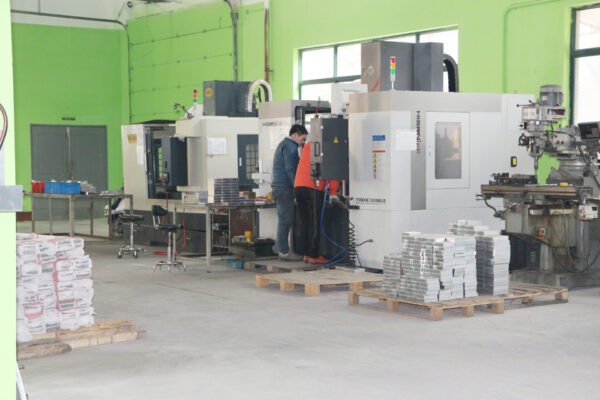
TPS addresses this by integrating all stages of sheet metal rack cabinet production. Rather than outsourcing cutting, bending, and finishing to separate suppliers. Each with their own tolerance interpretations — TPS controls the entire workflow. This eliminates tolerance stack‑up and ensures that every 42U cabinet shipped meets the critical dimensions that system integrators and data center operators rely on. For more details on how these processes integrate, see the dedicated overview on EMS sheet metal processing for electronics enclosures.
2. TPS integrated sheet metal fabrication workflow
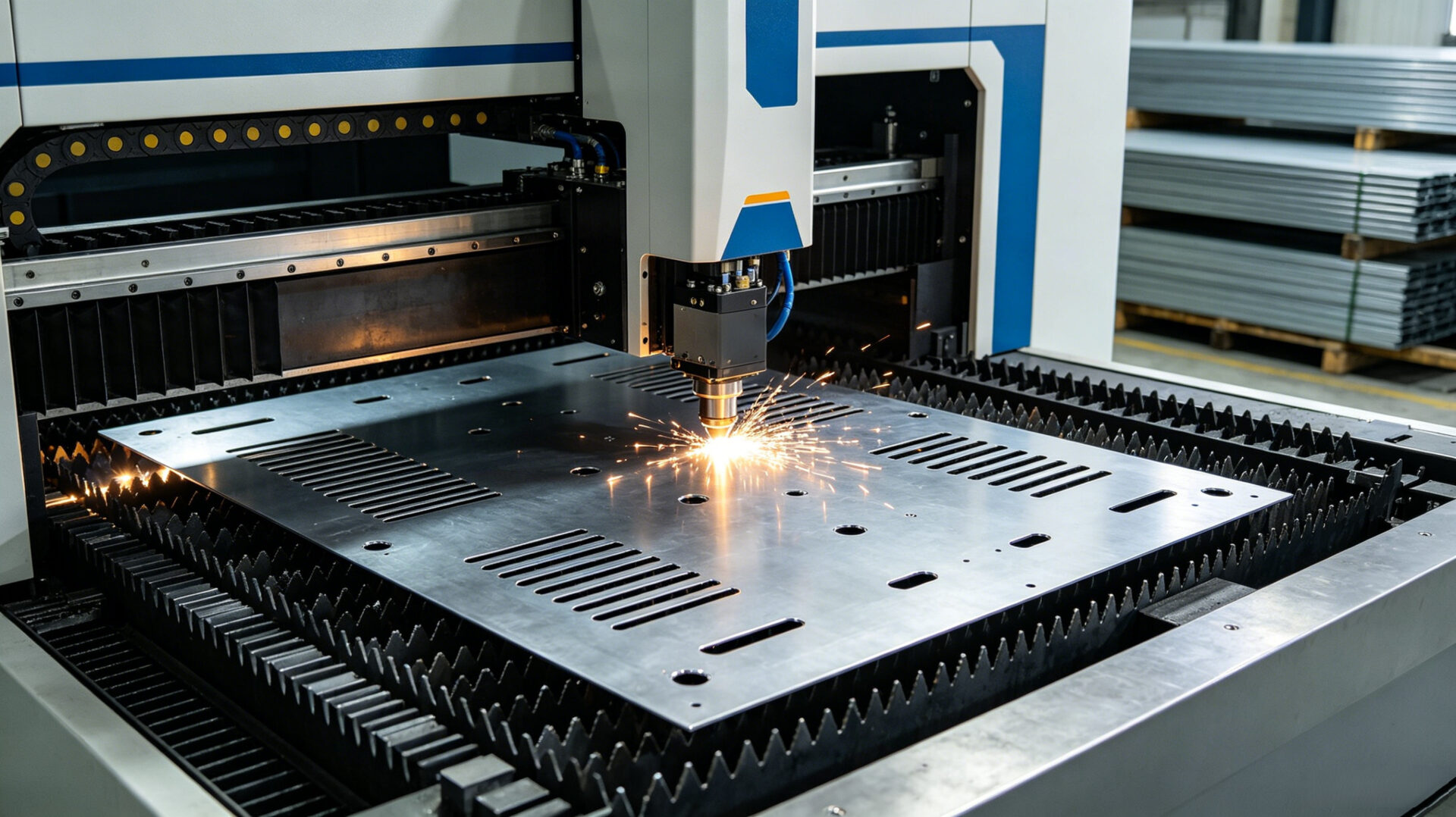
2.1 Laser cutting
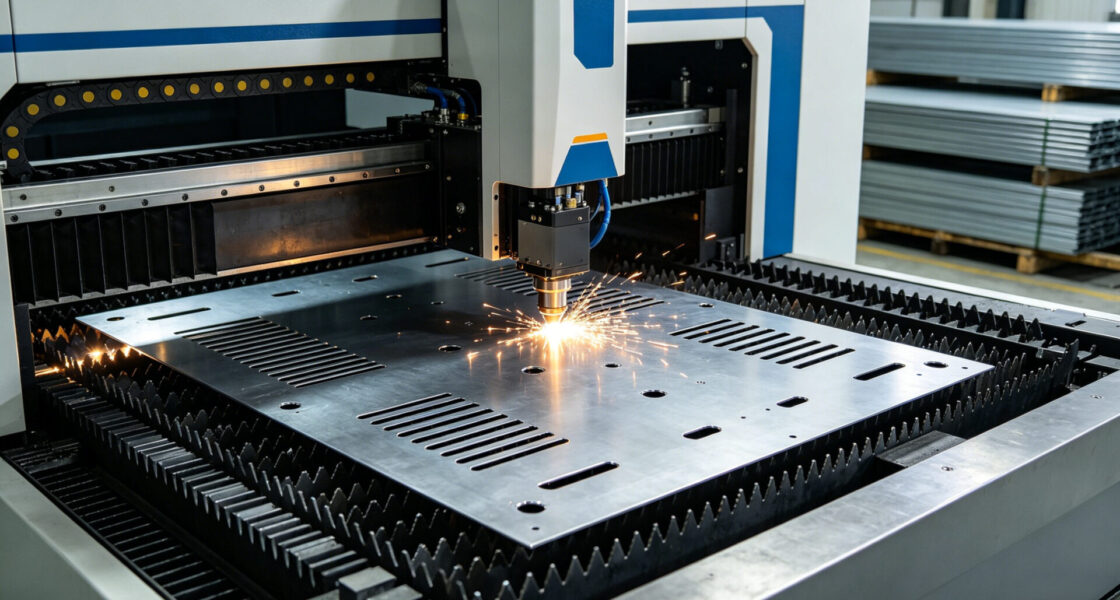
The first step in fabricating any data center enclosure is cutting the steel panels that will form the frame, doors, and side walls. TPS uses fiber laser cutting technology to achieve a dimensional tolerance of ±0.1–0.2 mm on cold‑rolled steel sheets ranging from 0.8 mm to 8 mm. This level of precision ensures that mounting holes for cage nuts, cable entry cutouts. And ventilation perforations positioned exactly where the design specifies. Which eliminating costly manual rework during assembly.
2.2 CNC bending
After cutting, panels move to CNC press brakes for forming. TPS programs bend sequences offline and verifies them with simulation software before touching the first physical part. Bend angles are maintained within ±0.5°, ensuring that door frames, side panels, and internal mounting rails assemble into a rigid, square structure. For a deeper technical reference on how CNC bending integrates into electronics enclosure manufacturing, see the guide on EMS sheet metal processing: RFQ‑ready CNC bending.
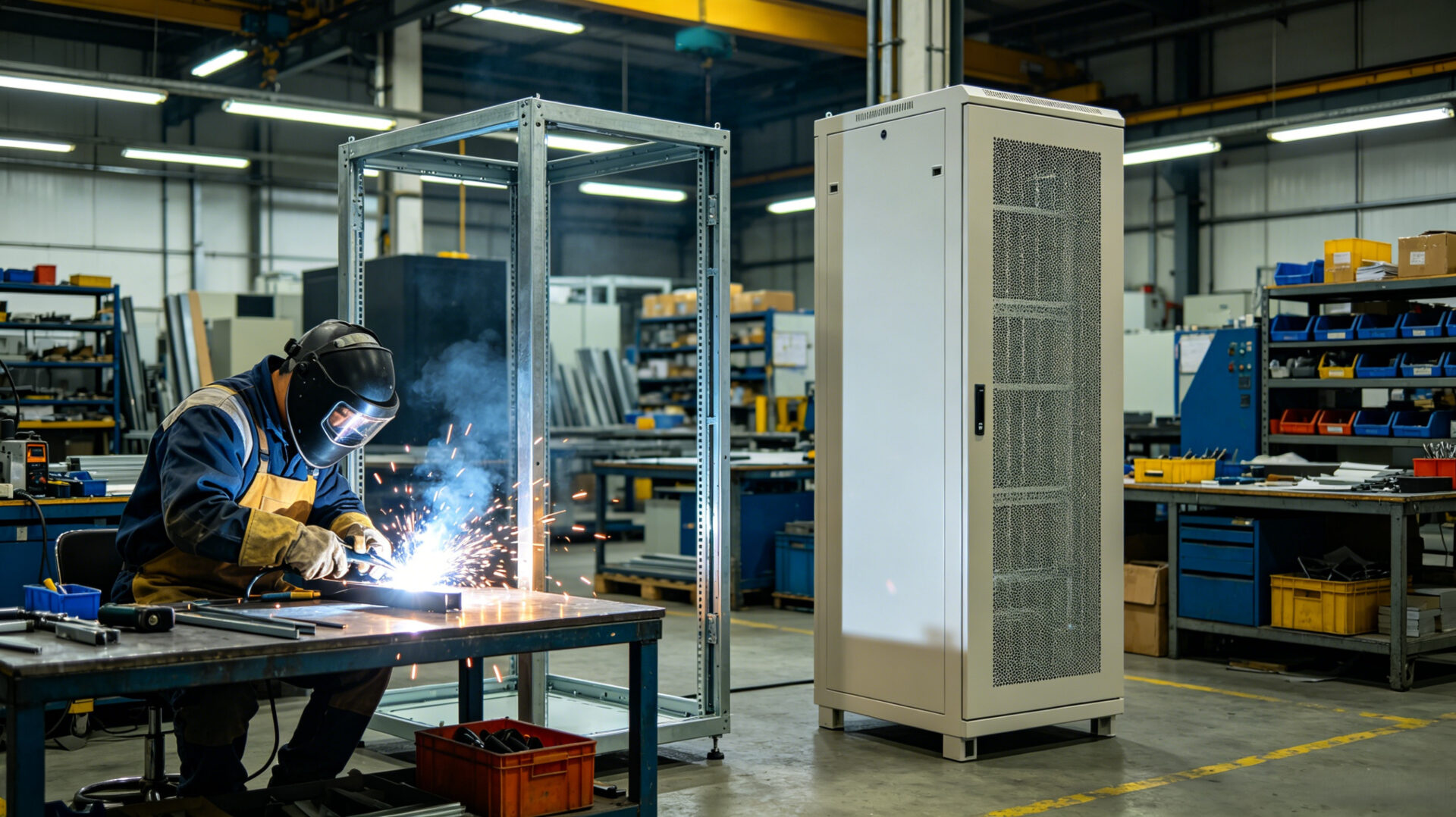
2.3 Welding and finishing
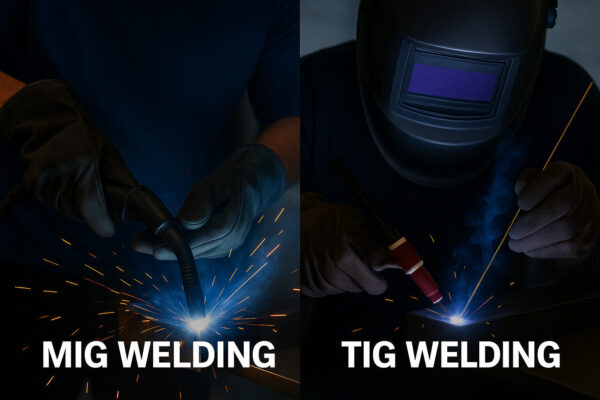
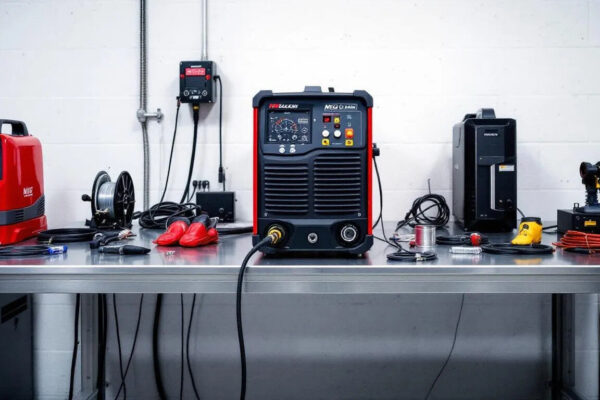
Structural integrity is built at the welding stage. TPS applies MIG welding for heavy frame connections. Such as joining the cabinet’s top and bottom frames to corner posts. And TIG welding for cosmetic seams, such as door frame corners visible to the end customer. For a comparison of these techniques, see TPS’s resources on MIG welding and MIG vs TIG welding. After welding, parts are deburred, prepared, and powder‑coated in RAL 7035 light gray — the standard finish for data center equipment — providing corrosion resistance and grounding continuity.
3. Scalable production: from prototype to volume
Scalability in server rack sheet metal manufacturing means that a cabinet design proven in a pilot run of 10 units can be replicated identically in a production batch of 1,000. TPS achieves this by using the same equipment, fixtures, and process documentation for prototypes as for series production. First Article Inspection (FAI) on the initial batch captures all critical dimensions, and subsequent production lots verified against this baseline. For procurement teams, this eliminates the risk of dimensional drift that can occur when a fabrication partner changes tooling or subcontracts during volume ramp‑up. For more on how TPS manages quality in integrated workflows, see the article on custom sheet metal fabrication precision manufacturing.
4. Compliance with rack and safety standards
Data center cabinets must comply with recognized mechanical and electrical safety standards. TPS ensures that all fabricated enclosures meet the dimensional requirements of EIA‑310‑D for 19‑inch mounting. For cabinets housing power distribution equipment, TPS designs and builds to support compliance with IEC 60204‑1 (safety of machinery — electrical equipment of machines). Certificates of Conformance and material traceability documentation provided with every shipment. Which reducing the burden on system integrators during their own CE marking or UL listing process.
Request a quotation for your data center cabinet fabrication →
5. RFQ checklist for data center cabinet fabrication
- CAD data: 3D STEP files and 2D DXF drawings with GD&T annotations.
- Material specification: Steel grade (e.g., DC01, S235), sheet thicknesses, and surface finish (standard RAL 7035 powder coating).
- Dimensions and rack units: Target cabinet height (e.g., 42U), width, and depth.
- Quantities and schedule: Prototype, pilot, and series volumes with target delivery dates.
- Inspection requirements: FAI reports, material certificates, and PPAP if applicable.
6. FAQ
What thickness of steel does TPS laser‑cut for data center cabinets?
TPS laser‑cuts cold‑rolled steel from 0.8 mm to 8 mm, covering the range needed for cabinet panels, mounting brackets, and structural frames.
Can TPS fabricate custom sizes beyond standard 42U racks?
Yes. TPS manufactures custom rack dimensions to match specific deployment requirements, including non‑standard heights, widths, and depths.
Does TPS provide powder coating in other colors besides RAL 7035?
Yes. Custom powder coating colors are available on request to match brand or facility requirements.
How does TPS ensure consistent quality across large production batches?
TPS uses First Article Inspection and documented process controls for every batch, maintaining bend angle and dimensional tolerances within ±0.5° and ±0.2–0.4 mm respectively.
Where can I learn more about TPS sheet metal fabrication capabilities?
Visit the TPS sheet metal processing service page or read our guide on EMS sheet metal processing for electronics enclosures.