

For system integrators, panel builders, and engineering‑driven procurement teams, electrostatic discharge protection is not optional. It is a prerequisite for reliable testing. A single ESD event — invisible to the eye. Which can degrade a semiconductor device and produce measurement drift that takes days to diagnose. When test instruments, PCBs, and sensitive components move between workstations on a non‑ESD cart. The entire quality assurance chain compromised before the first data point is recorded.
A properly designed ESD trolley solves this by providing a mobile, grounded platform that extends the ESD Protected Area (EPA) to wherever the work occurs. TPS Elektronik’s ESD trolleys — including the TPS‑RV and TV series — integrate adjustable shelves, all‑steel dissipative construction, and a defined grounding path that meets the requirements of IEC 61340‑5‑1, the international standard governing ESD control programs in electronics manufacturing.
What a TPS ESD trolley is and why mobility matters in an EPA
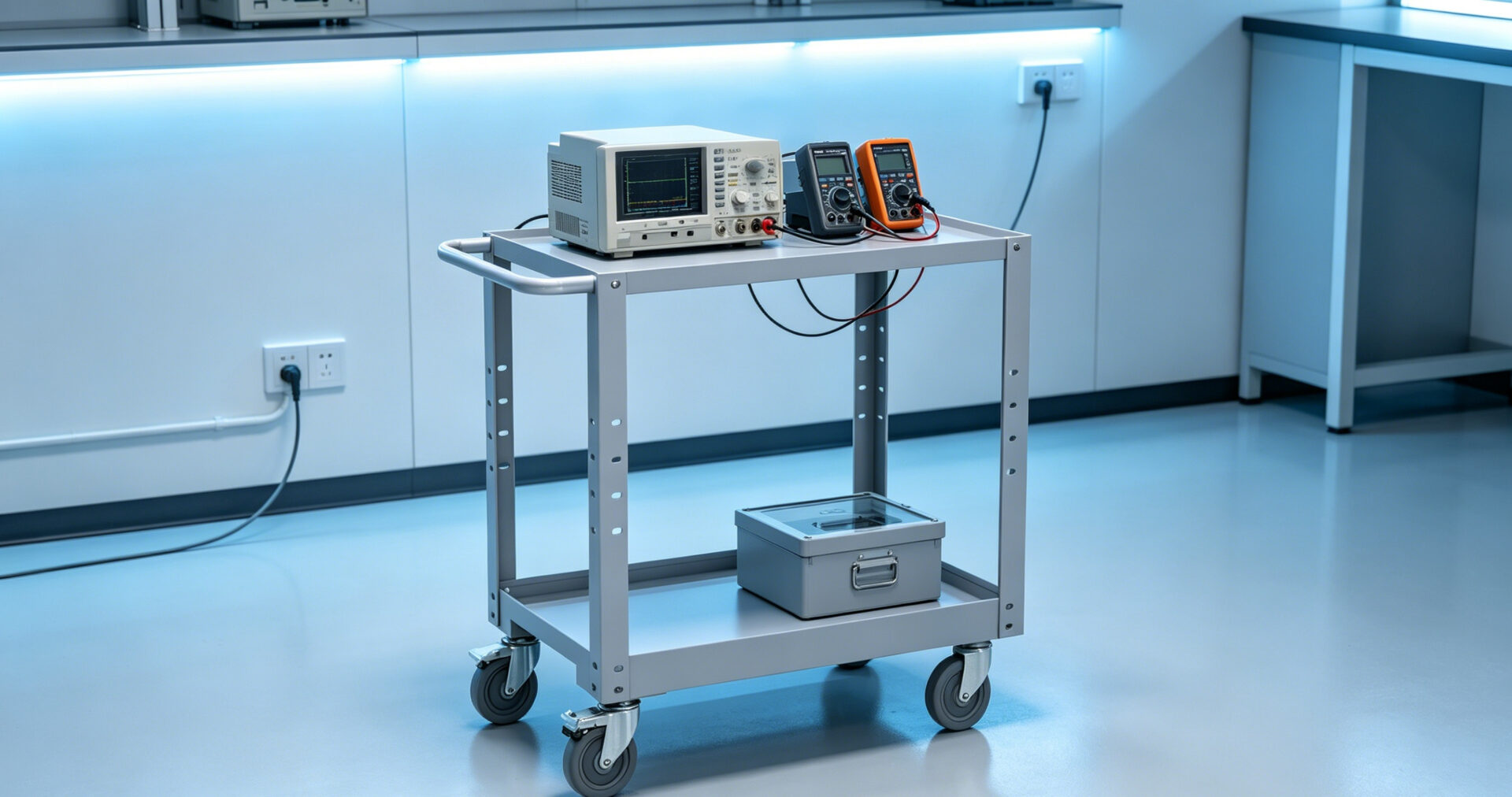
An ESD trolley — also referred to as an ESD cart or anti‑static trolley. It is a mobile component of an Electrostatic Discharge Protected Area. It is designed to support the safe handling and transport of ESD‑sensitive devices outside fixed workbenches. In practical terms, it is a rolling, grounded work surface that travels with the operator.
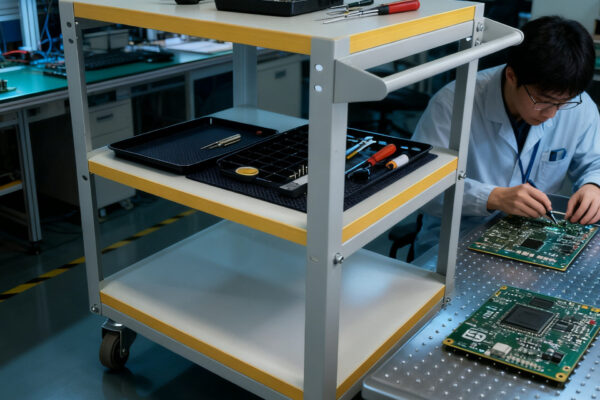
Fixed workbenches remain the foundation of any EPA. But real‑world workflows in test laboratories, repair centers, and assembly lines demand mobility. A technician calibrating oscilloscopes at multiple test racks needs a grounded surface for tools and probe accessories that moves with them. A PCB rework station that serves three assembly lines needs a cart that can repositioned without breaking the ESD protection chain. An ESD‑protected cart addresses these scenarios by keeping components within a controlled, grounded environment during handling and movement.
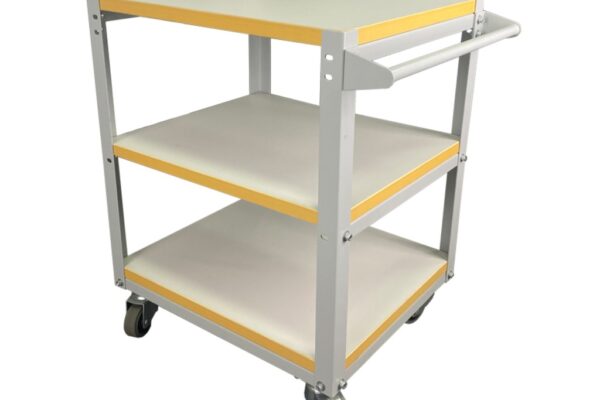
The TPS ESD trolley range — models TPS‑RV01 through TPS‑RV03 and TPS‑TV01 through TPS‑TV03. It built around an all‑steel frame with an ESD‑compatible powder coating. This surface finish provides controlled dissipation of electrostatic charge. Which ensuring that charge does not accumulate on the trolley body or shelves. The frame manufactured from steel. Which offers the mechanical robustness required for industrial environments while maintaining a defined resistance path to ground.
Grounding and surface resistance: IEC 61340‑5‑1 compliance
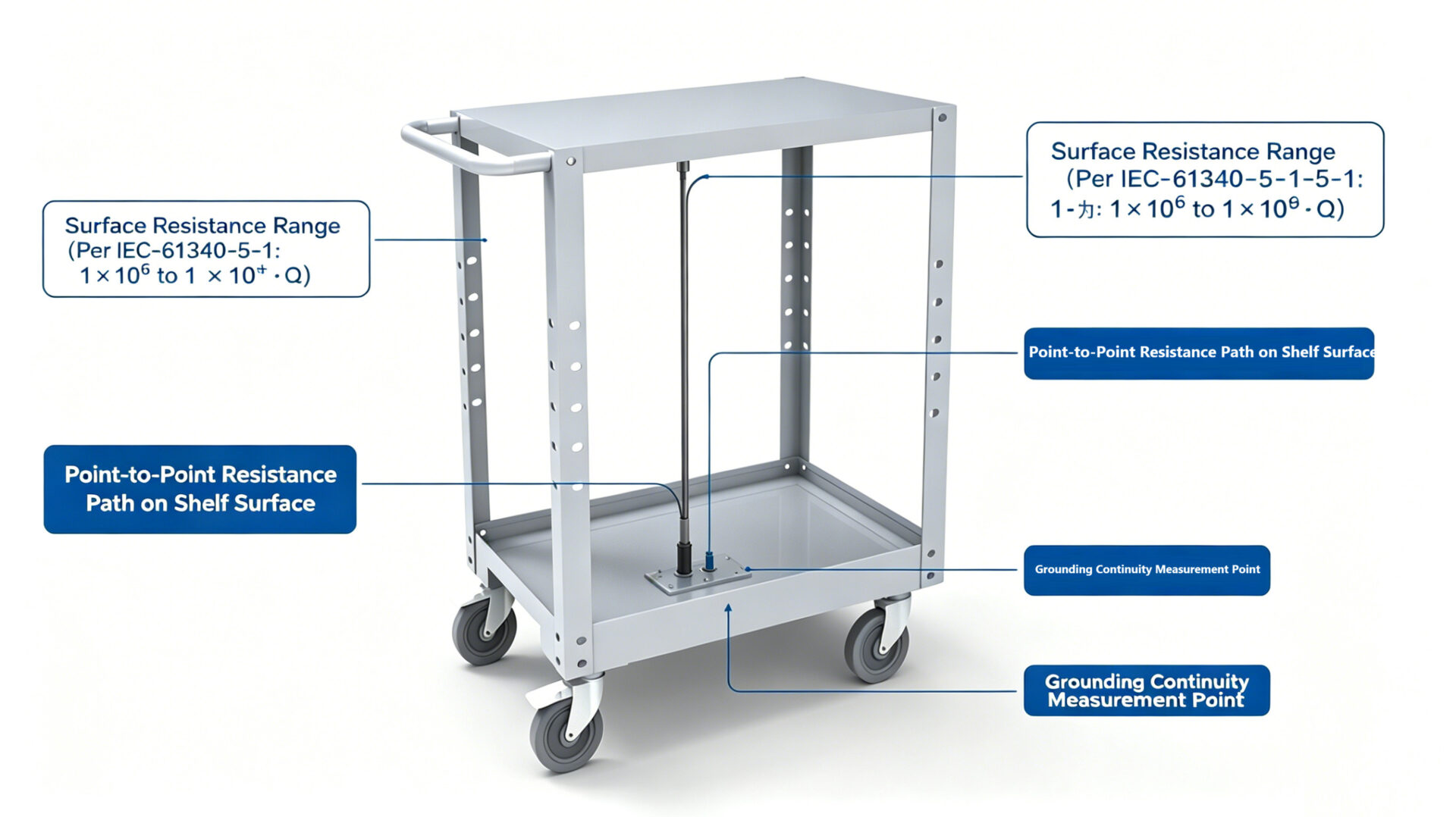
The defining characteristic of an ESD trolley is not its shelves or casters. It is the controlled electrical path from the work surface to facility ground. Without this path, the trolley is simply a cart. IEC 61340‑5‑1, the international standard for the protection of electronic devices from electrostatic phenomena. Which defines the requirements for an ESD control program including EPA equipment, grounding, and surface resistance limits.
Within an EPA, any surface on which ESD‑sensitive devices are placed must have a resistance to ground below 1 × 10⁹ Ω (1 GΩ). This ensures that static charge bleeds to ground at a controlled rate — fast enough to prevent accumulation, but slow enough to avoid a rapid discharge that could itself damage sensitive components. The TPS ESD trolley achieves this through a combination of the dissipative powder‑coated steel frame. ESD laminate or dissipative shelf surfaces, and a dedicated grounding point on the frame. This grounding point connected to the facility ground via a coil cord with a 1 MΩ current‑limiting resistor. A standard safety feature that protects personnel while maintaining the ground path.
Periodic verification of grounding continuity and surface resistance is an essential part of EPA maintenance. TPS recommends measuring surface resistance and grounding continuity at defined intervals using calibrated test equipment. And training users to connect the grounding cord whenever the trolley used for ESD‑sensitive work. The trolley’s grounding point clearly marked and accessible, simplifying this verification process.
Adjustable shelves and mechanical load capacity
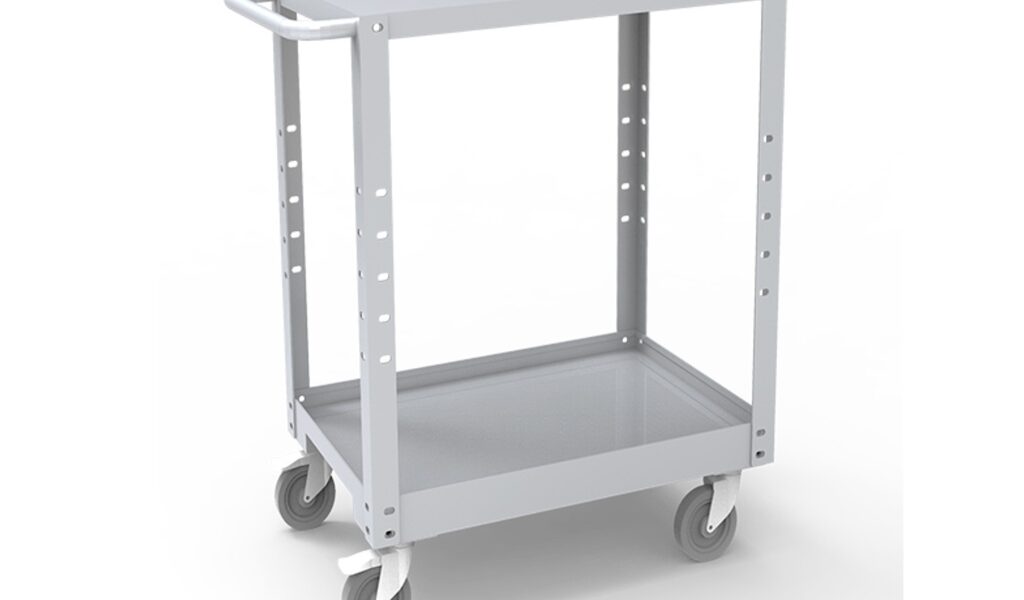
Fixed‑height carts force operators to work around the cart’s geometry. Adjustable shelves invert that relationship: the cart adapts to the workflow. TPS ESD trolleys are available in single‑shelf and multi‑shelf configurations. Multi‑shelf models. Such as the TPS‑RV02 and TPS‑RV03 — allow shelves to positioned at different heights along the frame. Which accommodating tall instruments on one level and shallow component trays on another.
The load capacity specified as 50 kg per shelf and 150 kg per trolley for the TPS RV series. These figures are not marketing estimates. They represent the uniform static load that the all‑steel frame and shelf brackets can support without permanent deformation. For procurement teams, this means that a single trolley can carry a spectrum analyzer, two power supplies. And a set of ESD component bins without exceeding its rated capacity. The 600 × 500 × 750 mm standard dimensions provide a work surface large enough for a benchtop instrument plus a laptop or documentation binder. While remaining compact enough to navigate standard laboratory aisles.
For additional context on how ESD‑safe work surfaces and shelving integrate into broader electronics manufacturing workflows, see the TPS overview of services.
Mobility features: casters, locking, and frame design
An ESD trolley that cannot moved safely undermines its own purpose. TPS equips every trolley with four swivel casters, of which two are lockable. The swivel function allows the trolley to maneuvered in tight spaces — between test racks, through laboratory doorways, and alongside workbenches. The locking brakes on two casters ensure that once positioned, the trolley remains stationary during use, preventing unintended movement that could topple instruments or disconnect cables.
The all‑steel frame construction contributes to both mobility and stability. A lightweight frame would be easier to push but would also vibrate and flex under load, potentially causing sensitive instruments to shift or interconnect cables to loosen. The steel frame provides the mass and rigidity necessary to dampen vibration during movement, while the powder‑coated finish protects against corrosion in humid or chemically active environments. The standard color is RAL 7035 light gray, consistent with the TPS ESD workstation product line, enabling visual uniformity across an EPA.
Product range overview: single‑shelf, multi‑shelf, and heavy‑duty ESD trolleys
The TPS ESD trolley portfolio organized into two series: the RV series (standard models) and the TV series (variant models). Key configurations are summarized below:
RV Series — Standard ESD trolleys
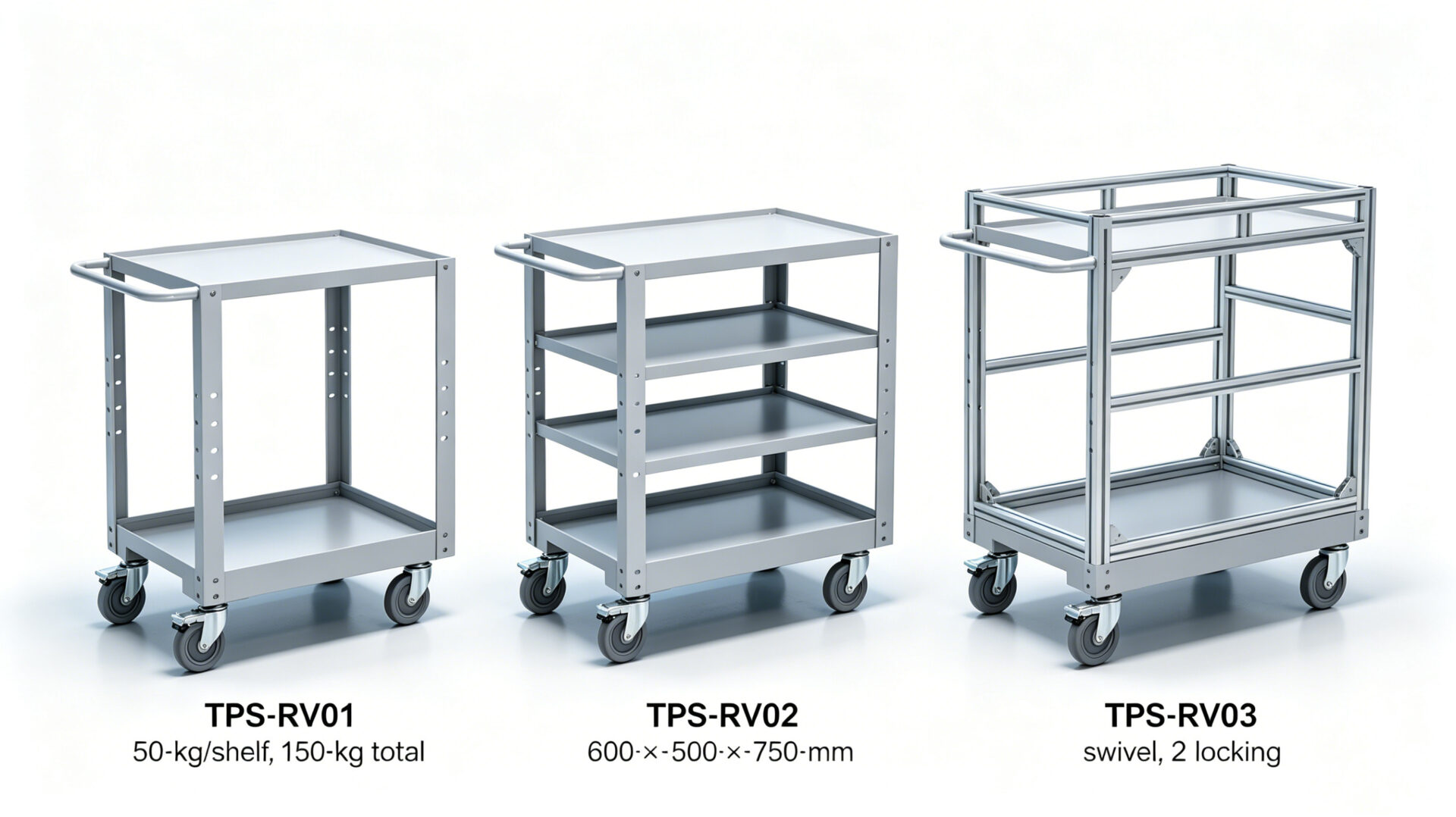
- TPS‑RV01 (WESD00088): Single‑shelf configuration, 150 kg total capacity, 600 × 500 × 750 mm. The foundational model for general‑purpose instrument transport within an EPA.
- TPS‑RV02 (WESD00089): Multi‑shelf configuration, 50 kg/shelf and 150 kg total, 600 × 500 × 750 mm. Adjustable shelves enable organized storage of instruments, tools, and component trays on separate levels.
- TPS‑RV03 (WESD00070): Multi‑shelf configuration with reinforced frame, 50 kg/shelf and 150 kg total, 600 × 500 × 750 mm. The additional reinforcement suits environments where the trolley is subject to frequent repositioning or incidental impacts.
TV Series — Variant ESD trolleys
- TPS‑TV01 (WESD00071): Single‑shelf configuration, 150 kg total capacity, 650 × 450 × 750 mm. A slightly larger footprint than the RV series, suited for wider instruments.
- TPS‑TV02 (WESD00072): Extended‑height configuration, 150 kg total capacity, 650 × 450 × 1160 mm. The additional height accommodates rack‑mount instruments or taller equipment stacks.
- TPS‑TV03 (WESD00073): Compact variant, 150 kg total capacity, 650 × 450 × 750 mm.
These models provide structured options for implementing mobile ESD workstations within an EPA. All models share the same core features. All‑steel construction, dissipative powder coating, integrated grounding point, and locking casters — with dimensions and shelf configurations as the primary differentiators. The full product range is available for review on the TPS ESD trolley category page.
Application guidance for lab and test environments
TPS ESD trolleys serve three distinct roles in laboratory and test environments:
Mobile instrument cart
Oscilloscopes, spectrum analyzers, signal generators, and multimeters are expensive and ESD‑sensitive. A TPS‑RV01 trolley provides a dedicated mobile platform for a single benchtop instrument, allowing it to rolled between test stations while remaining grounded. The locking casters ensure stability during measurement. And the grounding cord maintains ESD protection at every location.
Test equipment workstation
For multi‑instrument test setups — such as an automated test equipment (ATE) calibration station — a TPS‑RV02 or TPS‑RV03 with adjustable shelves organizes instruments, probes, adapters, and documentation on separate levels. The multi‑shelf configuration keeps heavy instruments on the lower shelf for a low center of gravity and lighter accessories on the upper shelf for ergonomic access.
Component handling and transport
In PCB assembly and rework environments, ESD‑sensitive boards and components must transported between workstations without leaving the EPA. A TPS ESD trolley with ESD‑safe bins or trays on the shelves serves as a mobile kitting station. It reducing handling steps and the associated ESD risk. All models support the integration of modular accessories including ESD trays, PCB racks, and tool holders.
For more on ESD protection in manufacturing environments, see the TPS news and insights section.
RFQ checklist
To streamline quotation and evaluation for an ESD trolley:
- Required model: Specify TPS‑RV01, RV02, RV03, TV01, TV02, or TV03 based on the shelf configuration and dimensions needed.
- Quantity: Prototype evaluation unit, pilot quantity, and series production volume.
- Accessories: ESD trays, bins, PCB racks, tool holders, additional shelves.
- Grounding requirements: Standard facility ground connection, or any customer‑specific grounding interface.
- Surface finish: Standard RAL 7035 light gray or custom color if required.
- Documentation: IEC 61340‑5‑1 compliance certificate, surface resistance test report, grounding continuity verification.
- Delivery: Single shipment or phased delivery across multiple sites.
Frequently Asked Questions
What is the difference between the TPS RV and TV ESD trolley series?
The RV series (TPS‑RV01, RV02, RV03) uses a 600 × 500 mm footprint and is the standard range. The TV series (TPS‑TV01, TV02, TV03) uses a 650 × 450 mm footprint and includes an extended‑height model (TV02, 1160 mm). Both series share the same 150 kg total capacity, all‑steel dissipative construction, and locking casters.
Are the shelves on multi‑shelf models individually adjustable?
Yes. Multi‑shelf models such as the TPS‑RV02 and TPS‑RV03 allow shelves to positioned at different heights along the frame, accommodating instruments and components of varying sizes. Each shelf is rated for 50 kg uniform load.
What grounding cord is required for the TPS ESD trolley?
The trolley frame includes a dedicated grounding point. It should connected to a verified facility ground via a coil cord with an integrated 1 MΩ current‑limiting resistor. The grounding cord typically ordered as an accessory; contact TPS during the RFQ process to include it.
Is the TPS ESD trolley compliant with IEC 61340‑5‑1?
Yes. The dissipative powder‑coated steel frame and ESD laminate shelf surfaces designed to meet the surface resistance requirements defined in IEC 61340‑5‑1 for EPA work surfaces (< 1 × 10⁹ Ω to ground). Periodic verification testing recommended as part of EPA maintenance.
Can the casters be replaced with conductive casters for cleanroom use?
The standard TPS ESD trolley equipped with ESD‑safe casters. For cleanroom or special environment requirements, contact TPS to discuss caster material and conductivity specifications.