

For system integrators and test engineers operating precision measurement labs, the workbench is not merely furniture. It is the physical foundation upon which sensitive instrumentation, power supplies, oscilloscopes, and signal analyzers are deployed. A workbench that fails to control electrostatic discharge, manage cable routing. Or support instrument mounting introduces measurement errors that compound across every data point acquired on that surface.
TPS Elektronik addresses these requirements with a comprehensive line of laboratory-grade ESD table solutions. Every workstation in the TPS portfolio integrates a static-dissipative laminated work surface, modular accessory mounting, configurable cable management, and compliance with IEC 61340-5-1. The international standard governing the protection of electronic devices from electrostatic phenomena. Procurement teams specifying these workbenches gain a single-source solution for ESD-safe lab infrastructure that reduces vendor count and simplifies acceptance documentation.
Why ESD control matters for laboratory test and measurement environments
In precision measurement environments, electrostatic discharge is not simply a reliability concern for the components under test. It is a direct source of measurement uncertainty. Static charge accumulating on a non-dissipative work surface couples capacitively into high-impedance measurement circuits. Which distorting readings from digital multimeters, oscilloscope probes, and spectrum analyzers. A test engineer attempting to characterize a low-noise amplifier on a non-ESD bench may spend hours chasing apparent noise floors that are, in reality, artifacts of the workstation itself.
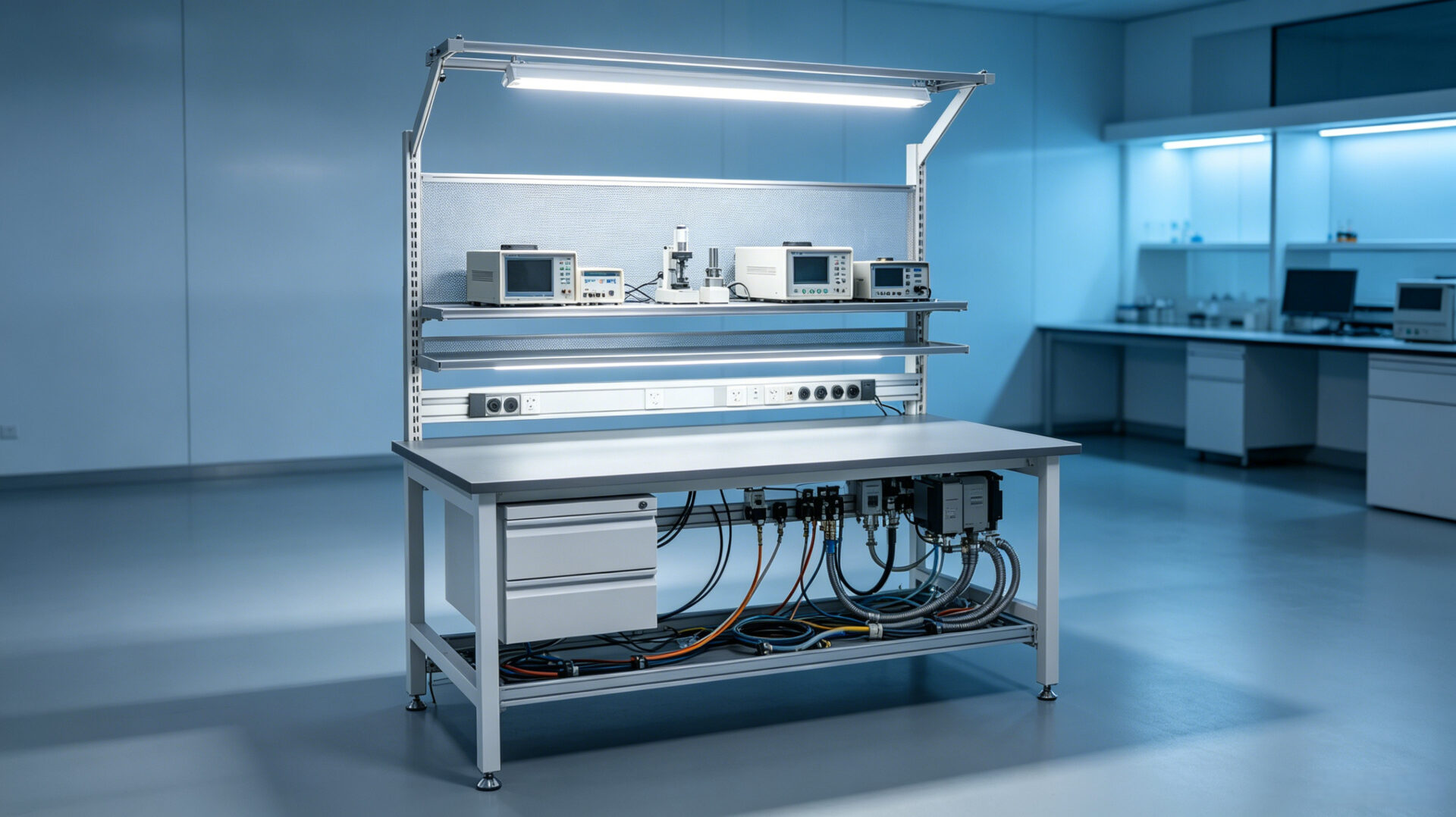
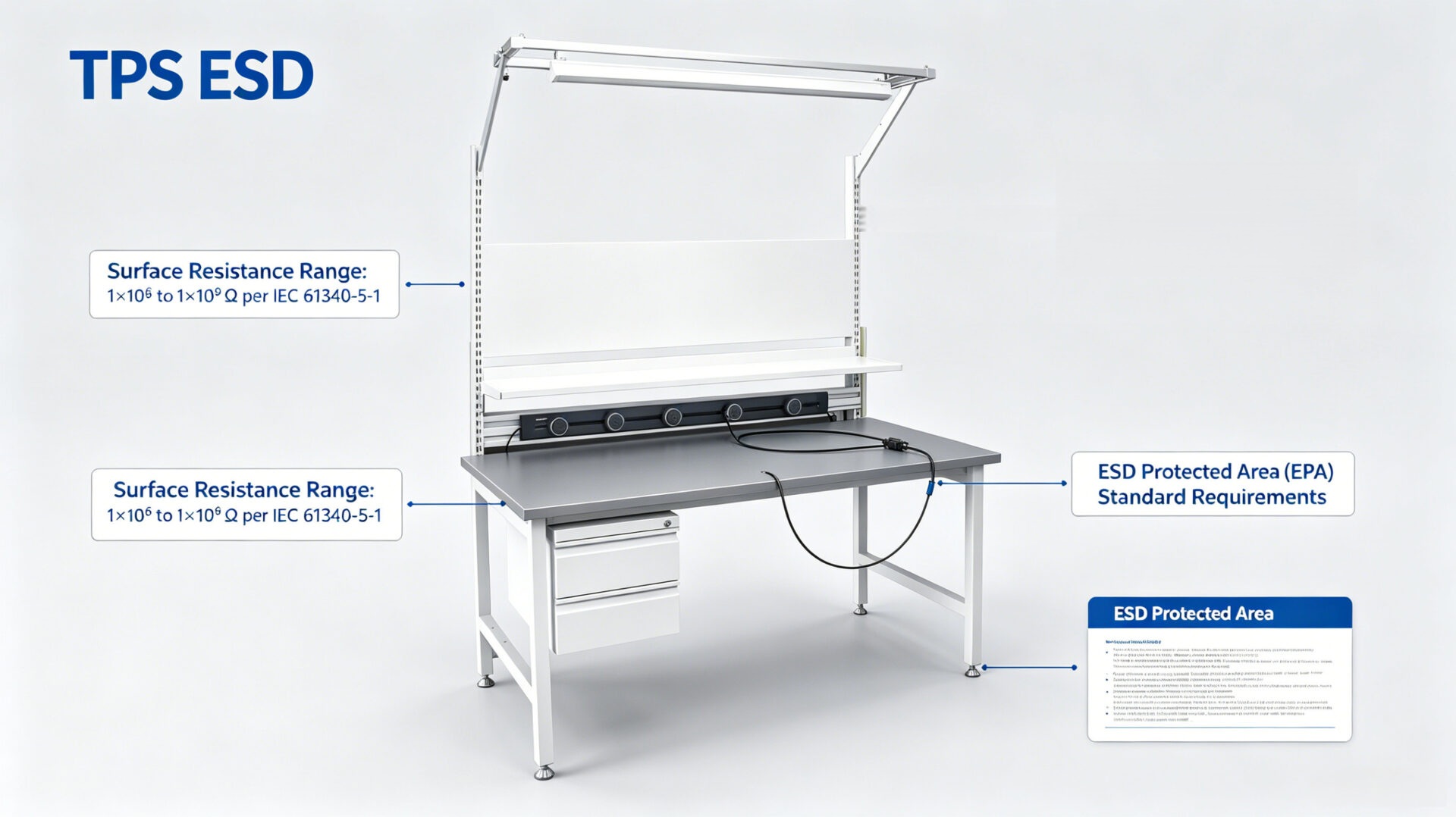
TPS ESD table eliminate this variable by ensuring that the entire work surface maintains a controlled resistance path to ground. The 25mm HPL laminate top provides a static-dissipative surface that meets the surface resistance requirements defined by ANSI/ESD S20.20. Which resistance to ground (Rtg) below 1×10⁹ ohms for surfaces that contact ESD-sensitive items. Within an ESD Protected Area (EPA), IEC 61340-5-1 requires that all work surfaces, shelving. And accessible conductive elements maintain equipotential bonding to a common ground point. The TPS workstation frame — finished in RAL 7035 powder coating. And the ESD HPL laminated top together form a fully compliant EPA foundation when connected to facility ground via the integrated grounding points.
For further context on how electrostatic protection integrates into broader manufacturing quality systems, see the TPS overview of services. Additional technical detail on surface material performance and cooling interactions is available in the TPS analysis of aluminum heat sink efficiency Relevant when placing heat-dissipating test equipment on ESD table surfaces.
Cable management systems: organizing power, data, and pneumatic lines
A laboratory workstation hosting a spectrum analyzer, two oscilloscopes, a programmable DC power supply, and a test PC generates a substantial volume of cabling. Power cords, BNC cables, USB leads, and probe connections quickly become entangled if not managed systematically. This clutter is not simply an aesthetic problem: poorly managed cables introduce mechanical stress on instrument connectors, create trip hazards. And — critically — facilitate unintended antenna structures that radiate or couple electromagnetic interference into sensitive measurement setups.
Tethered, uncontrolled cables introduce several operational risks in a laboratory environment. Loose instrument leads trailing across a bench surface can snag on equipment corners. Which causing sudden disconnection during critical measurements. Bundled cables without proper separation between power and signal lines become unintentional coupled noise paths, degrading acquired signal quality. A collection of dangling cables without anchors transfers stress directly to the connector solder joints on expensive instrumentation when equipment is repositioned. Which leading to premature connector failure and intermittent measurement errors that are notoriously difficult to diagnose.
TPS addresses cable management as an integrated design feature, not an afterthought. The modular frame design accommodates cable routing channels beneath the work surface and along the rear of the workstation. Power rails mounted on the rear frame provide organized termination points for electrical power, network connections. And pneumatic interfaces — consolidating all utility connections in one accessible location rather than scattered across the benchtop. This systematic approach to cable management eliminates the common failure modes associated with uncontrolled cabling.
The industry-standard approach — powder-coated steel cable trays mounted beneath the tabletop — provides organized and secure routing for all power, data, and pneumatic lines. TPS workstations employ a similar philosophy: cables route through channels integrated into the modular frame, with rear entry points keeping lines off the work surface. This system keeps the work surface clear for instrumentation while maintaining full access to cables for reconfiguration. For environments with frequent equipment changes. Such as R&D labs or multi-purpose test stations — the quick-disassembly design of TPS accessories means cable management components can be repositioned without tools, in alignment with the broader modular design philosophy that characterizes the complete TPS ESD Workshop lineup.
Instrument shelving and power rail integration
Test and measurement laboratories accumulate instruments. Oscilloscopes, signal generators, spectrum analyzers, and multimeters compete for horizontal bench space. Without a vertical storage strategy, instruments stack precariously, ventilation paths are blocked. And the workspace shrinks to the point where productive work becomes difficult.
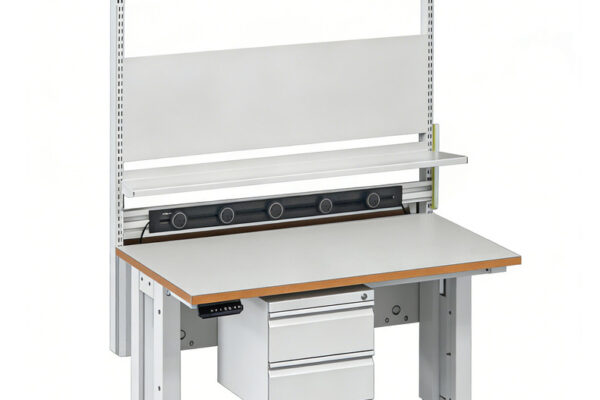
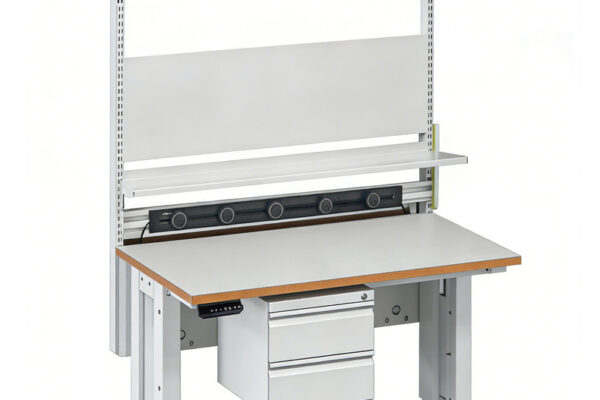
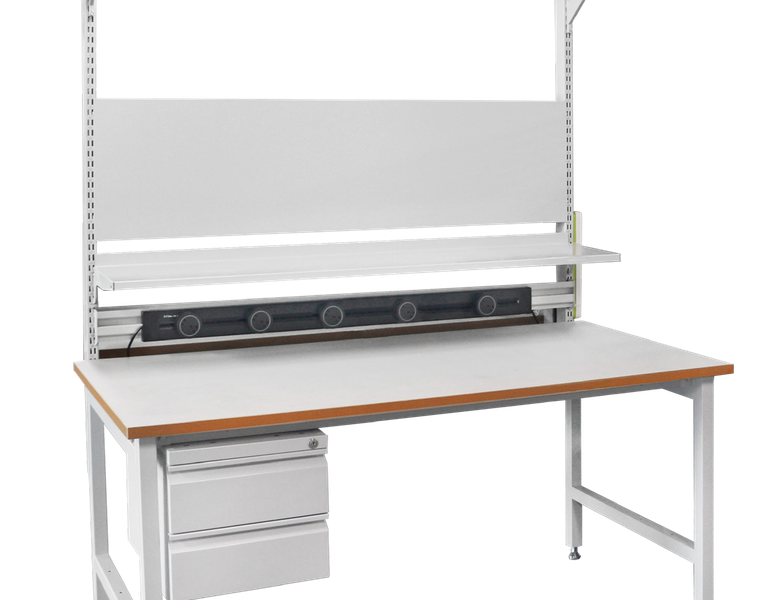
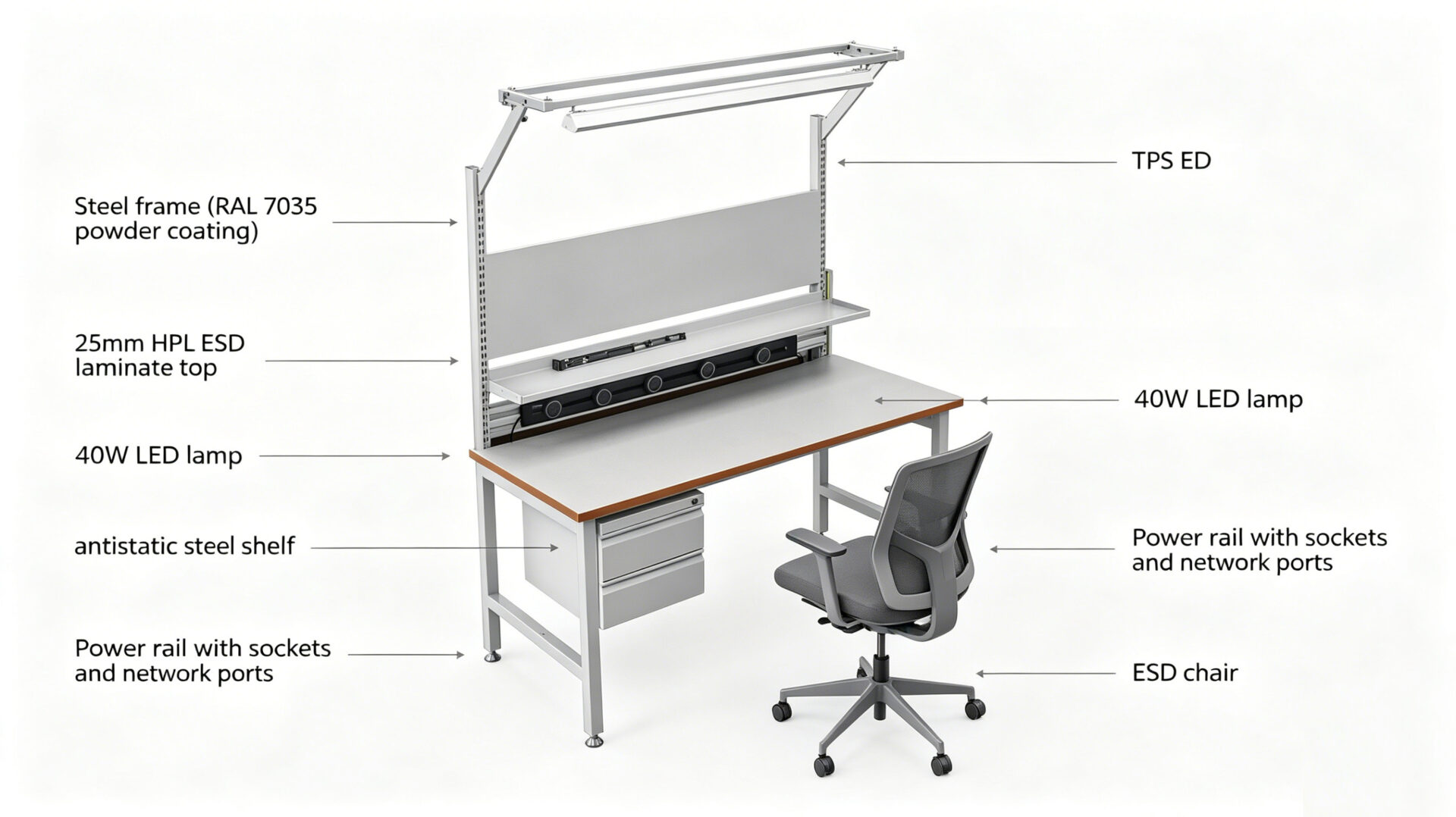
TPS ESD table address this through configurable antistatic steel shelving. The standard shelf has a depth of 649mm and carries an ESD-safe paint finish in RAL 7035, matching the workbench frame. Heavy instruments, such as older-generation spectrum analyzers weighing 15–25 kg. Which require a shelf that does not deflect under load. The TPS shelf system, integrated into the modular frame, distributes weight through the steel structure rather than relying on cantilevered brackets alone. For dual-operator L-shaped configurations, shelving can be positioned to serve both operators simultaneously. Which reducing the need for duplicate instrumentation.
Complementing the physical shelving is the integrated power rail. A feature that consolidates instrument power distribution. Rather than running individual power cords from each instrument to wall outlets (creating ground loops and consuming floor space), the power rail provides multiple standard sockets, RJ45 network ports. And pneumatic interfaces in a single accessible location along the rear of the workstation. This consolidation simplifies both initial setup and subsequent reconfiguration. The power rail is compatible with international electrical standards. Which supporting the varied requirements of global laboratories.
Work surface design for precision measurement applications
The work surface is where physics meets engineering. For precision measurement, the surface must satisfy multiple constraints simultaneously: static dissipation, mechanical flatness, chemical resistance, and thermal stability. The TPS workstations use a 25mm thick HPL (High-Pressure Laminate) top in RAL 7035 light gray. HPL is manufactured by bonding multiple layers of phenolic resin-impregnated kraft paper under high pressure and temperature. Which creating a material that is dense, dimensionally stable. And resistant to common laboratory chemicals including isopropyl alcohol, mild acids, and cleaning solvents.
The ESD property of HPL laminate is achieved through the incorporation of conductive elements within the laminate structure. Which producing a surface with controlled resistivity typically in the range of 1×10⁶ to 1×10⁹ ohms. This range is dissipative rather than conductive — meaning static charge bleeds to ground at a controlled rate rather than discharging abruptly. Which could itself damage sensitive components. The thickness (25mm) provides the mechanical stiffness necessary to support heavy instrumentation without sagging. While the smooth, non-porous surface facilitates cleaning and prevents particulate contamination that could interfere with optical or semiconductor test procedures.
The 40W LED lamp integrated into TPS workstations provides 5000K white light with a color rendering suitable for detailed inspection work — reading component markings, inspecting solder joints, and verifying connector orientations. Proper illumination reduces eye strain during long measurement sessions and minimizes the risk of connection errors that could damage sensitive equipment.
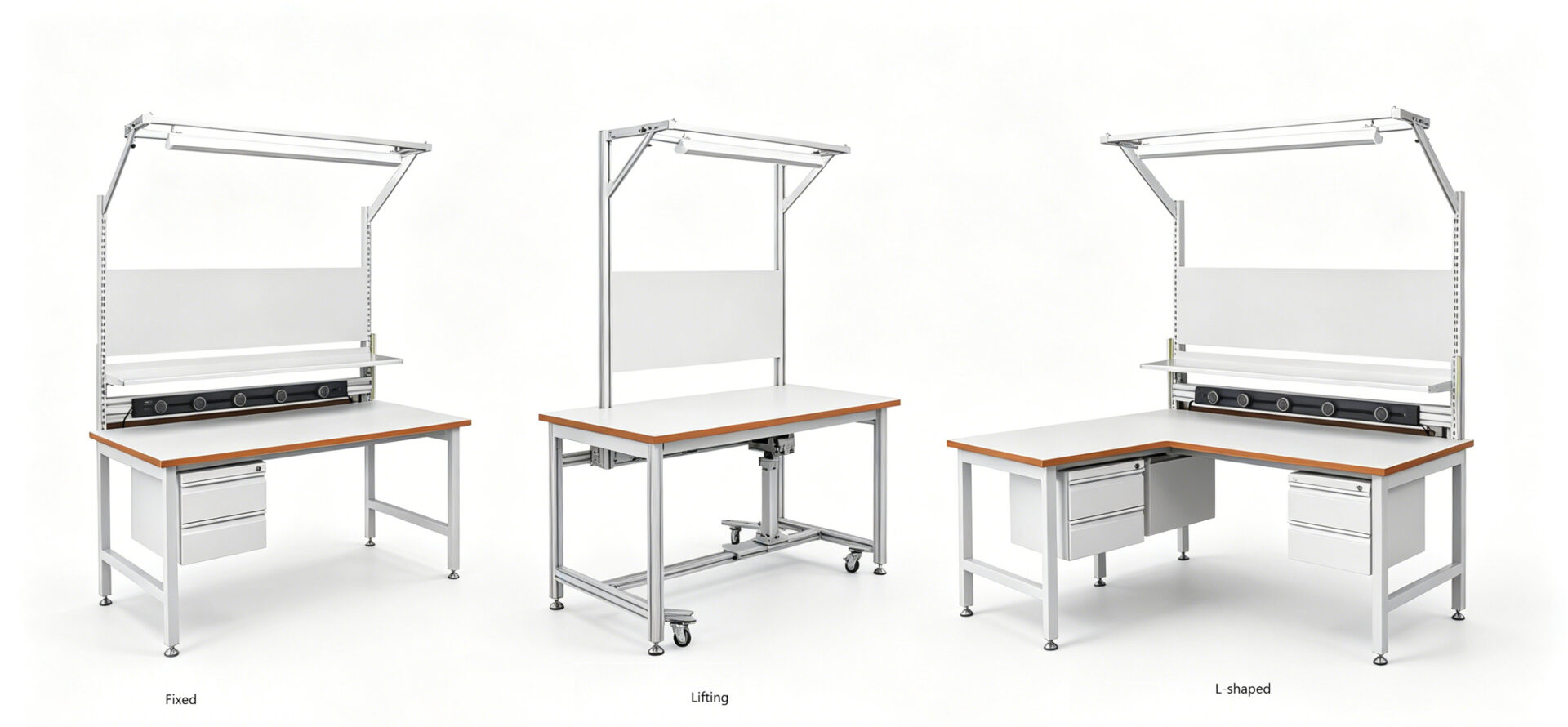
Beyond these standard features, TPS accommodates custom dimensions for laboratories with specific spatial constraints. Fixed-height, lifting, and L-shaped configurations — explored in the product line overview below — offer a complete range of workstation formats without sacrificing ESD compliance or build quality.
Product line overview: Fixed, Lifting, and L-shaped ESD Table
Fixed workstations: heavy-duty, high static load
Fixed ESD workstations are the foundation of the TPS product line. Available in multiple size variants — including Fixed-1260 (1220×600×760mm), Fixed-1575 (1550×750×760mm), and Fixed-1890 (1850×900×760mm) — these workbenches support a uniform static load of 500kg. The heavy-gauge steel frame with RAL 7035 powder coating provides corrosion resistance and structural rigidity suitable for permanent laboratory installations. Fixed stations serve applications where bench height remains constant, such as dedicated test racks, calibration stations, and production-line inspection positions.
Height-adjustable workstations: ergonomic sit-stand flexibility
For laboratories where multiple operators share a workstation or where ergonomic flexibility is a requirement, TPS offers Lifting ESD workstations with electrically adjustable height. The Lifting-1260 (1200×600mm) adjusts from 720mm to 1060mm, supporting 200kg static load and 130kg dynamic load. The Lifting-1575 (1530×750mm) and Lifting-1890 (1830×900mm) provide larger work surfaces with similar height ranges. These sit-stand workstations enable operators to alternate between seated and standing positions throughout a shift, reducing fatigue during extended measurement sessions while maintaining full ESD protection throughout the height range.
L-shaped workstations: dual-operator space optimization
For laboratories where floor space is at a premium, L-shaped ESD workstations maximize usable surface area within a compact footprint. Available in L-shaped-12060, L-shaped-15375, and L-shaped-18390 configurations, these workstations feature dual-surface layouts with primary and secondary worktops connected at a right angle. All L-shaped variants support 500kg uniform static load and comply with IEC 61340-5-1:2016. The corner-optimized design accommodates two operators simultaneously on a single workstation, making L-shaped configurations particularly suitable for collaborative test environments, training labs, and production cells where multiple technicians work in close proximity.
Compliance and certification: IEC 61340-5-1 and ANSI/ESD S20.20
For system integrators and procurement teams, “ESD-safe” is not meaningful without reference to a specific standard. In Europe and internationally, IEC 61340-5-1 governs the protection of electronic devices from electrostatic phenomena within an ESD Protected Area. This standard specifies the design, establishment, implementation, and maintenance of an ESD control program. ANSI/ESD S20.20 serves the equivalent role in North America, defining the requirements for an ESD control program including workstation grounding, personnel grounding, and packaging.
TPS ESD workstations are compliant with the requirements of IEC 61340-5-1:2016 for point-to-point and point-to-earth static control. The 25mm HPL laminate work surface provides a dissipative path to ground consistent with the surface resistance requirements defined in both IEC 61340-5-1 and ANSI/ESD S20.20. Grounding points integrated into the steel frame enable connection to the facility’s common point ground via standard grounding cords. When combined with appropriate ESD seating — such as the TPS ESD Chair1 or ESD Chair2, which are compatible with the complete workstation lineup — a fully compliant EPA workstation configuration is achieved.
For documentation purposes, TPS provides compliance certificates and test reports that support customer audit requirements. The modular design also simplifies periodic verification testing, as individual components can be tested for ground continuity without disassembling the entire workstation. For additional technical resources, consult the TPS news and insights section.
RFQ checklist for ESD table procurement
- Workstation type: Fixed, height-adjustable (Lifting), or L-shaped configuration.
- Dimensions: Required work surface dimensions (L×W×H in mm) or select standard size from the TPS product line.
- Load requirements: Maximum static and dynamic load per workstation.
- Accessories: Antistatic steel shelf, LED lamp (40W, 5000K), power rail, ESD chair type (Chair1 or Chair2).
- Surface finish: Standard RAL 7035 HPL laminate top or custom color requirements
- Custom dimensions: If standard sizes do not fit the laboratory layout, provide preferred dimensions.
- Compliance documentation: IEC 61340-5-1 compliance certificates, surface resistance test reports, grounding continuity verification.
- Quantity: Number of workstations and delivery schedule.
Frequently Asked Questions
What standard does the TPS ESD table comply with?
TPS ESD workstations are compliant with IEC 61340-5-1:2016 for electrostatic protection in electronics manufacturing environments. The ESD HPL laminate work surface meets the surface resistance requirements (< 1×10⁹ Ω) recognized under both IEC 61340-5-1 and ANSI/ESD S20.20.
Can TPS provide ESD workstations with custom dimensions?
Yes. TPS offers customizable sizes to fit specific workspace layouts. Both fixed and L-shaped configurations can be adapted with custom wing lengths and heights (standard height 760mm). Custom dimension requirements should be specified during the RFQ phase.
What accessories are available for TPS ESD workstations?
Standard accessories include the 25mm ESD HPL laminated top (RAL 7035), antistatic steel shelf (649mm depth), 40W LED lamp (5000K white light), power rail (integrating standard sockets, network ports, and pneumatic interfaces), and ESD chairs (Chair1: 420–560mm; Chair2: 600–780mm height).
Are the lifting workstations electrically adjustable?
Yes. TPS Lifting workstations provide electrically adjustable height from 720mm to 1060mm, supporting sit-stand operation. Dynamic load ratings range from 100kg to 130kg depending on model, with static loads to 200kg.
What load capacity can TPS ESD workstations support?
Fixed and L-shaped ESD workstations support a uniform static load of 500kg. Lifting workstations support 200kg static load with dynamic load ratings of 100–130kg depending on model. Uniform load distribution across the work surface is assumed.