

For system integrators, panel builders, and engineering‑driven procurement teams, the 24 V DC power supply is the single most critical component in any industrial control panel. It is not merely a source of power. And it determines whether the PLC boots reliably after a factory‑wide brownout. It dictates whether sensor readings remain accurate under fluctuating loads. And it carries the weight of regulatory compliance — the SELV classification, the EMC limits, the safety isolation — that must documented and proven during factory acceptance testing.
The TPS 24V DC power supply range is engineered for these demands. It spans multiple form factors — DIN rail, panel mount, and open‑frame — with power ratings from 30 W to 180 W. All models share a common architecture: universal 85–264 V AC input, regulated 24 V SELV output, active PFC on higher‑power units. And a suite of protection functions that guard against overload, short circuit, overvoltage, and overtemperature. This article examines the TPS 24V DC power supply lineup and explains why it forms the electrical foundation of reliable machine operation.
Why 24V DC is the standard for industrial automation
The 24 V DC voltage level has been the backbone of industrial control for decades. It represents a deliberate engineering trade‑off. The voltage is high enough to drive relays, contactors, and solenoid valves over long cable runs without excessive current or voltage drop. Yet it is low enough to be classified as Safety Extra‑Low Voltage (SELV) under IEC 61140. Which meaning the risk of electric shock inherently limited. This simplifies panel design, because SELV circuits do not require the same creepage and clearance distances or protective earthing as mains‑voltage circuits.
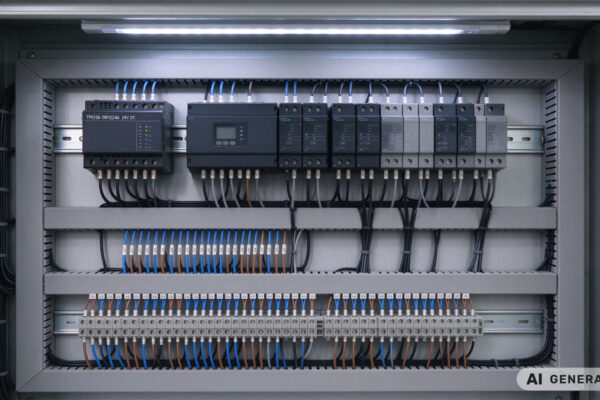
In a typical automation control panel, a single 24 V DC power supply feeds the PLC CPU and I/O modules, dozens of sensors (photoelectric, inductive, ultrasonic), and numerous actuators (pilot lights, solenoid valves, small DC motors). The power supply must maintain a stable output voltage under widely varying load conditions. From near‑zero current when the machine is idle to the full rated current when all outputs are active. If the voltage sags below approximately 20 V, the PLC may enter an undefined state, and sensors may generate erroneous signals. This is why an industrial switching power supply 24V must deliver more than just the right nominal voltage. It must provide tight regulation, fast transient response, and sufficient hold‑up time to ride through brief mains interruptions.
TPS 24V DC power supply range overview
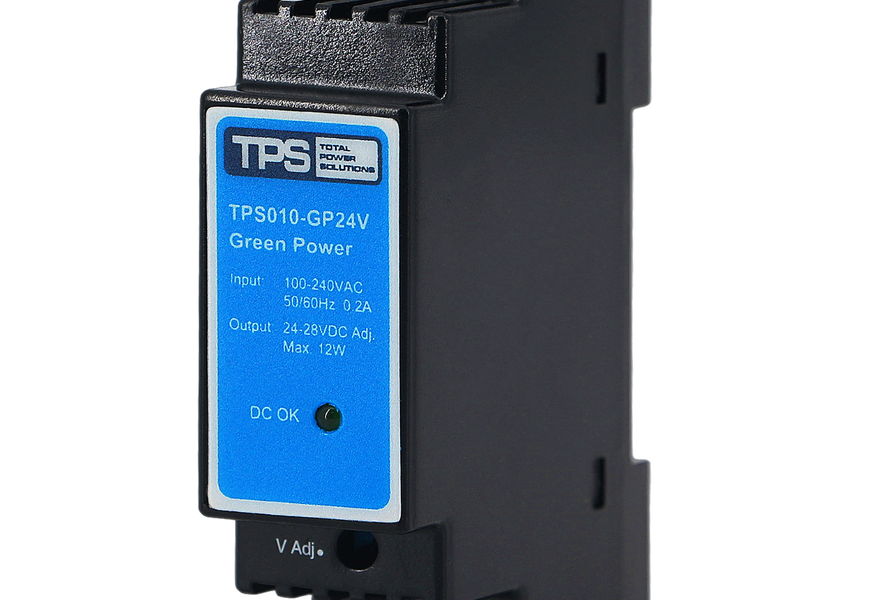
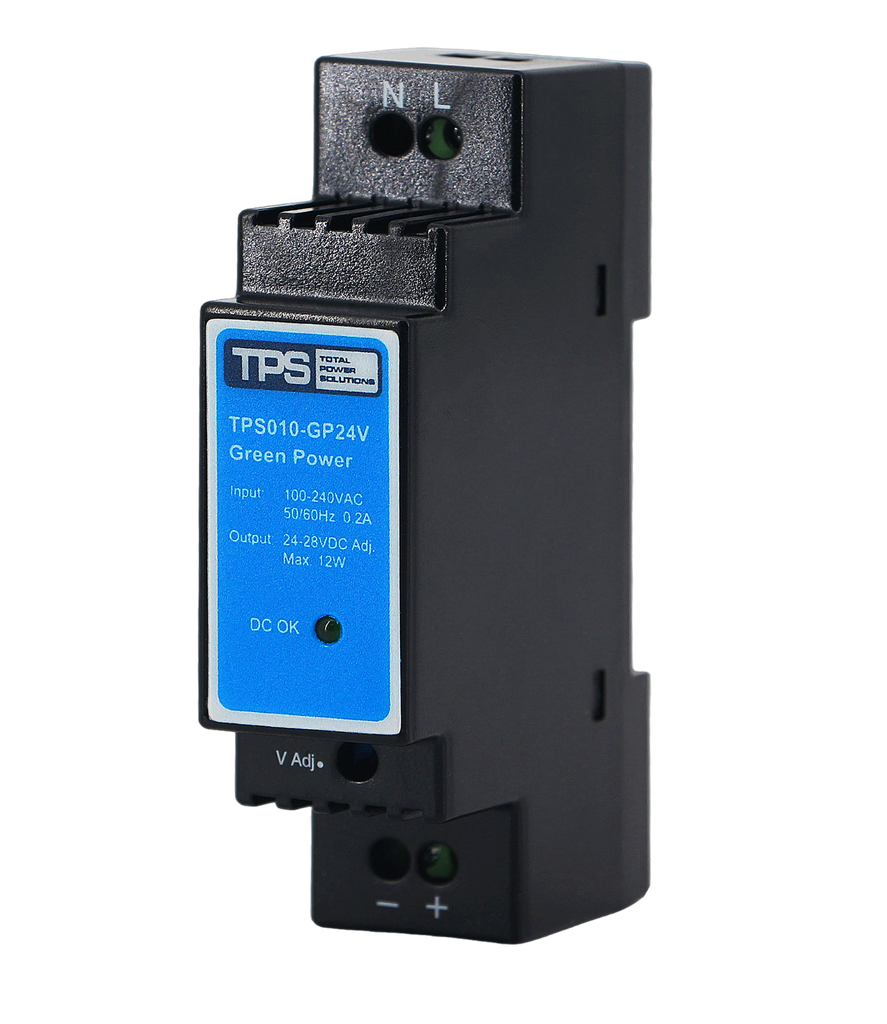
The TPS 24V DC power supply family organized by power rating and form factor. The compact TPS010 series starts at 30 W in a slim DIN rail housing, ideal for small control panels where space is at a premium. The TPS030 series scales to 130 W with active PFC. Which supplying larger PLC installations and distributed I/O racks. For applications requiring open‑frame integration. Such as embedding the power supply inside a larger instrument. The TPS‑GSH180S series provides 180 W in a compact PCB‑mount format. A complete overview is available on the TPS power supply category page.
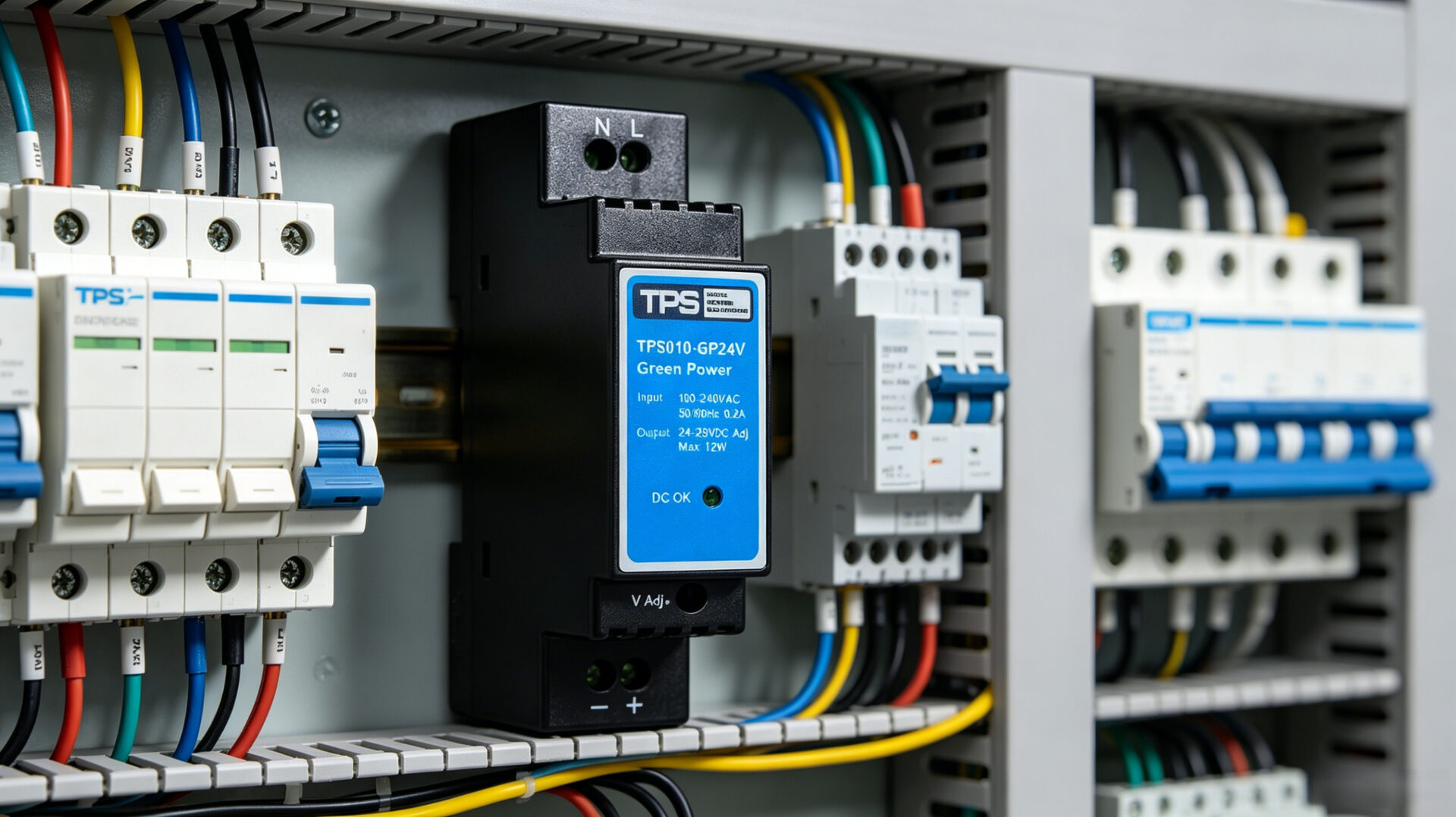
For panel builders, the DIN rail form factor is the preferred choice because it standardizes mounting and simplifies wiring. TPS DIN rail power supplies feature clearly labeled, accessible screw terminals that accept ring or fork lugs. Which reducing installation time and minimizing the risk of loose connections. Panel mount versions are also available for enclosures that do not use DIN rail. All models designed for natural convection cooling, eliminating the need for fans that can fail and reduce system reliability. For further reading on power supply integration strategies, see the TPS news and insights section.
Electrical performance: input range, efficiency, and regulation
A universal AC input range of 85–264 V AC (and 120–370 V DC on most models) is a defining characteristic of the TPS 24V DC supply line. This range covers the full spectrum of global mains voltages, from 100 V AC in Japan to 240 V AC in Europe, with sufficient margin for voltage fluctuations. The wide input also simplifies inventory management for OEMs who ship equipment to multiple regions: one power supply part number serves all destinations. Which eliminating the risk of installing a 115 V‑only unit on a 230 V supply.
Efficiency is an important parameter for two reasons. First, higher efficiency reduces the waste heat that must dissipated inside the control panel, lowering the ambient temperature and extending the life of all components. Second, it directly reduces energy consumption over the operating life of the machine. TPS power supplies achieve typical efficiencies above 90 %, with active PFC on higher‑power models improving power factor to 0.95 or better. This reduces the RMS current drawn from the mains, which in turn reduces stress on upstream circuit breakers and wiring.
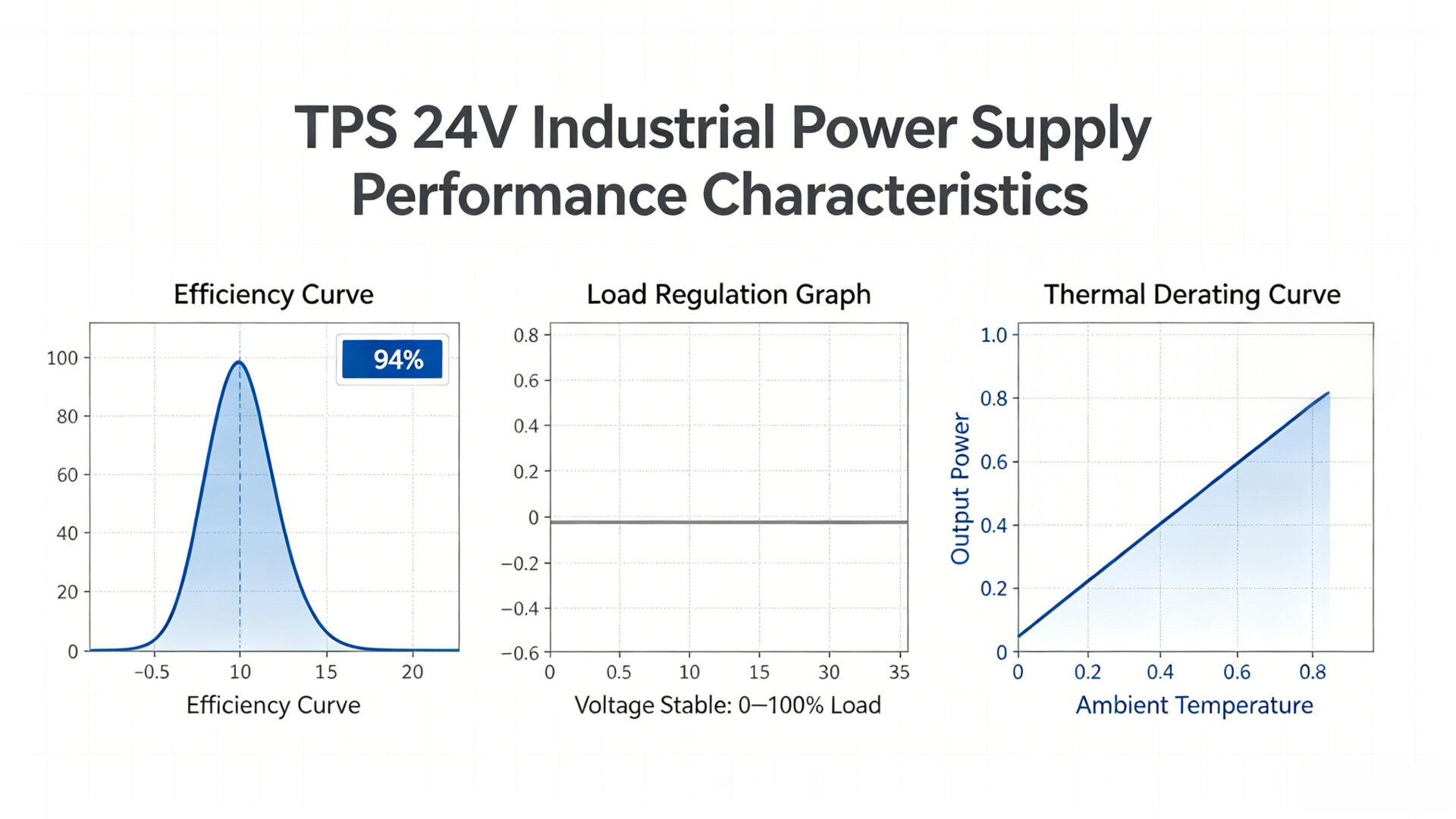
Output regulation specified as line and load regulation, typically within ±1 % across the full input voltage range and from no load to full load. A potentiometer on the front panel allows fine‑tuning of the output voltage. For example, adjusting from the nominal 24 V to 27 V to compensate for a long cable run to a distant sensor array. Ripple and noise are controlled to low levels, ensuring that sensitive analog circuits and communication modules receive clean power. For detailed technical data, consult the product datasheets available on the power supply category page.
Protection functions: overload, short circuit, and thermal
Industrial environments are unforgiving. A miswired sensor can create a short circuit on the 24 V rail. A jammed actuator can draw excessive current and stall. A control panel with inadequate ventilation can reach temperatures that degrade electrolytic capacitors. The power supply must survive all of these conditions without failure, and it must protect the downstream equipment to the greatest extent possible.
TPS 24V DC power supplies incorporate a standard suite of protection functions. Overload protection limits the output current when the load exceeds the rated value. Which typically using a constant‑current characteristic that allows the voltage to drop while maintaining a safe current level. Short‑circuit protection is an extension of overload protection: if the output is shorted, the power supply enters a hiccup mode, periodically attempting to restart and checking whether the fault has cleared. Overvoltage protection shuts down the output if the internal regulation loop fails and the output voltage rises above a safe threshold. A critical safeguard for protecting expensive PLC and I/O modules. Overtemperature protection monitors the internal temperature and shuts down the unit if safe limits are exceeded.
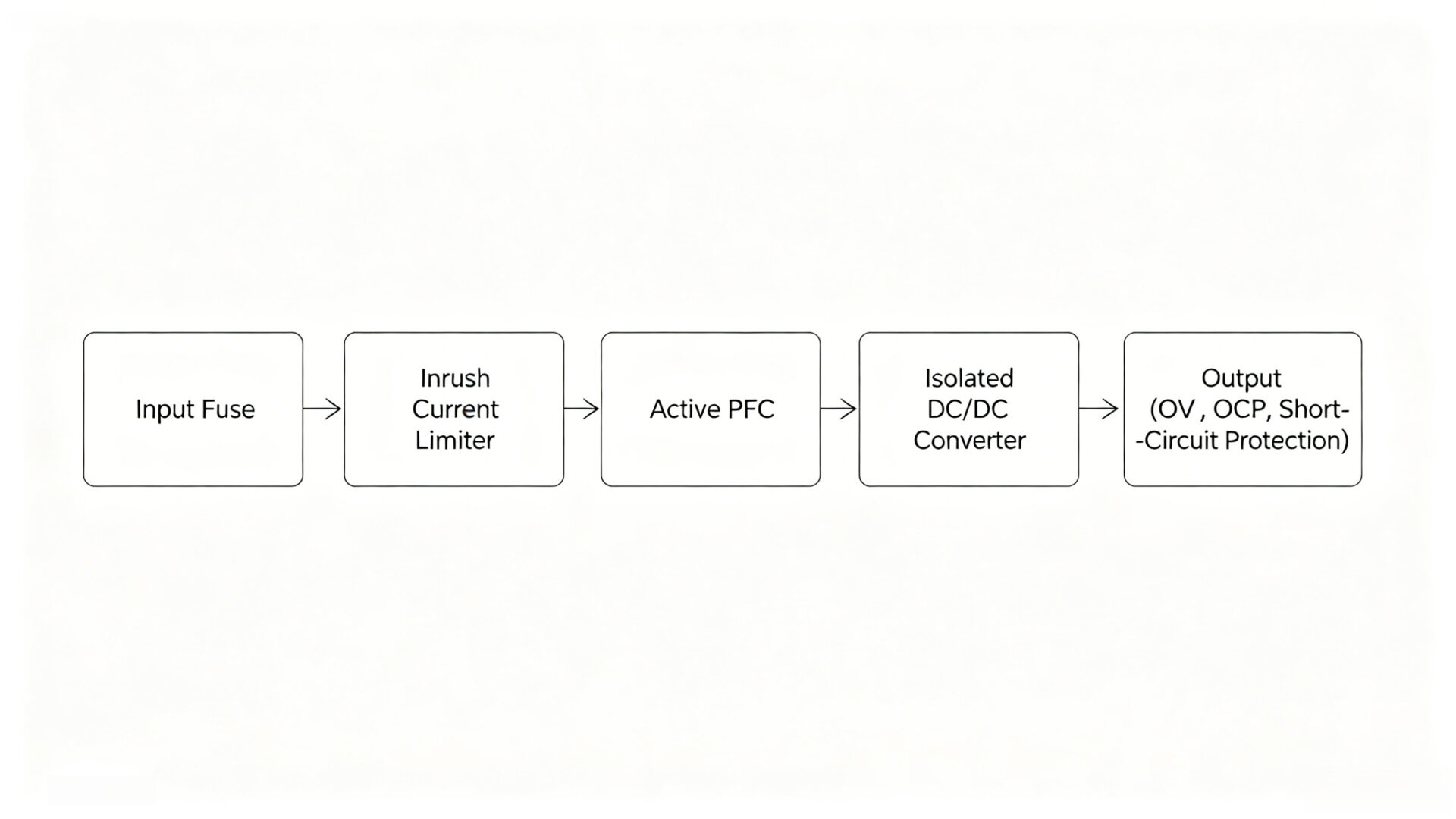
These protection functions are not just safety features; they are uptime features. A power supply that shuts down cleanly on a fault and recovers automatically when the fault is cleared keeps a production line running. A power supply that fails permanently on a transient overload stops the line and requires a maintenance call. This distinction is critical for panel builders and system integrators who design for high availability. For a broader discussion on power supply reliability. Which refer to the TPS services overview and available technical resources.
Mechanical integration: DIN rail, panel mount, and wiring
The physical installation of a power supply in a control panel affects both electrical performance and serviceability. DIN rail mounting — standardized by EN 60715. Which allows power supplies to be snapped into place alongside other DIN rail devices, creating a compact, organized layout. TPS DIN rail supplies use a robust metal housing with ventilation slots designed for vertical convection airflow. The housing dimensions follow the common industrial widths (e.g., 35 mm, 55 mm, or 85 mm). Which making it straightforward to allocate space in the panel layout.
Wiring is a practical concern that is often overlooked during component selection. TPS power supplies feature clearly labeled screw terminals that accept a range of wire sizes. The input terminals typically separated from the output terminals by a physical barrier, reducing the risk of accidental contact between mains and SELV circuits. The DC output terminals often provided in duplicate (positive and negative pairs). Which allowing the output to be daisy‑chained to multiple loads without the need for additional terminal blocks. This feature alone can save significant wiring time in a complex panel. For panel builders interested in further streamlining their wiring processes, TPS offers additional accessories and integration guidance through its technical resources.
Compliance and safety: SELV, IEC 62368‑1, and EMC
For any product destined for the European market, compliance with applicable directives is mandatory. A 24V DC regulated power supply falls under the Low Voltage Directive (2014/35/EU) and the EMC Directive (2014/30/EU). TPS power supplies are designed and tested to meet IEC 62368‑1, the hazard‑based safety standard for AV, ICT, and industrial equipment. This standard governs protection against electric shock, fire, mechanical hazards, and thermal hazards. All relevant to a power supply installed in a control panel.
The SELV classification is particularly significant. Under normal operation and single‑fault conditions, the output voltage remains below 60 V DC, and the isolation between the mains input and the SELV output reinforced. This means that the 24 V circuit does not require the same protective earthing as the mains circuit. Which simplifying panel wiring and reducing the risk of ground loops. TPS provides a Declaration of Conformity and supporting test reports with every product. Which reducing the documentation burden for system integrators and panel builders during their own CE marking process. For EMC, compliance demonstrated against EN 55032 (CISPR 32) Class B for emissions and the IEC 61000‑4‑x series for immunity.
Application guidance: PLC, sensors, actuators
The TPS 24V DC power supply supports three main application areas within industrial automation:
- PLC and control logic: The power supply feeds the PLC CPU and I/O modules, providing the stable, low‑noise voltage necessary for reliable program execution and accurate analog input readings. The hold‑up time (typically 20–30 ms at full load) allows the PLC to ride through brief mains interruptions without rebooting.
- Sensors and transmitters: Photoelectric sensors, proximity switches, pressure transmitters, and temperature sensors all require a clean 24 V supply. The low ripple and noise of the TPS supply prevent measurement errors that could trigger false alarms or incorrect control actions.
- Actuators and field devices: Solenoid valves, pilot lights, small DC motors, and control relays draw intermittent currents that can vary widely. The TPS power supply’s fast transient response and robust overload capability ensure that these loads are driven without voltage sags that could affect other circuits on the same rail.
RFQ checklist for 24V DC power supplies
- Power requirement: Total DC load current (in amperes) or wattage, including start‑up inrush and future expansion margin.
- Form factor: DIN rail, panel mount, or open‑frame.
- Input voltage: Nominal mains voltage and any special conditions (e.g., 120 V AC only, 230 V AC only, or universal).
- Redundancy: Single supply, N+1 parallel, or 1+1 redundant configuration.
- Environmental: Ambient temperature range, altitude, humidity, and any special pollution degree.
- Certifications: IEC 62368‑1 (standard), UL 62368‑1, IEC 60601‑1 (medical), or customer‑specific.
- Quantity and schedule: Prototype, pilot, and series volumes with target delivery dates.
- Documentation: Test reports, CE Declaration of Conformity, material declarations.
Frequently Asked Questions
What is the difference between a 24V DC power supply and a 24V battery charger?
A 24V DC power supply provides a regulated constant voltage to operate equipment continuously. A battery charger designed to charge a battery and may use a different charging profile (constant current, float charge, etc.). TPS power supplies designed for direct equipment power, not battery charging, unless specifically configured.
Can TPS 24V power supplies be connected in parallel for redundancy or higher power?
Yes, many TPS models support parallel operation with active current sharing or simple N+1 redundancy using external OR‑ing diodes. Consult the specific product datasheet or contact TPS engineering for configuration guidance.
Do TPS 24V supplies include active PFC?
Active PFC is included on models rated 100 W and above. Lower‑power models use passive PFC or meet harmonic current limits without active correction, depending on the specific design.
What is SELV and why is it important?
SELV stands for Safety Extra‑Low Voltage, defined by IEC 61140. A SELV circuit operates at a voltage low enough to prevent electric shock under normal and single‑fault conditions, and it is galvanically isolated from hazardous voltages. Using a SELV power supply simplifies panel safety design and compliance.
Where can I find technical documentation for TPS power supplies?
Datasheets, installation manuals, and compliance certificates are available on the TPS power supply product page or through the TPS technical resources.