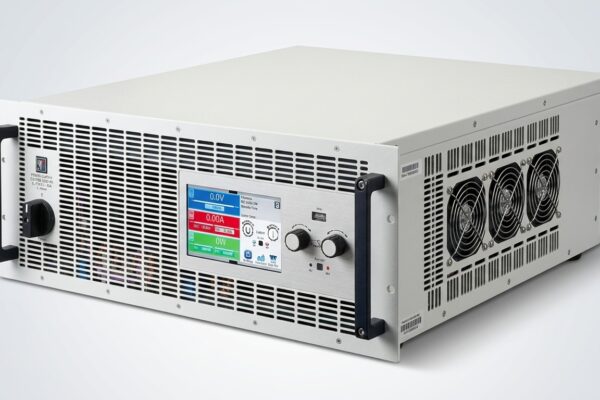


For system integrators, panel builders, and engineering-driven procurement teams, rack space in data centers and automated testing facilities is a premium asset. Every inch of a 19-inch rack translates directly to operational costs, thermal management challenges, and facility footprint.
Historically, achieving high wattage output required bulky, heavy power supplies that consumed multiple rack units (3U, 4U, or more). Today, the paradigm has shifted. The demand for a high power density DC solution has led to the development of ultra-compact, highly efficient power systems that deliver uncompromising performance without the spatial penalty.
In this comprehensive technical guide, we will explore what a dc programmable power supply is, how a 1U programmable DC supply optimizes data center and laboratory rack space. And why features like autoranging, active PFC, and isolated interfaces are critical for modern electrical engineers. We will specifically examine the capabilities of the EA-PS 9000 1U series, a benchmark in precision programmable DC power.
What Is a High Power Density Programmable DC Supply?
A dc programmable power supply is an advanced piece of electronic test equipment that provides a highly stable, precisely controlled direct current (DC) output. Unlike standard fixed-output power supplies, a programmable unit allows engineers to dynamically adjust voltage, current, and power limits either manually via the front panel or remotely through digital/analog interfaces.
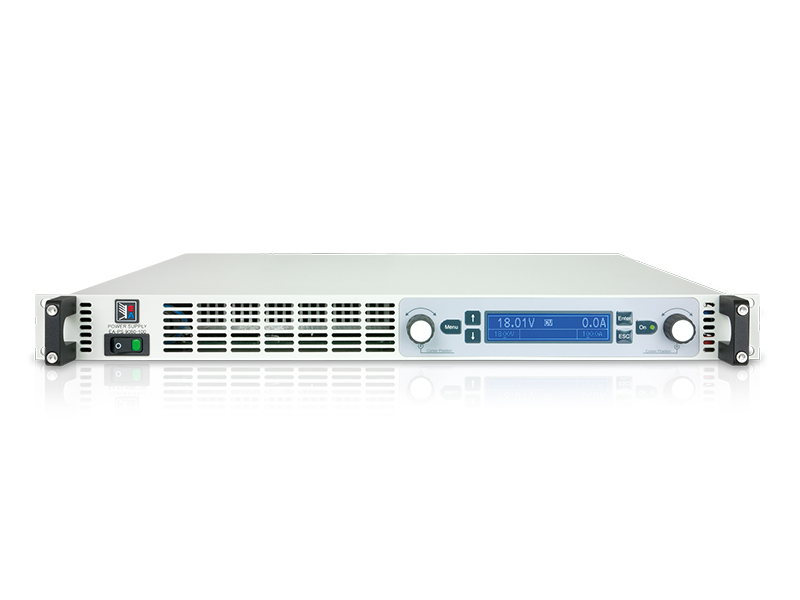
The term “High Power Density” refers to the ratio of output power to the physical volume of the unit. In the past, a 1500W power supply might have required a 3U or 4U chassis. Today, leading programmable power supply manufacturers have engineered solutions like the EA-PS 9080-50 1U. Which packs 1500W of power (0-80V, 0-50A) into a remarkably compact 1U 19″ rack-mount chassis (19″ x 1U x 500mm).
This evolution is driven by advancements in microprocessor control, high-frequency switching topologies, and advanced thermal dissipation materials. For engineers requiring a high voltage programmable DC source or a high-current solution. These compact units offer unprecedented flexibility.
The 1U Advantage: Optimizing Data Center Rack Space
In data centers and large-scale automated test equipment (ATE) setups, rack space is expensive. A standard server rack offers 42U of vertical space. When integrating a programmable DC power supply system for server burn-in testing, component validation, or telecommunications power, minimizing the footprint of the power infrastructure allows for more revenue-generating servers or test nodes per rack.
The Shift to Rack Mount DC Power High Density
By utilizing a 1U programmable DC supply, system integrators can stack multiple units to create high-power parallel systems without sacrificing significant rack real estate. For instance, combining three 1U 1500W units yields a 4500W system in just 3U of space, whereas older technologies would require an entire rack for the same output.
Furthermore, the EA-PS 9000 1U series features a front control panel equipped with rotary knobs, pushbuttons, and a clear blue LCD that displays values, status, and alarms. A crucial feature for data center environments is the panel lock. Which prevents unintentional misuse or accidental parameter changes by technicians working in tight rack aisles.

Autoranging: Maximizing the 1500W Output
One of the most significant technological leaps in a modern high wattage programmable DC supply is the implementation of “Autoranging” output stages.
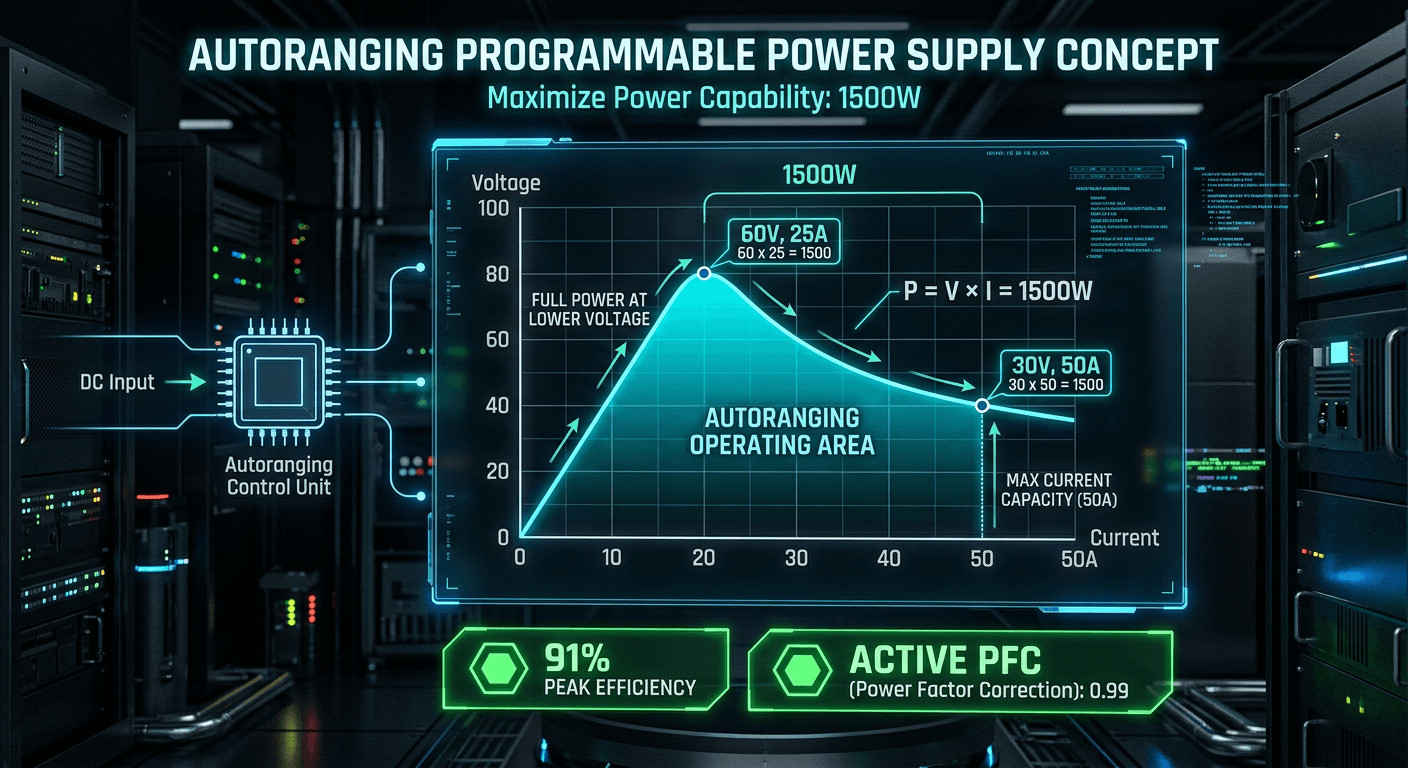
Traditional power supplies have a rectangular operating curve. If you buy an 80V, 18.75A power supply (1500W), you only get 1500W when operating at exactly 80V. If your test requires 40V, the maximum current is still locked at 18.75A, meaning you can only utilize 750W of the unit’s capacity.
The EA-PS 9080-50 1U utilizes a flexible autoranging output. It automatically adjusts the available voltage and current to ensure the user can draw the full 1500W across a much wider operating range. It can provide 80V at 18.75A, or it can provide 30V at 50A. This flexibility means a single programmable DC power source can replace multiple fixed-range power supplies. Which further reducing capital expenditure and rack space.
Note: The unit intelligently derates its output to 1000W when the AC input drops below 150V AC, ensuring stability even in facilities with poor power quality.
Efficiency, Active PFC, and Thermal Management
When deploying a data center power supply, thermal management and energy efficiency are paramount. Heat is the enemy of electronic longevity. And inefficient power supplies require massive HVAC systems to compensate.
Up to 91% Efficiency
The EA-PS 9000 1U series delivers up to 91% efficiency. This high efficiency drastically cuts energy loss, meaning less heat is dissipated into the rack. This allows for the ultra-compact 1U design and reduces the cooling burden on the facility’s air conditioning systems.
Active Power Factor Correction (PFC)
Industrial grids and data centers strictly regulate power quality. This unit features Active PFC, achieving a Power Factor (PF) of 0.99. It works seamlessly with wide-range 100…264V AC grids (45…65Hz). Active PFC minimizes reactive power. Which reduces harmonic distortion on the AC mains, and ensures compliance with international power quality standards. This is critical when installing dozens of rack mount DC programmable units in a single facility.
Precision and Low Ripple
Efficiency does not come at the cost of precision. The unit boasts a voltage accuracy of <0.1% and load regulation of <0.05%. The low ripple design ensures absolute stability for sensitive electronics: 100 mV PP (HF) / 5.2 mV RMS (LF) voltage ripple, and just 4 mA RMS current ripple.
Galvanically Isolated Interfaces & Software Control
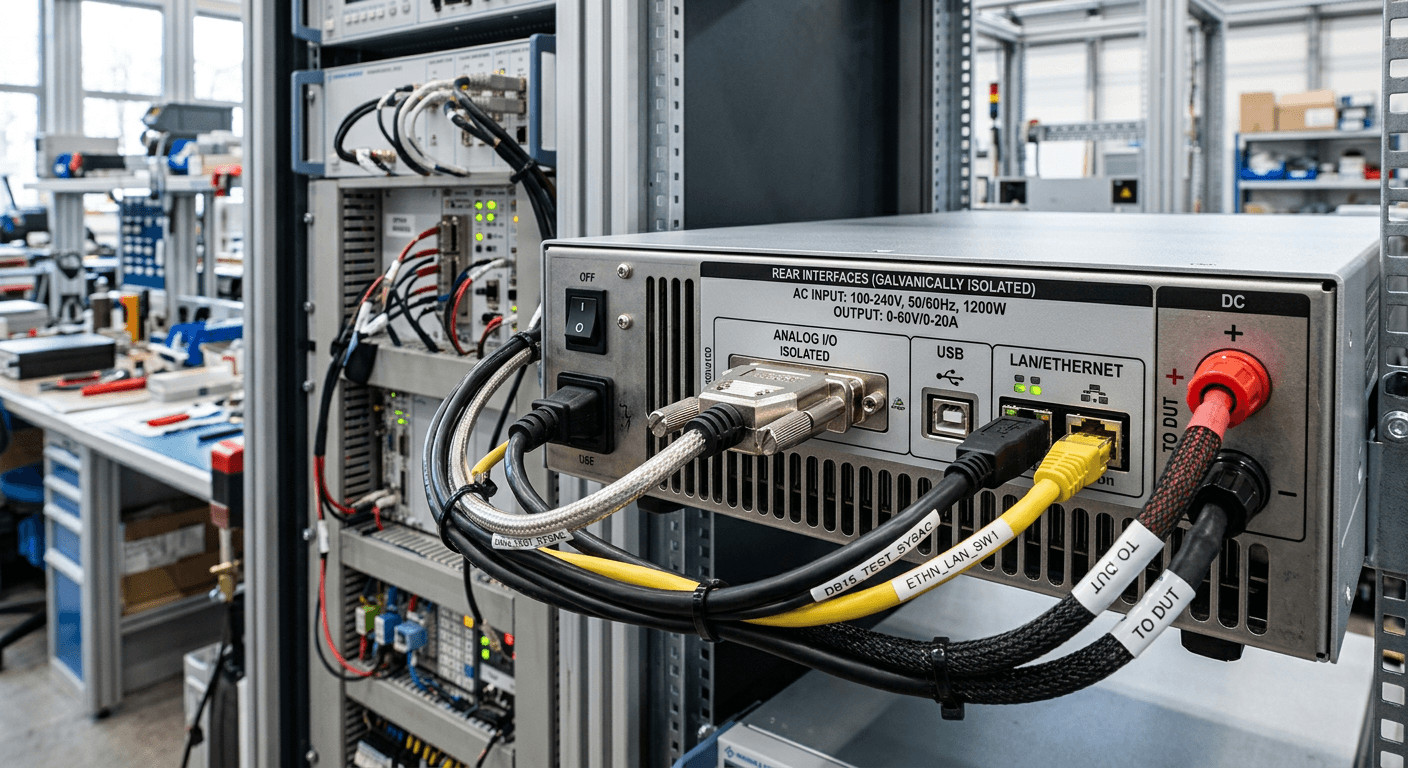
In automated testing and industrial control, a power supply must communicate flawlessly with PLCs, industrial PCs, and DAQ systems. The EA-PS 9080-50 1U excels as a precision programmable DC power unit due to its comprehensive connectivity.
Galvanically Isolated Analog and Digital Ports
Ground loops and electrical noise can destroy sensitive DAQ equipment. This unit features galvanically isolated interfaces to prevent this. It includes a 15-pole D-Sub analog interface (0…5V or 0…10V signals for setting and monitoring) and digital interfaces (USB and Ethernet).
SCPI, ModBus, and LabView Integration
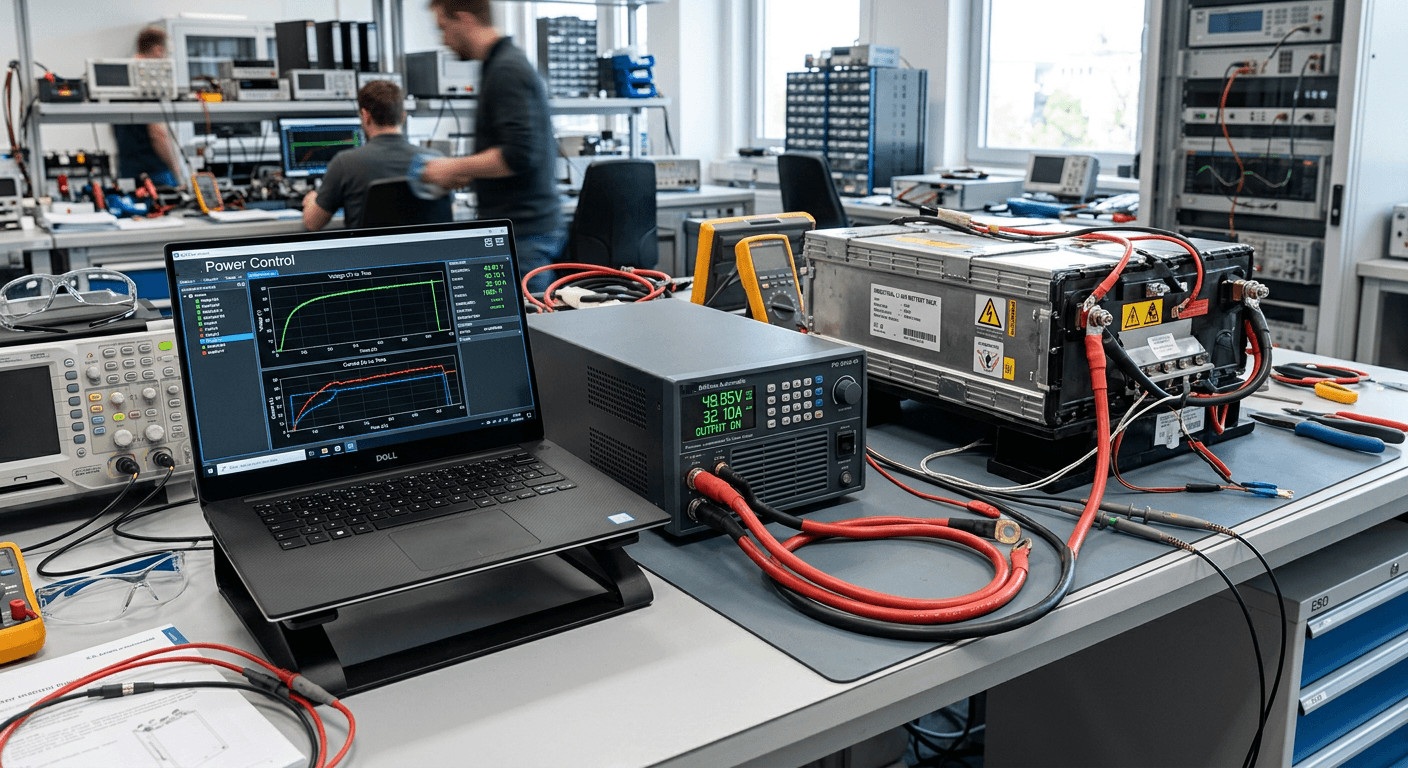
For software engineers building a custom programmable power supply automated rig, the unit supports industry-standard SCPI commands and ModBus RTU protocols. It is fully compatible with LabView VIs for custom applications. Additionally, it includes the “EA Power Control” software for Windows, allowing for intuitive multi-unit management, data logging, and the generation of a programmable power supply pulse sequence for dynamic load testing.
For systems requiring more power, the unit supports remote sensing and parallel operation via a Share Bus, allowing multiple units to act as a single, massive power source.
Key Applications: From Battery Testing to R&D
The versatility of a 1U programmable DC supply makes it indispensable across various sectors:
- Data Center Server Burn-in: Providing stable, high-current DC power to test server motherboards and components before deployment.
- Battery Test Power Supply: The precise voltage and current control, combined with software logging, makes it ideal for charging and testing industrial battery packs, EV modules, and energy storage systems.
- R&D and Prototype Validation: Engineers rely on lab programmable DC power to simulate various operating conditions, voltage dips, and power surges to validate prototype resilience.
- Automated Test Equipment (ATE): The 1U form factor and SCPI compatibility allow panel builders to integrate these units into dense ATE racks for end-of-line manufacturing tests.
Comprehensive Protection and Safety Standards
When dealing with 1500W of DC power, safety is non-negotiable. The EA-PS 9000 1U series is equipped with a full suite of protective features that automatically shut off the DC output upon detecting anomalies:
- OVP (Overvoltage Protection): Protects the device under test (DUT) from voltage spikes.
- OCP (Overcurrent Protection): Prevents excessive current draw that could damage wiring or the DUT.
- OPP (Overpower Protection): Ensures the unit stays within its safe operating area.
- OTP (Overtemperature Protection): Works in tandem with temperature-controlled fans that adjust speed to maintain optimal internal temperatures.
The unit meets stringent international standards, including EN 60950 (Safety), EN 61326 (EMC), and EN 55022 Class B (Emissions). Weighing approximately 10.5 kg and capable of operating at 0…50 °C, it is a rugged, reliable choice for high-current, medium-power tasks.
Procurement & RFQ Checklist
If you are a procurement engineer or system integrator preparing an RFQ for a dc programmable power supply, ensure you specify the following to get the most accurate proposal:
- Voltage and Current Range: Specify the maximum voltage and current required (e.g., 0-80V, 0-50A).
- Form Factor: Explicitly request a 1U programmable DC supply if rack space is limited. (Check our 2U, 3U, or 4U options for higher power needs).
- Interface Requirements: Confirm the need for galvanically isolated analog, USB, Ethernet, or specific protocols like ModBus/SCPI.
- Autoranging Capability: Ensure the unit offers autoranging to maximize power utility across different test setups.
- Accessories: Don’t forget to include necessary programmable power accessories like Share Bus cables or rack-mount slides.
Frequently Asked Questions (FAQ)
1. What is the main advantage of an autoranging programmable DC power supply?
Autoranging allows the power supply to automatically adjust its maximum voltage and current limits to maintain full output power (e.g., 1500W) across a wider operating range. This means one autoranging unit can replace multiple fixed-range power supplies, saving cost and rack space.
2. Why is galvanic isolation important for the analog and digital interfaces?
Galvanic isolation prevents ground loops and electrical noise from traveling between the power supply and your sensitive control equipment (like a PC or PLC). This ensures accurate control signals and protects your DAQ systems from high-voltage damage.
3. Can I connect multiple 1U programmable DC supplies in parallel?
Yes. The EA-PS 9000 1U series supports parallel operation via a Share Bus. This allows multiple units to balance the load evenly and act as a single, higher-power system, which is easily managed via the EA Power Control software.
4. Is this unit suitable for battery testing?
Absolutely. As a battery test power supply, its high precision, low ripple, and software logging capabilities make it ideal for charging cycles, simulating battery behavior, and validating energy storage systems in R&D environments.
5. How does the unit handle low AC input voltage?
The unit features a wide input range (100…264V AC). However, to protect its internal components, it intelligently derates its maximum output power from 1500W to 1000W when the AC input drops below 150V AC.