

For system integrators, panel builders, and engineering-driven procurement teams, selecting a power supply for EV battery testing is not only about wattage.
It also involves bidirectional energy flow, regenerative efficiency, autoranging output flexibility, and whether the system can recover discharged energy instead of dissipating it as heat—a factor that directly determines operating cost in high-volume battery cycling.
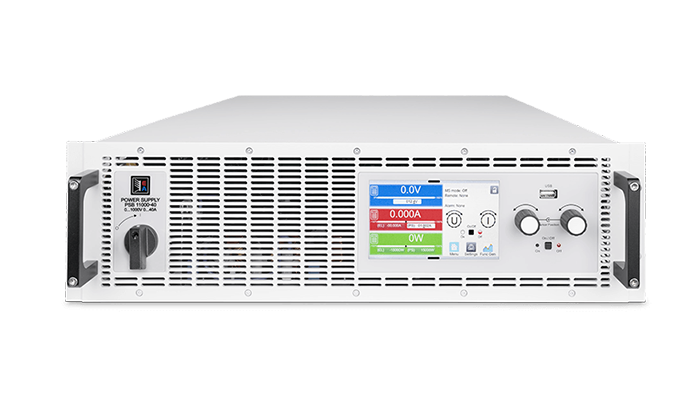
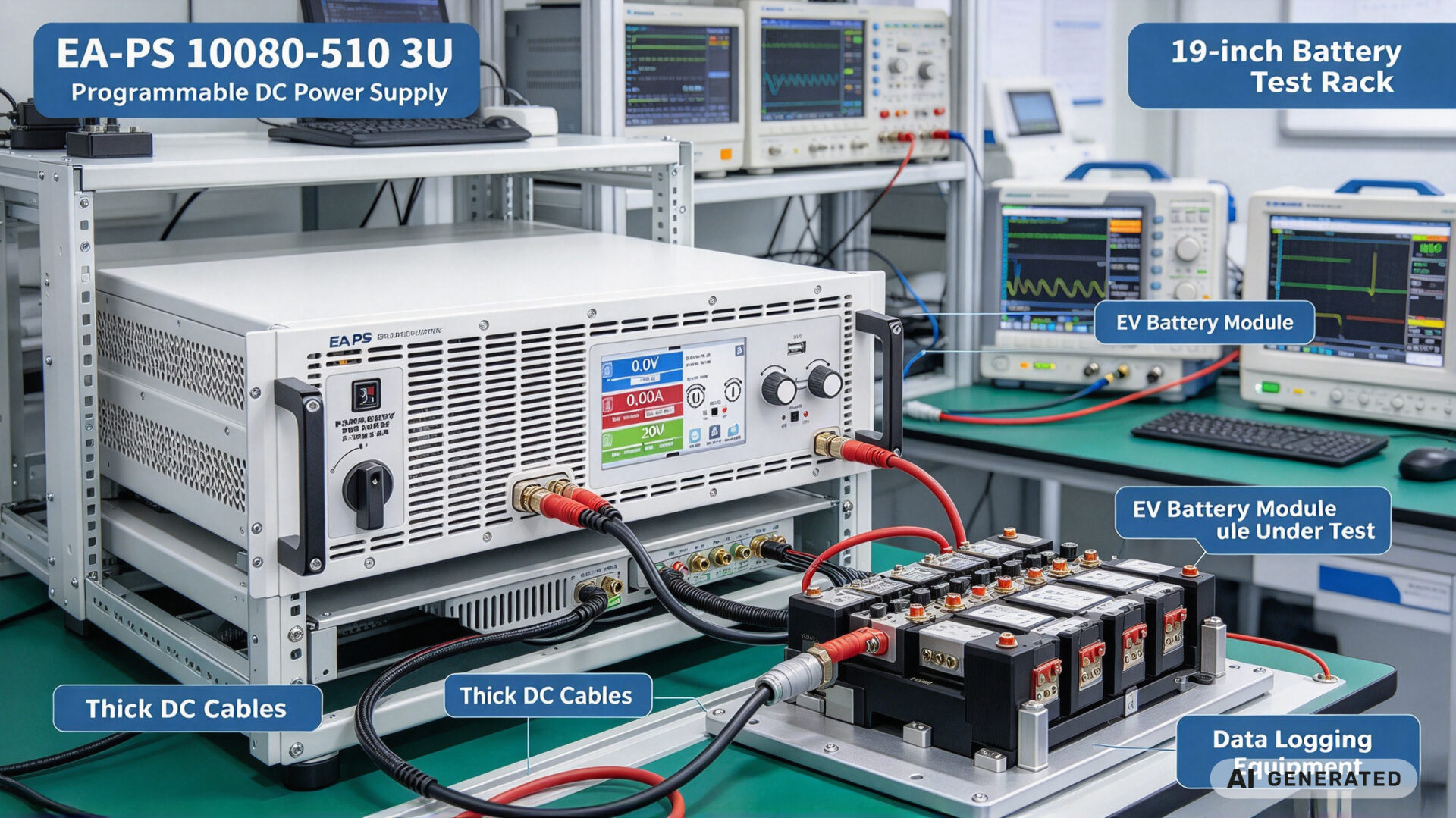
The EA-PS 10080-510 3U is a high-performance programmable DC power supply from the EA Elektro Automatik PS 10000 Series. It delivers 80V output voltage, 510A output current, and 15,000W output power in a compact 3U form factor, combining up to 94.5% efficiency with advanced autoranging technology. Built-in protections include adjustable OVP (0-110%), OCP (0-110%), OPP (0-110%), and overtemperature protection.
Typical applications include EV battery charge/discharge testing, battery charger testing, fuel cell test systems, on-board charger test, and automated test systems.
1. What a 15kW bidirectional power supply is (and why 15kW matters)
A 15kW battery test power supply is a programmable DC source designed for the high-power charge and discharge cycles required in EV battery module and pack testing. Unlike standard laboratory power supplies limited to 300W-1,000W, a 15kW supply can handle the full charge/discharge profile of a multi-cell battery module without current derating or test time extension.
The global electric vehicle battery testing market is valued at USD 1.35 billion in 2025 and is projected to grow from USD 1.5 billion in 2026 to USD 5.36 billion by 2035, at a CAGR of 15.2%. This growth is driven by increasing EV production—global electric-car production reached 17.3 million units in 2024—and the need for comprehensive battery qualification before cells move into module and pack assembly.
The EA-PS 10080-510 3U delivers 15,000W output power in just 3U of rack space. For test laboratories where floor space and rack capacity are constrained, this power density allows multiple test channels to be accommodated in a single cabinet. The 3U chassis with forced air cooling (front intake, rear exhaust) ensures reliable operation at ambient temperatures up to 50°C, making it suitable for deployment in test facilities without specialized cooling infrastructure.
2. Bidirectional energy recovery: why it is critical for battery cycling economics
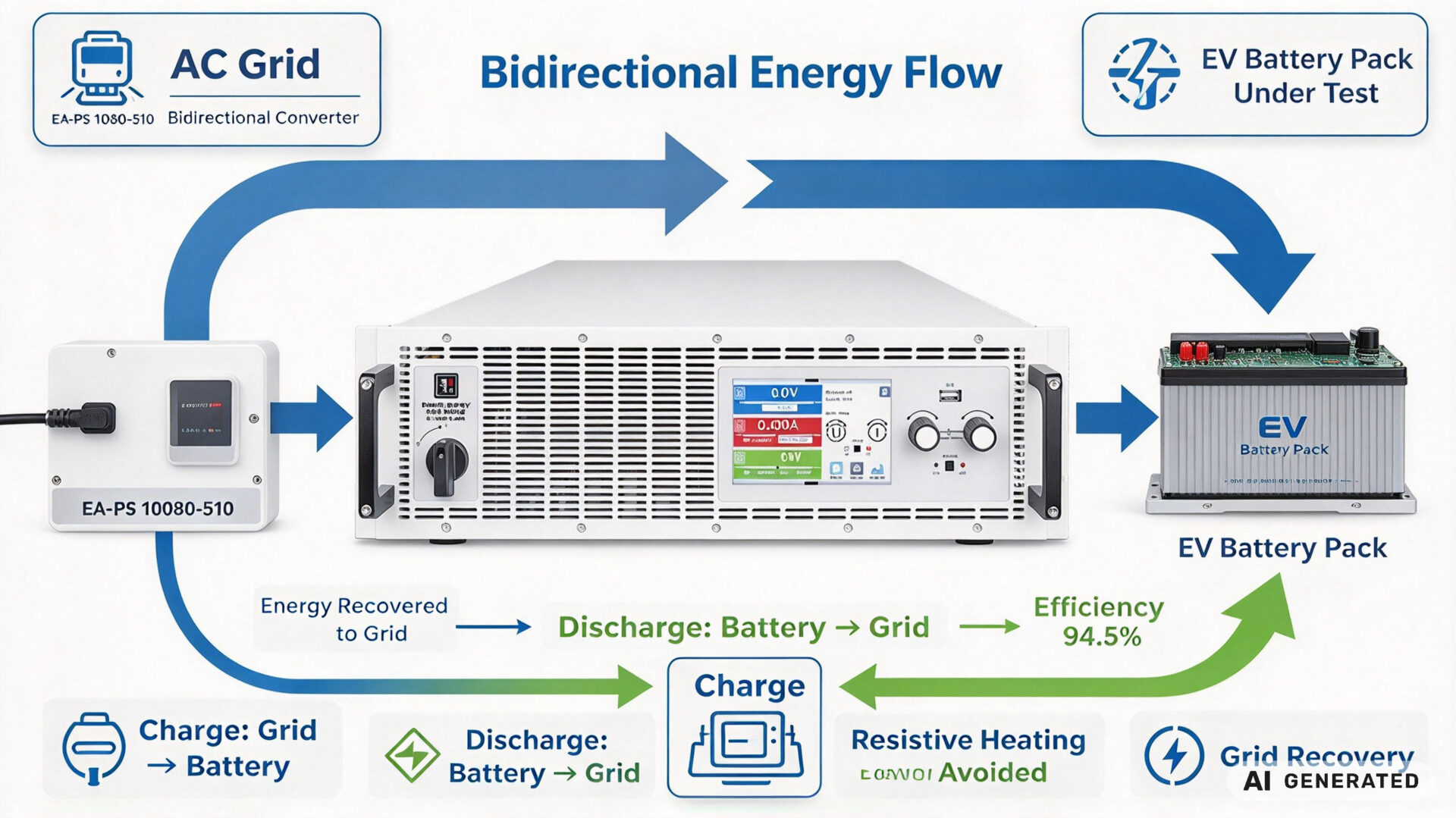
In conventional battery cycling, the discharge phase dissipates the battery’s stored energy as heat through resistive loads. This energy is not recovered—it is wasted, and it generates additional heat that must be removed by HVAC systems, increasing both energy cost and cooling load.
Bidirectional energy recovery changes this equation. During battery discharge, the regenerative 15kW power supply converts the DC energy from the battery back into AC power and returns it to the local grid or facility distribution system. The energy is recycled instead of wasted.
2.1 Energy recovery efficiency benchmarks
Published data on regenerative battery test systems demonstrates energy recovery efficiencies ranging from 83% to 96.5%:
- 92-93%: Regenerative battery pack test systems with efficiency >92%, PF >0.99, and current THD <3%
- 94.5%: EA-PS 10080-510 peak efficiency in AC-DC mode
- 95%: Battery formation energy recycling via PWM rectifier feedback to grid
- 96.5%: High-power battery cycler with regenerative efficiency over 96.5%
The energy recovery efficiency directly determines the operating cost of a battery test facility. For every kWh discharged during cycling, the regenerative system recovers 0.92-0.96 kWh—meaning only 4-8% of the discharge energy is lost as heat, compared to 100% loss in a dissipative system.
2.2 Quantifying cost savings from regenerative operation
The commercial case for regenerative battery testing is substantial. Published data indicates that cost savings for a 100-unit installation may reach $150,000-$200,000 per year. This figure reflects both the recovered energy value and the reduced cooling load—since recovered energy is not dissipated as heat, the HVAC system does not need to remove it.
For a facility cycling EV battery modules at 15kW discharge power for 12 hours per day, the recovered energy amounts to approximately 180 kWh per day per channel. At an industrial electricity rate of $0.10/kWh, this translates to $18/day per channel, or $6,570/year per channel. Across a test facility with 20 channels, the annual energy recovery value alone exceeds $130,000.
The additional benefit is thermal: a dissipative system generating 15kW of heat per channel requires substantial HVAC capacity. The regenerative system reduces this heat load by 92-96%, eliminating the need for dedicated cooling equipment and reducing facility infrastructure costs.
For related technical resources, see TPS’s production category and blog content.
3. EA-PS 10080-510 3U: technical capabilities for battery testing
The EA-PS 10080-510 3U provides the specific capabilities required for EV battery charge and discharge testing, with a combination of power density, efficiency, and control flexibility that addresses the practical constraints of battery test laboratories.
3.1 Autoranging output for flexible battery test profiles
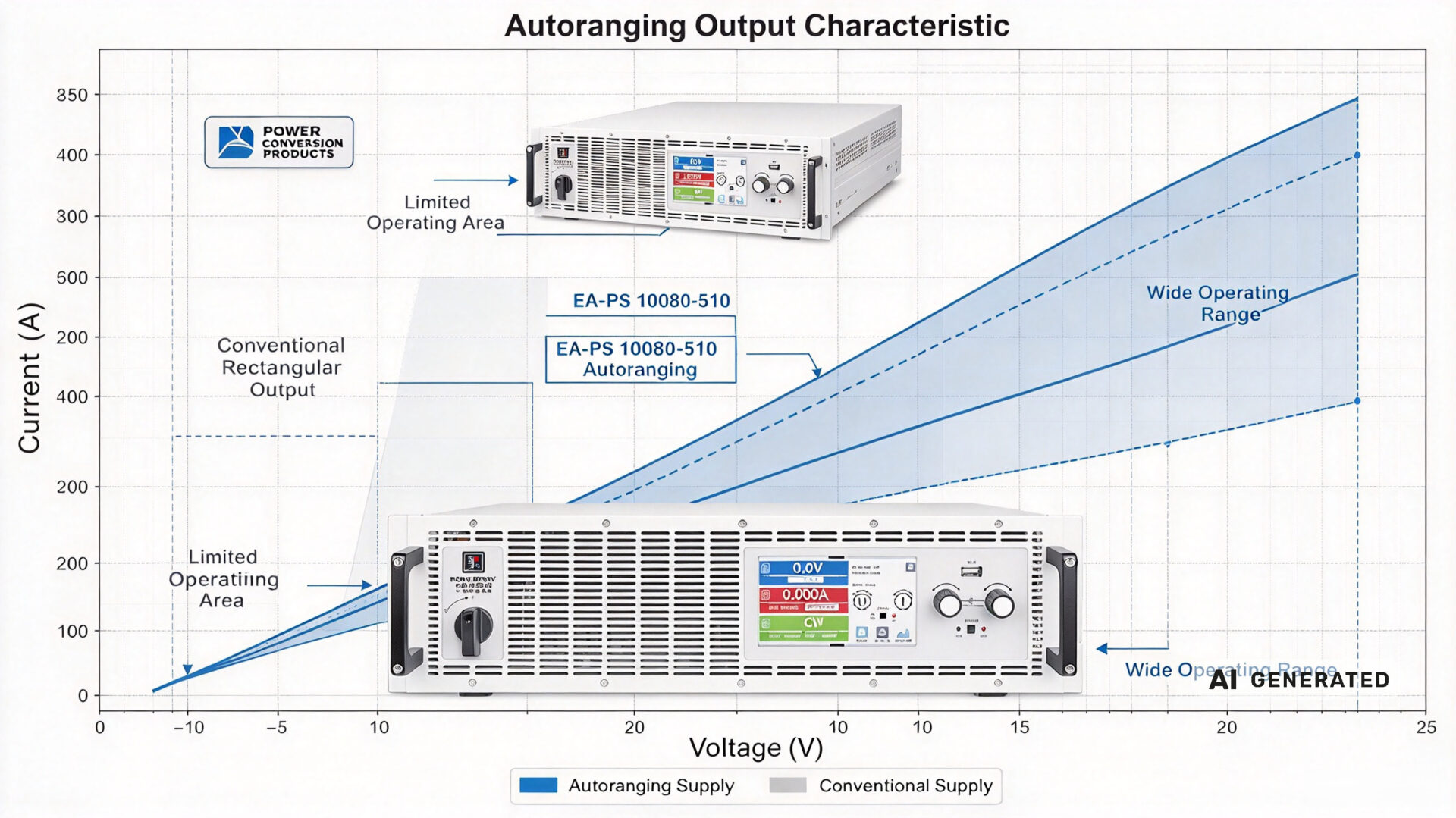
Conventional power supplies have a rectangular output characteristic: the rated voltage and rated current can only be delivered at full power, and reducing voltage reduces available current proportionally. Battery testing requires a wider operating envelope—a 400V battery pack may require 40A during constant-voltage charging but 100A during constant-current discharge.
The EA-PS 10080-510 3U’s autoranging output provides a wide operating range across voltage and current combinations. The full 15kW output power is available across a broad range, not just at the maximum voltage and current intersection. This eliminates the need for separate power supplies for different battery test phases and simplifies test system design.
3.2 Master-slave parallel operation up to 960kW
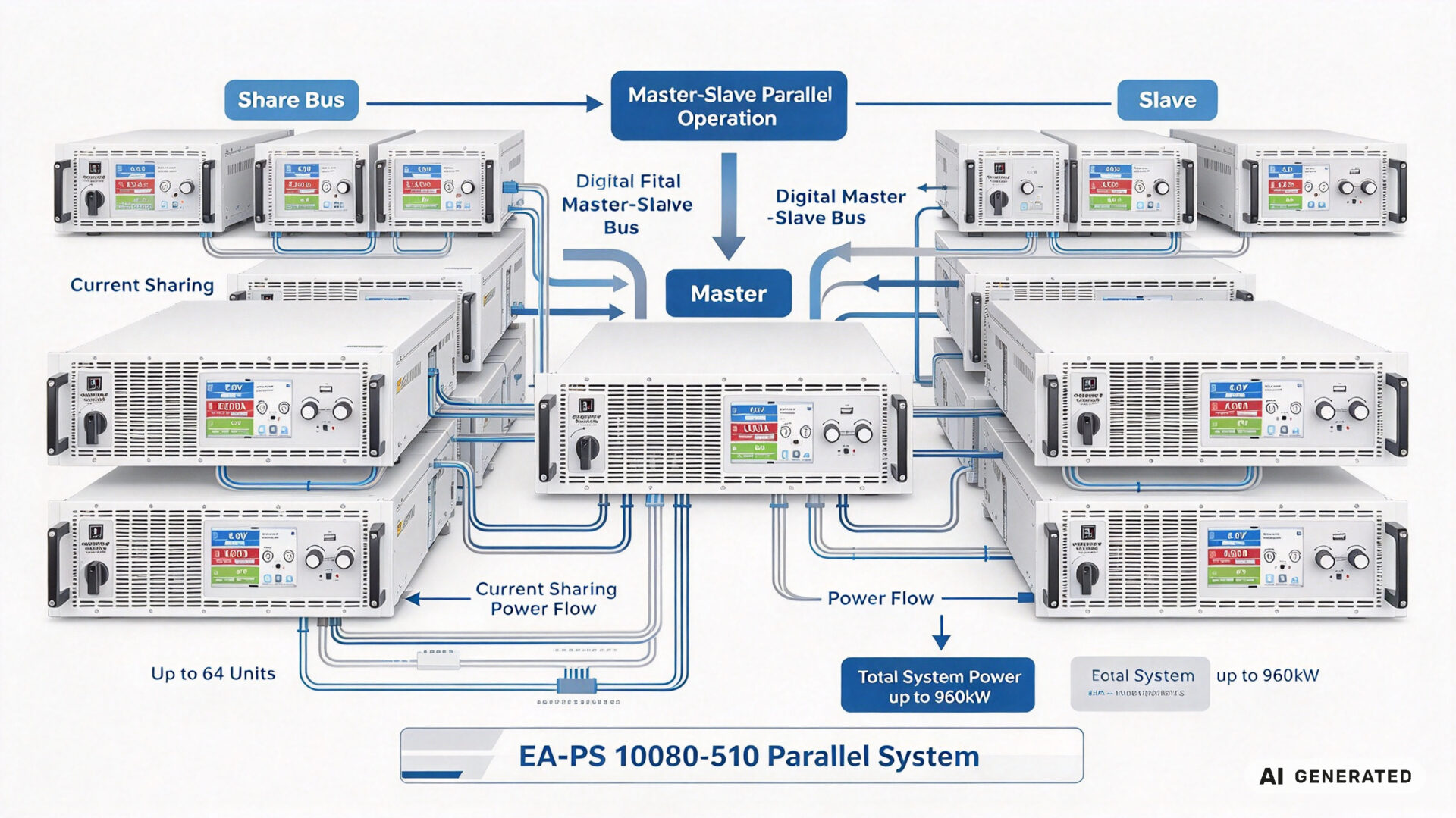
For battery pack testing at higher power levels, the EA-PS 10080-510 3U supports master-slave parallel operation of up to 64 units via Share bus and digital master-slave bus, achieving scalable power up to 960kW with true current sharing. This parallel capability allows test facilities to start with a single 15kW unit and expand as testing requirements grow—without replacing the initial investment.
The parallel configuration also provides N+1 redundancy: if one unit fails, the remaining units continue to operate, and the failed unit can be replaced without shutting down the entire test system. For facilities running long-duration battery cycling tests (1,000+ hours), this redundancy eliminates the risk of test interruption.
Communication interfaces include built-in USB, Ethernet, and galvanically isolated analog interface (0-5V/0-10V switchable), with optional fieldbus modules for Profibus, CANopen, EtherCAT, RS232, and ModBus TCP. This enables integration into automated test systems and industrial networks.
4. EV battery testing standards and compliance
EV battery testing is governed by a comprehensive framework of international standards that define the electrical, thermal, mechanical, and safety requirements for battery cells, modules, and packs. The primary standards applicable to EV battery charge/discharge testing include:
- IEC 62660 series: Secondary lithium-ion cells for the propulsion of electric road vehicles. Part 2 covers performance testing, Part 3 covers safety requirements.
- ISO 12405: Electrically propelled road vehicles—test specification for lithium-ion traction battery packs and systems.
- UL 2580: Batteries for use in electric vehicles. Covers electrical, mechanical, and environmental abuse testing.
- UL 1973: Batteries for use in stationary, vehicle auxiliary power, and light electric rail applications.
- SAE J2464: Electric and hybrid electric vehicle rechargeable energy storage system safety and abuse testing.
- UN 38.3: Transport testing for lithium batteries, including altitude simulation, thermal test, vibration, shock, and short circuit testing.
The EA-PS 10080-510 3U supports these test requirements through its programmable output, fast transient response, and comprehensive protection functions. The instrument’s 5-inch color TFT touchscreen, two rotary knobs, data logging to USB stick, and graphical display of actual values simplify bench power supply tasks and test configuration management.
For additional product context, see the TPS-DM570T1512KIF and TPS-DM570T1512KIRF bidirectional DC-DC modules for lithium battery formation applications.
5. Product specifications
| Parameter | EA-PS 10080-510 3U | Typical Dissipative Test Supply |
|---|---|---|
| Output voltage | 0-80 V DC | 0-80 V DC |
| Output current | 0-510 A | 0-100 A |
| Output power | 15,000 W | 2,000-5,000 W |
| Efficiency | Up to 94.5% | 85-88% |
| Energy recovery | Bidirectional, regenerative | None (heat dissipation) |
| Form factor | 3U, 19-inch rack | 6U-12U typical |
| Voltage load regulation | ≤0.05% FS (CV) | 0.1-0.5% FS |
| Current load regulation | ≤0.1% FS (CC) | 0.2-0.5% FS |
| Ripple | ≤10 mV rms / ≤100 mV pp | Often unspecified |
| Protections | OVP, OCP, OPP, overtemperature (all adjustable 0-110%) | Basic OVP, OCP |
| Interfaces | USB, Ethernet, analog, optional fieldbus | USB or GPIB |
| Parallel capability | Up to 64 units (960 kW) | Limited or none |
Important note on AC supply: When operating on 208V AC supply, the output power is derated to 9,000W. Full 15,000W is available at 380-480V AC. This derating must be considered when specifying the power supply for facilities with 208V distribution.
6. RFQ checklist
To streamline quotation and evaluation for a 15kW power supply, provide the following information:
- Application type: EV battery charge/discharge testing, battery formation, or battery module validation
- Voltage and current requirements: Battery pack voltage range and maximum charge/discharge current
- Energy recovery requirement: Whether regenerative operation is required and target recovery efficiency
- AC supply voltage: 380-480V AC for full 15kW output, or 208V AC with derated output
- Parallel configuration: Single unit or multi-unit parallel for higher power
- Communication interface: Required protocol (USB, Ethernet, Profibus, CANopen, EtherCAT, RS232, ModBus TCP)
- Certification documentation: Required standards and documentation format
- Project scale: Prototype quantity, series production volume, and delivery schedule
Providing these details reduces clarification cycles during evaluation. TPS’s engineering team can support power supply selection, parallel configuration design, energy recovery calculation, and system integration as part of the RFQ process.
7. FAQ
What is the difference between a bidirectional power supply and a standard battery test power supply?
A standard battery test power supply can only source current (charge the battery). A bidirectional power supply can both source and sink current, enabling discharge testing without switching to a separate electronic load. The EA-PS 10080-510 3U integrates both functions in a single 3U chassis, and during discharge, it recovers the energy and returns it to the grid rather than dissipating it as heat.
How much energy can the EA-PS 10080-510 3U recover during battery discharge?
The EA-PS 10080-510 3U achieves up to 94.5% efficiency in AC-DC mode. Published data on comparable regenerative battery test systems shows energy recovery efficiencies ranging from 92% to 96.5%. The exact recovery depends on the discharge power level and battery voltage relative to the power supply’s autoranging output characteristic.
Can the EA-PS 10080-510 3U test EV battery packs at 400V or higher?
The EA-PS 10080-510 3U has a maximum output voltage of 80V. For higher-voltage EV battery pack testing, TPS offers bidirectional DC-DC modules including the TPS-DM570T1512KIF and TPS-DM570T1512KIRF. Contact TPS for a recommendation based on your battery pack voltage.
What AC supply voltage is required for full 15kW output?
Full 15,000W output is available at 380-480V AC supply. When operating on 208V AC supply, the output power is derated to 9,000W. This derating must be considered when specifying the power supply for facilities with 208V distribution.
How many units can be paralleled for higher power?
The EA-PS 10080-510 3U supports master-slave parallel operation of up to 64 units via Share bus and digital master-slave bus, achieving scalable power up to 960kW with true current sharing.