

For system integrators, panel builders, and engineering-driven procurement teams, selecting a laboratory power supply is not only about voltage and current ratings.
It also involves output ripple, load regulation, transient response, remote control capability, and whether the supply can deliver stable, repeatable power for measurements where a millivolt of noise corrupts the result.
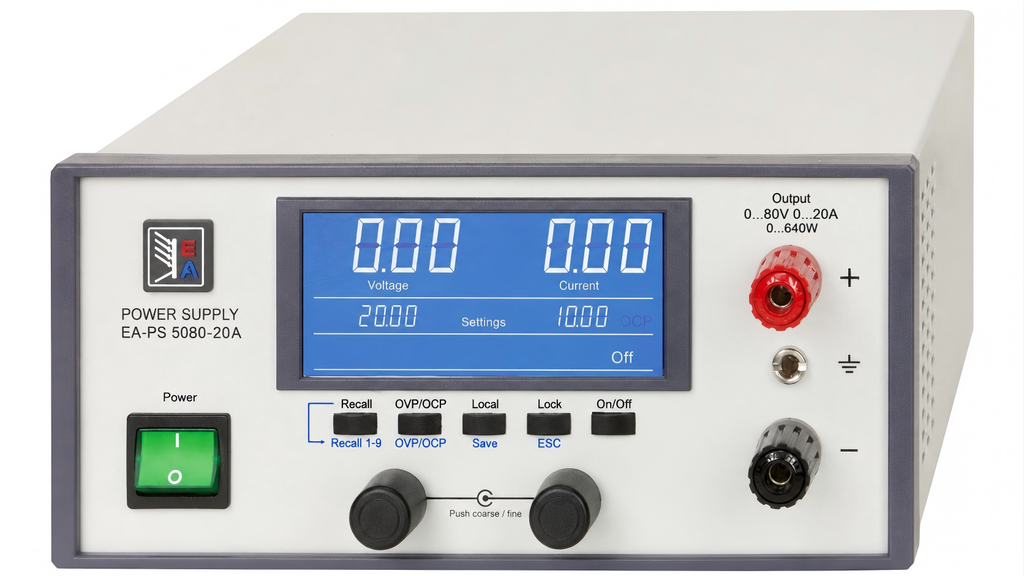
The EA-PS 5080-20A is a programmable desktop DC power supply from the EA-PS 5000 A series. It delivers 0-80V DC at 0-20A (0-640W) with <0.08% voltage load regulation, <0.02% line regulation, <80mV PP ripple, and <10mV RMS ripple—performance that meets the demanding requirements of laboratory test benches and precision measurement applications.
Typical applications include semiconductor characterization, battery testing, sensor calibration, and automated test systems where low noise and high stability are essential.
1. What a 150V-class laboratory power supply is (and why 150V matters)
A 150V-class laboratory power supply is a programmable DC source designed to deliver output voltages up to 150V with the precision and stability required for measurement applications. While many benchtop supplies top out at 30V or 60V, the 150V range is essential for testing power semiconductors, high-voltage sensors, DC-DC converters, and battery modules where the operating voltage exceeds the common low-voltage rails.
The EA-PS 5080-20A operates in the 0-80V range with 0-20A current capability and 640W total output power. Its auto-ranging power stage provides flexibility: the full 640W is available across a wide range of voltage-current combinations, so the same instrument can power a 12V/20A load or a 80V/8A load without manual range switching. For laboratories that test a variety of devices, this eliminates the need for multiple single-range supplies.
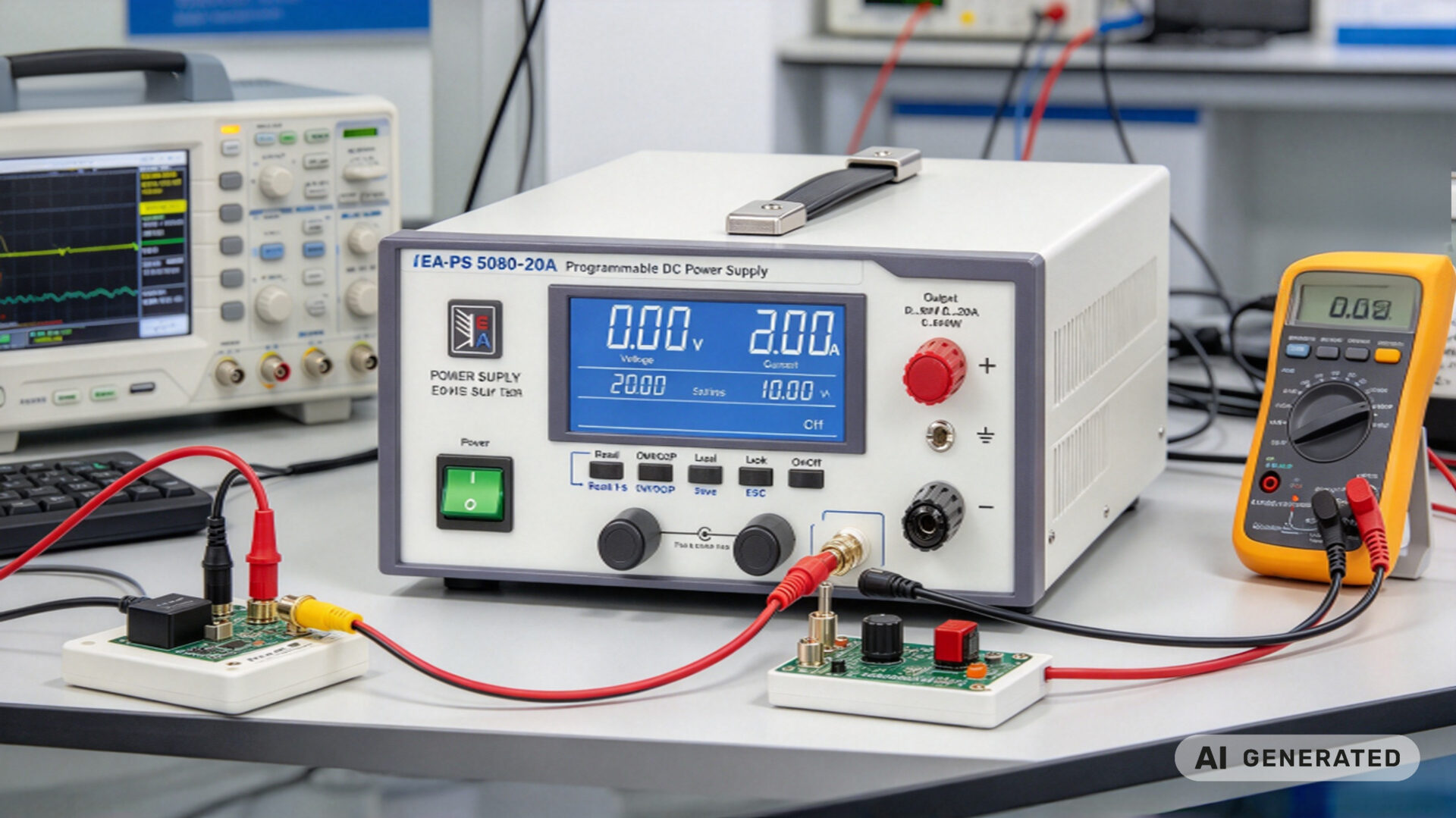
For engineers evaluating a 150V test bench power supply, the voltage rating is only the starting point. The specifications that determine whether the supply is suitable for measurement work are ripple, regulation, and transient response—covered in the following sections.
2. Low ripple: why millivolts of noise destroy measurement accuracy
Output ripple is the residual AC component superimposed on the DC output voltage. It originates from the switching frequency of the power supply’s internal converter, the rectification of the AC input, and the ESR of the output capacitors. In measurement applications, ripple is the enemy of accuracy: it adds noise to the signal being measured, reduces the effective resolution of the measurement, and can couple into sensitive circuits under test.
2.1 Ripple sources and their frequency content
Switching power supplies generate ripple at the switching frequency and its harmonics. A supply switching at 100kHz produces ripple components at 100kHz, 200kHz, 300kHz, and so on. These high-frequency components are difficult to filter and can couple capacitively into nearby measurement circuits. Linear power supplies produce lower ripple but with higher heat dissipation and lower efficiency.
The EA-PS 5080-20A uses a high-frequency switching topology with advanced filtering to achieve <80mV peak-to-peak ripple and <10mV RMS ripple. The RMS figure is particularly important for precision measurements: RMS ripple directly affects the noise floor of the measurement, while peak-to-peak ripple indicates the worst-case deviation from the set voltage.
2.2 Peak-to-peak vs. RMS ripple specifications
Peak-to-peak and RMS ripple are both important, but for different reasons. Peak-to-peak ripple defines the maximum instantaneous deviation from the nominal output—critical when testing devices with tight absolute voltage limits. RMS ripple defines the average noise power delivered to the load—critical when the measurement involves averaging or when the device under test is sensitive to broadband noise.
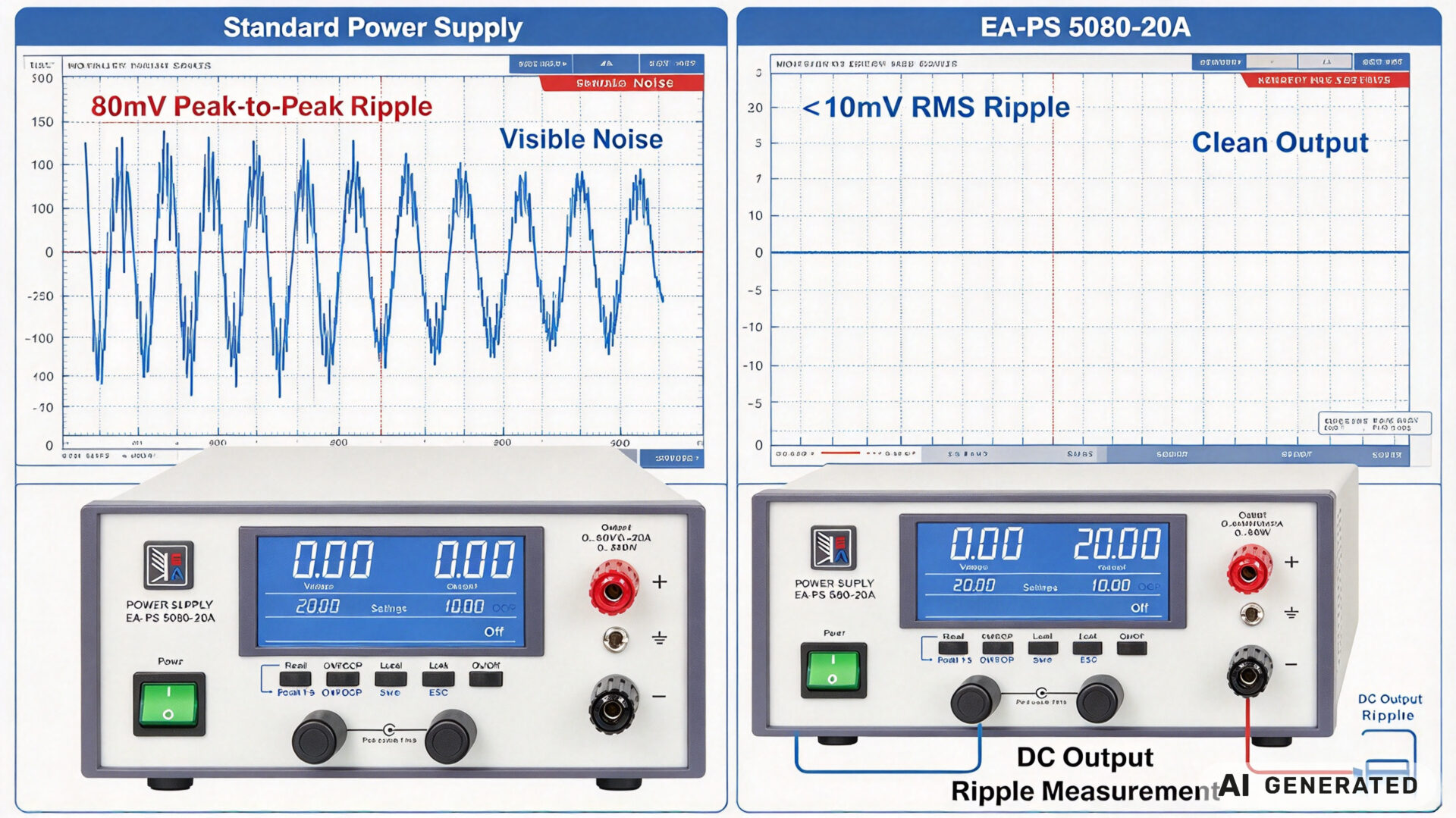
For a laboratory that measures sensor output in the millivolt range, the difference between a power supply with 50mV RMS ripple and one with 10mV RMS ripple is the difference between a reliable measurement and an unusable one. The EA-PS 5080-20A’s <10mV RMS specification ensures that the power supply contributes no more than 10mV of noise to the measurement—well within the tolerance of most precision test applications.
3. High stability: load regulation, line regulation, and transient response
Stability defines how well the power supply maintains its output voltage when the load current changes or when the AC input voltage varies. Three specifications quantify stability:
- Load regulation (<0.08%): The change in output voltage when the load current changes from no-load to full-load, expressed as a percentage of the set voltage. For an 80V output, 0.08% is 64mV—meaning the output voltage varies by no more than 64mV across the entire 0-20A load range.
- Line regulation (<0.02%): The change in output voltage when the AC input varies across its specified range (90-264 VAC). This specification matters in facilities where the mains voltage fluctuates due to other equipment on the same circuit.
- Load regulation time (<1 ms): The time required for the output voltage to recover to within its specified tolerance after a step change in load current. A fast recovery time is essential for automated test sequences where the load changes rapidly and the measurement must be valid immediately after the change.
For high stability 150V PSU applications, these specifications determine whether the test results are repeatable. A power supply with poor load regulation will produce different results when the device under test draws different currents—even if the device itself is behaving correctly.
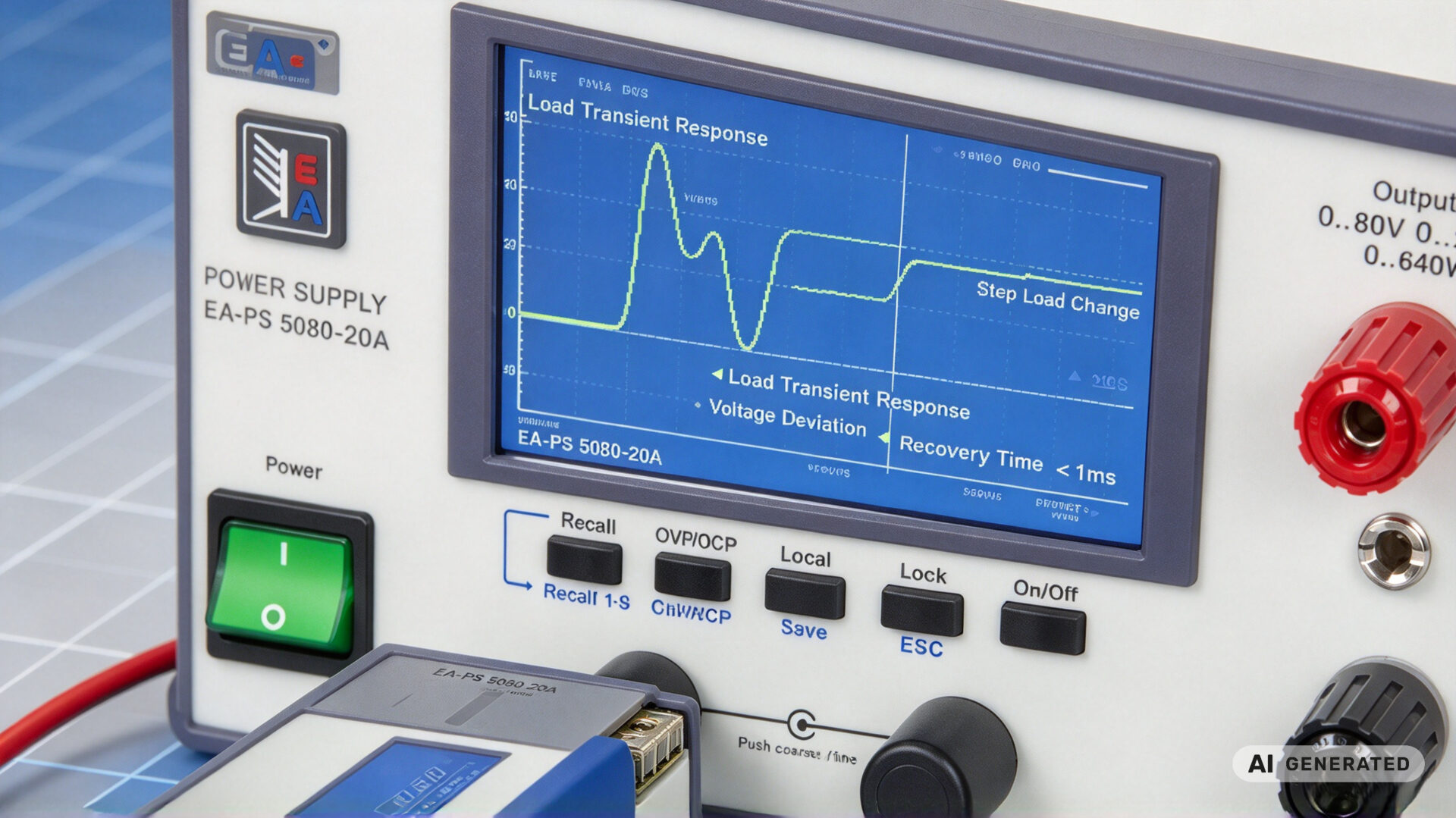
In addition to the standard specifications, the EA-PS 5080-20A provides <0.2% voltage accuracy and <0.2% current accuracy, ensuring that the setpoint the instrument displays is the setpoint it delivers. For calibration laboratories and test benches where the power supply is used as a reference source, this accuracy is fundamental.
4. EA-PS 5080-20A features for laboratory integration
Physical Characteristics
| Parameter | Specification |
|---|---|
| Model | EA-PS 5080-20A (order no. 05100307) |
| Series | EA-PS 5000 A (microprocessor controlled) |
| Display | Blue LCD for voltage, current, power monitoring |
| Controls | 9 preset memories, key lock, recall function |
| Cooling | Temperature controlled fan, low noise |
| Weight | 4.3 kg |
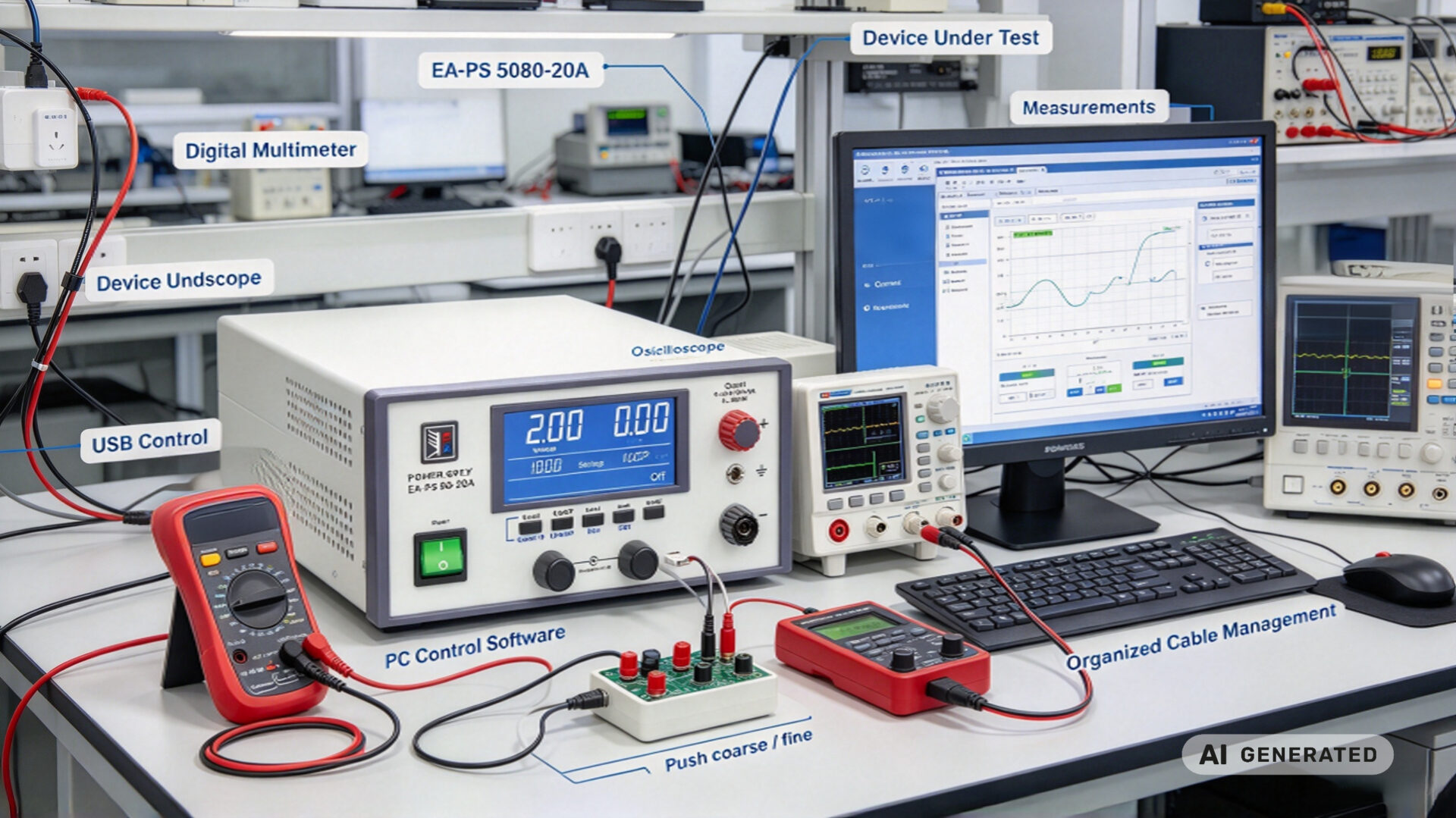
| Interface | USB with LabView VIs and Windows control software |
The EA-PS 5080-20A is also available in related configurations within the TPS power module portfolio. For battery testing and DC-DC converter applications, see the TPS-DM570T1512KIF and TPS-DM570T1512KIRF bidirectional DC-DC modules. For additional application context, see the TPS production category and TPS blog content.
5. Product specifications
| Parameter | EA-PS 5080-20A | Typical Generic Bench Supply |
|---|---|---|
| Output voltage | 0-80 V DC | 0-30 V DC |
| Output current | 0-20 A DC | 0-5 A DC |
| Output power | 0-640 W | 0-150 W |
| Voltage ripple (RMS) | <10 mV | Often unspecified |
| Load regulation | <0.08% | 0.1-0.5% |
| Load regulation time | <1 ms | Often unspecified |
| Voltage accuracy | <0.2% | 0.5-1% |
| Remote control | USB with LabView VIs | USB or GPIB optional |
| Preset memories | 9 | 2-4 typical |
| PFC | >0.99 active | Passive or none |
6. RFQ checklist
To streamline quotation and evaluation for a 150V power supply, provide the following information:
- Application type: Semiconductor characterization, battery testing, sensor calibration, or automated test system
- Voltage and current range: Maximum voltage and current required for the specific test application
- Ripple requirement: Peak-to-peak and RMS ripple limits, if specified by the measurement standard
- Stability requirement: Load regulation and line regulation targets
- Control interface: USB, GPIB, LAN, or analog programming required
- Form factor: Desktop, rack-mount, or modular
- Quantity: Single unit, multiple units, or series procurement
- Documentation needs: Calibration certificate, test report, or compliance documentation
Providing these details reduces clarification cycles during evaluation. TPS’s engineering team can support supply selection, application matching, and system integration as part of the RFQ process.
7. FAQ
What is the difference between 150V and 80V laboratory power supplies?
A 150V power supply delivers higher output voltage for applications such as high-voltage sensor testing, power semiconductor characterization, and battery module testing. The EA-PS 5080-20A covers 0-80V, which is sufficient for the majority of benchtop test applications. For test applications requiring voltages above 80V, contact TPS for higher-voltage alternatives.
Why is low ripple important for laboratory measurements?
Ripple adds noise to the signal being measured, reducing the effective resolution of the measurement. For a test bench measuring sensor output in the millivolt range, 10mV RMS ripple from the power supply can dominate the measurement. The EA-PS 5080-20A’s <10mV RMS ripple ensures the power supply contributes no more than 10mV of noise to the measurement.
What is load regulation and why does it matter?
Load regulation is the change in output voltage when the load current changes from no-load to full-load. Poor load regulation causes the output voltage to drop as the load draws more current, introducing measurement error. The EA-PS 5080-20A’s <0.08% load regulation ensures stable output voltage across the full 0-20A load range.
Can the EA-PS 5080-20A be controlled remotely?
Yes. The EA-PS 5080-20A is equipped with a USB interface and comes with LabView VIs and Windows control software, enabling seamless integration into automated test systems and reducing manual test equipment requirements.
What is the difference between peak-to-peak and RMS ripple?
Peak-to-peak ripple defines the maximum instantaneous deviation from the nominal output voltage—critical for absolute voltage limits. RMS ripple defines the average noise power delivered to the load—critical for measurements that involve averaging or are sensitive to broadband noise. Both specifications should be evaluated when selecting a power supply for precision measurement.