

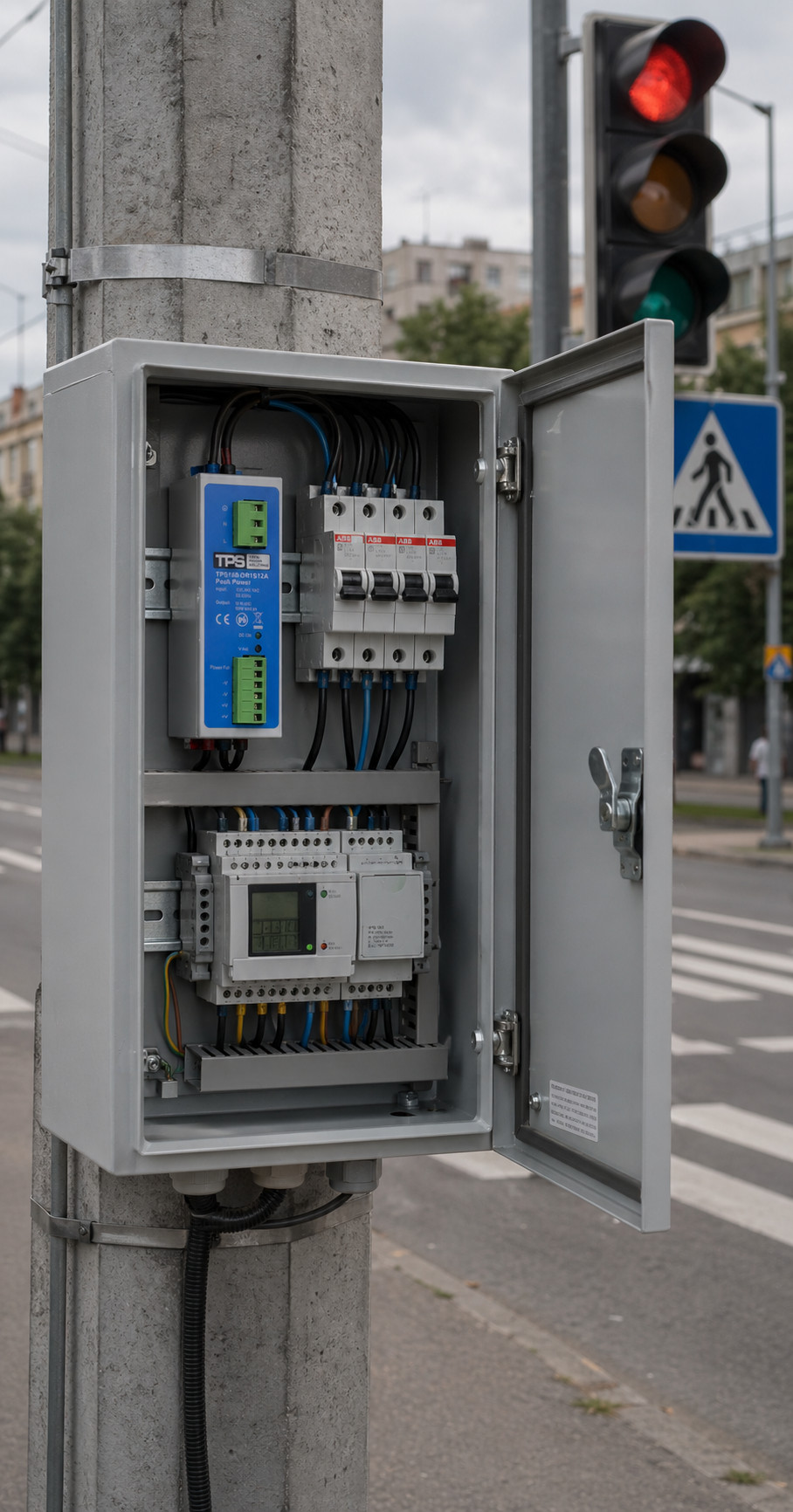
You step into an elevator. The doors seal. The car rises. You scroll your phone — full bars. At the next intersection, the traffic light turns green exactly when it should. None of this feels remarkable. It feels effortless, because the infrastructure beneath it was designed to be invisible. Bolted inside a grey cabinet on a concrete pole, or tucked above a false ceiling in a hospital corridor, sits a device you have never noticed: a din rail power supply. While the world chases thinner laptops and faster phone chargers, industrial engineers quietly specify industrial power supply units with names like TPS. These aren’t glamorous. But they keep ventilators breathing, traffic flowing, and assembly lines moving. This is the story of reliability by design — and why a 170% power boost for ten seconds matters more than any processor speed.
The Unseen Workhorse: Meet the Din Rail Power Supply
Most people have never heard of a Din Rail Power Supply. Search for power supply and you will see laptop bricks. Look up power supplies and you find PC components. Dig deeper for power supply supplies (a common misspelling that reveals how unfamiliar this world is) and you still won’t see what keeps a 5G tower alive. The real workhorses are ac/dc power supply modules clipped onto a metal rail inside a locked cabinet. They take raw mains — anywhere from 85-264VAC power supply to 120-370VDC power supply — and convert it into stable 12v power supply, 24 volt power supply, or 12v dc power supply. These devices run 24/7 for years without a single human visit. A single 24V DC power supply might power a dozen sensors on a packaging line. A stabilised power supply keeps a remote base station online through grid flickers.
Consider what happens when a bank of LED streetlights turns on at dawn. That unit must deliver a 170% power boost for ten seconds — often called a 10 second power boost or simply a power boost power supply feature. Fail once, and an entire intersection goes dark. Take the TPS power supply series as an example. It is one of those unseen units that can swallow anything from 85-264VAC to 120-370VDC and spit out a clean 24V or 12V rail. No one celebrates its existence. But when a hospital elevator demands its 170% power boost for 10 seconds, the TPS doesn’t flinch. That’s the whole point.
The Philosophy of Invisibility: Why Infrastructure Cannot Afford to Be Sexy
Consumer electronics live on the edge. A smartphone is as thin as possible. Its charger is tiny. Fans are avoided only if the chip can throttle. Everything is a trade-off for size, weight, and cost — with an assumed lifespan of two to three years. Infrastructure cannot think that way. An elevator may run for thirty years. A traffic controller might see forty summers of heat and winter freezes.
That is why power supplys (yes, that common misspelling) are built like small tanks. They use convection cooled power supply design because fans suck dust and fail. They include overload protection power, overtemperature protection power, overvoltage protection power, and auto recover protection — a blown supply in a chemical plant could cost millions per hour. These units are rated for 3000m altitude power supply because equipment may sit on a mountain-top telecom shack. They guarantee <1% ripple noise, as a noisy rail can corrupt a PLC’s memory. They also provide 20ms hold up time to ride through generator transfers — a spec that sounds arcane until the lights blink and your machine keeps running.
This philosophical chasm — reliability at all costs versus performance per dollar — explains why you never see a din rail power supply advertised on Instagram. It is the plumbing of the digital age. And like good plumbing, you only notice it when it fails. A 24v din rail power supply from a reputable brand is designed to never be noticed. That’s the point.
The Ten-Second Gift: Understanding 170% Power Boost
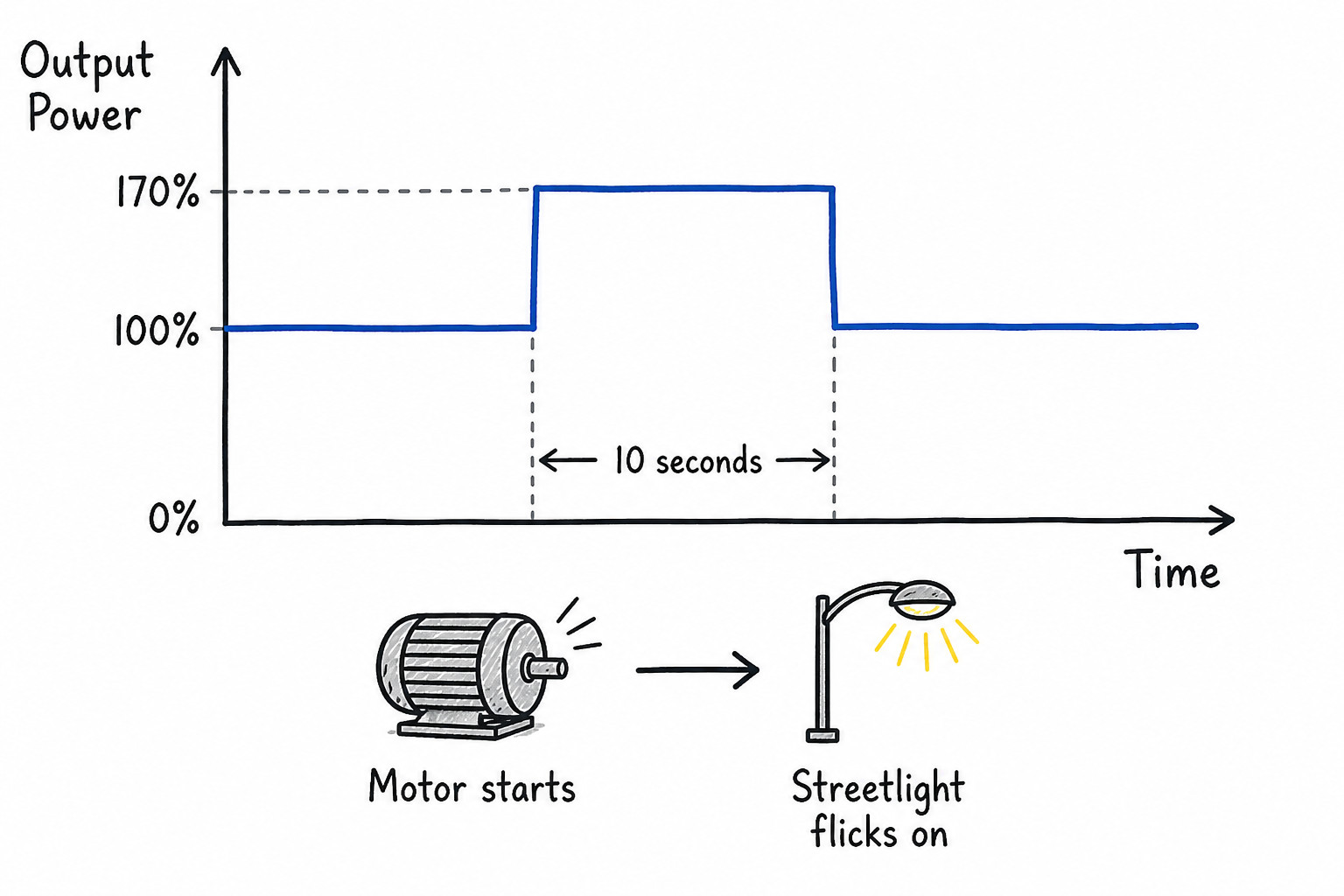
Imagine a cold winter morning. A row of LED streetlights turns on simultaneously. The inrush current is huge — sometimes double the steady-state value. If your 12 volt power supply or 24 volt power supply is sized only for running load, it will trip into overload protection power mode. The lights would flicker or fail to start. Oversizing the supply by 50–100% is one option, but that wastes energy and copper.
A smarter solution is the 170% power boost capability found in modern dc power supplies like the TPS series. This feature, often called a power boost power supply or 10 second power boost, allows the unit to deliver 170% of its nominal current for up to ten seconds. That is enough time for motor inrush, lamp startup, or capacitor charging. Then it returns to normal operation with auto recover protection seamlessly. No nuisance tripping, no over-specification, and no service call.
This is why a single power supply for 12 volt applications can handle a conveyor belt that starts under load, and also run the sensors that monitor it. The boost handles the peaks; the base rating handles the average. It is a principle of reliability engineering: design for the typical, but tolerate the transient. If you have ever wondered how a hospital’s pneumatic tube system — with dozens of solenoids all firing at once — never browns out, now you know.
The Ecosystem of a Power Rail: One Bar, Many Lives
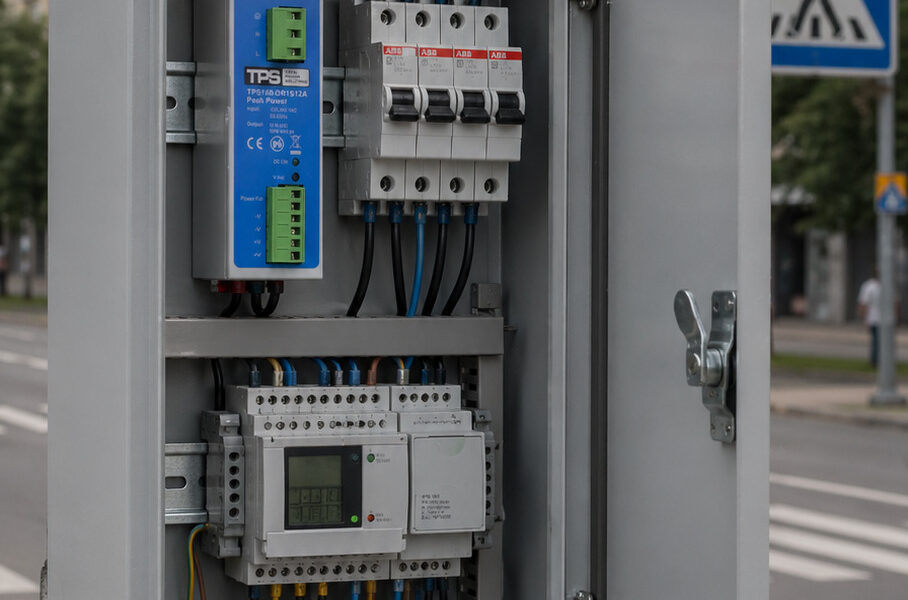
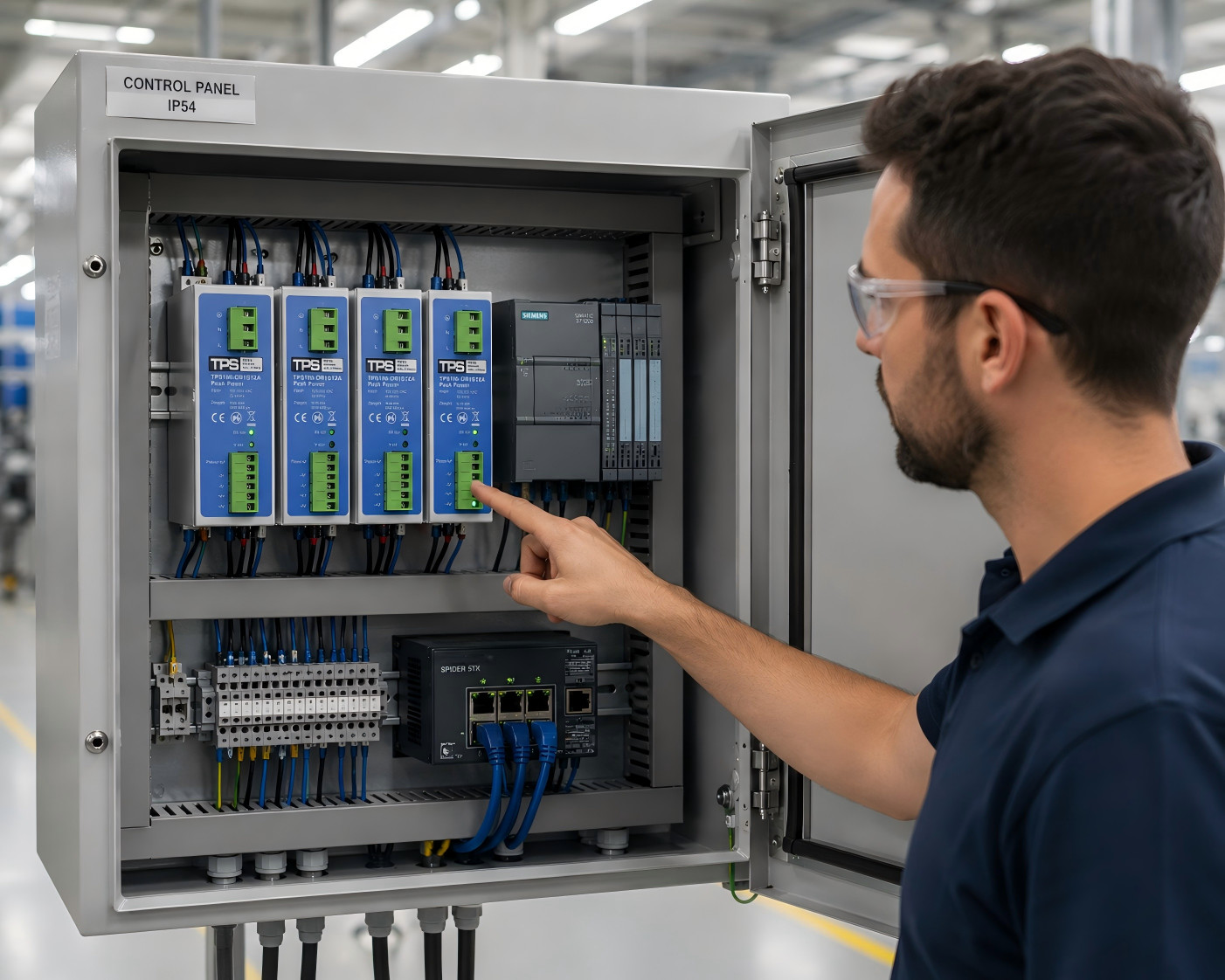
A single power rail inside a control cabinet can carry multiple power supplys (or power supplies if you prefer correct spelling). One might be a 12v dc power supply for analog sensors, another a 24V DC power supply for PLC I/O, and a third a dedicated ac-dc power supply for a touch panel HMI. They share the same DIN rail — that simple metal bar standardized as TS35 worldwide. When battery backup is needed, engineers add a din rail ups module. This din rail ups shares the same form factor, same wiring style, and same auto recover protection philosophy. The entire assembly becomes a modular, replaceable power ecosystem.
If one unit fails — which, given 350000 hours MTBF, is statistically unlikely more than once every forty years — a technician swaps it in minutes without rewiring the cabinet. This modularity stands in stark contrast to consumer power supply and power supply supplies that are molded, glued, and sealed. An industrial power supply is repairable. Its terminals accept field wiring (AWG26-14, IP20 power supply rated). Its LED indicators show status at a glance. Its datasheet includes derating curves for 3000m altitude power supply operation — because a factory in Mexico City (2,240m) or a mine in the Andes needs to know exactly how much current it can deliver as the air thins.
Clean Power, Silent Running: The Charm of Convection Cooling
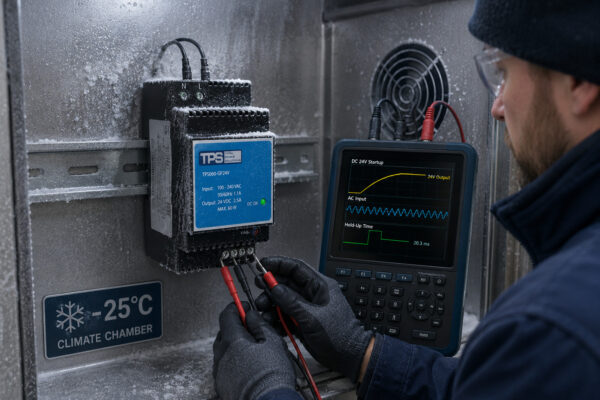
Walk into any factory floor. Listen. The loudest noises are pneumatics, conveyors, maybe a cooling fan on a servo drive. But the din rail power supply? Silent. That is because it uses convection cooled power supply design — no fan, no whine, no dust ingestion. Heat rises through vents in the aluminum housing. The efficiency, often hitting 93% for a 24v din rail power supply, means less waste heat in the first place. Less heat means longer capacitor life. Longer life means that 350000 hours MTBF is not just a number but a lived reality.
The power is remarkably clean. Less than 1% ripple noise is typical — often below 50 mV peak-to-peak on a 24V rail. That matters when your ac to dc power supply is feeding a microcontroller that expects a stable reference. It matters more when the load is a wireless communication module, where ripple can appear as sideband noise. The 20ms hold up time ensures that even if the input drops out for a cycle or two — a lightning strike, a switching of utility feeds — the output never blinks. Combined with a 0.96 power factor, these supplies draw current cleanly from the grid, reducing harmonic pollution and utility penalties. And the <0.5mA leakage current meets the stringent requirements of medical and touch-safe applications.
Where You’ve Already Met One: Stories You Didn’t Know
Consider a hospital’s automated medication dispenser. Each drawer has a solenoid that pulls when a nurse enters a code. Many solenoids may fire in rapid succession. A cheap power supplys would sag or trip. A proper stabilised power supply with 170% power boost handles it without drama. Or think of a toll highway’s electronic gantry. It must read transponders, capture license plates, and communicate with a central server — all in a metal box baking at 60°C in summer. Only a convection cooled power supply rated to 70°C (with derating above 50°C) can survive year after year.
The TPS power supply series is present in wind turbines, EV charging stations, airport baggage sorters, and submarine cable landing stations. It powers the LED screen that tells you your gate. It keeps the security camera recording. This device is the quiet enabler of modern infrastructure.
And the fine print matters: 20ms hold up time to ride through grid blinks. Less than 0.5mA leakage current for patient-connected equipment. 350000 hours MTBF so that a traffic cabinet in rural Nebraska doesn’t need a service call for decades. These are not selling points for a glossy brochure. They are the difference between a city that runs and a city that stops.
Conclusion: Next Time the Elevator Moves, Remember
The next time you step into an elevator, or a traffic light changes, or your phone claims “5G” inside a subway station, remember: none of it would be possible without reliable DC power. Behind a locked door, inside a weatherproof cabinet, a din rail power supply is converting 85-264VAC power supply into a clean, stable 24V DC power supply or 12v power supply. It runs at half load, staying cool by natural convection, and waits for a motor surge that will trigger its 170% power boost for ten seconds. This device has no screen, no app, no notifications. It just works. That is the highest form of technology: the kind you never have to think about. The silent guardian. The unseen stabilizer. The box on the rail.