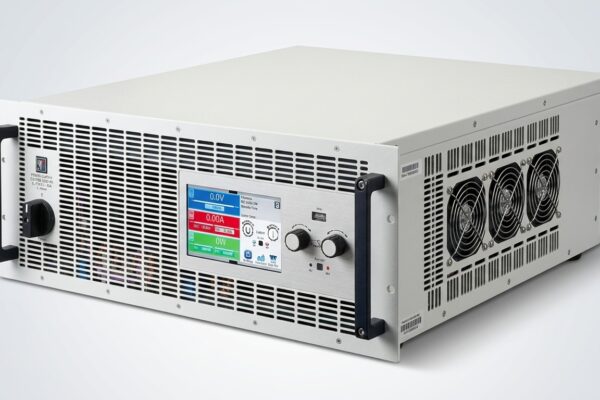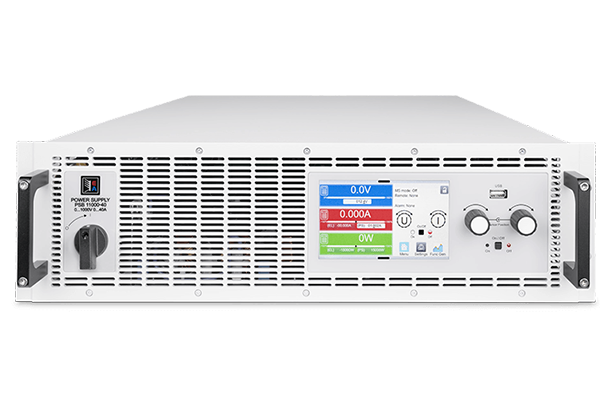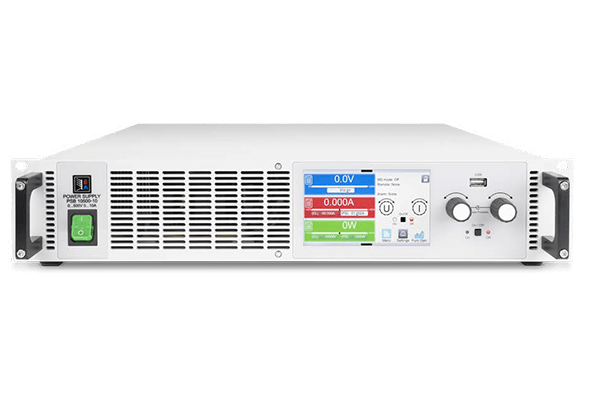


Modern electronics laboratories require DC power supplies that combine precise output control, electrical protection, and flexible integration into manual and automated test environments. TPS desktop programmable DC power supplies address these requirements with programmable voltage and current control, low ripple and noise, remote interfaces, and configurable protection functions.
For applications requiring safety extra-low voltage, the 40 V model provides a DC output within the SELV voltage range. Its 0–2 A output range and 1 mA current-setting resolution also support low-current testing of sensitive electronic components.
The power supply operates from a 90–264 VAC input with active power factor correction (PFC) and provides regulated DC output for laboratory, development, educational, and automated test applications. Typical use cases include semiconductor testing, embedded-system development, IoT devices, automotive electronics, battery-management systems, and low-voltage power-converter evaluation.
SELV Output for Low-Voltage Laboratory Testing
SELV is relevant wherever accessible low-voltage circuits must remain separated from hazardous voltages. With a maximum output of 40 V DC, the TPS 40 V model is intended for applications requiring operation within the SELV voltage range.
Voltage limitation, however, is only one aspect of laboratory protection. Current control is equally important when powering sensitive components or investigating circuits where excessive current could damage the device under test (DUT).
The programmable output provides:
- 0–40 V voltage range
- 0–2 A current range
- 1 mA current-setting resolution
- Current accuracy of 0.1% + 3 mA
- Programmable overcurrent protection (OCP)
These capabilities allow engineers to establish controlled current limits, including thresholds around 30 mA, when appropriate for the DUT and test procedure.
Why Precise Low-Current Control Matters
Sensitive electronic components can require substantially lower current limits than those commonly used when powering complete assemblies. CMOS devices, MEMS sensors, laser diodes, and other low-power components may be damaged if a fault condition allows excessive current to flow.
A programmable DC power supply with 1 mA setting resolution enables engineers to define tighter operating limits during prototype development and component characterization. For example, a device operating at 5 V and approximately 20 mA can be tested with an upper current threshold selected close to its expected operating range rather than relying on a substantially higher default limit.
This can assist with:
- Prototype bring-up
- Component characterization
- Leakage-current testing
- Fault investigation
- Firmware development
- Automated component screening
Appropriate current limits must always be determined from the DUT specifications and the applicable test requirements.
Configurable Protection Functions
Overvoltage Protection (OVP)
The OVP threshold can be configured to limit the maximum permissible output voltage. If the defined threshold is exceeded, the protection function shuts down the output.
Overcurrent Protection (OCP)
Programmable OCP allows the engineer to establish a maximum current threshold for the test. Low thresholds can be useful when working with sensitive devices that could be damaged by excessive current.
Overpower Protection (OPP)
OPP limits operation when the configured power threshold is exceeded. This provides an additional protection parameter when both voltage and current vary during a test.
Overtemperature Protection
Internal temperature monitoring protects the power supply against excessive thermal loading, including conditions that may result from restricted airflow.
Output Discharge
The integrated output discharge function reduces residual voltage after the output is switched off. This is particularly relevant when output capacitors can retain stored energy after a test has ended.
Protection thresholds should be configured according to the DUT ratings and the intended test conditions rather than treated as substitutes for the safety measures required by the applicable standard or laboratory procedure.
Low Ripple and Noise for Sensitive Electronics
The power supply specifies ripple and noise below 1 mVrms / 10 mVpp. Low output noise is important when powering circuits whose behavior can be influenced by disturbances on the supply rail.
Typical examples include:
- Analog circuits
- RF electronics
- Sensors
- Data-conversion circuits
- Low-noise amplifiers
- Semiconductor devices
A clean DC source can help engineers distinguish DUT behavior from disturbances introduced by the laboratory power supply itself.
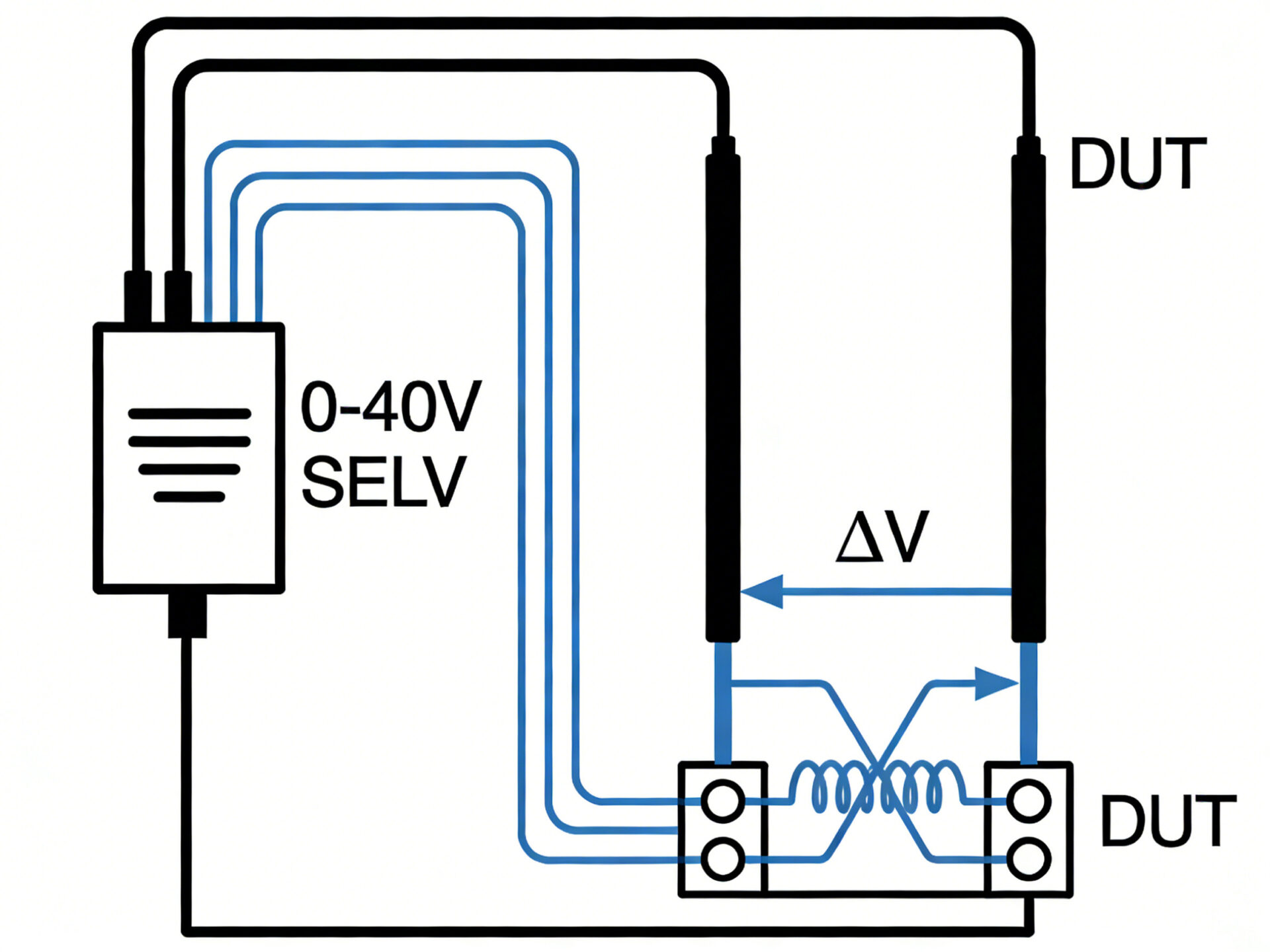
Remote Sensing for Improved Voltage Accuracy at the DUT
Voltage drops across cables and test leads become increasingly significant in low-voltage applications. Even a relatively small resistance can produce a measurable difference between the voltage at the power supply terminals and the voltage actually reaching the DUT.
Remote sensing compensates for these cable-related voltage drops by regulating the output based on the voltage measured at the load.
This is particularly useful when:
- Long test leads are required
- Current varies substantially during operation
- The DUT operates at low voltage
- Small voltage deviations can influence the measurement result
For a low-voltage circuit, even a 0.1 V drop may be significant relative to the nominal supply voltage. Remote sensing therefore supports more accurate voltage delivery at the DUT terminals.
Auto-Ranging Power Stage
The auto-ranging power stage allows the available output power to be used across a broader combination of voltage and current operating points than a conventional fixed-range architecture.
This can be useful in laboratories that test multiple device classes. Instead of dedicating separate supplies to different voltage/current combinations, an auto-ranging programmable DC power supply can cover a wider operating envelope within its rated limits.
The result is greater flexibility for development benches, component laboratories, and automated test systems where test requirements change frequently.
Active PFC and Wide-Range AC Input
The input stage operates from 90–264 VAC and incorporates active power factor correction with a specified power factor above 0.99.
The wide input range supports operation across common mains systems without requiring manual input-voltage selection. Active PFC also improves the input-current waveform compared with an uncompensated rectifier input.
For laboratories operating equipment internationally or integrating instruments into systems intended for different regions, this simplifies AC input compatibility.
USB, Ethernet, SCPI, and Analog Control
Programmability is increasingly important in laboratories where repetitive measurements, long-duration tests, and automated validation are required.
TPS desktop programmable DC power supplies support remote operation through multiple interface options.
USB Connectivity
USB provides direct PC communication for instrument control, configuration, and data-oriented test workflows.
Ethernet Connectivity
Optional Ethernet connectivity supports network-based operation, making it suitable for remotely controlled laboratories, automated test equipment, and long-duration test installations.
SCPI Commands
SCPI support allows the power supply to be integrated into existing automated test environments. Engineers can control instrument parameters from SCPI-compatible software environments and programming tools, including Python and LabVIEW-based test systems.
Typical automated operations can include:
- Setting voltage and current
- Enabling or disabling the output
- Configuring protection thresholds
- Executing predefined test sequences
- Reading operating parameters
Isolated Analog Interface
A galvanically isolated analog interface supports 0–10 V control signals for voltage, current, and power settings and provides corresponding monitoring outputs.
This interface is useful for industrial test systems and existing automation architectures that rely on analog rather than digital instrument control.
Dynamic Output Sequences and Waveform Generation
Optional function-generator and arbitrary-waveform capabilities extend the power supply beyond static DC operation.
Programmable sequences of up to 99 steps can be used to reproduce changing supply conditions. This allows engineers to investigate DUT behavior during controlled voltage or current variations.
Potential applications include:
- Battery-voltage variation
- Supply-voltage dips
- Power-up and power-down sequences
- Repetitive voltage steps
- Transient-response testing
- Device stress testing
For example, a sequence can transition between 3.3 V and 5 V while the DUT response is monitored. Configurable current and protection limits remain available during the test.
These functions can reduce the need for separate waveform-generation hardware in applications where programmable DC-level transitions are sufficient.
Application: Low-Power IoT and Embedded Devices
LoRa, BLE, NB-IoT, and other embedded wireless systems often operate across substantially different power states. Development work may therefore require a source capable of supplying both low steady-state currents and higher active-mode currents.
The programmable voltage and current controls can support functional testing during firmware development, while configurable OCP provides a means of defining an upper current threshold for detecting unexpected operating conditions such as short circuits or abnormal current consumption.
For detailed low-current power profiling, however, engineers should evaluate the complete measurement specifications of the power supply against the required current range and measurement accuracy.
Application: Educational Electronics Laboratories
A 40 V SELV-range power source can also be appropriate for supervised educational laboratories working with low-voltage electronic circuits.
Instructors can configure voltage and current limits before experiments begin. Typical student projects may use 5 V, 12 V, or 24 V supply rails, while OCP can be selected according to the circuit being tested.
Programmable protection settings can help limit the consequences of wiring errors or short circuits, while the output discharge function reduces residual output voltage after the supply is switched off.
These functions complement, rather than replace, the laboratory’s required electrical safety procedures.
Application: Automated Component Screening
SCPI and Ethernet connectivity allow the power supply to be incorporated into automated component-test systems.
A test sequence can configure voltage, establish a defined current threshold, enable the output, monitor operating conditions, and record the result through external test software.
This approach may be applicable to automated evaluation of components such as:
- Capacitors
- Diodes
- Transistors
- Sensors
- Low-power ICs
The specific voltage, current, timing, and pass/fail criteria must be derived from the relevant component specifications and test methodology.
Application: Power Converter and Computer Power Testing
Programmable DC output can also support the characterization of DC/DC converters and other power-electronic assemblies.
A 24 V converter, for example, can be evaluated across different input conditions while remote sensing compensates for voltage drop between the source and the DUT. Programmable sequences can reproduce supply variations to observe how the converter responds to changing input voltage.
For computer power-supply testing or related power-electronics development, the programmable source can be used as part of a broader test setup for evaluating input behavior and transient operating conditions.
SELV and Current Limiting: Important Distinctions
SELV and programmable current limiting address different aspects of electrical protection and should not be treated as equivalent safety measures.
SELV concerns voltage limitation and separation from hazardous voltage circuits under defined conditions. A 40 V DC output falls below the commonly referenced 60 V DC SELV voltage boundary, but compliance depends on the complete circuit architecture and the applicable safety standard.
Current limiting or OCP, by contrast, controls the output current available to the DUT. A threshold such as 30 mA may be useful for specific component tests, but it should not be presented as a universal human-safety threshold.
Human physiological response depends on multiple factors, including current path, contact duration, skin condition, voltage, waveform, and environmental conditions. Consequently, programmable OCP should not be used as a substitute for the protective measures required by standards such as IEC 61010-1, IEC 62368-1, or application-specific safety requirements.
For laboratory component testing, the engineering value of precise current control is primarily the ability to establish limits appropriate to the DUT and the test procedure.
Combining Clean DC Output with Dynamic Testing
The combination of low ripple and noise, programmable voltage and current, remote sensing, protection functions, and optional waveform generation allows the same instrument to support both static and dynamic testing.
An engineer can use clean DC output for normal DUT operation and then apply controlled voltage transitions to investigate behavior under changing supply conditions. This is useful during prototype validation because the test configuration can remain consistent while the electrical stimulus changes.
Remote interfaces further allow these procedures to be automated and repeated under software control.
Front-Panel Operation and Stored Configurations
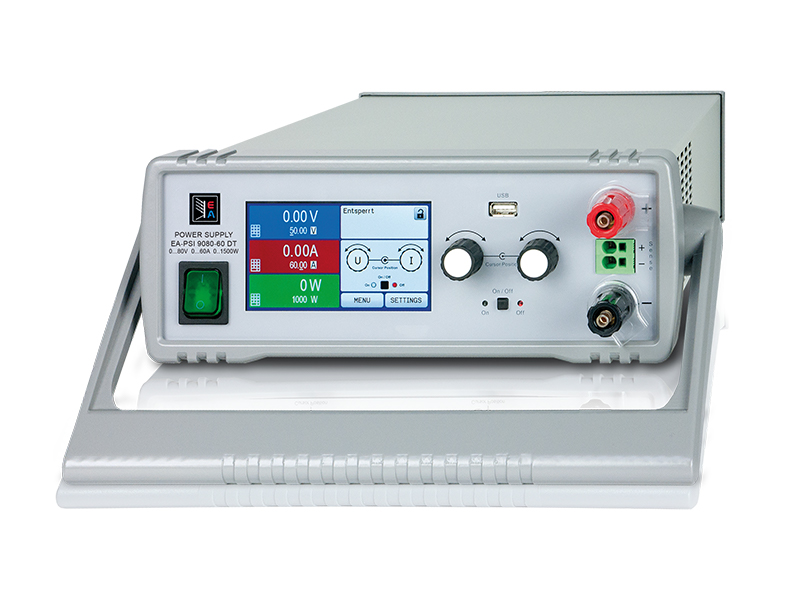
For manual laboratory work, the color touchscreen and dedicated control knobs provide direct access to the primary operating parameters.
Five user profiles can store frequently used settings for later recall. This is useful where the same bench supply is shared between recurring test configurations or different DUT types.
For automated environments, the same core functions can be accessed through the available remote interfaces.
Selecting a Programmable DC Power Supply for SELV-Range Testing
When evaluating a desktop programmable DC power supply for low-voltage laboratory applications, engineers should consider more than maximum voltage and current ratings.
Relevant selection criteria include:
- Required voltage and current operating range
- Voltage and current setting resolution
- Output accuracy
- Ripple and noise
- Protection functions and adjustment ranges
- Remote sensing capability
- Output discharge behavior
- Auto-ranging characteristics
- AC input range and PFC
- USB, Ethernet, SCPI, or analog-control requirements
- Sequence and waveform-generation capabilities
- Integration requirements for automated test equipment
For sensitive component testing, the relationship between current resolution, accuracy, protection thresholds, and the DUT’s absolute maximum ratings deserves particular attention.
Conclusion
TPS desktop programmable DC power supplies combine programmable voltage and current control with low ripple and noise, remote sensing, configurable protection functions, and multiple options for remote integration.
The 40 V model is particularly relevant to laboratory applications requiring operation within the SELV voltage range. Its 1 mA current-setting resolution supports controlled low-current testing, while USB, Ethernet, SCPI, and analog interfaces provide options for integration into manual and automated test environments.
For engineers working with embedded electronics, semiconductor components, sensors, power converters, educational systems, or automated component testing, these capabilities provide a flexible platform for controlled DC power delivery. The appropriate voltage, current, and protection settings should always be selected according to the DUT specifications, test methodology, and applicable safety requirements.