

For utilities, system integrators, and electrical procurement teams, selecting a pole-mounted transformer requires careful consideration of electrical ratings, environmental protection, safety features, installation requirements, and applicable grid standards.
The TPS Elektronik single-phase pole-mounted transformer is designed in accordance with relevant ANSI/IEEE requirements for overhead distribution systems. Its fully sealed, oil-immersed design is available with rated capacities from 10 kVA to 333 kVA, covering a range of utility and commercial distribution applications.
Primary voltages can be configured up to 34.5 kV, with secondary voltages available down to 120 V. The transformer uses copper windings and can be equipped with protection components such as lightning arresters and a pressure relief valve for outdoor distribution applications.
1. Sealed-Tank and Oil-Immersed Design
The transformer uses a fully sealed tank that isolates the internal components and insulating oil from ambient air. This design helps limit the ingress of moisture, dust, and other contaminants that could affect the insulating oil and internal insulation over time.
Insulating oil provides both electrical insulation and heat transfer. Heat generated by the core and windings is transferred through the oil to the tank, where it is dissipated to the surrounding environment under normal operating conditions.
For applications requiring a different installation concept, such as ground-mounted distribution, other transformer configurations may be more appropriate.

2. Electrical Ratings and Configuration Options
The transformer can be configured for different distribution-system requirements. Typical ratings include:
- Rated capacity: 10–333 kVA
- Primary (HV) voltage: typically 7.2–34.5 kV
- Secondary (LV) voltage: typically 120–600 V
- Winding material: copper as standard
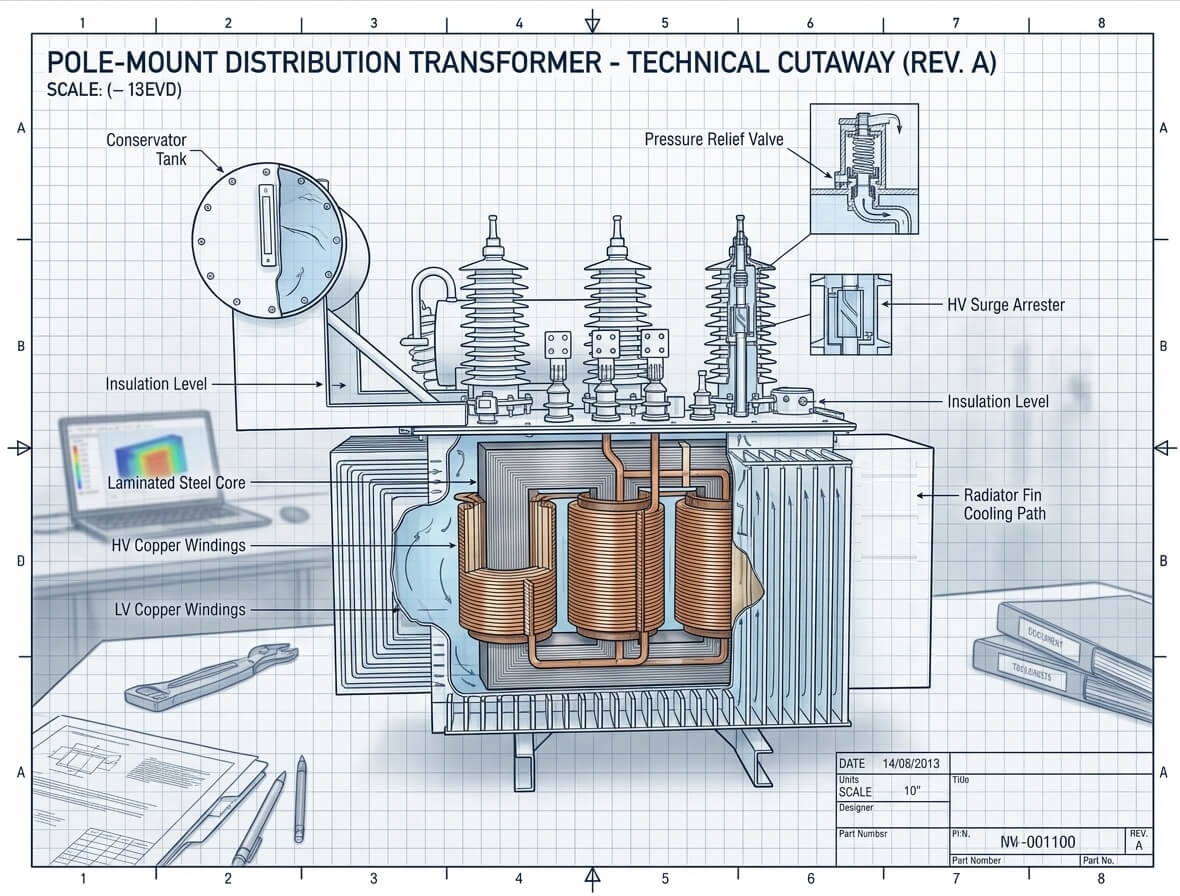
Copper windings provide high electrical conductivity and mechanical strength. The magnetic core uses silicon-steel laminations, a conventional construction for distribution transformers intended to limit core losses.
Actual efficiency and loss values depend on the selected transformer rating, voltage configuration, and operating conditions. In general:
- No-load losses depend primarily on the core design and transformer rating.
- Load losses vary with current and operating load.
Where galvanic isolation is the primary application requirement rather than voltage distribution, a dedicated isolation transformer may be considered.
3. Safety and Protection Features
The transformer can be equipped with protection and safety components commonly used in overhead distribution systems:
- Lightning arresters (optional): Help limit transient overvoltages caused by lightning or switching events.
- Pressure relief valve: Provides a means of relieving excessive internal pressure under specified fault conditions.
- Sealed cover assembly: Helps protect the insulating oil and internal components from environmental exposure.
The required protection configuration should be selected according to the utility specification, network design, and installation environment.
4. Installation and Handling
Several mechanical and electrical features support installation and connection in pole-mounted distribution systems:
- Lifting lugs: Provide designated lifting points for handling and installation.
- HV and LV bushings: Provide insulated connection points for primary and secondary conductors.
- Grounding connection: Supports integration into the installation’s grounding system.
- Nameplate: Identifies the transformer and provides key electrical and technical data.
Installation procedures, clearances, grounding, conductor connections, and protective measures must be determined according to the applicable standards, utility requirements, and site conditions.
5. Typical Applications
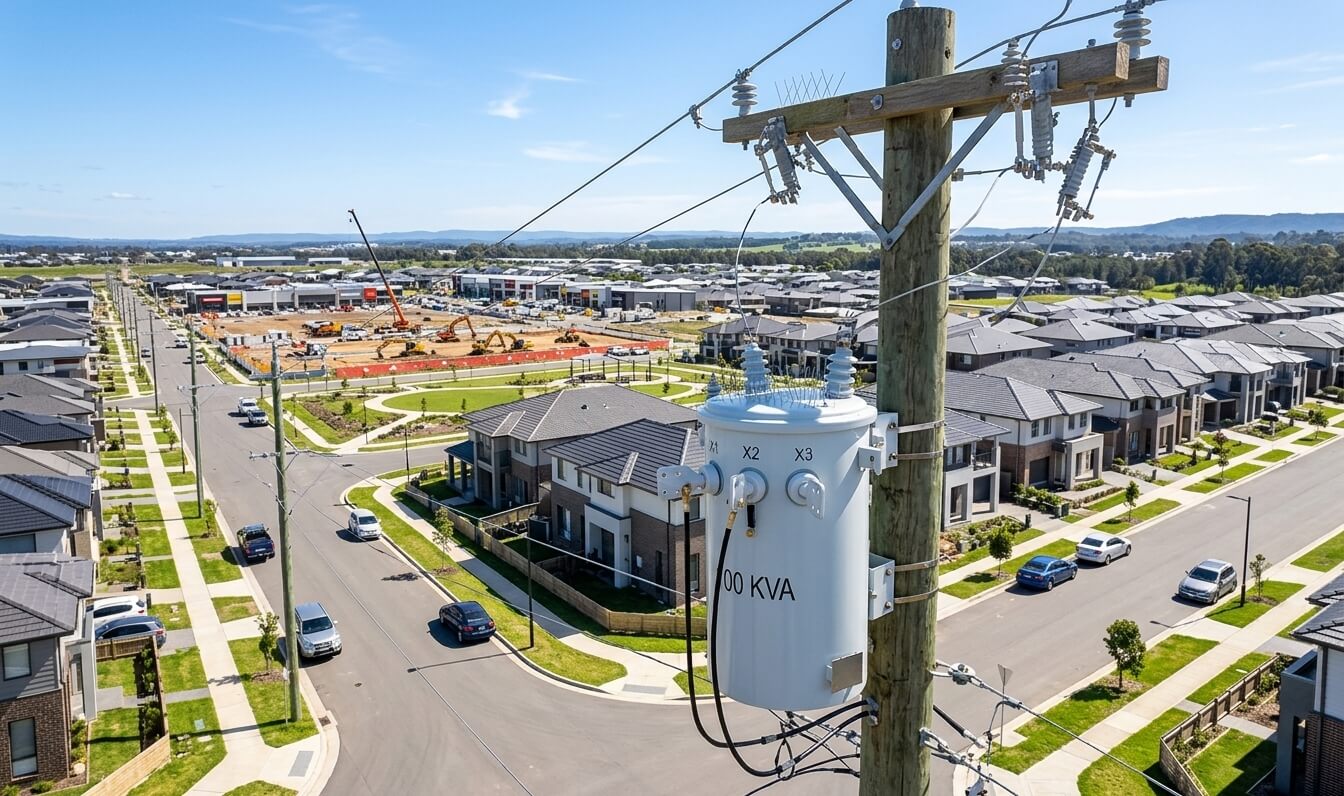
Single-phase pole-mounted transformers are widely used at the distribution level to step medium-voltage supply down to utilization voltages. Typical applications include:
- Urban distribution networks: Supplying residential and light-commercial loads.
- Rural electrification: Supporting overhead distribution networks across geographically dispersed loads.
- Temporary power distribution: Supplying suitable construction-site or temporary installations where pole-mounted distribution is required.
The transformer design is based on relevant ANSI/IEEE requirements for overhead distribution transformers and is intended for applications using corresponding distribution-system practices. Final suitability depends on the specified transformer configuration and project requirements.
6. RFQ Checklist for Transformer Procurement
A technically complete request for quotation helps suppliers evaluate the required transformer configuration and prepare an appropriate proposal. The RFQ should typically specify:
- Rated capacity in kVA
- Primary voltage
- Secondary voltage
- Frequency, if required by the project specification
- Efficiency or loss requirements, where specified
- Required winding material
- Required accessories, such as lightning arresters, bushings, or valves
- Applicable ANSI/IEEE standards
- Utility-specific or project-specific requirements
Providing these parameters at the RFQ stage can simplify technical evaluation and reduce the need for subsequent clarification.
7. Frequently Asked Questions
What is the benefit of a fully sealed transformer design?
A fully sealed design limits direct exposure of the insulating oil and internal components to ambient air. This can help reduce the ingress of moisture and contaminants and support stable insulation conditions over the transformer’s operating life.
Why are copper windings used?
Copper combines high electrical conductivity with good mechanical strength. These characteristics make it suitable for transformer windings where electrical losses, thermal performance, and mechanical stresses must be considered.
What is the function of a lightning arrester?
A lightning arrester provides a path for transient overvoltages to be diverted toward ground, helping limit the voltage stress applied to transformer insulation and connected equipment.
Can the transformer be configured for different voltage levels?
Yes. Primary and secondary voltage configurations can be adapted within the specified ranges to meet the requirements of the distribution system and application.
Does the transformer comply with ANSI/IEEE standards?
The transformer design is based on relevant ANSI/IEEE requirements for overhead distribution transformers. Applicable standards and required compliance should be defined for each project, as the final configuration depends on the specified electrical ratings, accessories, and utility requirements.