

Industrial automation environments place high demands on power infrastructure. In applications such as CNC machinery, automated production lines, and smart warehouse systems, power quality, grounding integrity, and electrical protection directly influence system stability and operational continuity.
Unlike consumer-grade PC power supplies, industrial ATX PC power supplies are designed for electrically demanding environments with fluctuating loads, electromagnetic interference (EMI), and extended operating times.
This article explains the role of grounding reliability, Class I protection, Active PFC, and industrial-grade protection mechanisms in industrial ATX power supply design.
Key Takeaways
- Grounding reliability plays a central role in system stability and electrical safety in industrial automation environments.
- Class I protection design provides a defined protective earth connection for fault-current management and EMI control.
- Active Power Factor Correction (PFC) and wide AC input ranges help maintain stable DC output under varying grid conditions.
- Protection functions such as OCP, OVP, SCP, and OTP help protect industrial PCs, PLCs, HMIs, and control electronics.
- Compliance with standards such as CE, UL, UKCA, and RoHS supports integration into international industrial systems.
- Low ripple, controlled leakage current, and extended MTBF values are important considerations for long-term industrial operation.
- Standard ATX and Flex ATX form factors simplify integration into industrial control cabinets and embedded systems.
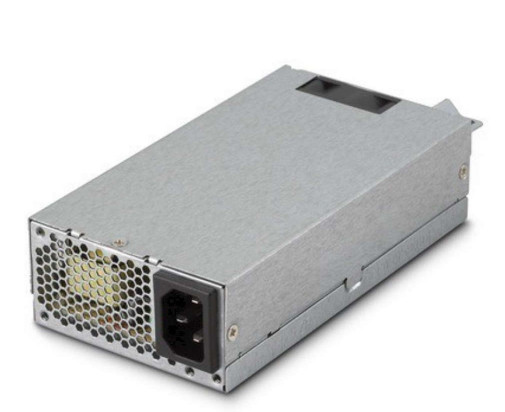
1. Grounding Reliability in Industrial Environments
Industrial facilities typically contain a combination of high-power equipment and sensitive control electronics. Variable frequency drives (VFDs), motors, robotic systems, and welding equipment can generate electromagnetic interference and common-mode noise that affect nearby systems.
In these environments, grounding quality becomes especially important. Long cable runs, shared grounding conductors, or corroded protective earth connections can increase impedance and reduce grounding effectiveness.
If grounding integrity is compromised, leakage currents from EMI filters may elevate chassis potential and interfere with connected industrial systems such as:
- Industrial PCs
- PLCs
- HMIs
- Sensor systems
- Motion controllers
In CNC applications, this may contribute to communication instability, positioning errors, or unexpected controller behavior. In warehouse automation systems, it can affect communication between conveyors, scanners, gateways, and warehouse management systems.
Industrial ATX power supplies are designed with grounding architectures intended for these operating conditions.
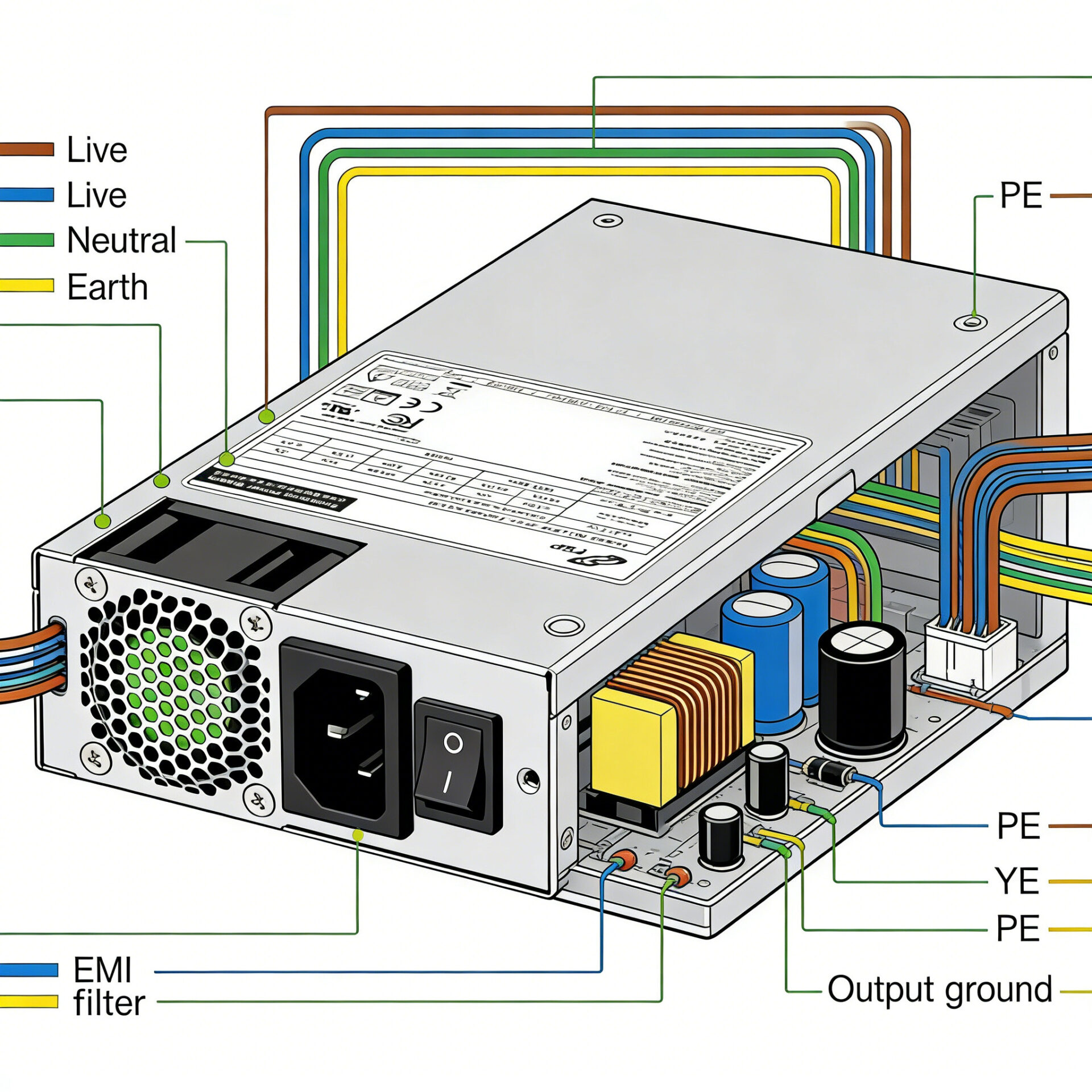
2. Class I Protection and System Stability
Class I electrical equipment uses basic insulation together with a protective earth (PE) connection. In industrial power supplies, the chassis and accessible conductive parts are bonded to protective earth.
This approach serves two primary functions:
- It provides a low-impedance path for fault currents during insulation failures.
- It establishes a stable grounding reference for connected equipment.
A defined earth reference can help reduce common-mode noise in industrial communication and control systems.
Compared with floating-output designs commonly found in Class II power supplies, Class I industrial PSUs are generally preferred in grounded control cabinet environments where multiple devices share a common reference potential.
3. Active PFC and Wide AC Input Range
Industrial grids are often exposed to:
- Voltage sags
- Harmonic distortion
- Load fluctuations
- High inrush currents
- Phase imbalance
Power supplies with Active Power Factor Correction (PFC) help shape the input current waveform and improve compatibility with industrial electrical infrastructure.
Combined with a wide AC input range (typically 90–264 VAC), Active PFC can support stable DC output operation under varying input conditions.
Key advantages may include:
- Reduced harmonic distortion
- Improved energy efficiency
- Lower peak current demand
- Improved tolerance to voltage fluctuations
- Simplified global deployment without manual voltage selection
These characteristics are particularly relevant in production lines where multiple high-load systems share the same power distribution network.
4. Leakage Current and Protection Functions
Industrial systems often use residual current devices (RCDs) for electrical safety. Excessive leakage current from power supplies may contribute to nuisance tripping.
Industrial ATX power supplies typically use optimized EMI filtering and grounding strategies to help control leakage current levels and improve compatibility with industrial installations.
Protection mechanisms commonly include:
- OCP (Overcurrent Protection) – helps protect against overload conditions
- OVP (Overvoltage Protection) – helps protect downstream electronics from excessive voltage
- SCP (Short-Circuit Protection) – limits current during short-circuit events
- OTP (Overtemperature Protection) – helps prevent thermal overload
These protection features are particularly important in automation systems with continuous operation and sensitive electronics.
5. Compliance and International Integration
For machine builders and system integrators, regulatory compliance is an important consideration when selecting industrial power supplies.
Depending on the product series and target market, industrial ATX power supplies may support compliance with:
- CE requirements for the European market
- UL safety standards for North America
- UKCA requirements for Great Britain
- RoHS environmental directives
These compliance frameworks support integration into internationally distributed industrial systems and machinery.
6. Industrial Performance Considerations
Industrial applications often require operating characteristics beyond those expected from consumer-grade PC power supplies.
Important performance parameters may include:
Low Ripple and Noise
Low output ripple can help support stable operation of:
- Analog sensors
- Encoder systems
- Measurement equipment
- Industrial communication interfaces
Stable Output Regulation
Stable voltage regulation is important for industrial motherboards, embedded systems, and motion-control electronics operating under varying loads.
Wide Input Voltage Range
Wide-range AC input supports operation in facilities with fluctuating supply conditions and simplifies international deployment.
Acoustic Performance
Temperature-controlled fan operation can help reduce acoustic noise in operator stations, laboratory systems, or industrial workspaces.
MTBF Considerations
MTBF (Mean Time Between Failures) values are commonly used as an indicator for long-term reliability expectations under defined operating conditions.
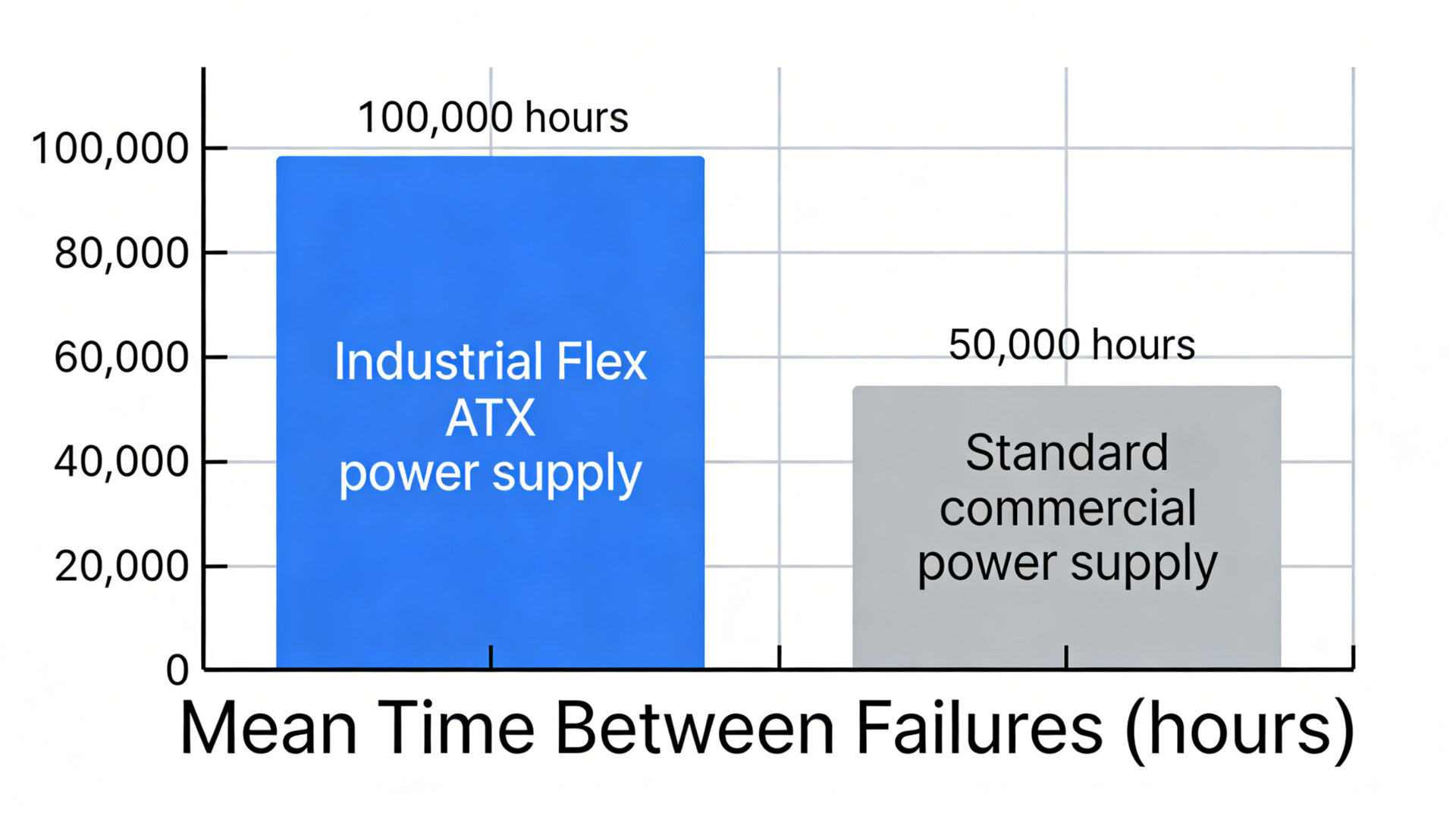
7. ATX and Flex ATX Form Factors
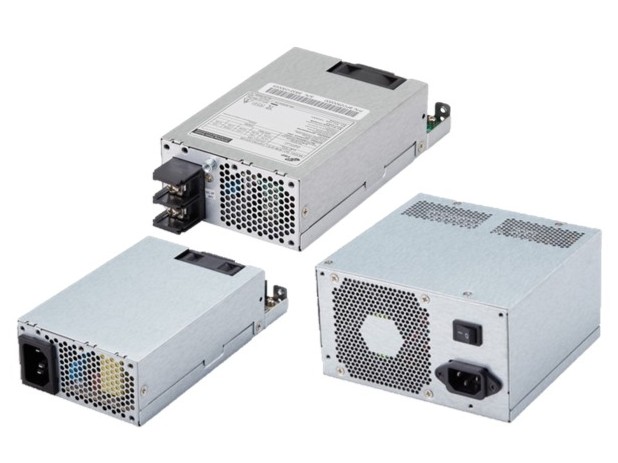
Industrial systems use a wide range of enclosure and cabinet formats. To support different installation requirements, industrial PSUs are commonly available in:
- Standard ATX form factor
- Flex ATX form factor
Flex ATX power supplies are often used in:
- Compact industrial PCs
- 1U rack systems
- Embedded controllers
- Space-constrained control cabinets
Many industrial models also use IEC 320 C14 AC inlets for compatibility with standardized industrial power cables.
8. Application Areas
Automated Production Lines
Industrial ATX power supplies are commonly used in automated production systems involving:
- Robotics
- Vision systems
- Conveyor systems
- Safety PLCs
- HMIs
Stable grounding and low-noise power delivery can support communication reliability for industrial protocols such as:
- Profinet
- EtherCAT
- Modbus TCP
CNC Control Cabinets
CNC systems operate in electrically demanding environments with high-power spindle drives and rapidly changing loads.
Industrial-grade power supplies are designed to support stable operation under these conditions through:
- EMI-resistant design
- Wide input voltage tolerance
- Controlled ripple
- Protection mechanisms
- Industrial temperature capability
Smart Warehouses
Warehouse automation systems typically operate continuously and may include:
- AS/RS systems
- Conveyor sorters
- RFID readers
- Barcode scanners
- IoT gateways
- Wireless communication systems
Stable power delivery and controlled grounding behavior can support communication reliability across distributed automation infrastructure.
9. Why Consumer PSUs Often Struggle in Industrial Environments
Consumer desktop power supplies are generally designed for office or home computing environments rather than industrial installations.
Typical industrial challenges may include:
- Electrical transients from inductive loads
- Elevated ambient temperatures
- Continuous operation
- Voltage fluctuations
- High EMI exposure
- Shared grounding networks
Industrial ATX power supplies are typically designed with enhanced protections, wider operating ranges, and grounding strategies intended for these operating conditions.
10. Installation Best Practices
To support grounding performance and system stability:
- Use a dedicated PE busbar bonded to the facility grounding system.
- Ensure metal-to-metal chassis bonding where required.
- Use separate grounding conductors where appropriate.
- Separate AC input and DC output wiring paths.
- Use shielded cables for sensitive signal lines.
- Periodically inspect grounding connections for corrosion or loosening.
Installation practices should always follow applicable electrical standards and local regulations.
11. Industrial ATX vs. Commercial Desktop PSU
| Parameter | Commercial Desktop PSU | Industrial ATX PSU |
|---|---|---|
| Intended Environment | Office / Consumer | Industrial Automation |
| Input Voltage | Often fixed-range | Wide-range AC input |
| Grounding Design | Standard desktop design | Industrial grounding focus |
| Protection Functions | Basic | Extended industrial protections |
| Operating Temperature | Consumer range | Extended industrial range |
| EMI Considerations | Standard office environment | Industrial EMI environment |
| Form Factors | ATX | ATX / Flex ATX |
| Continuous Operation | Moderate duty cycle | Long-duration operation |
12. Frequently Asked Questions (FAQ)
Can industrial ATX power supplies be used in standard PCs?
Yes. However, industrial models are primarily designed for automation, embedded, and control applications rather than consumer desktop optimization.
What are the advantages of Flex ATX power supplies?
Flex ATX models are suitable for compact industrial systems where installation space is limited while maintaining standard industrial protection features.
Why is Active PFC important in industrial systems?
Active PFC can improve power quality, reduce harmonic distortion, and support more stable operation under fluctuating input conditions.
What does MTBF indicate?
MTBF is a statistical reliability indicator used to estimate expected operational reliability under defined test conditions.
Why is grounding important in automation systems?
Proper grounding helps reduce electrical noise, improve EMC behavior, and support safe operation of connected equipment.
13. Conclusion
Industrial automation systems require power supplies designed for electrically demanding environments. Grounding reliability, controlled leakage current, Active PFC, wide input voltage support, and industrial protection mechanisms all play an important role in long-term system stability.
Compared with consumer-grade desktop PSUs, industrial ATX power supplies are designed to support automation systems operating under continuous load, elevated temperatures, and challenging EMI conditions.
For machine builders, system integrators, and industrial operators, selecting an appropriate industrial PSU can contribute to improved operational reliability and simplified system integration.