

System integrators, panel builders, and procurement teams in railway projects rarely lose schedule because the control logic is wrong. They lose it when a signaling cabinet fails immunity at the accredited test house because the 0–150kHz conducted disturbance requirement not assessed, when a rolling stock electronic unit is assigned Performance Criterion A but behaves like Criterion C during ESD, or when the equipment is tested to EN 50121-3-2 when its installation location actually falls under EN 50121-4.
TPS Elektronik’s EMC testing laboratory services structured to reduce that risk: pre-compliance evaluation against the relevant EN 50121 part, port-by-port test planning, preliminary immunity assessment, and documentation that the accredited test house can build on—not replace.
1. Two standard domains: rolling stock and trackside are not the same test
The first decision in any railway EMC project is not which test level to use. It is which standard part applies to the equipment’s installation location. Getting this wrong sends the project to the wrong test table, the wrong performance criteria, and the wrong accreditation scope.
1.1 EN 50121-3-2 for apparatus on rolling stock
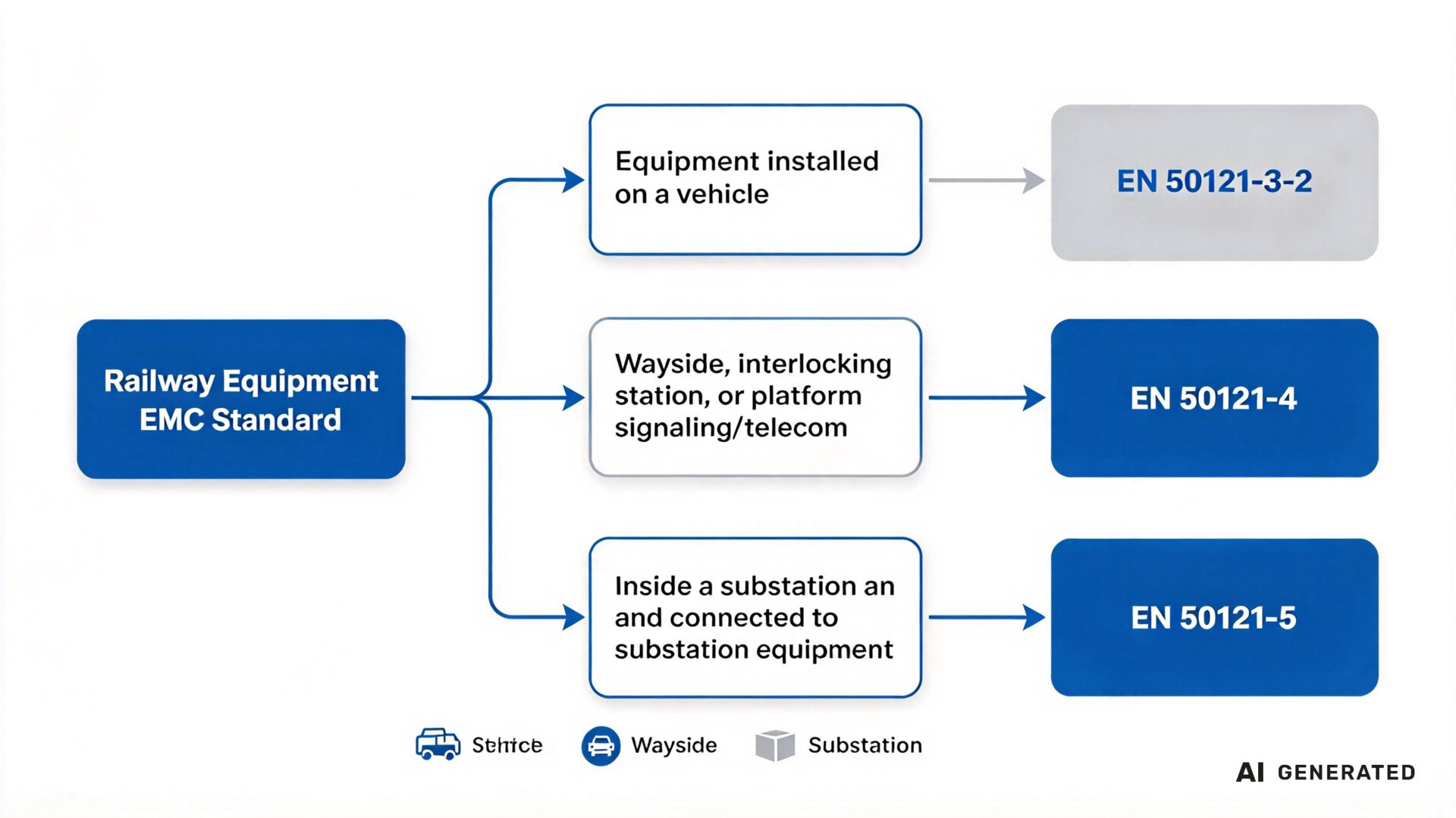
prEN 50121-3-2:2025 applies to emission and immunity aspects of EMC for electrical and electronic apparatus intended for use on railway rolling stock. Which including the integration of apparatus onto the vehicle. The defined test frequency range covers 0Hz (DC) to 400GHz, although the applicable tests depend on the apparatus, its configuration, ports, technology, and operating conditions. The standard explicitly excludes AC and DC traction power ports from its scope. Which means the traction interface is handled elsewhere in the EN 50121 series.
For a rolling stock electronic unit—a door controller, a brake electronic unit, a passenger information system—EN 50121-3-2 is the correct reference for the apparatus-level immunity and emission tests. The tests include conducted disturbance on auxiliary and control ports, radiated disturbance, ESD, and transient immunity, with test levels and performance criteria defined per port.
1.2 EN 50121-4 for signaling and telecommunication apparatus
FprEN 50121-4:2026 applies to signaling and telecommunication apparatus, including the power supply system belonging to that apparatus. Which installed inside interlocking stations, trackside cabinets, and other trackside locations including platforms. It covers essential equipment such as interlockings, signals, point machines. And level crossings, and it specifies emission and immunity limits plus performance criteria. Like EN 50121-3-2, the test frequency range extends from 0Hz to 400GHz.
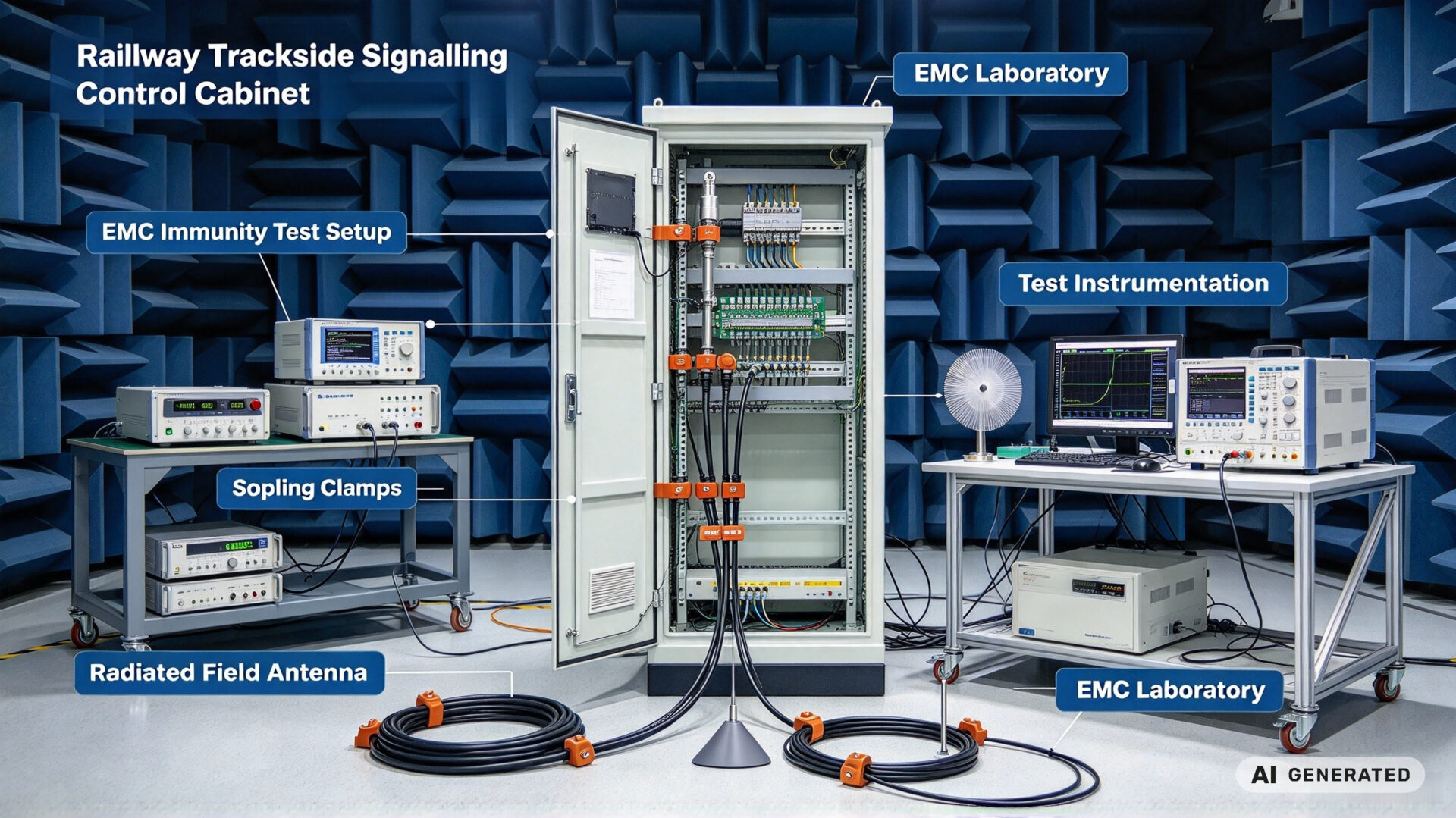
The trackside environment is not simply “outdoor rolling stock.” The disturbance profile includes traction return currents in the running rails, conducted disturbances in the 0–150kHz range from traction power, and the specific port configuration of a wayside cabinet. A signaling cabinet tested only to generic industrial immunity standards will miss the low-frequency conducted requirement and the traction-related disturbance profile.
1.3 The EN 50121-5 boundary and why it matters
Equipment installed inside a substation and connected to substation equipment covered by EN 50121-5, not EN 50121-4. The same signaling technology can fall under part 3-2 on a vehicle, part 5 in a substation, and part 4 along the track. This is not an academic distinction: the disturbance levels and port definitions differ, and testing to the wrong part produces a report that the assessor will reject.
2. EN 50155: the product standard that ties EMC to performance criteria
EN 50155:2017 is the product standard for electronic equipment used on rolling stock. Its EMC clause references EN 50121-3-2 for the EMI conformity requirements, and it adds the performance criteria framework that determines whether a test result is a pass or a fail for the specific function.
2.1 Performance criteria A, B, and C
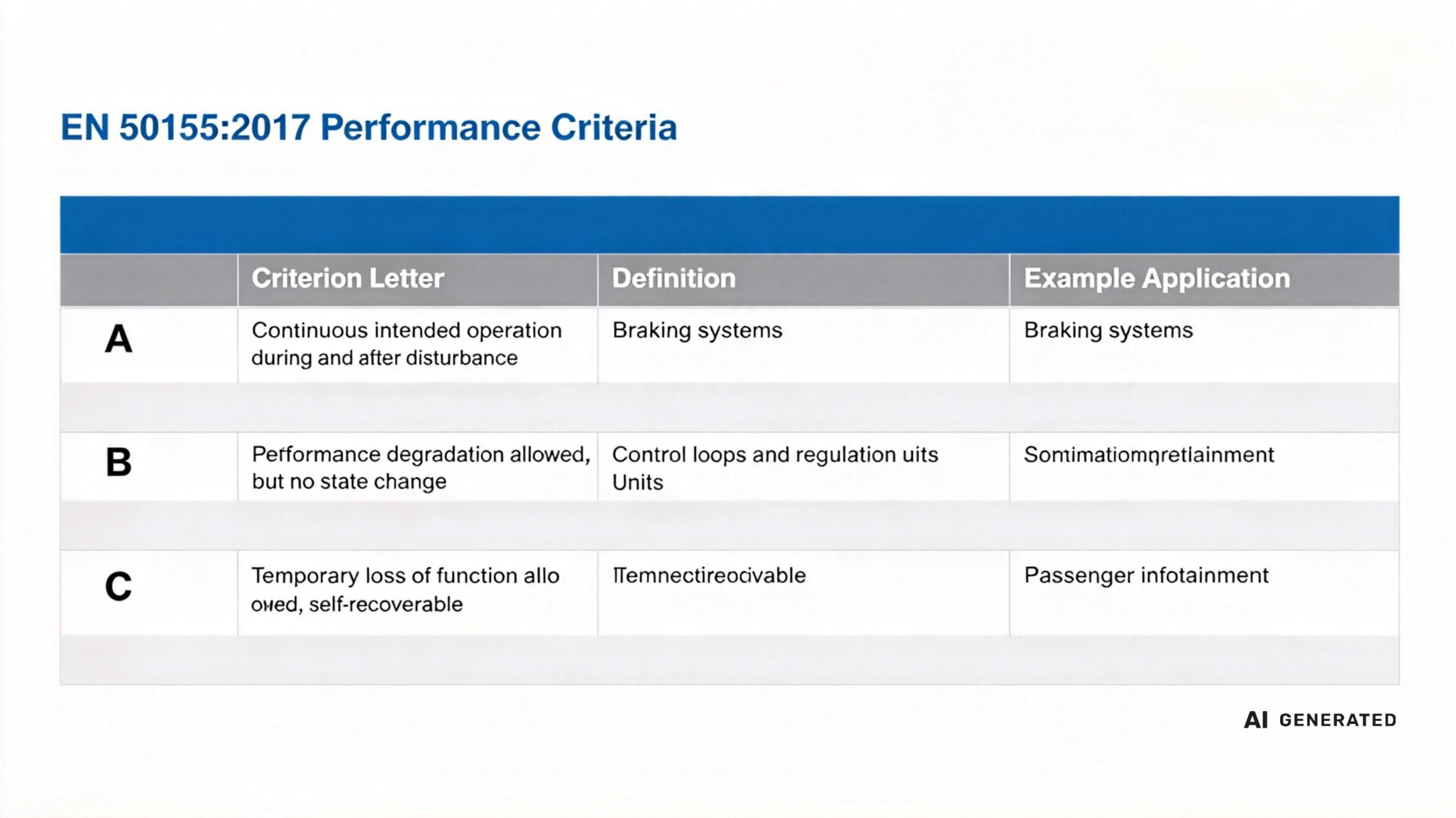
EN 50155:2017 defines three performance criteria, and the assignment is based on the equipment’s function and criticality, not on a default for the whole unit.
- Criterion A: The equipment must continue to operate as intended during and after the disturbance, with no performance degradation and no loss of function. Safety-critical functions such as braking systems typically require Criterion A.
- Criterion B: Performance degradation is allowed during the disturbance, but the operating state and stored data must not change, and the equipment must recover to intended operation after the disturbance.
- Criterion C: Temporary loss of function is allowed, provided the equipment recovers without operator intervention and without unsafe behavior. Non-critical applications such as passenger infotainment typically fall under Criterion C.
The practical consequence for pre-compliance is that the same test level can be a pass for one function and a fail for another. A door controller may be allowed to show degradation (Criterion B) on its communication port but must maintain safe operation (Criterion A) on its safety input. The pre-compliance plan must map each port to its assigned criterion before any measurement is taken.
2.2 Voltage interruption classes and the EMC interface
EN 50155:2017 also defines voltage interruption classes (S1, S2, S3) and supply voltage ranges for battery-supplied equipment, with additional hold-up capacitance required for classes S2 and S3. While the interruption classes are primarily a power-quality requirement, they interact with EMC immunity: a unit that meets the transient immunity level but has insufficient hold-up will still reset during a supply interruption, and the assessor may treat that as a functional failure under the assigned performance criterion.
For a DC/DC converter used inside the unit, the converter itself is a component and does not need to meet EN 50155 in isolation, but it must satisfy the voltage transient and environmental conditions so that the final system meets the standard. Pre-compliance should therefore include the converter’s transient response at the system level, not only at the component terminals.
3. What railway EMC pre-compliance actually looks like
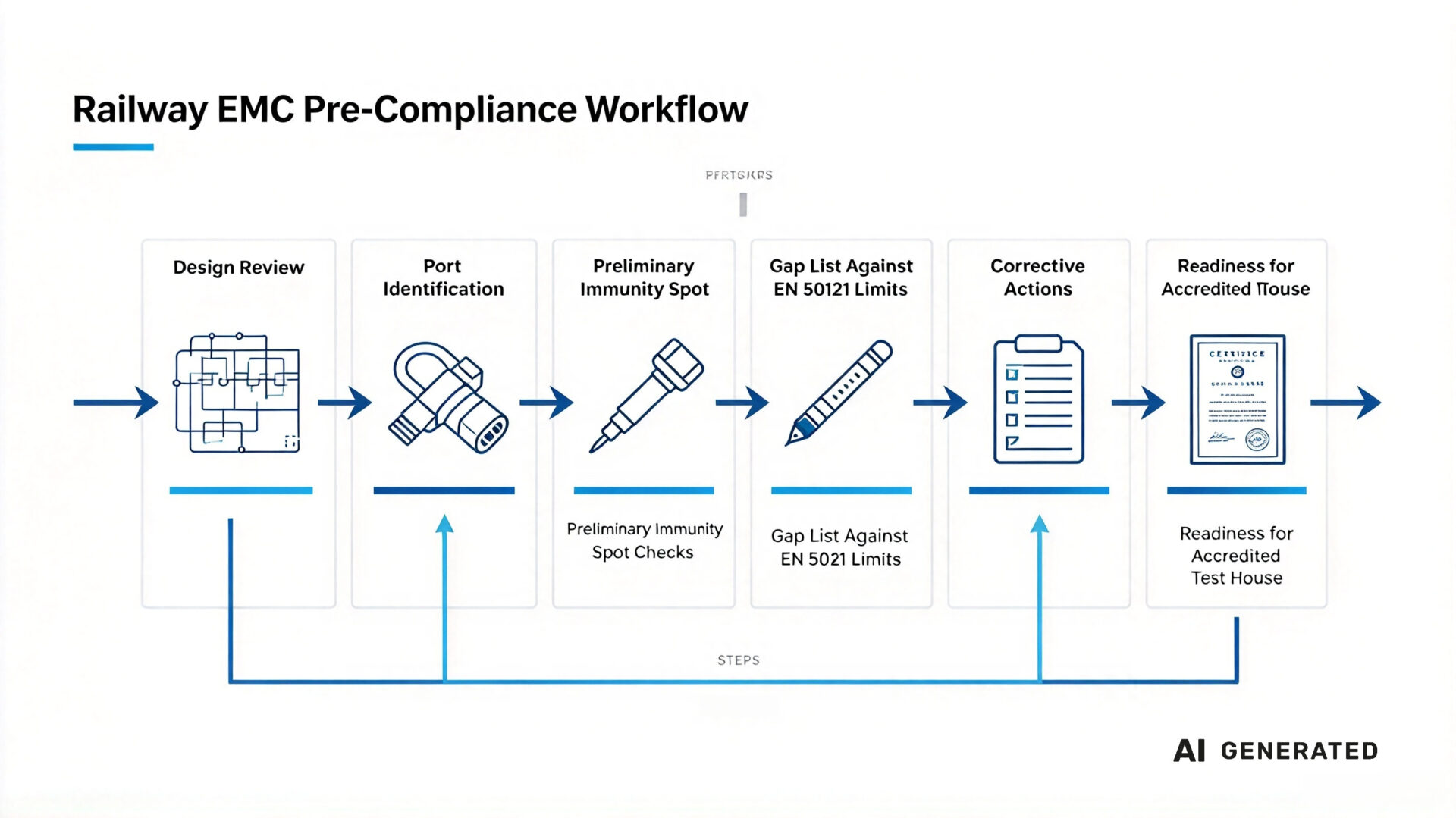
Railway EMC pre-compliance is not a scaled-down version of the accredited test. It is a gap analysis that identifies, before the formal test house booking. Which ports are likely to fail, which performance criterion is at risk, and which corrective action has the highest probability of moving the result into the pass region.
3.1 Port identification and test table mapping
The first deliverable is a port map. For each port—auxiliary power input, DC control input, encoder or sensor interface, communication port, enclosure—the pre-compliance review identifies the applicable EN 50121 test table, the test level, and the assigned performance criterion. This mapping exposes two common errors: ports that omitted from the test plan, and ports that were assigned the wrong criterion.
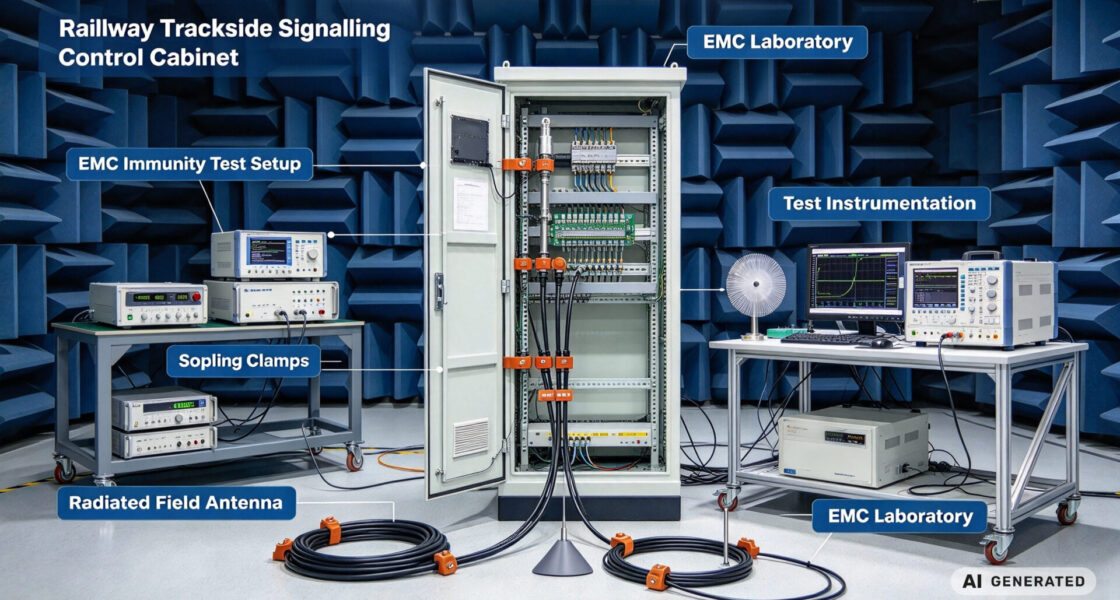
A trackside signaling cabinet, for example, may have a 0–150kHz conducted disturbance requirement that is not covered by a generic industrial immunity test. The port map makes that gap visible before the cabinet shipped to the test house.
3.2 Preliminary immunity spot checks
Not every test can reproduced outside an accredited laboratory. However, several high-value checks can performed at pre-compliance: ESD at accessible points, burst/EFT on auxiliary and control ports, surge on DC inputs, and conducted RF immunity on representative cable runs. These spot checks do not replace the accredited measurement; they identify the failure mode early enough that the corrective action can designed and validated before the formal test slot.
TPS’s EMC laboratory provides structured pre-compliance testing and consulting, with a technical focus on power electronics and industrial assemblies. The laboratory’s immunity and emission measurement scope includes conducted and radiated emissions, ESD, burst, surge, and conducted RF immunity. Which are the building blocks of the EN 50121 port tests. Where a specific railway test requires a capability outside the in-house scope, the pre-compliance review identifies that requirement and the project plan routes it to the appropriate partner or accredited facility.
3.3 The gap list and corrective action path
The output of pre-compliance is a gap list: port, test, observed behaviour, assigned criterion, gap severity, and recommended action. The action may be a filter change, a cable shield termination improvement, a transient suppressor upgrade. A hold-up capacitance increase, or a firmware recovery behaviour change. Each action prioritized by the probability that it changes the formal test outcome.
This is the point where pre-compliance pays for itself. A filter change on a prototype is inexpensive; the same change after a failed accredited test costs the re-test slot, the engineering time, and the schedule buffer.
4. Where TPS fits—and what the accredited lab still does
TPS is a pre-compliance and engineering support provider, not the accredited certification body. The accredited test house issues the formal EN 50121/EN 50155 test report that the assessor accepts. TPS’s role is to make that formal test more likely to pass on the first attempt, and to reduce the number of clarification cycles between the design team and the test house.
The division of work is deliberate. TPS reviews the design against the relevant EN 50121 part, maps the ports and performance criteria, performs preliminary checks where the capability exists, and produces a gap list with prioritized actions. The accredited laboratory then performs the formal measurements on the corrected design, with a test plan that already reflects the correct standard part and port mapping.
The EMC compliance guide and the how-to-test guide describe the pre-compliance workflow in more detail. For projects that combine EMC with electrical safety, the EMC and electrical safety resource covers the integrated scope.
5. RFQ checklist for railway EMC pre-compliance
To get a usable pre-compliance scope for a railway project, provide the following:
- Installation location: On-vehicle, trackside cabinet, interlocking station, platform, or substation-connected—this determines whether EN 50121-3-2, -4, or -5 applies
- Equipment function and criticality: Which functions must meet Criterion A, B, or C
- Port list: Auxiliary power, DC control, communication, sensor/encoder, enclosure, and any traction interface excluded from the apparatus standard
- Supply characteristics: Nominal battery voltage, voltage interruption class (S1/S2/S3), and hold-up requirement
- Existing test evidence: Any preliminary measurements, filter data, or previous test reports
- Target accredited laboratory: The test house’s scope and the standard revision it will test to
- Schedule: The formal test slot and the design freeze date
- Documentation: Port map, gap list, and pre-compliance test report format required
Providing these details allows the pre-compliance scope to matched to the actual standard part and performance criteria, rather than to a generic “railway EMC” label.