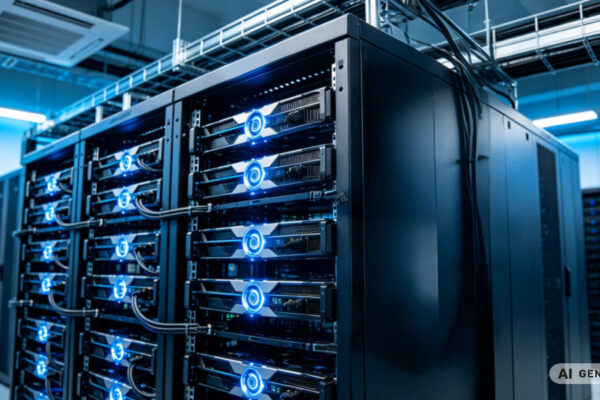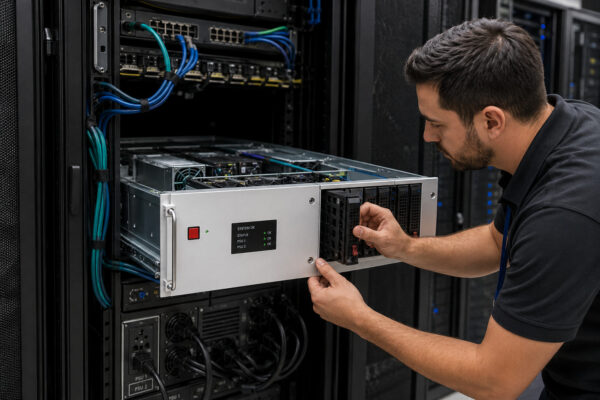


For system integrators, panel builders, and procurement teams deploying AI infrastructure, selecting a server cabinet is no longer about rack units and cable management. It is about structural engineering.
AI GPU servers weigh two to three times more per rack unit than traditional enterprise servers, draw 120–140 kW per rack, and require liquid cooling architectures that standard cabinets cannot accommodate. When the cabinet cannot carry the load or manage the thermal density, the deployment stalls—and the schedule slips.
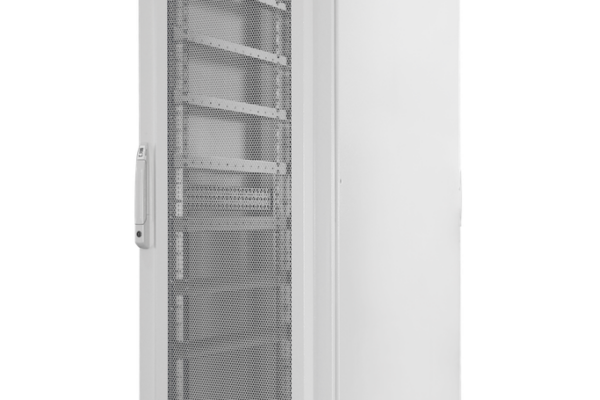
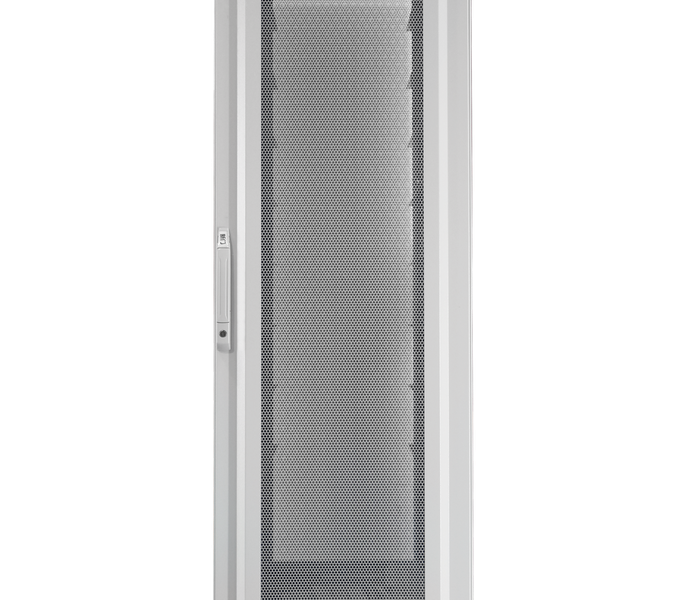
The TPS 42U Heavy Duty Server Cabinet is a modular, frame-mounted 19-inch industrial cabinet rated for 1,000 kg dynamic load (1,200 kg static), with external dimensions of 610 × 907 × 2120 mm. It is designed for the weight, depth, and thermal demands of modern AI GPU deployments.
1. Why AI GPU servers break standard cabinets
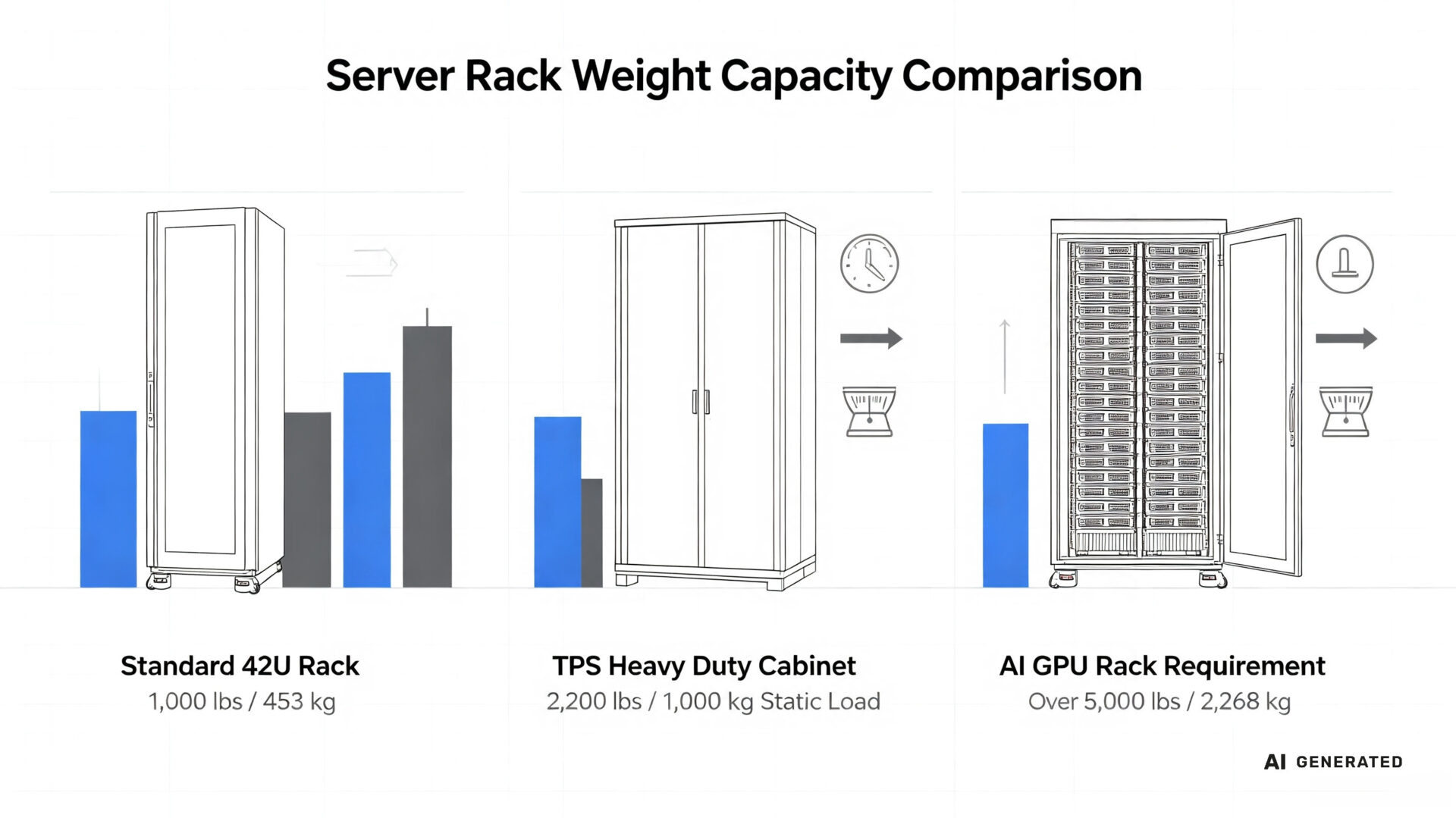
The physics of AI compute has outgrown the assumptions built into traditional data center cabinets. A standard 42U server rack was designed around 17 pounds (7.7 kg) per rack unit—the weight of a typical enterprise 1U server. An NVIDIA H100-based AI server weighs up to 36 pounds (16.5 kg) per rack unit, more than double that figure. A fully loaded AI rack can require structural capacity exceeding 5,000 pounds (2,268 kg) of static weight.
NVIDIA’s GB200 NVL72 rack-scale system weighs approximately 3,000 kilograms (6,600 pounds) and consumes 120 kW. The upcoming GB300 NVL72 requires up to 142 kW per rack. These are not incremental increases—they represent a generational shift in the physical demands placed on cabinet infrastructure.
The operational consequences are predictable. Cabinets rated for 1,000–1,500 lbs buckle under loads three to five times their design capacity. Floor loading requirements in data centers have increased from 500 kg/m² to 2,000–2,500 kg/m² to accommodate these densities. When the cabinet itself cannot safely bear the load, the risk is not merely operational—it is a safety hazard.
2. Structural load capacity: the 1,000 kg foundation
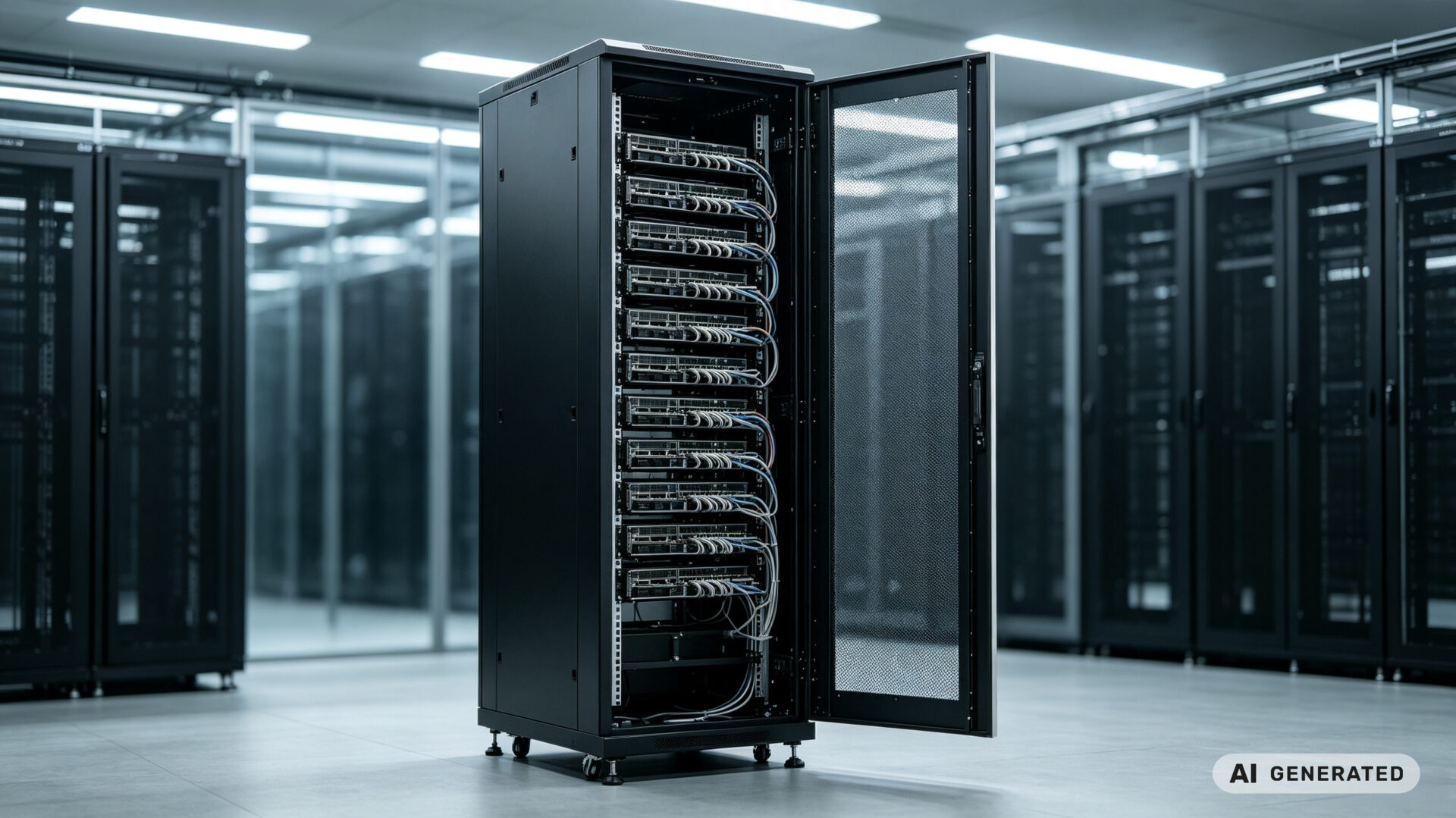
The TPS 42U cabinet is a free-standing 19-inch industrial rack built on a welded, frame-mounted steel structure. Its rated load capacity of 1,000 kg dynamic (1,200 kg static) provides a structural margin that accommodates AI GPU server configurations without compromising frame integrity.
For comparison, a Vertiv Liebert DCE rack supports 4,000 lbs (1,361 kg) static load, while Eaton’s Heavy-Duty SmartRack is rated for 5,000 lbs (2,268 kg) stationary. The TPS cabinet’s 1,200 kg static rating places it firmly in the heavy-duty category—sufficient for 42U deployments of current-generation AI compute nodes, with the modular design allowing scalability as server weights evolve.
Key structural features include:
- Welded steel frame construction: The modular, frame-mounted design provides rigidity without sacrificing configurability. Unlike bolted-together enclosures, the welded frame resists torsion under uneven loads.
- Height-adjustable casters (GD-100): Four casters with Fuma brand bearings enable movement during commissioning. Once positioned, the casters can be raised and the cabinet rests on leveling feet for stable, load-bearing placement.
- Optional lifting rings: For crane-assisted installation in raised-floor or confined data center environments.
- EIA-310 compliant 19-inch rails: Standard hole spacing ensures compatibility with all 19-inch rack-mount equipment, from 1U servers to GPU compute trays.
For deployments in seismic zones, the cabinet’s frame design supports anchorage configurations tested to NEBS GR-63-CORE Zone 4 requirements—the standard applied to data center enclosures in earthquake-prone regions.
3. Modular architecture and secure access
AI infrastructure deployments are not static. Servers are added, upgraded, and reconfigured throughout the system lifecycle. The TPS cabinet’s modular architecture is designed for this reality.
Secure, serviceable design: The cabinet features single front and rear doors equipped with TS007 lock rod fasteners, providing physical security without obstructing service access. The removable top and bottom panels simplify cable routing and airflow management during installation and maintenance. Fixed left and right side doors provide structural rigidity and EMC containment.
Customization options: As a modular, frame-mounted cabinet, the TPS 42U platform supports customization to fit specific deployment requirements—including cable management accessories, PDU mounting brackets, blanking panels, and airflow management kits. This aligns with the requirements of a customized industrial cabinet for diverse AI and HPC applications.
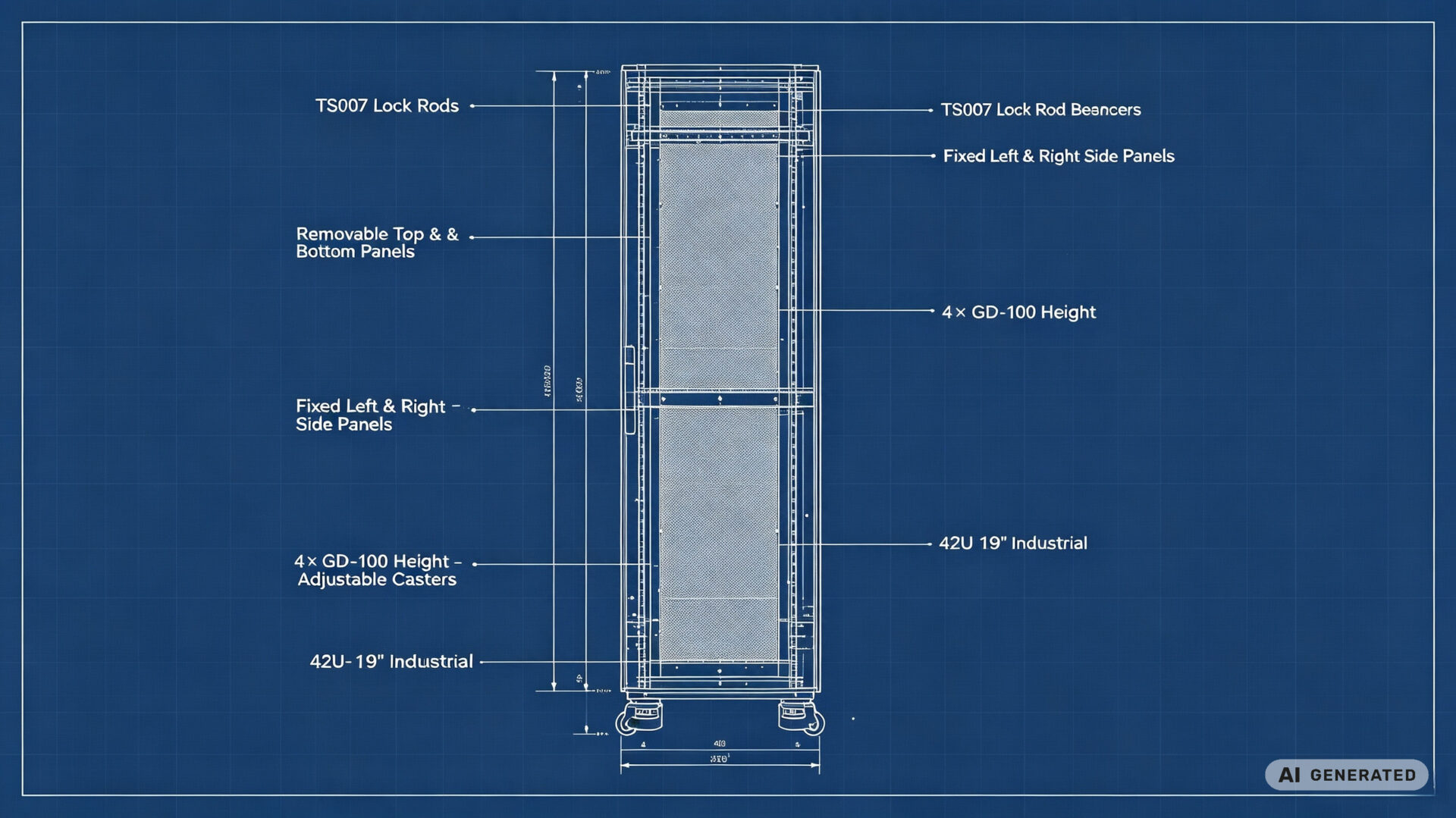
For system integrators and panel builders, the modular design reduces integration time. Equipment can be pre-mounted, cabled, and tested before final positioning. The cabinet’s standardized dimensions—610 mm width, 907 mm depth, 2120 mm height—ensure compatibility with standard data center aisle layouts and raised floor cutouts.
4. Thermal and liquid cooling integration
Air cooling becomes impractical above approximately 50 kW per rack. Direct-to-chip liquid cooling now handles 100–150 kW per rack and holds 55% market share for high-density AI deployments. ASHRAE TC9.9 and ASME piping standards provide the engineering framework for these systems.
The TPS cabinet’s design supports liquid cooling integration in three ways:
- Extra depth for manifolds: The 907 mm depth provides space for liquid cooling manifolds and rear-door heat exchangers behind the equipment mounting plane. Legrand recommends cabinets of 1,400 mm depth for direct-to-chip liquid cooling applications due to manifold space requirements; the TPS cabinet’s modular design allows configuration with extended depth options through TPS’s 19-inch cabinet and chassis platform.
- Removable panels for piping routing: The removable top and bottom panels facilitate liquid cooling pipe routing without compromising the cabinet’s structural integrity.
- Compatibility with CDU architectures: Cooling Distribution Units (CDUs) manage heat exchange between facility water systems and technology cooling systems. The TPS cabinet’s modular frame accommodates CDU mounting within or adjacent to the cabinet footprint.
For air-cooled deployments below 50 kW, the cabinet’s fixed side panels and door configuration support aisle containment strategies. Sealed cable-entry points and blanking panels reduce airflow waste—a critical factor when AI workloads create dynamic thermal transients that stress cooling loops.
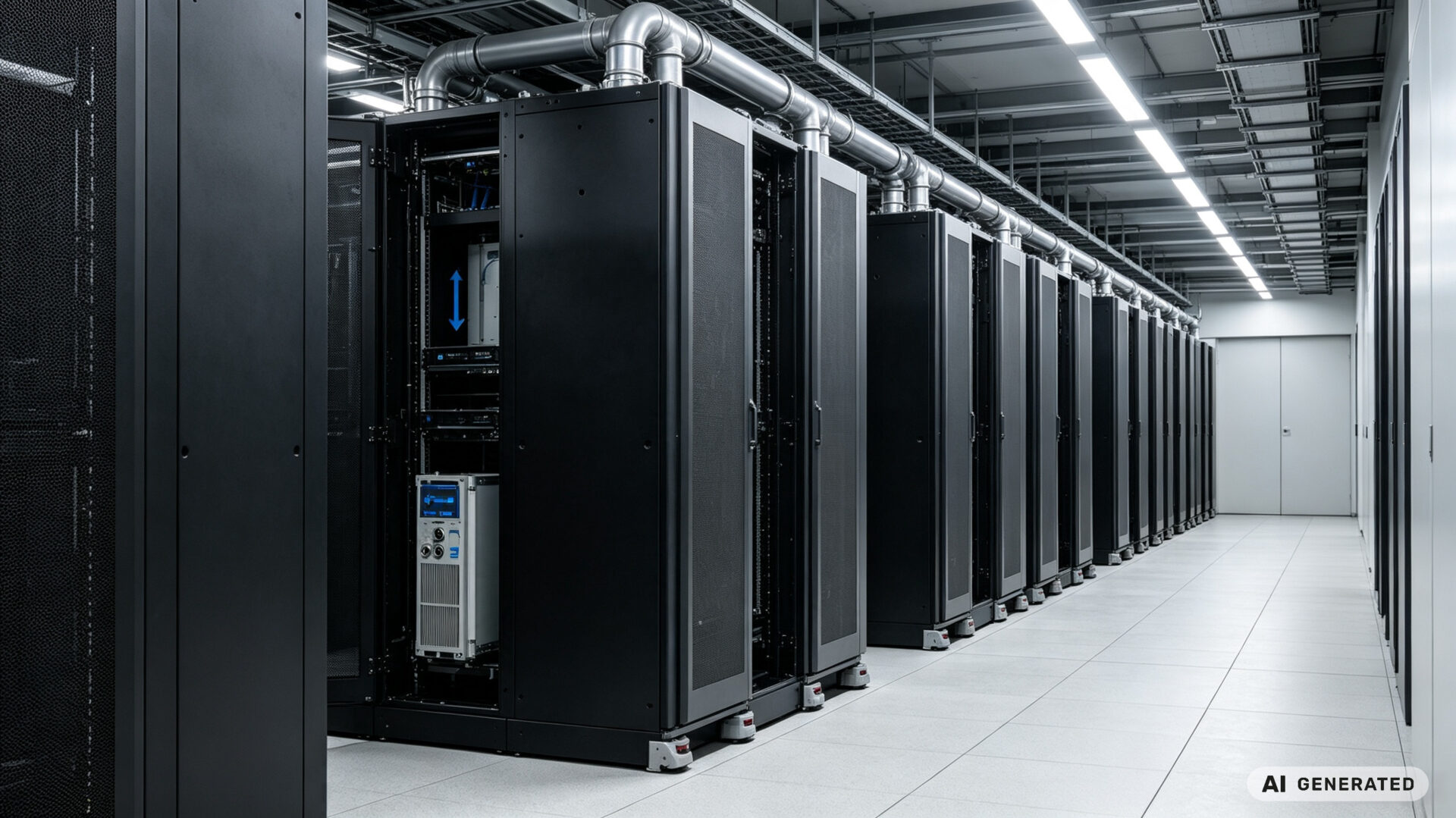
5. Application guide by cabinet height and deployment scale
TPS offers the heavy-duty cabinet platform in multiple heights to match deployment scale. The table below maps cabinet height to typical AI GPU deployment scenarios:
42U Heavy Duty Cabinet — Full-Scale AI Training Clusters
The 42U cabinet is the reference platform for AI training deployments. It accommodates 8-GPU HGX nodes, GB200 NVL72 rack-scale systems (where depth permits), and multi-node GPU clusters with liquid cooling manifolds. Rated for 1,000 kg dynamic load, it supports fully populated AI racks without structural compromise.
Typical configuration: 4–8 GPU compute nodes, 2–4 rack PDUs, liquid cooling manifold, rear-door heat exchanger, cable management arms.
For additional deployment insights and technical updates, see TPS’s news and insights.
6. Product specifications
| Parameter | Specification |
|---|---|
| Rack height | 42U (also available in 24U and 15U) |
| External dimensions (W×D×H) | 610 × 907 × 2120 mm |
| Load capacity (dynamic) | 1,000 kg |
| Load capacity (static) | 1,200 kg |
| Standard compliance | EIA-310 19-inch |
| Doors | Single front and rear doors with TS007 lock rod fasteners; fixed left and right side doors |
| Removable panels | Top and bottom |
| Casters | 4× GD-100 height-adjustable with Fuma brand bearings |
| Optional accessories | Lifting rings, cable management, PDU brackets, blanking panels |
7. RFQ checklist
To streamline quotation and evaluation, provide the following information when submitting your RFQ:
- Cabinet height and quantity: 42U, 24U, or 15U; prototype quantity vs. series volume
- Expected load profile: Total equipment weight, including servers, PDUs, and cable management
- Cooling architecture: Air-cooled, rear-door heat exchanger, or direct-to-chip liquid cooling
- Seismic or environmental requirements: Zone classification, anchorage specifications
- Accessory requirements: Casters vs. leveling feet, lifting rings, cable management, PDU mounting
- Documentation needs: Load test certificates, dimensional drawings, compliance documentation
Providing these details reduces clarification cycles during evaluation. TPS’s engineering team can support load calculations, thermal modeling, and seismic anchorage planning as part of the RFQ process.
8. FAQ
What is the maximum load capacity of the TPS 42U heavy duty server cabinet?
The cabinet is rated for 1,000 kg dynamic load and 1,200 kg static load. This accommodates fully populated AI GPU racks within the 42U form factor, with structural margin for cable management and PDUs.
Can the TPS cabinet accommodate liquid cooling manifolds?
Yes. The 907 mm depth provides space for rear-mounted manifolds and heat exchangers. The removable top and bottom panels facilitate pipe routing, and the modular frame supports configuration with extended depth options.
Is the cabinet EIA-310 compliant?
Yes. The cabinet adheres to the 19-inch standard with EIA-310 compliant mounting rails, ensuring compatibility with all standard rack-mount servers, including GPU compute trays and network equipment.
What caster system does the cabinet use?
The cabinet is equipped with 4× GD-100 height-adjustable casters featuring Fuma brand bearings. Once positioned, casters can be raised so the cabinet rests on leveling feet for stable load-bearing placement.
Can TPS provide seismic anchorage documentation?
TPS supports seismic anchorage planning as part of the RFQ process. The cabinet frame design is compatible with anchorage configurations tested to NEBS GR-63-CORE Zone 4 requirements. Contact TPS engineering for project-specific seismic documentation.