

For system integrators, panel builders, and engineering-driven procurement teams, running industrial machinery on a 220V domestic power supply is not a single product decision. It is an architecture decision that separates control power, auxiliary loads, and motor drive power—because those three have very different requirements.
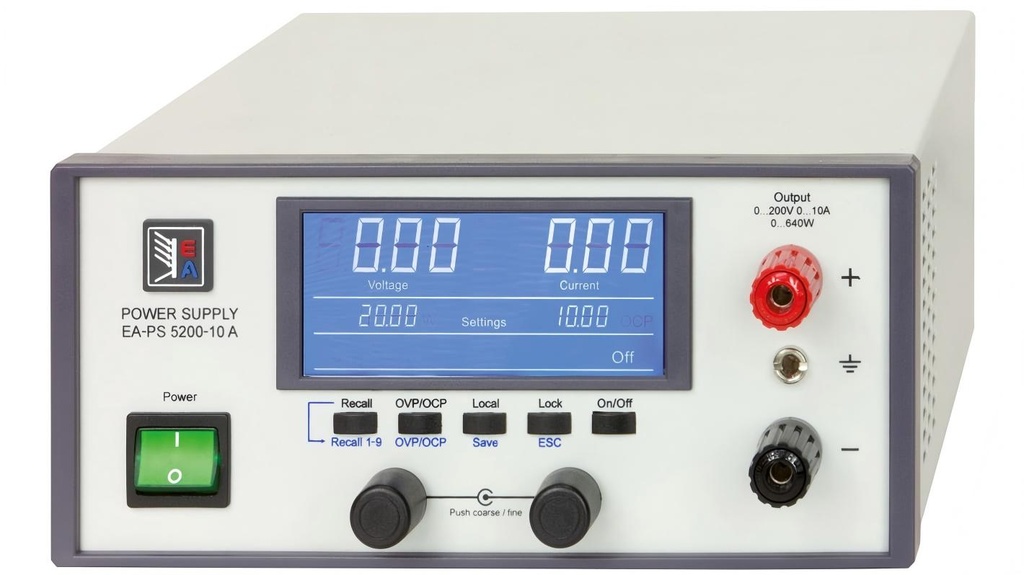
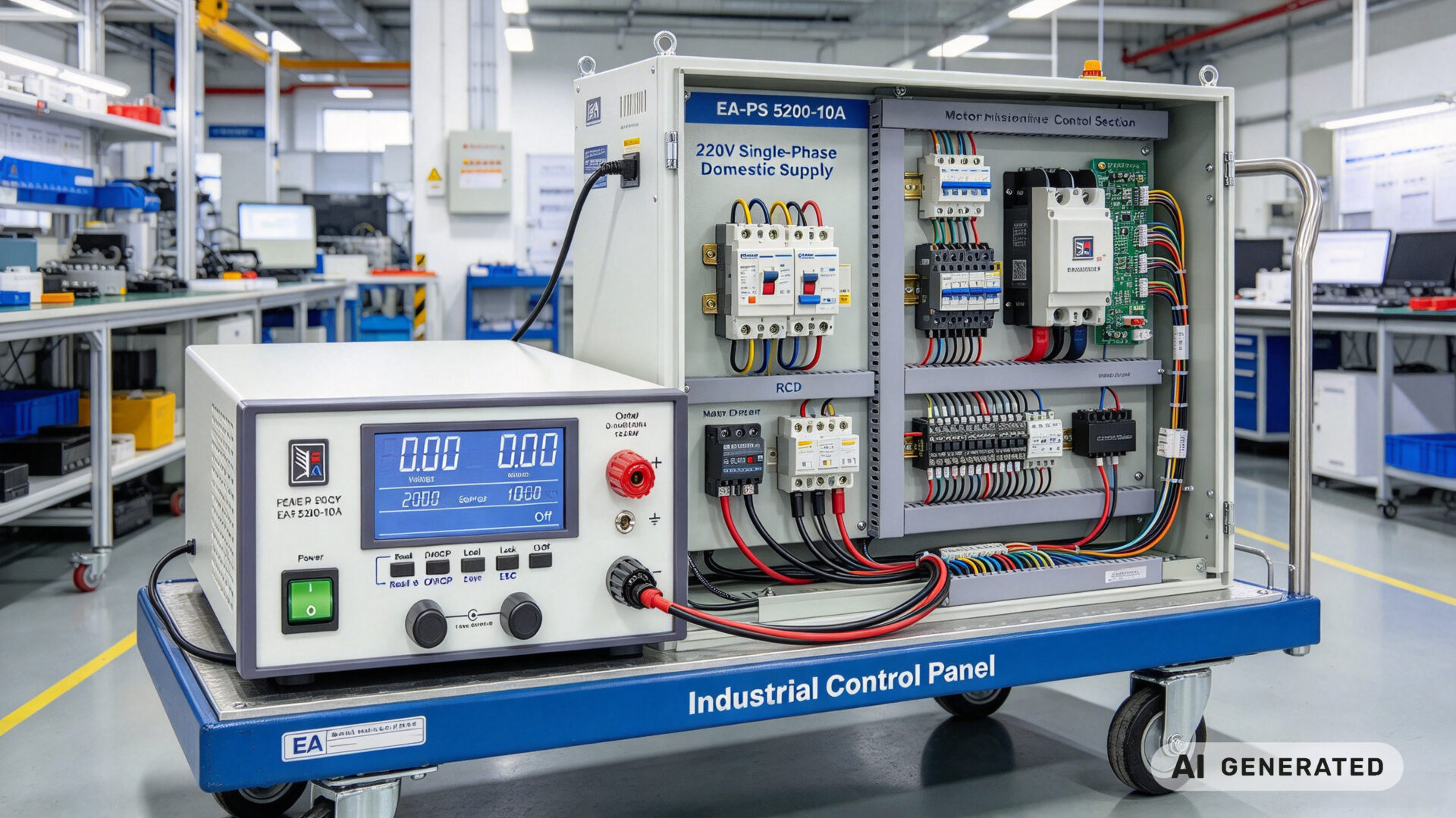
The EA-PS 5200-10A is a programmable desktop DC power supply with 90–264VAC input, 0–200VDC / 0–10A / 640W auto-ranging output, and <30mV RMS ripple. It is a laboratory and test instrument—not a motor drive. This article explains where it genuinely fits in a 220V-only workshop, and how to address the harder problem: running a 400V three-phase motor from a single-phase 220V supply.
1. What “running on 220V” actually involves
A workshop with only a 220V single-phase domestic supply has limited current capacity and no three-phase rotation. Machinery that designed around a 400V three-phase feed cannot simply plugged in. The loads must separated, and each category addressed with the appropriate conversion.
1.1 Three load categories with different requirements
- Control loads: PLC CPU, I/O modules, sensors, HMIs, communication gateways. Typically 24VDC, low power, sensitive to ripple and transients. These are the easiest to supply from 220V via a suitable AC/DC supply.
- Auxiliary loads: cabinet lighting, cooling fans, door interlocks, small pumps. Often 230VAC single-phase or 24VDC. These can run directly from the 220V supply within its current budget.
- Motor drive loads: three-phase induction or synchronous motors, often rated 400V. These are the hard problem. A 220V single-phase supply cannot produce a 400V three-phase output without either a transformer, a drive with voltage boost, or a motor reconnection that changes the winding voltage.
1.2 Where the EA-PS 5200-10A fits—and where it does not
The EA-PS 5200-10A is a 640W programmable bench supply. Its 90–264VAC input means it can be powered from a 220V domestic socket. Its 0–200VDC output and <30mV RMS ripple make it useful for control-electronics development, sensor loop testing, PLC rack commissioning, and validation of 24VDC or 48VDC control circuits.
It is not a variable frequency drive, it does not produce three-phase AC, and at 640W it cannot supply industrial motor power. Any article that presents a bench DC supply as a substitute for a 400V three-phase drive is misleading. The correct role of this product is control and test power, not traction power.
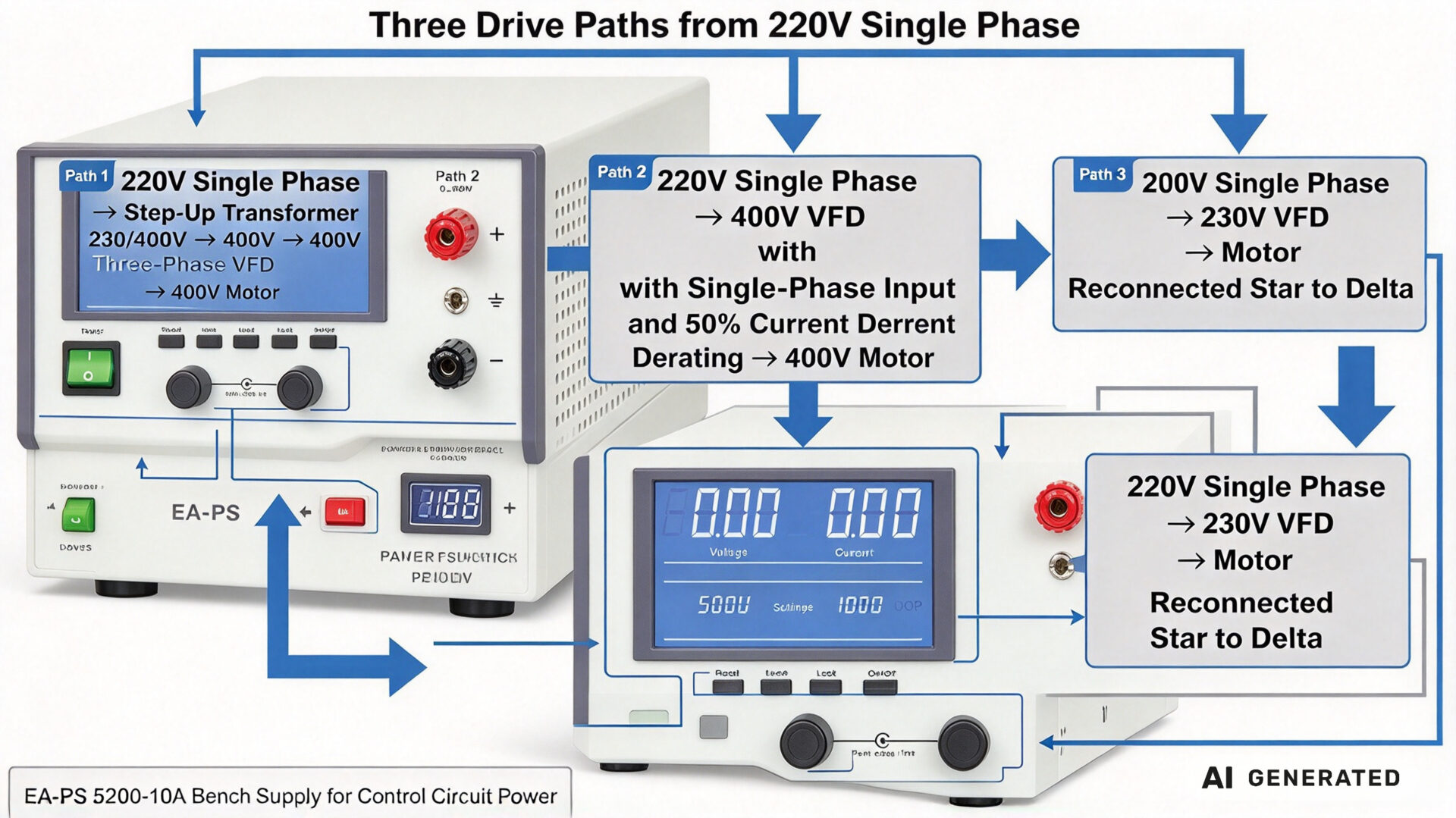
2. Three engineering paths to run a 400V motor from 220V single phase
There is no single universal answer. The correct path depends on motor nameplate data, load torque profile, duty cycle, and whether the motor winding can be reconfigured.
2.1 Path 1: step-up transformer plus 400V VFD
The most robust approach is a 230V/400V single-phase step-up transformer between the mains and a standard 400V three-phase VFD. The transformer operates at 50Hz, so it not exposed to the PWM stress that an output-side transformer would see. The VFD then produces a normal 400V three-phase output.
Transformer sizing must based on the VFD’s input apparent power, not the motor’s mechanical output. For an 11kW motor with a 0.95–0.98 efficiency drive, the input power is roughly 12–13kW, corresponding to 15–18kVA apparent power, plus margin. This path is reliable but adds cost, weight, and a magnetic component that must be installed and protected.
2.2 Path 2: 400V VFD with single-phase input and 50% derating
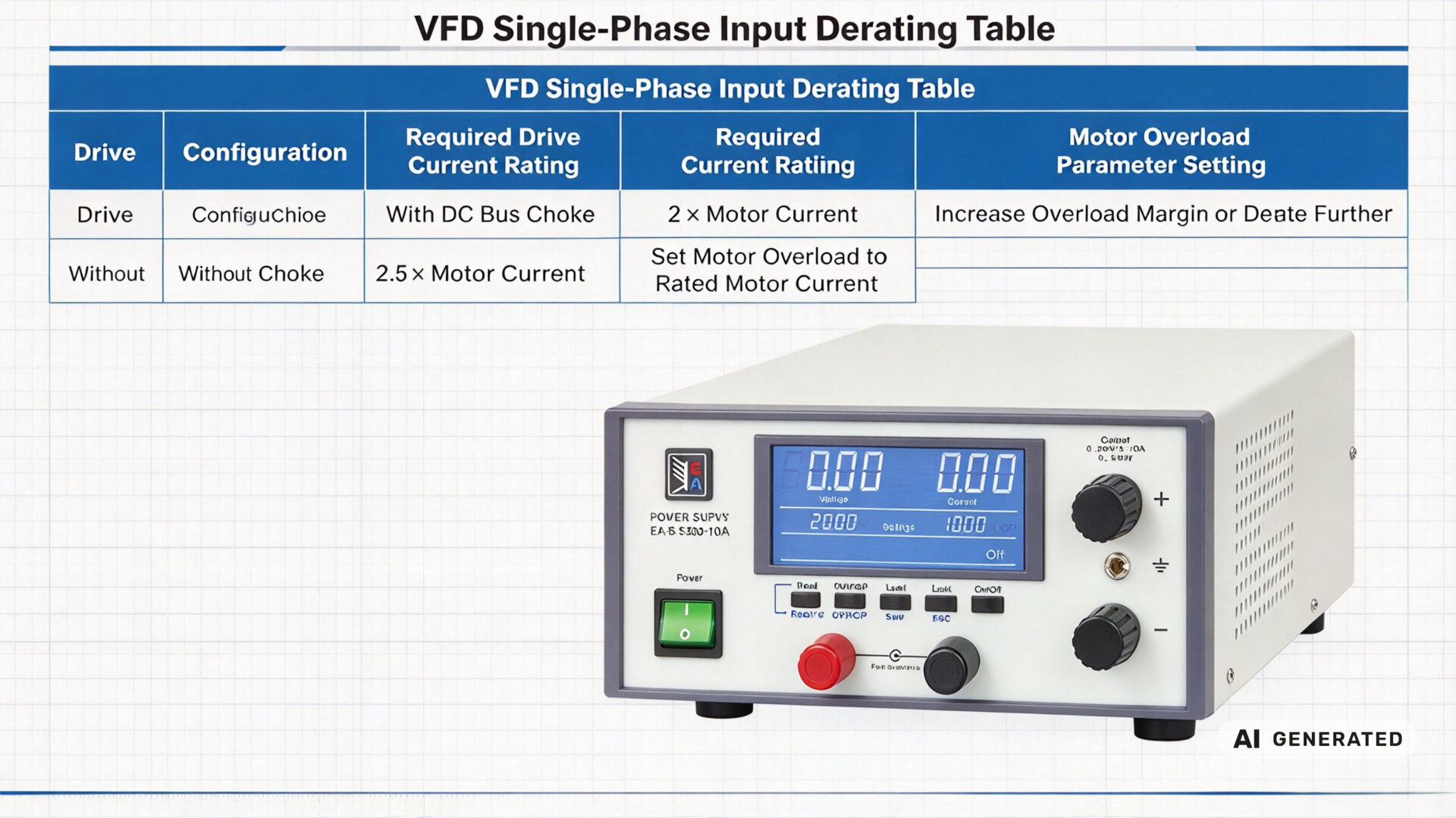
Many modern 400V three-phase VFDs can accept single-phase input if they correctly derated. The DC bus ripple increases, so the output current must reduced. Published guidance indicates a 50% output current derating, meaning the drive’s current rating must be doubled relative to the motor current. With a DC bus choke, the required drive current is approximately 2× the motor current; without a choke, approximately 2.5×.
Two checks are critical. First, the drive’s phase-loss protection must disabled or must use DC-bus ripple monitoring rather than phase-voltage monitoring; otherwise the drive will trip on single-phase input. Second, the motor overload parameter must scaled to the drive’s true output rating, not the nameplate three-phase rating. This path avoids a transformer but requires a larger drive and careful parameter configuration.
2.3 Path 3: motor reconnection plus 230V VFD
A 230/400V motor with a six-terminal terminal box can sometimes reconnected from star (400V) to delta (230V), allowing it to run from a 230V three-phase VFD. The winding voltage drops by √3, and the current increases correspondingly. This is only possible if the motor nameplate explicitly shows a 230V delta connection and the terminal box supports the change.
A motor rated only 400V delta cannot reconnected to 230V without rewinding. Attempting to run a 400V motor from a 230V VFD without reconnection produces reduced torque and may cause stalling under load; the drive cannot produce 400V output from a 230V input. This path is the lowest-cost when it applies, but it is the most frequently misapplied.
3. Control and auxiliary power on 220V
The control and auxiliary side is where a 220V-only workshop is easiest to serve, and where a bench supply like the EA-PS 5200-10A has a legitimate role.
3.1 PLC, I/O, and sensor power
For permanent installation, a DIN rail AC/DC supply with 220VAC input and 24VDC output is the correct component. It must sized for the total 24VDC load, verified for the cabinet’s internal ambient temperature, and selected for the applicable EMC environment. A bench supply is not a substitute for permanent cabinet power.
3.2 Commissioning and test power with the EA-PS
During panel build, commissioning, and validation, the EA-PS 5200-10A can power PLC racks, sensor loops, and communication gateways from a 220V socket. Its 0–200VDC range covers 24VDC control circuits as well as higher-voltage sensor and transducer loops. The USB interface and LabView/Windows software allow voltage and current logging during commissioning, which becomes part of the validation record.
For related products, see the TPS-DM570T1512KIF and TPS-DM570T1512KIRF modules, and the TPS production category.
4. EMC, protection, and installation constraints
Single-phase motor drives and their cabling subject to IEC 61800-3, the EMC product standard for adjustable-speed drive systems. Single-phase drives typically require an external mains filter to meet Class B or C1 limits; without it, the drive may only meet the less restrictive Class C3 for restricted distribution. The motor cable should be shielded, and its length should respect the drive manufacturer’s limit.
Protection coordination matters more on a 220V domestic supply because the available fault current is lower and the supply impedance is higher. Verify breaker trip curves against the drive’s inrush current, and use an RCD type suitable for the drive’s leakage current. For the bench supply, the 90–264VAC input and active PFC reduce harmonic injection into the workshop distribution, but the supply is still a Class B EMC device, not a drive-rated product.
5. Product specifications
| Parameter | EA-PS 5200-10A | Typical 400V three-phase VFD |
|---|---|---|
| Input | 90–264VAC, 45–65Hz | 380–480VAC three-phase |
| Output | 0–200VDC / 0–10A / 640W | 0–400VAC three-phase, motor-rated current |
| Function | Programmable DC source | Motor speed/torque control |
| Ripple | <30mV RMS | PWM output, not applicable |
| Typical use | Control/test/commissioning | Motor drive |
| Can drive a 400V motor? | No | Yes, with correct input configuration |
The table makes the boundary explicit: the EA-PS is a DC instrument, not an AC drive.
6. RFQ checklist
To get a usable 220V machinery architecture review, provide:
- Motor nameplate: Rated voltage, connection (star/delta), current, power, frequency, and whether the terminal box allows reconnection
- Load profile: Torque versus speed, starting torque, duty cycle, and whether the load is constant-torque or variable-torque
- Supply data: Nominal voltage, available current, breaker size, and whether the 220V circuit is dedicated
- Preferred drive path: Transformer plus VFD, single-phase input VFD with derating, or motor reconnection
- Control loads: PLC, I/O, sensor, and HMI power requirements
- EMC environment: Required IEC 61800-3 category and cable length
- Documentation: Motor datasheet, drive datasheet, and protection coordination study
Providing these details lets TPS check the architecture against the actual motor and load, rather than quoting a product that cannot do the job.