

For system integrators, panel builders, and procurement teams, replacing a failed router power adapter is not simply about matching voltage and amperage.
It involves connector dimensions, polarity orientation, safety certification currency, and whether the replacement unit will pass acceptance testing without introducing compliance gaps.
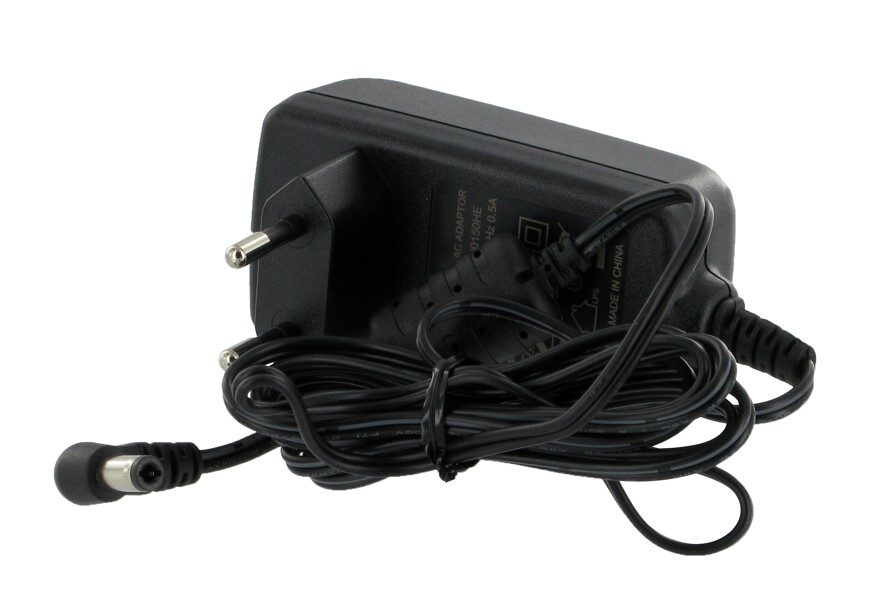
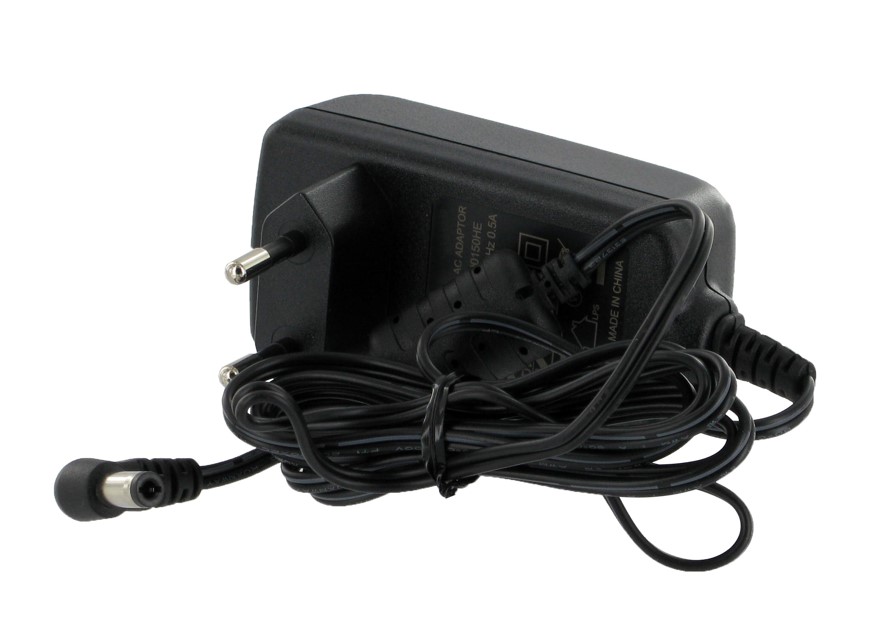
The TPS KSAS0181200150HE is a wall-mount switching-mode AC-DC power adapter delivering 12V DC at 1.5A (18W), manufactured by KUANTECH and distributed by TPS-Elektronik GmbH. It features a 5.5×2.5×11mm 90-degree barrel connector (center positive), universal 90–264Vac input, and full GS & CE safety certification.
Typical applications include WiFi routers, network switches, security cameras, and industrial sensors where reliable 12V DC power is required.
1. Why router power adapters fail and what to check before replacing
Router power adapters typically fail through one of four mechanisms: electrolytic capacitor degradation, output voltage drift, connector wear, or thermal stress. Each failure mode leaves different diagnostic clues, and understanding which one occurred determines whether a like-for-like replacement is sufficient or whether the root cause points to a deeper electrical issue.
Capacitor degradation is the most common cause. Electrolytic capacitors inside switching adapters have a finite operational life—typically 5–8 years under continuous load at elevated temperature. When the output capacitor loses capacitance, ripple voltage increases beyond the router’s tolerance threshold, causing intermittent reboots, dropped connections, or complete failure to boot.
Output voltage drift presents differently. The router may power on but exhibit unstable behavior—frequent disconnections, reduced WiFi range, or failure to complete boot sequences. Measuring the adapter’s output voltage under load with a multimeter reveals whether the adapter is delivering the required 12V DC within tolerance.
Connector wear is often overlooked. The 5.5mm barrel connector experiences mechanical stress each time it is inserted or removed. Over years of service, the center pin contact may develop increased contact resistance, causing voltage drop at the router input. A replacement adapter with a fresh connector eliminates this variable.
Before ordering a replacement, verify three parameters: output voltage (must match the router’s specification), output current rating (must equal or exceed the original), and connector dimensions (must match the router’s DC input jack).
2. Connector compatibility: 5.5×2.5mm plug and polarity verification
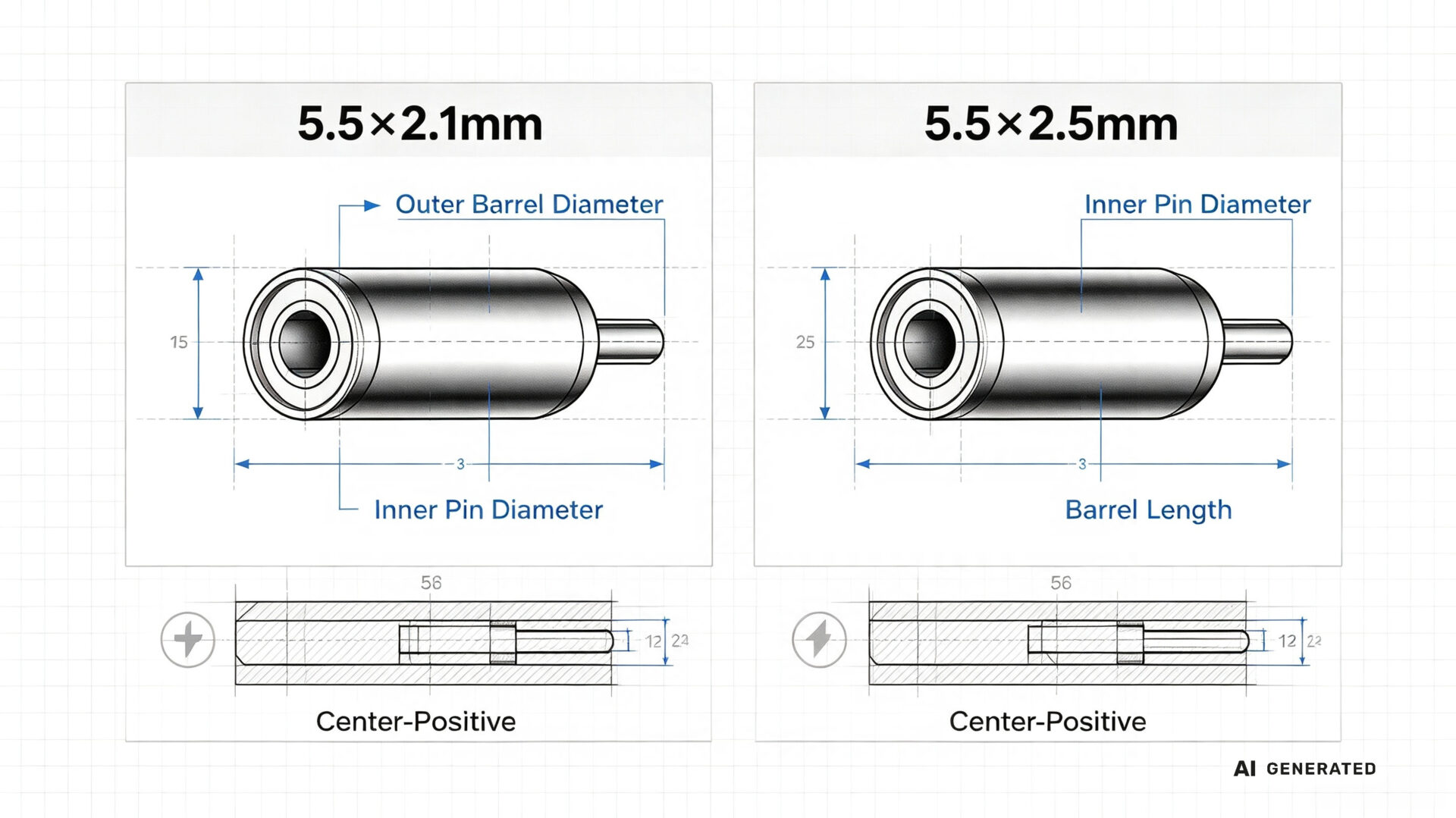
DC barrel connector compatibility is determined by three measurements: outer barrel diameter, inner pin diameter, and barrel length. The most common sizes in networking equipment are 5.5×2.1mm and 5.5×2.5mm, which share the same 5.5mm outer barrel but differ in center pin diameter.
The TPS KSAS0181200150HE uses a 5.5×2.5×11mm fork-groove barrel connector with a 90-degree angled design. The 5.5mm outer diameter and 2.5mm inner pin diameter match the most widely used DC input jack in routers, switches, and network appliances. The 11mm barrel length ensures full insertion depth for reliable contact.
The 90-degree angled connector provides a practical installation advantage in wall-mount and cabinet deployments, routing the cable parallel to the mounting surface rather than protruding outward. This reduces strain on the connector and simplifies cable management in confined spaces.
Polarity verification is equally critical. The TPS adapter uses center-positive polarity, which is the dominant convention for networking equipment. However, polarity reversal—connecting a center-positive adapter to a center-negative device—can cause immediate and permanent damage. Always verify the polarity symbol on the router’s power input label before connecting a replacement adapter.
A practical caution: 5.5×2.1mm and 5.5×2.5mm connectors are visually very similar and difficult to distinguish by eye. The 5.5×2.1mm plug will physically fit into a 5.5×2.5mm jack, but the contact area is reduced, leading to higher contact resistance and potential intermittent operation. If the router specifies a 5.5×2.5mm jack, use a matching 5.5×2.5mm plug.
3. Electrical performance: voltage accuracy, ripple, and efficiency
The TPS KSAS0181200150HE delivers 12V DC nominal output with a tolerance range of 11.4–12.6V. This ±5% window accommodates the voltage regulation requirements of most networking equipment while maintaining sufficient margin for cable voltage drop.
For 12V router power supply applications, ripple and noise directly affect signal integrity. The TPS adapter specifies maximum ripple-noise of ≤150 mV peak-to-peak at 20 MHz measurement bandwidth. Excessive ripple can couple into the router’s sensitive RF circuits, degrading WiFi performance or causing data transmission errors.
Efficiency performance meets DOE Level VI requirements. The average efficiency is ≥85.45% across 25–100% load conditions, with 10% load efficiency at ≥75.45%. For reference, DOE Level VI mandates a minimum average efficiency of 0.071 × ln(Pout) − 0.0014 × Pout + 0.67 for external power supplies rated 1W < Pout ≤ 49W, with maximum no-load power consumption ≤0.100W. The TPS adapter’s no-load power consumption of ≤0.075W exceeds this requirement.
Protection functions include over-voltage protection, over-current protection, and auto-recovering short-circuit protection. When a fault condition is removed, the adapter returns to normal operation automatically—an important characteristic for unattended networking installations where manual reset is impractical.
4. Safety and compliance: IEC 62368-1, GS, CE, and DOE Level VI
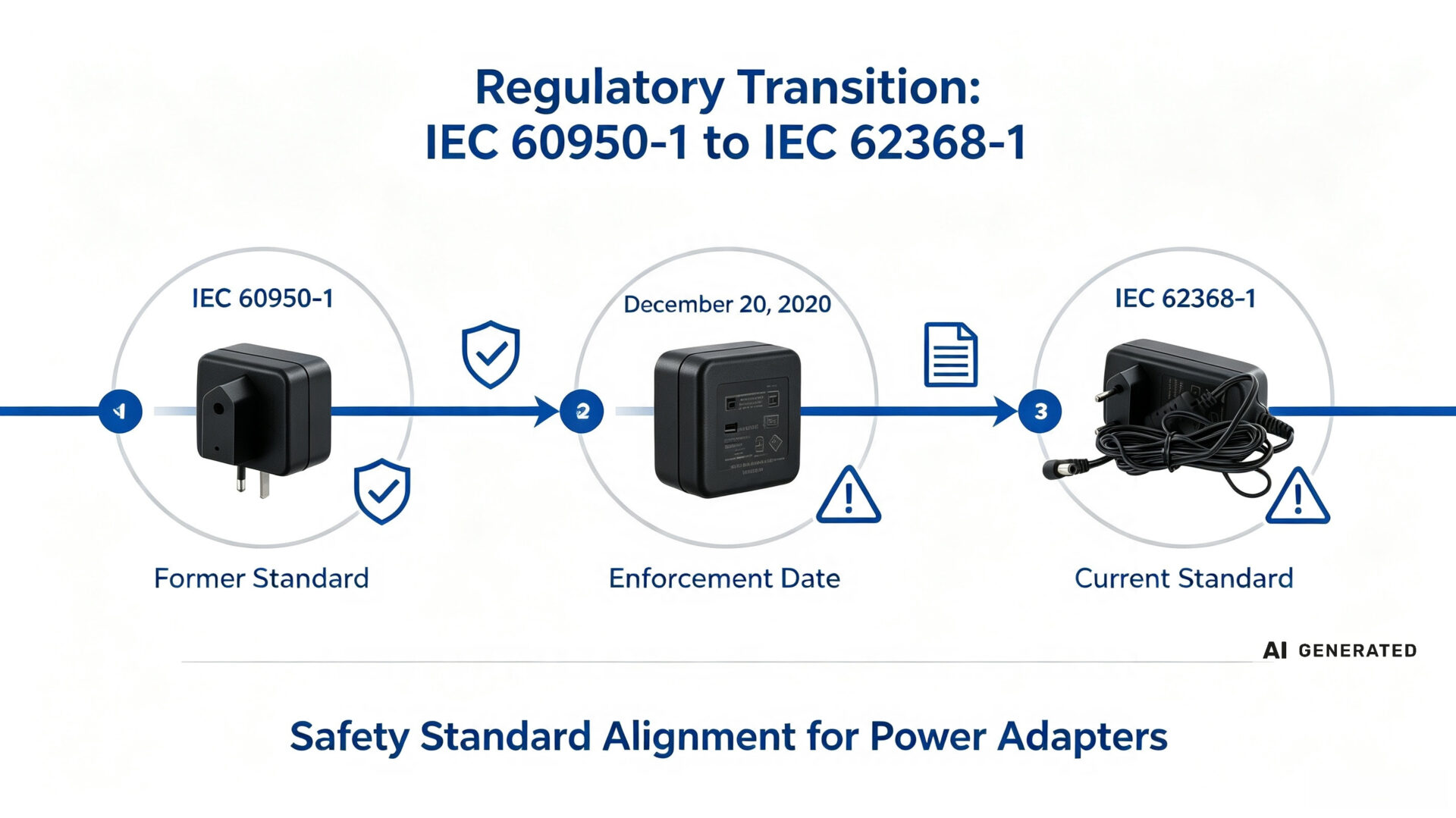
The regulatory landscape for power adapters has undergone a fundamental shift. IEC 60950-1, the legacy standard for information technology equipment safety, was fully superseded by IEC 62368-1 on December 20, 2020. For any new product placed on the market after this date, IEC 62368-1 is the applicable framework.
IEC 62368-1 introduces a hazard-based safety engineering approach, classifying energy sources and prescribing safeguards rather than applying device-type-specific rules. The most impactful change in the 4th edition (IEC 62368-1:2023) is the removal of acceptance—without further evaluation—of components previously certified under IEC 60950-1 or IEC 60065. This means that legacy power supplies used as components in new end products now require case-by-case review.
The TPS KSAS0181200150HE is certified to EN 60950-1, which remains valid for standalone power adapters sold as accessories or service parts. Its safety architecture includes reinforced insulation, 3000Vac hipot withstand, insulation resistance ≥10 MΩ, and leakage current ≤0.25 mA—fully compliant with SELV and LPS limited-power-source requirements. The UL94V-1 flame-retardant housing provides an additional fire-safety margin.
For North American deployments, the adapter meets DOE Level VI efficiency standards and FCC Part 15 Class B emissions requirements. For European deployments, GS and CE certification confirm compliance with EN 55022 Class B and EN 55024 immunity standards.
5. Mechanical and thermal integration
The TPS adapter’s dimensions—85.5 × 43.8 × 31.7 mm—represent a compact wall-mount form factor suitable for installation behind furniture, inside network cabinets, or on a wall outlet adjacent to the router.
Physical Characteristics
| Parameter | Specification |
|---|---|
| Dimensions (W×H×D) | 85.5 × 43.8 × 31.7 mm |
| Housing material | UL94V-1 flame-retardant black plastic |
| AC plug type | EU 2-pin wall plug |
| Output cable | 1500 mm, 20AWG, VW-1 rated |
| DC connector | 5.5×2.5×11 mm, 90° angled, center positive |
| Net weight | Approx. 145 g (without cable) |
The 1500mm output cable length is sufficient for most wall-mount router installations, while the 20AWG conductor gauge minimizes voltage drop at 1.5A load. The VW-1 fire rating on the cable jacket provides additional safety compliance for in-wall or conduit routing.
Operating temperature range of 0–40°C with natural convection cooling is suitable for typical office and home environments. The adapter should not be installed in enclosed spaces where ambient temperature exceeds 40°C, as thermal derating would reduce available output power.
For office networking deployments, the adapter’s EU 2-pin plug and compact form factor allow installation in wall-mount network cabinets or DIN-rail adjacent power strips. The 90-degree angled DC connector routes the cable neatly along the wall surface.
6. Product specifications
| Parameter | KSAS0181200150HE | Typical Generic Replacement |
|---|---|---|
| Output voltage | 12 V DC (11.4–12.6 V) | 12 V DC ±5% |
| Rated current | 1.5 A | 1–2 A |
| DC connector | 5.5×2.5×11 mm, 90° angled | 5.5×2.1 mm or 5.5×2.5 mm, straight |
| Polarity | Center positive | Center positive (verify) |
| AC input | 90–264 Vac universal | 100–240 Vac |
| No-load power | ≤0.075 W | Often unspecified |
| Efficiency | ≥85.45% average | Often unspecified |
| Safety cert. | GS & CE per EN 60950-1 | CE only (varies) |
| MTBF | ≥50,000 h (Bellcore SR-332) | Often unspecified |
| Cable | 1500 mm, 20AWG, VW-1 | 1000–1500 mm, gauge varies |
7. RFQ checklist
To streamline quotation and evaluation for router power adapter replacement:
- Required quantity: Single unit, spare parts batch, or series production volume
- Router model and DC input specification: Voltage, current rating, and connector dimensions (5.5×2.1mm vs. 5.5×2.5mm)
- Polarity requirement: Center-positive (standard) or center-negative (verify router label)
- Plug type: EU 2-pin, UK, US, or other regional variants
- Compliance documentation: GS/CE certificates, test reports, or Declaration of Conformity required
- Cable length requirement: Standard 1500mm or custom length
Providing these details reduces clarification cycles during evaluation. TPS’s engineering team can support connector verification, polarity confirmation, and compliance documentation review as part of the RFQ process.
8. FAQ
What voltage and current does a router power adapter need?
Most home and office routers require 12V DC at 1–2A. The TPS KSAS0181200150HE delivers 12V DC at 1.5A (18W), covering the majority of consumer and SMB networking equipment. Always verify the router’s label for the exact voltage, current rating, and connector type.
Is 5.5×2.5mm compatible with 5.5×2.1mm?
The 5.5×2.5mm plug will physically fit into a 5.5×2.1mm jack and vice versa, but the contact area is reduced, potentially causing higher contact resistance. For reliable long-term operation, match the exact connector specification of your router’s DC input jack.
Why does the TPS adapter reference EN 60950-1 instead of IEC 62368-1?
The TPS KSAS0181200150HE is certified to EN 60950-1, which remains valid for standalone power adapters sold as service parts or accessories. IEC 62368-1 is the successor standard for new product certifications and end-product integration. For component-level integration into new IEC 62368-1 certified systems, contact TPS for guidance on compliance documentation.
Does the TPS adapter meet energy efficiency requirements?
Yes. The adapter meets DOE Level VI efficiency standards with average efficiency ≥85.45% and no-load power consumption ≤0.075W, exceeding the DOE requirement of ≤0.100W for external power supplies in the 1W–49W range.
Can TPS provide a replacement adapter for a specific router model?
TPS can cross-reference the required voltage, current, and connector specification against its wall-mount adapter portfolio. Provide the router model number and DC input specification when submitting an RFQ to TPS wall-mount power adapters.