

For system integrators, optical engineers, and procurement teams in the high-power laser industry, thermal management is not a secondary concern—it is the primary constraint that determines laser diode performance, reliability, and lifetime. A high-power laser diode bar can generate heat fluxes exceeding 1,000 W/cm², demanding cooling solutions that conventional machining cannot deliver.
TPS Elektronik’s precision CNC micro-milling service is engineered specifically for this challenge: manufacturing high aspect ratio micro-channel coolers with sub-100 micron feature sizes, in oxygen-free copper substrates, with the dimensional accuracy and surface finish required for low thermal resistance laser diode packaging—from prototype validation to series production.
1. The Thermal Challenge: Cooling High Power Laser Diode Bars
High-power laser diode bars are the workhorses of industrial laser systems—used in material processing, laser welding, cutting, additive manufacturing, and defense applications. A single laser diode bar, typically 10mm wide, can deliver 100W or more of optical power while generating even greater thermal power that must be dissipated.
Heat fluxes at the laser diode junction can exceed 1,000 W/cm², with junction temperatures that must be maintained below 80–100°C to ensure reliable operation and acceptable lifetime. The thermal resistance between the laser diode junction and the coolant must be minimized—typically below 0.1 K/W—to achieve this.
For system integrators and optical engineers, the thermal management solution must meet several critical requirements:
- Low thermal resistance: Efficient heat transfer from the laser diode junction to the coolant
- High heat flux capability: Ability to dissipate 1,000 W/cm² or more
- Uniform cooling: Consistent temperature across the laser bar to prevent wavelength shift and mode hopping
- Compact form factor: Must fit within the laser diode package footprint, typically 3.6mm × 3.6mm or similar
- Reliability: 24/7 operation in industrial environments with minimal maintenance
Among the various cooling approaches available—passive heatsinks, jet impingement, and thermoelectric cooling—micro-channel coolers have emerged as the most effective solution for high-power laser diode bars.
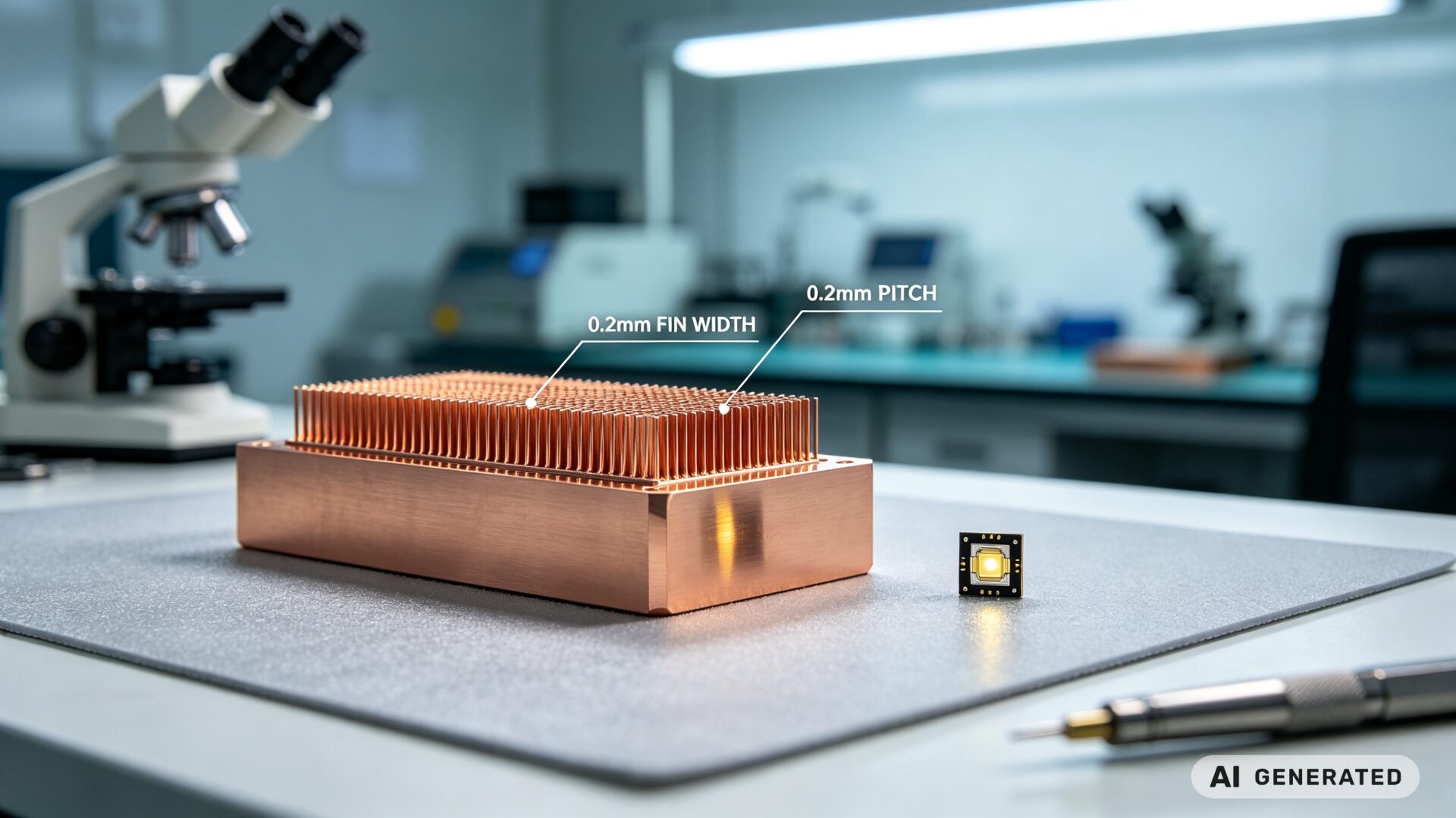
2. Micro-Channel Coolers: The Industry Standard for Laser Diode Cooling
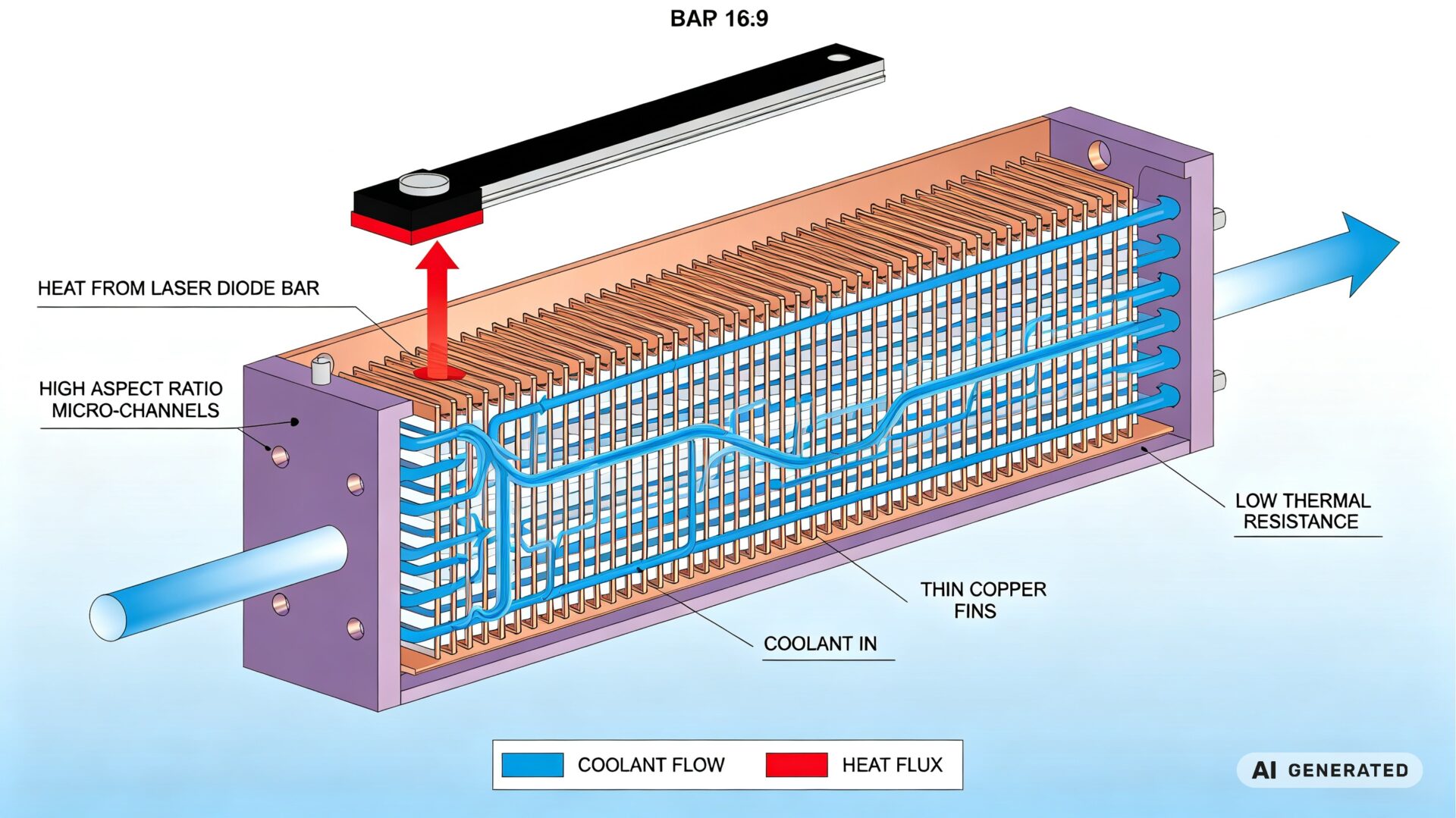
Micro-channel coolers (MCCs) are copper heat exchangers with microscopic cooling channels that allow water or other coolants to flow in close proximity to the laser diode junction. The small channel dimensions—typically 0.2mm to 0.5mm in width and depth—create high heat transfer coefficients due to the thin thermal boundary layers and large surface area-to-volume ratio.
Key advantages of micro-channel coolers for laser diode applications:
- Extremely low thermal resistance: Copper’s high thermal conductivity (401 W/m·K) combined with the thin channel walls provides minimal thermal resistance
- High heat flux capability: Capable of dissipating heat fluxes exceeding 1,000 W/cm²
- Direct integration: The laser diode bar can be mounted directly on the cooler surface, minimizing thermal interfaces
- Scalability: Multiple laser bars can be stacked with individual micro-channel coolers
- Proven reliability: Micro-channel cooling is a mature technology with decades of field experience in high-power laser systems
For laser diode bar cooler CNC applications, the micro-channel cooler must be manufactured with exceptional precision to achieve the required thermal performance. The channel dimensions, wall thickness, and surface finish all directly impact thermal resistance and coolant flow characteristics.
TPS Elektronik’s precision CNC micro-milling service delivers the manufacturing capability required for these demanding components, with experience in machining oxygen-free copper to sub-100 micron tolerances.
3. The Manufacturing Challenge: High Aspect Ratio Micro-Channels in Copper
Manufacturing micro-channel coolers for high-power laser diodes presents significant challenges that conventional machining cannot address:
- High aspect ratio: Micro-channels typically have depth-to-width ratios of 5:1 to 10:1 or higher. Achieving these ratios in copper requires specialized tooling and machining strategies
- Sub-100 micron features: Channel widths and fin thicknesses often below 0.2mm (200 microns)
- Copper’s ductility: Copper is a gummy material that tends to form built-up edge on cutting tools, making micro-machining challenging
- Dimensional stability: Thermal expansion during machining must be controlled to maintain tight tolerances
- Surface finish requirements: Channel surfaces must be smooth to minimize pressure drop and prevent flow separation
Alternative manufacturing methods exist—wire EDM, laser machining, etching, and 3D printing—but each has limitations. Wire EDM, while capable of producing deep channels with high aspect ratios, is a slow process that is not cost-effective for production volumes. Laser machining can introduce heat-affected zones that degrade thermal performance. Etching is limited in depth and aspect ratio. 3D printing struggles with the surface finish required for low thermal resistance.
For precision micro-milling service applications, CNC micro-milling offers the optimal combination of precision, surface finish, throughput, and material compatibility—particularly when supported by the right machine tools, tooling, and process knowledge.
TPS Elektronik’s precision CNC machining capability addresses these challenges through specialized micro-milling equipment, optimized tool paths, and deep experience with copper machining.
4. The TPS Solution: Precision CNC Micro-Milling for Micro-Channel Coolers
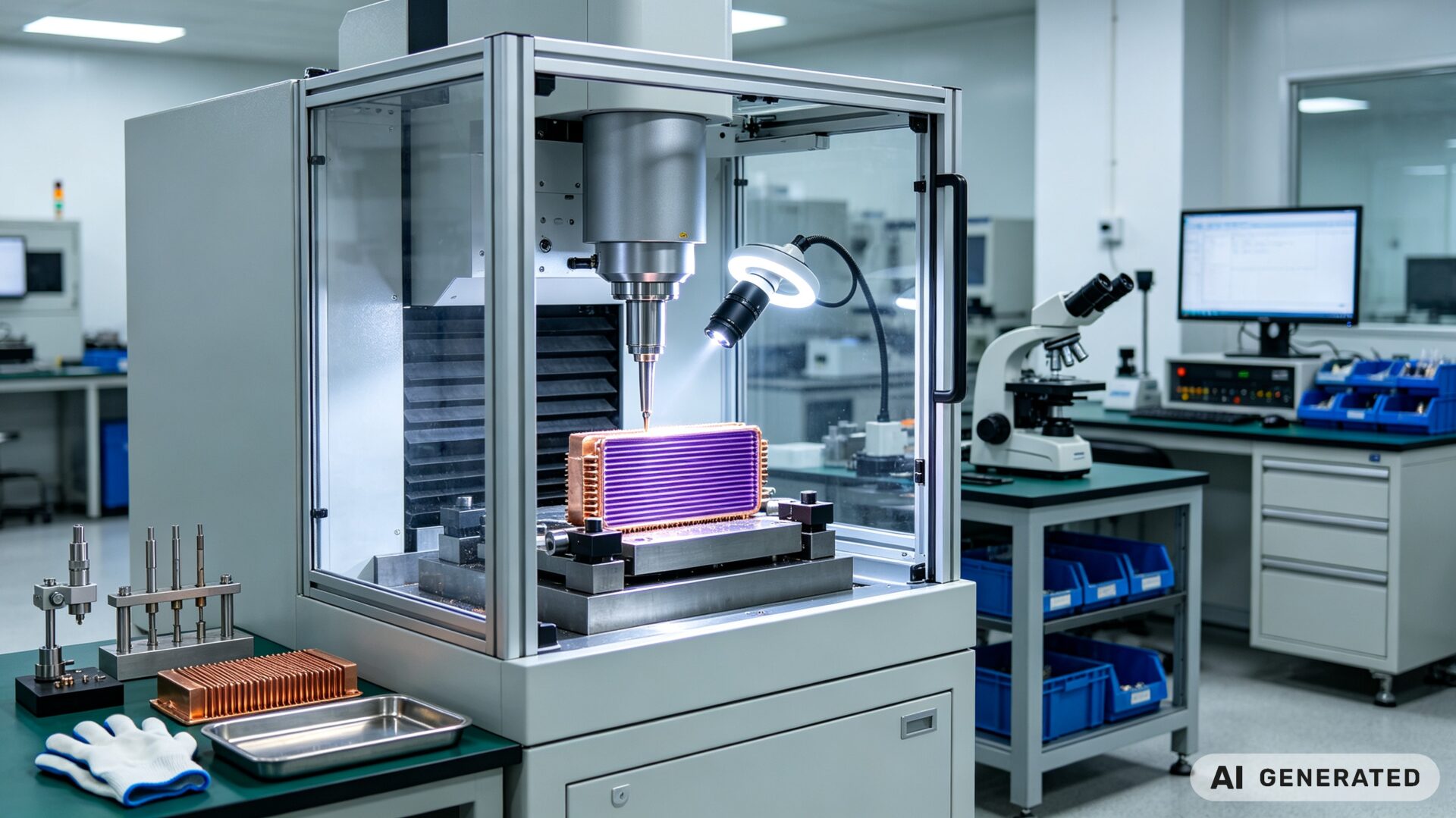
TPS Elektronik’s precision CNC micro-milling service for laser diode micro-channel coolers combines specialized equipment, process expertise, and rigorous quality control in a single integrated workflow.
Equipment and Tooling:
- High-speed spindles: Up to 60,000 RPM for micro-tool applications
- Micro-tooling: End mills as small as 0.1mm diameter for fine channel features
- Vision systems: In-process inspection for tool wear monitoring and dimensional verification
- Temperature-controlled environment: Stable machining conditions for dimensional accuracy
Process Capabilities:
- Channel widths: From 0.1mm to 1.0mm
- Channel depths: Up to 2.5mm (aspect ratios exceeding 10:1)
- Fin thickness: Down to 0.1mm
- Tolerances: ±0.01mm on critical dimensions
- Surface finish: Ra 0.4–0.8μm on channel surfaces
- Materials: Oxygen-free copper (C10100, C10200, C11000), copper-tungsten (CuW), aluminum, and other thermal management materials
Design for Manufacturability (DFM):
- Tool access analysis to ensure micro-tools can reach all required features
- Channel geometry optimization for machinability and thermal performance
- Material selection guidance based on thermal, mechanical, and cost requirements
- Prototype validation before production tooling commitment
For copper micro-channel heat sink CNC applications, TPS’s process expertise extends to managing copper’s material-specific challenges: tool selection to minimize built-up edge, optimized chip evacuation strategies, and coolant selection for thermal stability during machining.
5. Materials, Surface Finishes, and Quality Assurance
Material selection and surface treatment are as critical as machining accuracy for micro-channel cooler performance. The wrong material choice or surface finish can increase thermal resistance or cause flow instability.
Materials machined by TPS for micro-channel coolers:
- Oxygen-free copper (C10100, C10200, C11000): The industry standard for laser diode coolers—excellent thermal conductivity (401 W/m·K), good machinability, and compatible with soldering and brazing processes
- Copper-tungsten (CuW): Used for applications requiring matched thermal expansion with laser diode materials
- Aluminum alloys: For lower-cost or lower-power applications
Surface treatments:
- Nickel plating: Provides corrosion resistance and a solderable surface for laser diode attachment
- Gold plating: For applications requiring the highest solderability and corrosion resistance
- Passivation: For copper surfaces to prevent oxidation before assembly
Quality Assurance:
- In-process probing: Critical dimensions verified during machining
- CMM inspection: Coordinate Measuring Machine verification of all critical dimensions, including channel width, depth, and flatness
- Surface profilometry: Measurement of channel surface finish
- First Article Inspection (FAI): Comprehensive dimensional reports for the first part of each production run
- Flow testing: Verification of coolant flow characteristics
TPS’s quality system is certified to ISO 9001, with additional certifications available for regulated applications.
6. TPS Precision CNC Micro-Milling Capabilities
TPS Elektronik’s precision CNC micro-milling service for high-power laser diode micro-channel coolers is built on a foundation of specialized equipment, deep process knowledge, and integrated manufacturing capabilities.
Core Capabilities:
- Micro-milling: 3-axis and 5-axis CNC micro-milling with high-speed spindles and micro-tooling
- High aspect ratio machining: Channels with depth-to-width ratios exceeding 10:1
- Precision tolerances: ±0.01mm on critical dimensions
- Materials: Oxygen-free copper, copper-tungsten, aluminum, and other thermal management materials
- Batch sizes: From prototype single units to series production
Additional Services:
- DFM feedback: Design for manufacturability optimization during the design phase
- Surface finishing: Nickel plating, gold plating, and passivation
- Assembly: Laser diode packaging and cooler assembly integration
- Testing: Flow testing and thermal performance verification
Quality and Compliance:
- ISO 9001 certified quality management
- First Article Inspection (FAI): Comprehensive dimensional reports
- Material certificates: Full traceability of material provenance
- In-process inspection: Vision systems and probing for real-time quality control
For laser bar packaging machining applications, TPS supports both development and production programs, with design-for-manufacturing feedback to optimize performance without compromising manufacturability. TPS’s precision CNC micro-milling service is integrated with broader EMS capabilities—including electronics assembly and system integration—reducing supply chain complexity for system integrators and procurement teams.
Get your precision CNC micro-milling RFQ in 24–48 hours →