

For system integrators, panel builders, and engineering-driven procurement teams, selecting a bench power supply for precision circuit development is not only about voltage and current ratings.
It also involves output ripple, load regulation, remote sensing, resolution, protection behavior, and whether the supply can deliver a repeatable setpoint at the device terminals — not just at its own output terminals.
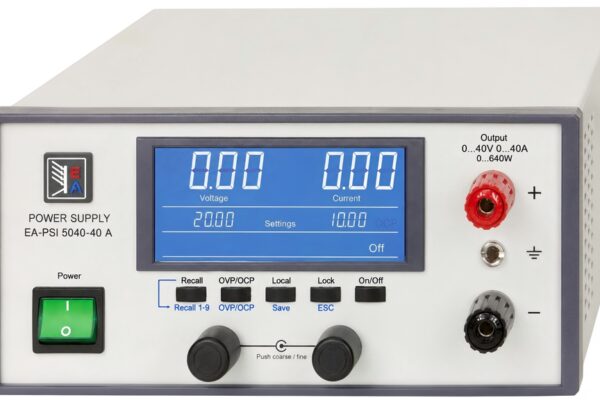
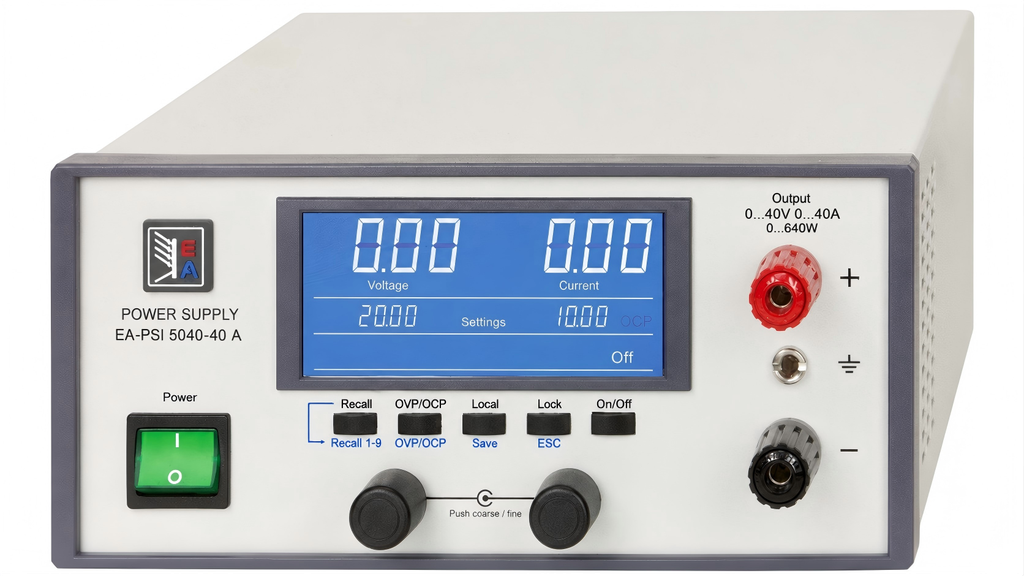
The EA-PSI 5040-40A is a microprocessor-controlled programmable desktop DC power supply with 0-40V, 0-40A, 640W auto-ranging output, <10mV RMS ripple, <0.08% voltage load regulation, and <1ms load regulation time. It is a switch-mode design with active PFC and up to 92% efficiency — a practical alternative to a traditional linear bench supply where low ripple and stable output matter more than the topology label.
Typical applications include analog front-end development, sensor signal chain evaluation, low-noise regulator characterization, and automated R&D test sequences.
1. What “linear-class” performance means in a desktop DC supply
A traditional linear bench supply regulates the output with a series pass transistor operating in its linear region. It produces very low switching noise, but it is inefficient, heavy, and generates significant heat. A switch-mode bench supply converts energy at high frequency and filters the output; modern designs can reach ripple levels that were once the exclusive domain of linear supplies.
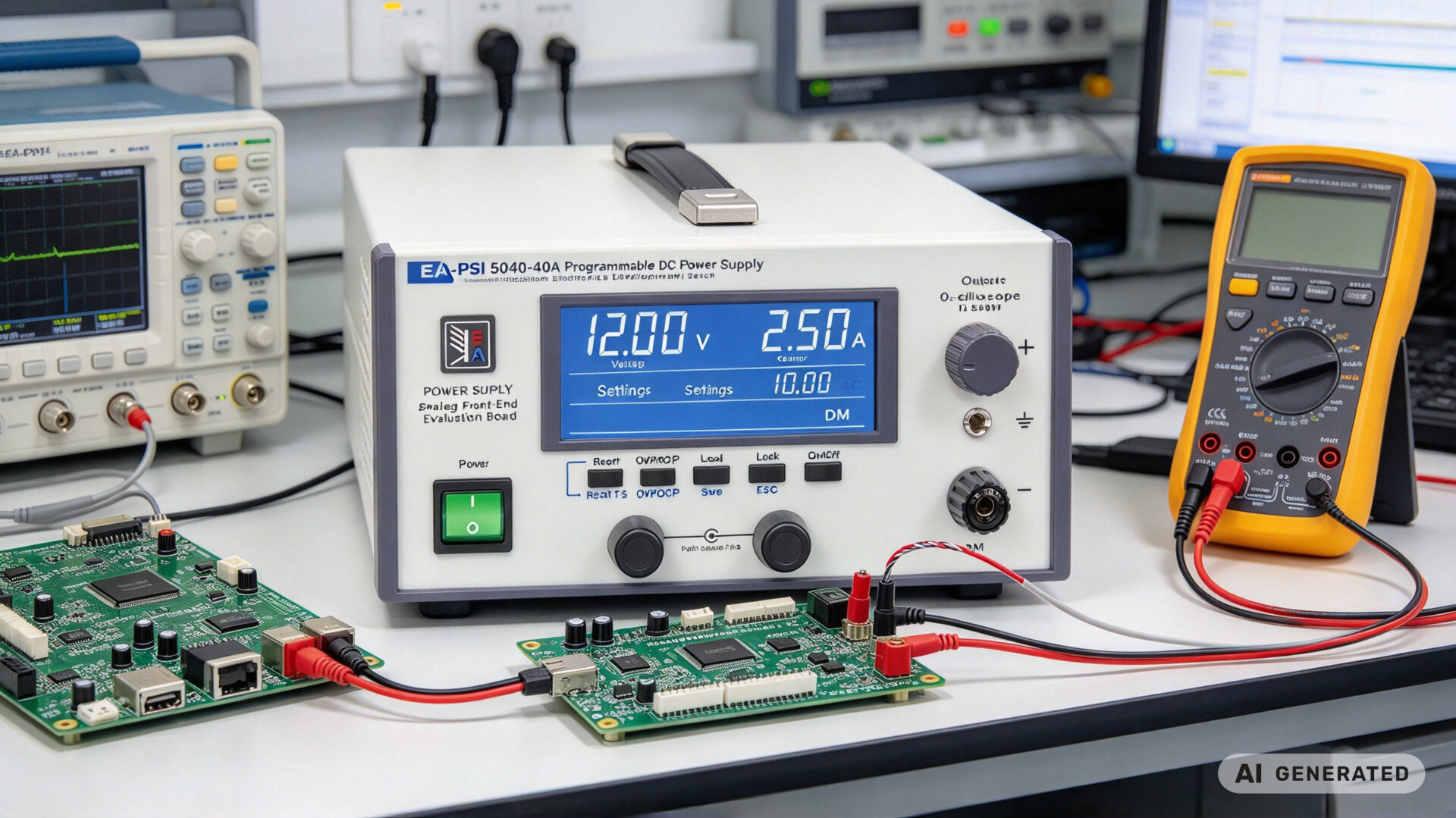
The EA-PSI 5040-40A belongs to the second category. Its specification — <10mV RMS and <80mV peak-to-peak ripple — is the number that matters for precision circuit development, not the topology label. In practice, a development bench that needs a clean DC rail for an analog front-end is comparing ripple, regulation, and resolution, and this supply is specified in those terms.
1.1 Topology reality: switch-mode with linear-class ripple
It is important to state this clearly for procurement and engineering: the EA-PSI 5040-40A is a switch-mode supply, not a pure linear supply. It uses active power factor correction (>0.99), reaches up to 92% efficiency, and uses a temperature-controlled fan. Those are advantages in a development lab — less heat, lower energy cost, quieter bench — but they are different from the characteristics of a large linear pass-transistor design.
If a project mandates a pure linear topology for regulatory or historical reasons, that requirement should be stated in the RFQ, and a different model should be selected. For most precision development work, the relevant requirement is the output quality at the load, and that is where this supply’s specification applies.
1.2 Reading the ripple specification correctly
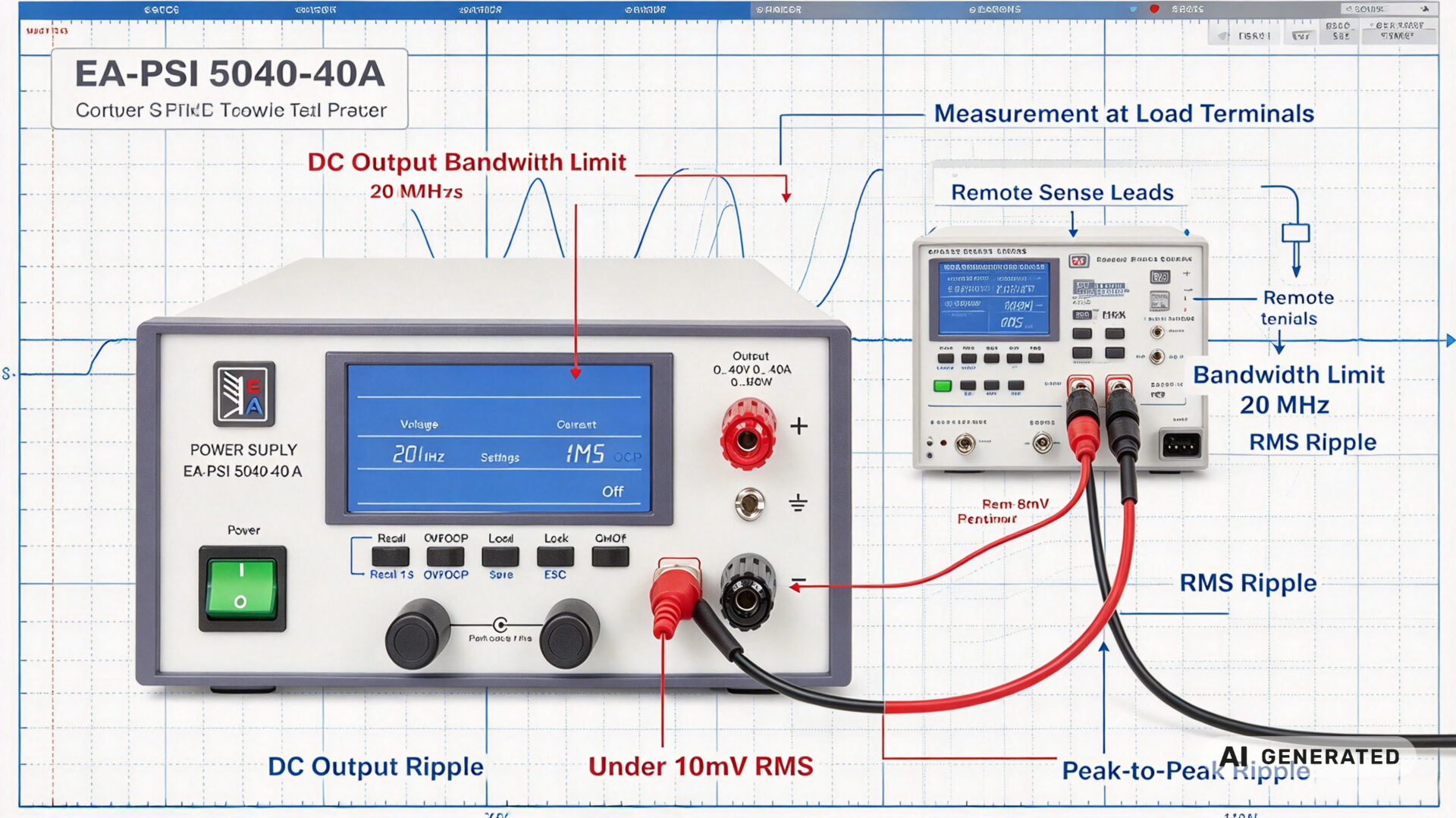
Ripple is meaningless without a measurement bandwidth. The EA-PSI 5040-40A specifies <80mV peak-to-peak and <10mV RMS. The peak-to-peak figure indicates the worst-case instantaneous deviation; the RMS figure indicates the noise power delivered to the load. For a low-noise analog rail, the RMS figure is usually the more relevant of the two, because it directly affects the noise floor of the circuit being developed.
The measurement must be made at the load, with a short ground lead and a bandwidth limit on the oscilloscope. Measuring at the supply terminals with a long ground clip will show higher ripple that belongs to the probe loop, not to the supply.
2. Why low ripple and stable output matter in precision circuits
A precision circuit under development is a measurement system in itself. The supply rail is part of that system, and its imperfections appear in the result — as offset, as noise, as drift, or as a transient that the circuit under test responds to.
2.1 The measurement error budget
Consider a sensor signal chain with a 10mV full-scale output. A supply with 10mV RMS ripple does not necessarily add 10mV to the signal, because the circuit’s power supply rejection ratio attenuates it. But at high frequency, PSRR falls, and the ripple that remains appears as noise on the output. In a 16-bit acquisition system, 10mV of rail noise can dominate the noise floor.
The EA-PSI 5040-40A’s <0.2% voltage accuracy and <0.2% current accuracy also matter: when the engineer sets 3.300V, the supply should deliver 3.300V at the load, not 3.320V. Remote sensing is the mechanism that makes this true at the device terminals.
2.2 Load step and line step behaviour
Precision circuits rarely draw constant current. A digital block wakes up, an ADC starts converting, a relay closes — and the rail must recover quickly. The <1ms load regulation time and <0.08% load regulation of the EA-PSI 5040-40A define how far the output deviates and how fast it returns. For a circuit that is sensitive to supply transients, this is as important as the steady-state ripple.
Line regulation of <0.02% covers mains voltage variation. In a shared laboratory where compressors, ovens, and welders are on the same distribution, this matters more than it does in a dedicated power lab.
3. EA-PSI 5040-40A features for precision development
Physical Characteristics
| Parameter | Specification |
|---|---|
| Model | EA-PSI 5040-40A |
| Form factor | Desktop, 200 × 87 × 331 mm |
| Weight | 4.3 kg |
| Display | Blue LCD, set and actual values simultaneous |
| Controls | 2 knobs, 5 buttons, 9 preset memory groups |
| Cooling | Temperature-controlled fan |
| Interfaces | USB, Ethernet, galvanically isolated analog |
3.1 Auto-ranging output and resolution
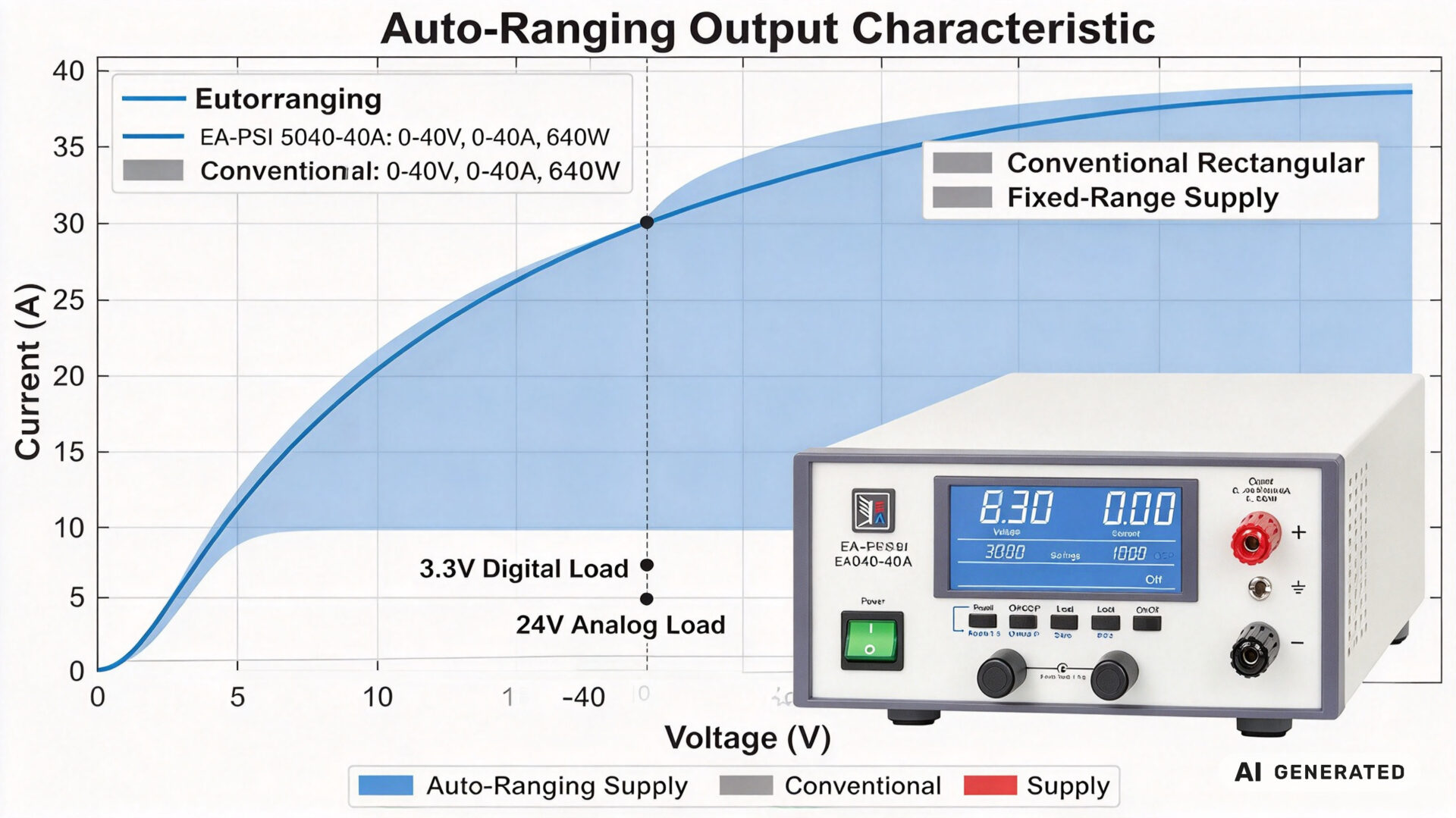
The 0-40V, 0-40A, 640W auto-ranging output means the supply can deliver high current at low voltage or high voltage at lower current within the 640W envelope. A 3.3V digital board and a 24V analog stage can be powered by the same instrument without swapping units. For a development bench that supports multiple projects, this reduces equipment count and bench clutter.
3.2 Remote sensing, interfaces, and automation
Remote sensing compensates for the voltage drop in the test leads, so the setpoint is maintained at the load. This is essential for precision work: with 40A through a 10mΩ lead pair, the drop is 400mV — far larger than the accuracy specification of the supply itself.
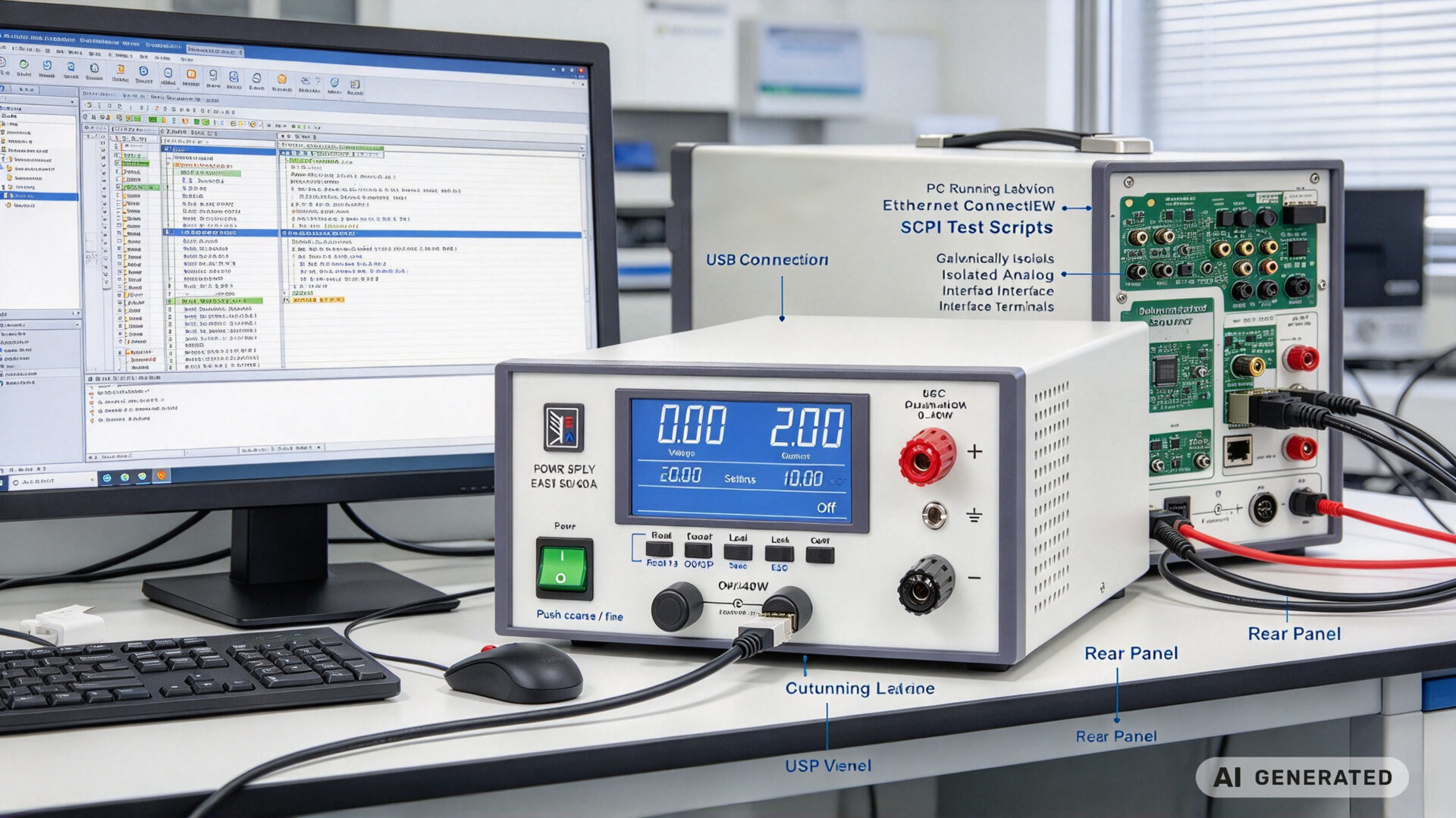
The supply supports USB, Ethernet, and a galvanically isolated analog interface, and is compatible with SCPI, LabView VIs, and Windows control software. For automated R&D sequences — voltage sweeps, load profiles, burn-in — this removes manual setpoint changes and reduces operator error. The TPS production category and TPS blog content provide additional application context.
3.3 Protection and thermal behaviour
OVP, OCP, OPP, and OTP protect both the supply and the circuit under development. Set OVP just above the expected rail voltage, and OCP just above the expected current, so that a fault in the DUT triggers a controlled shutdown rather than damage. The temperature-controlled fan keeps acoustic noise low at partial load, which matters on a bench where the engineer sits for hours.
For related high-current test hardware, see the TPS-DM570T1512KIF and TPS-DM570T1512KIRF bidirectional DC-DC modules.
4. Product specifications
| Parameter | EA-PSI 5040-40A | Typical entry-level bench supply |
|---|---|---|
| Output | 0-40V / 0-40A / 640W, auto-ranging | 0-30V / 0-5A / 150W, fixed range |
| Ripple (RMS) | <10 mV | Often unspecified |
| Voltage load regulation | <0.08% | 0.1-0.5% |
| Load regulation time | <1 ms | Often unspecified |
| Voltage accuracy | <0.2% | 0.5-1% |
| Remote sensing | Yes | Usually no |
| Interfaces | USB, Ethernet, isolated analog | USB optional |
| Presets | 9 | 2-4 |
| Efficiency | Up to 92% | Lower, more heat |
 The comparison shows where the specification matters. The auto-ranging envelope and the remote sensing are the two features that change how the bench is used day to day.
5. RFQ checklist
To streamline quotation and evaluation for a desktop dc power supply used in precision circuit development, provide the following information:
- Voltage and current range: Maximum rail voltage and peak current for the circuits under development
- Ripple requirement: RMS and peak-to-peak limits, and the measurement bandwidth to be used
- Regulation requirement: Load and line regulation targets, and the acceptable load-step recovery time
- Resolution and accuracy: Setpoint resolution and accuracy needed for the application
- Remote sensing: Whether sensing at the load is required
- Automation interface: USB, Ethernet, isolated analog, and the control software environment
- Topology requirement: Whether a pure linear topology is mandated, or whether output quality is the deciding criterion
- Documentation: Calibration certificate, test report, and compliance documentation
Providing these details reduces clarification cycles. TPS’s engineering team can support supply selection, ripple measurement setup, and automation integration as part of the RFQ process.
6. FAQ
Is the EA-PSI 5040-40A a linear power supply?
No. It is a switch-mode supply with active PFC, up to 92% efficiency, and a temperature-controlled fan. Its ripple specification (<10mV RMS, <80mV pp) is low enough for most precision development work, but the topology is switch-mode. If a pure linear topology is mandatory, state that in the RFQ and a different model will be selected.
How should ripple be measured to compare with the datasheet?
Measure at the load terminals, with a short ground lead and a bandwidth limit on the oscilloscope. Use remote sensing. Measuring at the supply output with a long ground clip will include probe-loop pickup that does not belong to the supply.
Why does remote sensing matter for precision circuits?
Remote sensing closes the regulation loop at the load, compensating for the voltage drop in the test leads. At 40A through a 10mΩ lead pair, the drop is 400mV — far larger than the supply’s accuracy specification. Without remote sensing, the setpoint at the device is not the setpoint at the supply.
Can the supply be automated for R&D test sequences?
Yes. It supports USB, Ethernet, and a galvanically isolated analog interface, and is compatible with SCPI, LabView VIs, and Windows control software. Voltage sweeps, load profiles, and burn-in sequences can be scripted.
What is the advantage of the auto-ranging output?
The 0-40V, 0-40A, 640W auto-ranging envelope allows high current at low voltage or high voltage at lower current within the same 640W limit. One instrument covers low-voltage digital boards and higher-voltage analog stages, reducing bench equipment count.