

Key Takeaways
- Europe’s Fit for 55 and REPowerEU mandates are dismantling the traditional distinction between a basic ac to dc converter and a grid-responsive bidirectional power module. As a result, this shift is forcing a continent-wide upgrade of power conversion infrastructure.
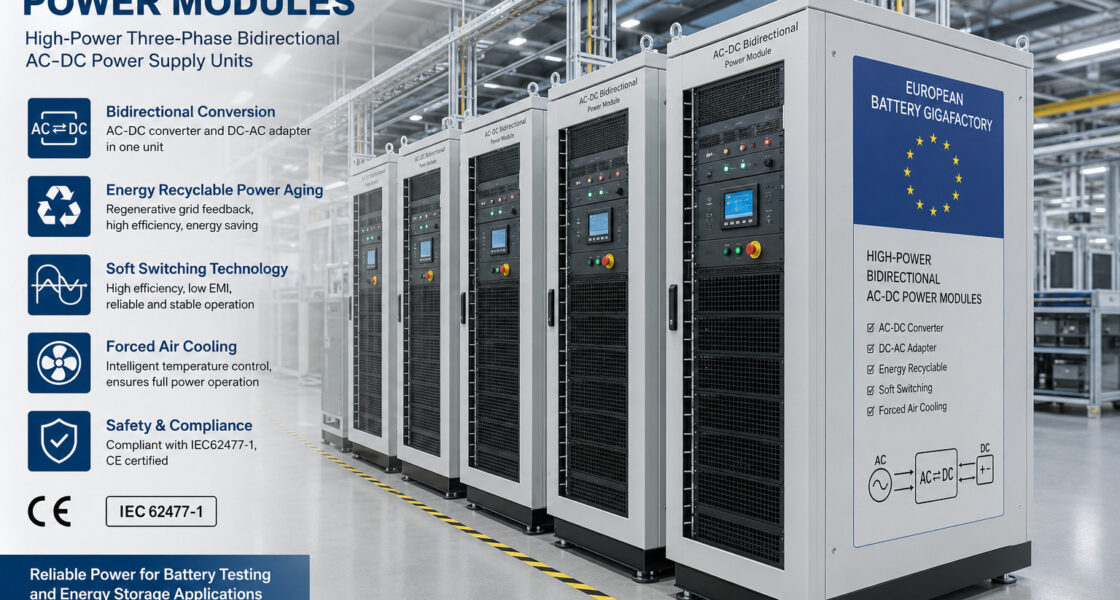
- Battery manufacturing has become the single largest demand driver. Specifically, energy recyclable power aging — enabled by three-phase AC-DC bidirectional modules — can slash gigafactory energy bills by over 90% during battery PACK aging and cells formation in series.
- Electrification of mobility and heating is destabilising distribution grids. Consequently, this makes unstable grid adaptation, no neutral line current operation, and fault protection non-negotiable requirements for any new ac to dc power supply installed from Barcelona to Helsinki.
- Technical features like soft switching technology, high-frequency isolation, forced air cooling, and no derating at 45°C are no longer premium add-ons. Instead, they have become baseline expectations for hardware operating in harsh environments without climate-controlled enclosures.
- Scalability through modular design, intelligent expansion, and automatic parallel operation allows a single ac dc power supply architecture to serve everything from a research lab to a multi-MW industrial park. Moreover, full CE certification, UL certification, and TUV certification provide the regulatory passport.
Walk into any battery gigafactory under construction in Sweden, Germany, or Hungary, and you will see a fundamental shift taking place. The days of relying on a simple ac of dc adapter or a unidirectional alternating current to direct current converter are over. Instead, engineers now install rack after rack of high-power ac dc converter systems that do far more than convert ac to dc. These systems operate as true bidirectional power modules, flipping seamlessly from an ac to dc power supply into a dc to ac adapter that pumps energy back into the building grid.
This is not an incremental improvement. In fact, two seismic EU policy packages are driving this change: Fit for 55, which legally binds the bloc to slash net greenhouse gas emissions by at least 55% by 2030, and REPowerEU, the accelerated plan to eliminate Russian fossil fuel imports while supercharging clean energy manufacturing. Together, they are reshaping what any electrical converter ac to dc must deliver. As a result, a commodity component is turning into a critical grid-edge asset.
From Policy to Production: How REPowerEU Is Rewriting the Battery Factory Specification
REPowerEU set the target of 550 GW of solar by 2030 and laid out an aggressive strategy for electrifying transport. Consequently, this implicitly triggered the largest battery manufacturing expansion in European history. Over 30 gigafactories are now planned or operational, from Northvolt in Sweden to Verkor in France. Each one demands an enormous, concentrated load of ac to dc power supply equipment for formation, grading, and aging. To illustrate, a typical production line must slowly charge, discharge, and cycle cells — a process called formation — which can consume up to 40% of the factory’s total electricity. Historically, a standard dc and ac converter setup would simply dump that discharge energy into resistive load banks as heat. However, the EU Taxonomy’s “do no significant harm” criteria no longer permit this wasteful practice.
Energy Recyclable Power Aging
- The modern bidirectional power module operates as a true dc ac dc converter. First, it charges battery cells with a precise dc output from the ac to dc voltage converter front-end. Then, during discharge, it inverts the stored energy back to three-phase AC and synchronizes it with the factory microgrid.
- This energy recyclable power aging loop routinely achieves over 93% energy recovery efficiency. In turn, it turns the massive electricity appetite of battery PACK aging and cells formation in series into a nearly cost-neutral process after the initial capital expenditure.
- The system functions as both an ac to dc converter and a dc to ac adapter in a single unit. As a result, this drastically reduces factory floor space, cabling, and thermal management overhead compared to separate charge and discharge systems.
Bidirectional Power Module Architecture for Production
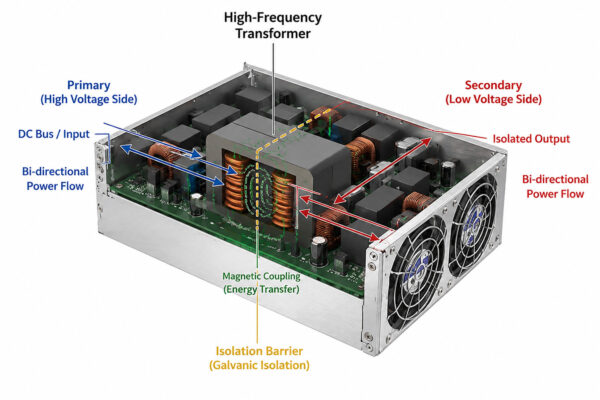
- Each unit is a three-phase AC-DC power converter with a galvanically isolated DC-DC stage. Crucially, this design ensures that no fault can propagate from the battery under test to the grid or vice versa.
- Integrated high-frequency isolation replaces bulky 50 Hz transformers. In doing so, it achieves the reinforced insulation required under IEC62477-1 compliance while maintaining a compact form factor that fits standard 19-inch racks.
- The module manages all auxiliary power internally. Therefore, this eliminates the need for a separate ac of dc adapter to power control circuits, simplifying installation and reducing points of failure.
When the Grid Becomes the Variable: Unstable Grid Adaptation as a Design Requirement
Fit for 55 and REPowerEU are flooding the European grid with inverter-based renewable generation. In turn, this fundamentally alters its physical characteristics. Inertia is falling, harmonics are rising, and voltage fluctuations are becoming commonplace, particularly in industrial parks co-located with large solar or wind installations. For any alternating current to direct current converter operating in this environment, the assumption of a stiff, stable grid is dangerously outdated. For example, a conventional ac to dc voltage converter might trip offline during a voltage sag. Consequently, this could halt an entire formation line and scrap thousands of cells mid-cycle. For this reason, that risk now drives procurement specifications toward hardware with intrinsic resilience.
Unstable Grid Adaptation
- Advanced digital control loops in the ac to dc front-end maintain phase lock and stable operation even when grid Total Harmonic Distortion exceeds 10%. Notably, this condition is becoming increasingly common in renewable-heavy distribution networks.
- Full Low-Voltage Ride-Through (LVRT) and High-Voltage Ride-Through (HVRT) capability ensure the power converter stays connected during short-duration disturbances. Moreover, this aligns with the EU Network Code Requirements for Generators.
- In its dc to ac adapter mode, the unit can inject or absorb reactive power on command. In effect, this supports local voltage regulation and turns a battery test system into a grid-stabilization asset.
No Neutral Line Current Operation
- The three-phase topology operates with no neutral line current. As a result, this eliminates the risk of neutral conductor overloading in aging European factory wiring and simplifies the installation of large arrays of ac dc power supply modules.
- Balanced three-phase loading also reduces upstream transformer stress and improves overall power factor. Additionally, industrial users face increasingly strict reactive power tariffs under revised grid codes, making this a growing concern.
Surviving the Factory Floor: Harsh Environment Adaptation and No Derating at 45°C
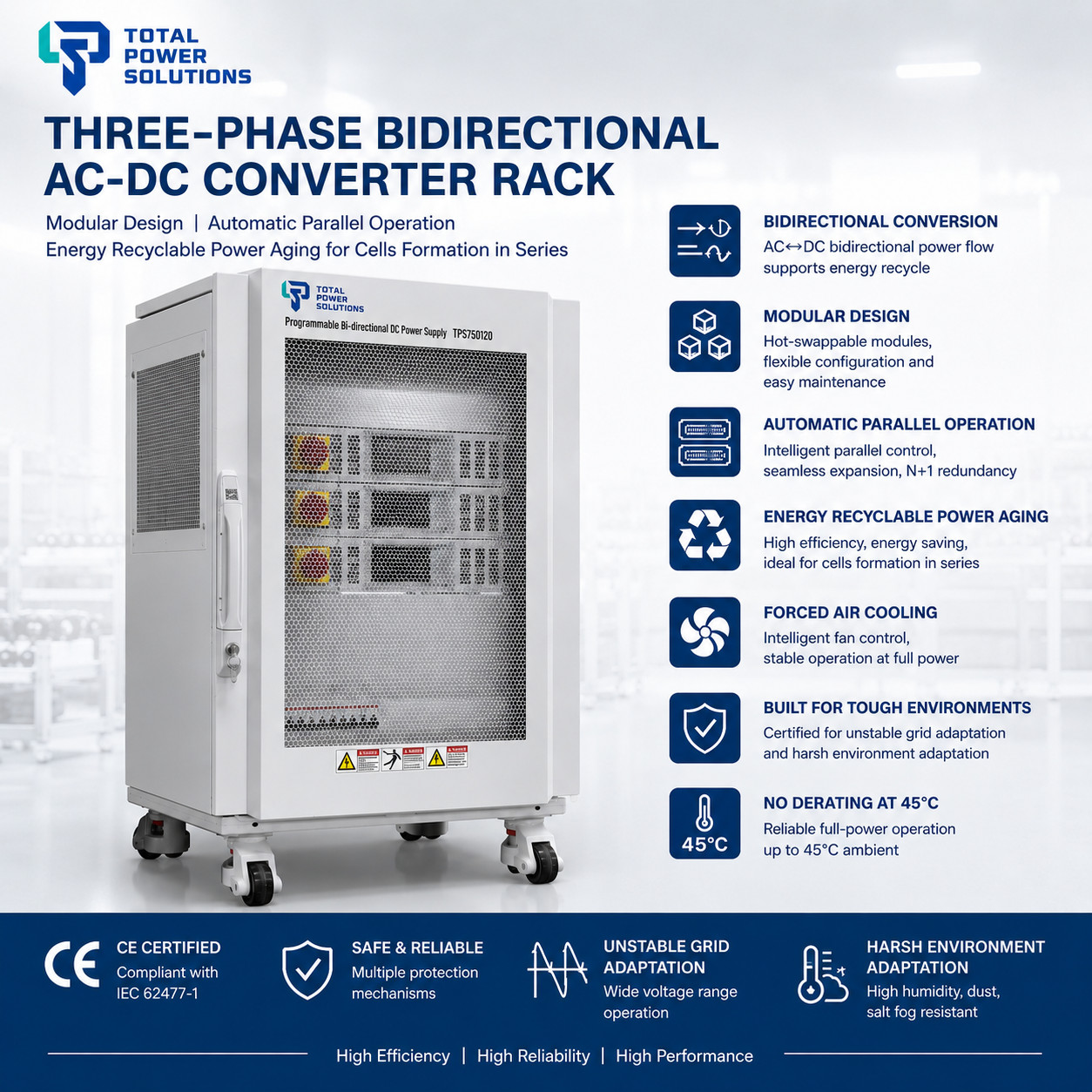
Policy documents and laboratory benches are one thing. However, a dusty, hot, and vibration-heavy production floor is another. European battery plants and energy storage sites span extreme climates — from the sub-zero winters of northern Sweden to the 40°C-plus summer heat of southern Spain. Repurposing standard commercial-grade power converters for these environments forces frequent derating, reducing output power as temperature rises. In turn, this cripples throughput and extends payback periods. For this reason, the new generation of European-bound ac to dc power supply hardware is engineered from the ground up to operate at full capacity without climate-controlled enclosures.
No Derating at 45°C
- The entire ac to dc converter, including magnetics and semiconductors, delivers continuous full-rated power at ambient temperatures up to 45°C. Specifically, thermal validation confirms this performance. Therefore, there is no need to over-specify a 30 kW unit to get 20 kW of usable power in a warm factory.
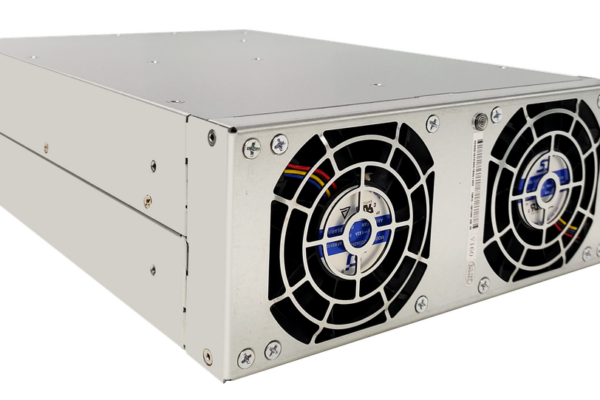
- Two technologies combine to achieve this performance: soft switching technology, which dramatically reduces semiconductor switching losses, and an optimized forced air cooling system with temperature-variable fan speed control.
Harsh Environment Adaptation
- Conformally coated printed circuit boards, sealed connectors, and corrosion-resistant aluminium heatsinks protect the dc and ac converter hardware. As a result, it operates reliably in 95% non-condensing humidity and in atmospheres with moderate dust or salt contamination.
- A wide operating temperature range from -20°C to +55°C, combined with no derating at 45°C, has passed verification through Highly Accelerated Life Testing (HALT). In turn, this gives European integrators confidence that the ac supplies will survive in unconditioned containerized energy storage systems.
High-Frequency Isolation and Soft Switching Technology
- High-frequency isolation transformers running at tens of kilohertz replace traditional line-frequency transformers. In doing so, they achieve the mandatory safety isolation required by IEC62477-1 compliance without the weight and size penalty.
- Soft switching technology uses Zero-Voltage Switching or Zero-Current Switching in the dc ac dc converter stages. Consequently, this minimizes switching losses and electromagnetic interference, making it significantly easier to satisfy EN55032 compliance without bulky external filters.
From 10 kW to 2 MW: The Economics of Modular Design and Intelligent Expansion
REPowerEU’s push for rapid battery deployment places immense pressure on manufacturers to scale production quickly. Indeed, this is one of its most underappreciated consequences. A startup might initially need a single 20 kW bidirectional power module for an R&D lab. However, within two years, that same company could require 1.5 MW of capacity on a fully automated production line. Buying separate systems for each stage is capital-intensive and creates a maintenance nightmare. To address this, a modular design with automatic parallel operation solves the problem by treating each ac dc converter unit as a building block.
Modular Design and Intelligent Expansion
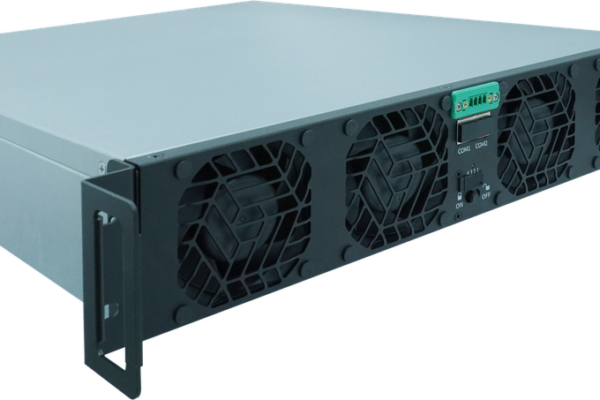
- Each ac to dc voltage converter module is a self-contained power converter that slots into a standard 19-inch rack. Moreover, all power, control, and cooling interfaces integrate at the backplane.
- Intelligent expansion firmware allows a master controller to automatically detect newly inserted modules. It then assigns addresses and rebalances current sharing without any manual configuration. As a result, this eliminates the risk of human error during capacity upgrades.
Automatic Parallel Operation
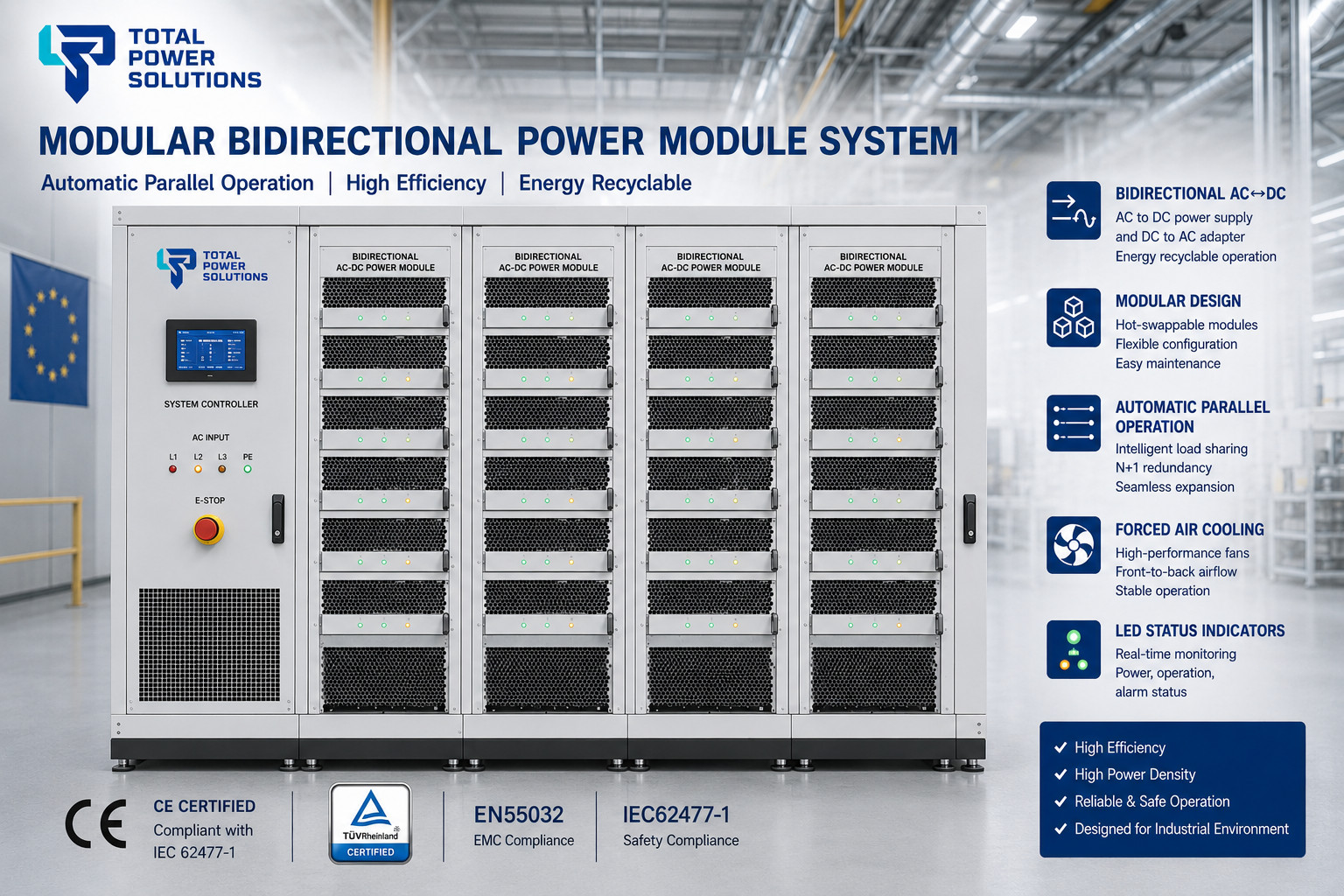
- High-speed digital load-sharing buses allow dozens of modules to operate in automatic parallel operation as a single, coherent dc and ac converter system. In effect, the system presents itself to the grid as one manageable load or source.
- If a single unit trips due to an internal fault, the remaining modules instantly redistribute the load. Meanwhile, comprehensive fault protection logs the event for maintenance without halting the entire production line.
The Regulatory Passport: Why CE, UL, TUV, and IEC Compliance Are Not Just Paperwork
Asian and North American manufacturers seeking to enter the European market must understand the certification landscape. Indeed, it matters as much as the hardware itself. Customs will stop a power converter that lacks the appropriate marks, regardless of its technical merits. Fit for 55 does not change the specific directives. However, it has significantly increased the scrutiny applied during compliance audits, particularly for energy efficiency and cybersecurity.
Fault Protection and Certified Safety
- A multi-layered fault protection architecture monitors multiple conditions: input over/under-voltage, output overcurrent, short-circuit, over-temperature, and anti-islanding at the grid interface. In turn, this ensures the electrical converter ac to dc fails safely into a de-energized state within milliseconds.
- Full IEC62477-1 compliance ensures the system meets the EU’s Low Voltage Directive safety requirements for power electronic converter systems. Similarly, EN55032 compliance guarantees that the equipment will not disrupt other sensitive electronics in industrial or residential settings.
- CE certification is the minimum legal requirement for the EU single market. Additionally, TUV certification provides the rigorous third-party verification that German and Austrian customers typically demand. Furthermore, UL certification opens doors for global corporates that standardise on UL-listed equipment worldwide.
Conclusion: The European Bidirectional Power Module is No Longer Optional
Fit for 55 and REPowerEU are not abstract policy slogans. Rather, they are enforceable mandates that are rapidly cascading into technical specifications across Europe. Every new ac dc power supply installed in the continent’s expanding battery factories, EV charging hubs, and grid-scale energy storage parks must now meet these demands. The simple unidirectional alternating current to direct current converter, or a basic ac of dc adapter, cannot satisfy the simultaneous requirements of energy recyclable power aging, unstable grid adaptation, no derating at 45°C, and modular scalability.
In response, the market is converging on a clear technical template. It demands a three-phase AC-DC bidirectional power module that combines soft switching technology, high-frequency isolation, no neutral line current operation, and forced air cooling. Moreover, the module must come packaged in a modular design with intelligent expansion and automatic parallel operation. Finally, full IEC62477-1 and EN55032 compliance, along with CE, UL, and TUV certification, back this new class of dc ac dc converter and ac to dc voltage converter. Ultimately, this hardware is not just powering Europe’s green transition — the transition itself is reshaping it.