

Every European facility engineer knows this moment. The team has installed the new test bench. They torque the busbars, size the upstream breaker, and close the switch. Then — darkness. The main incomer trips. A row of rack mount servers in the adjacent control room falls silent. The lab manager demands to know why the latest industrial power solution has stopped production. The root cause is rarely a component defect. More often, the team treated the new 420 kW Power Cabinet as a simple load. In fact, it was an active participant in the local grid ecosystem — and it behaved poorly.
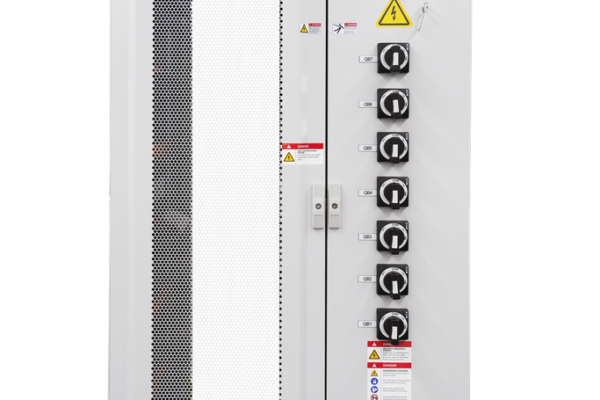
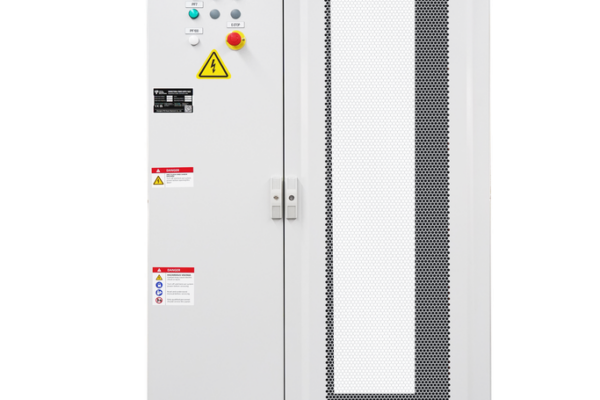
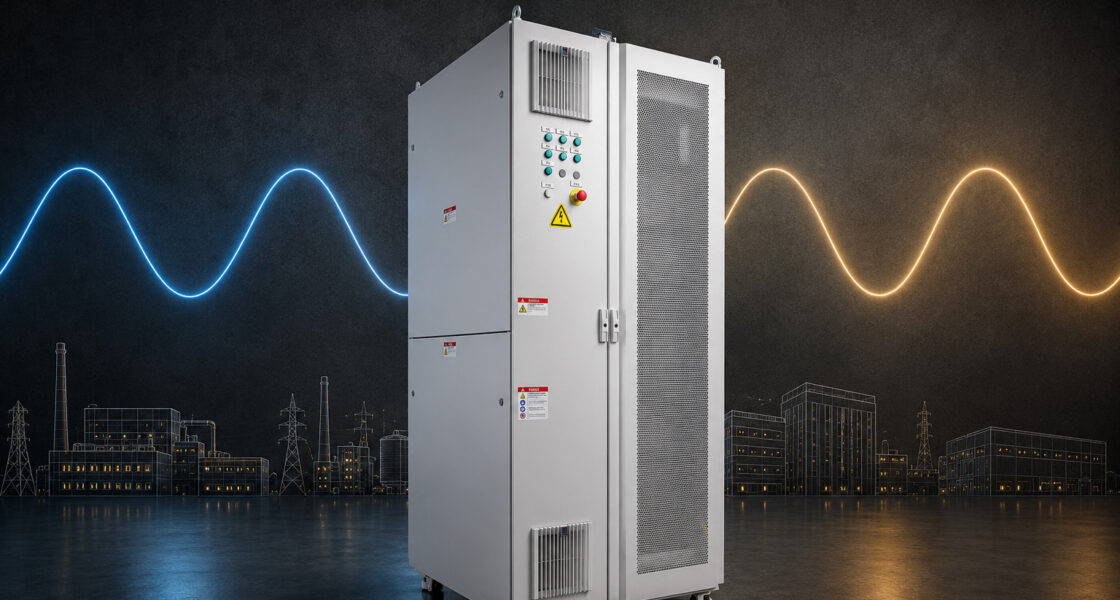
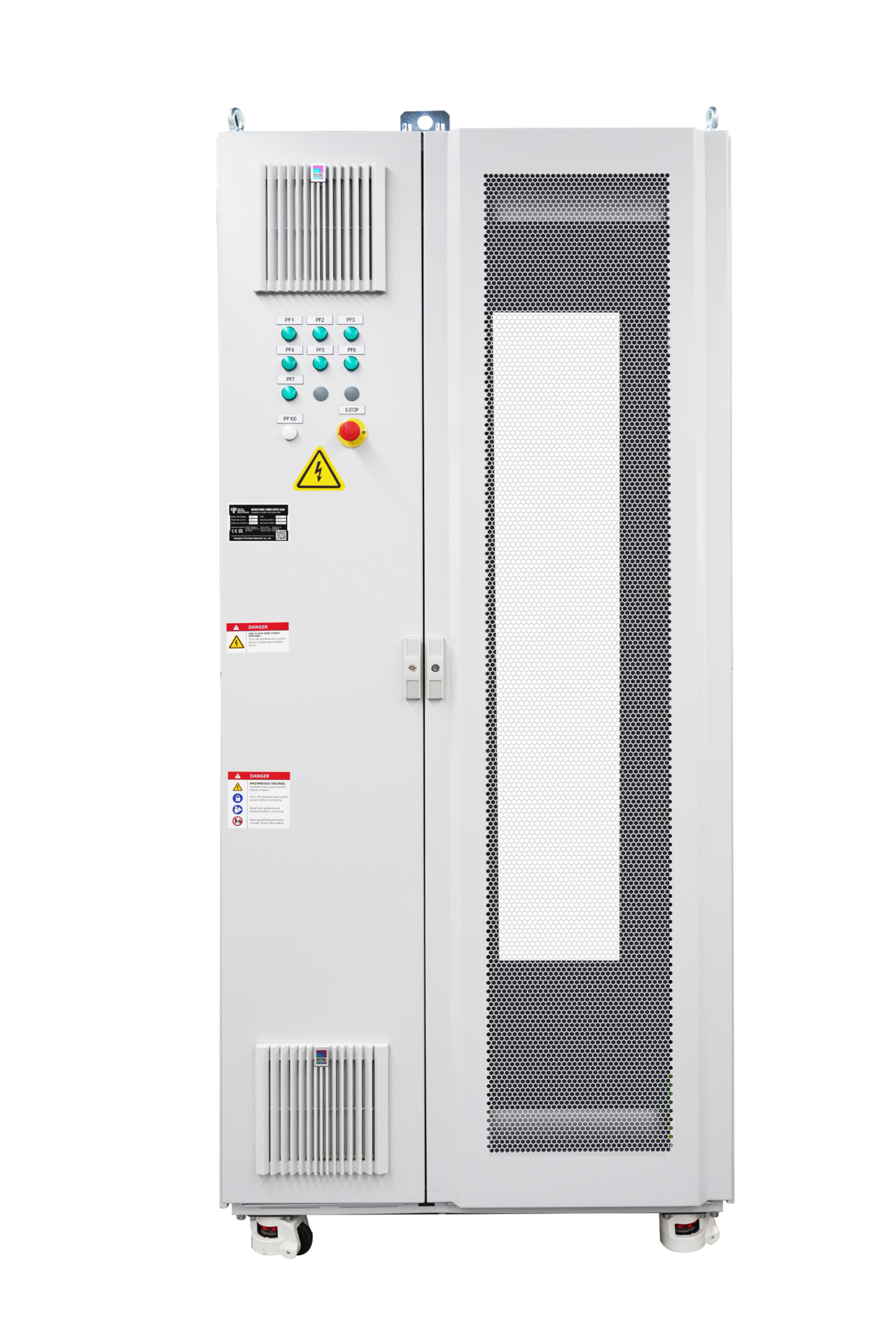
The 48U Power Cabinet reverses this narrative. Instead of injecting harmonic currents, asymmetric phase loading, and magnetising‑inrush surges, it actively improves the electrical environment it joins. It draws up to 600A AC input current from a 400VAC or 480VAC supply. It operates at 50Hz or 60Hz. Through parallel operation of up to seven 60 kW power modules, this high‑density power system delivers 420 kW total power. Yet its most important specification rarely appears on a datasheet: grid compatibility. Active power factor correction keeps THDi below 5 percent. A disciplined soft‑start sequence prevents nuisance tripping. Automatic neutral‑point shift prevention maintains balance. The 48U Power Cabinet behaves like a model grid citizen — it makes the upstream transformer’s life easier, not harder.
This article explores the six engineering pillars that transform a pre‑wired power cabinet from a potential grid disturbance into a benchmark of power quality management. We will see how the cabinet’s DC busbar infrastructure, advanced cooling architecture, and integrated safety systems — including a safety door interlock and emergency stop function — eliminate electrical risk while dramatically cutting field wiring time. Whether you are integrating a scalable power system alongside existing server racks or building a dedicated 19‑inch power rack for an ultra‑high‑power application, understanding these design choices will help you specify an industrial control panel that truly cooperates with the European grid.
1. How a 420 kW Load Becomes a Harmonic Neighbour: Active Power Factor Correction
- Every 60 kW power module includes a full active power factor correction front‑end, continuously shaping the input current into a sine wave.
- Total input current THDi stays below 5 percent from light load to full 420 kW, complying with EN 50160 and IEC 61000-3-4.
- No external harmonic traps or active filters are required, simplifying the power distribution cabinet footprint and certification.
- Compatible with both 400VAC and 480VAC grids, at 50Hz or 60Hz operating frequency.
- Sensitive co‑located equipment — from a rack mount server to precision measurement instruments — avoids harmonic interference.
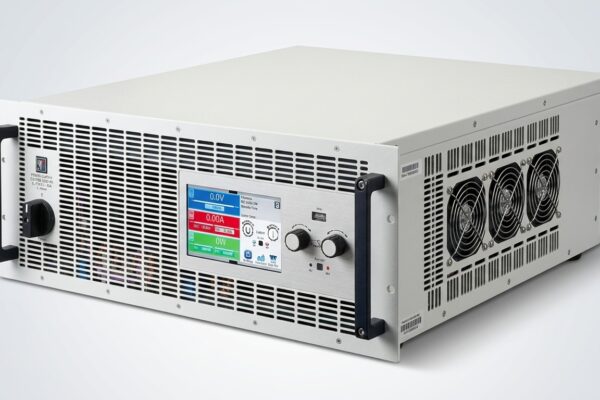
Imagine a 19 inch server rack running a quality‑assurance database just a few metres from your new 420 kW test stand. Its power supply expects a clean voltage sine wave. A conventional six‑pulse rectifier draws current in abrupt gulps. It floods the local bus with 5th, 7th, and 11th harmonics. Those harmonics flow through the transformer, through the neutral conductors, and into every other rack cabinet on the same secondary. The result can include erratic sensor readings, overheated neutral bars, and a utility bill with a penalty for excessive harmonic distortion.
The Active PFC Difference
The 48U Power Cabinet eliminates this problem at the module level. Its programmable power supply integration uses an active front‑end. This forces the line current to track the voltage waveform in real time. Even with all seven 60 kW modules running in parallel, the grid sees near‑unity power factor and THDi below 5 percent. For the plant engineer, this means no costly harmonic‑propagation study. No retrofitting the transformer for a higher K‑factor. The factory‑integrated power quality management makes the cabinet a net asset for grid stability.
2. The Blackout That Should Never Happen: Soft-Start Sequence
- A factory‑programmed soft‑start sequence brings each 60 kW power module online at 2‑second intervals, eliminating cumulative inrush.
- Directly prevents nuisance tripping on upstream breakers, even those rated for 10kA or 65kA SCCR.
- No external soft‑starters, pre‑charge contactors, or sequencing PLCs needed — contributing to significant field wiring time savings.
- Fully integrated with the cabinet’s remote control function, allowing monitoring and manual override from a supervisory system.
- Shift electricians can safely energise the pre‑wired power cabinet without specialised commissioning sequences.
Every seasoned commissioning engineer has a story about a “simple energisation” that became a plant‑wide blackout. Each 60 kW module contains DC‑link capacitors and a transformer. The transformer demands a magnetising current many times the steady‑state 600A. If seven modules start simultaneously, the combined inrush can kiss the upstream breaker’s instantaneous trip threshold. A nuisance trip takes down a home network rack, a homelab server, and half the building’s lighting.
How the Sequence Protects the Grid
The soft‑start sequence inside the 48U Power Cabinet avoids this entirely. An internal controller monitors the AC bus, then enables one module at a time with a precise two‑second pause. By the time the seventh module joins, the earlier modules have already stabilised their DC links. The peak inrush never exceeds the steady‑state draw by more than a few percent. This electrical risk elimination saves hard dollars. It removes the need for external sequencing contactors and reduces the time a highly paid electrical engineer spends on site. It feeds directly into the cabinet’s 70‑plus‑percent field wiring time savings.
3. Keeping the Neutral Point Where It Belongs: Neutral-Point Shift Prevention
- Each 60 kW power module draws perfectly balanced three‑phase current, eliminating neutral‑point shift under all conditions.
- No neutral current flows, even at full 420 kW total power, protecting upstream transformers and neutral conductors.
- Prevents overvoltage on lightly loaded phases that could degrade single‑phase rack mount server power supplies or a small rack mount UPS.
- Intrinsically supported by the DC busbar infrastructure and high‑current DC distribution layout.
- Simplifies arc‑flash and load‑flow studies by presenting a perfectly balanced industrial power solution to the network.
In many European factories, the same transformer feeds a 48U Power Cabinet and single‑phase office loads — a small server rack in the IT closet, a mini server cabinet under a desk, or a 19 inch rack of networking gear. An unbalanced industrial load shifts the neutral point away from ground potential. Some phases see overvoltage; others sag. Sensitive switch‑mode power supplies begin to fail months later. No one traces the root cause back to the day the team commissioned the big cabinet.
Balanced by Design
The 48U Power Cabinet prevents this at the architectural level. Each 60 kW module is a true three‑phase load. It draws identical RMS current on L1, L2, and L3 regardless of its DC output. During parallel operation, the aggregate remains perfectly symmetric. This automatic neutral‑point shift prevention is especially valuable in older facilities. Their distribution transformers were never sized for highly unbalanced industrial additions. Because no neutral current flows, there is no need to oversize the neutral cable. The cabinet behaves like a textbook resistive load — one of the easiest industrial control panel additions for a facility engineer to approve.
4. Efficiency That Pays Back Twice: DC Busbar Infrastructure and Thermal Engineering Design
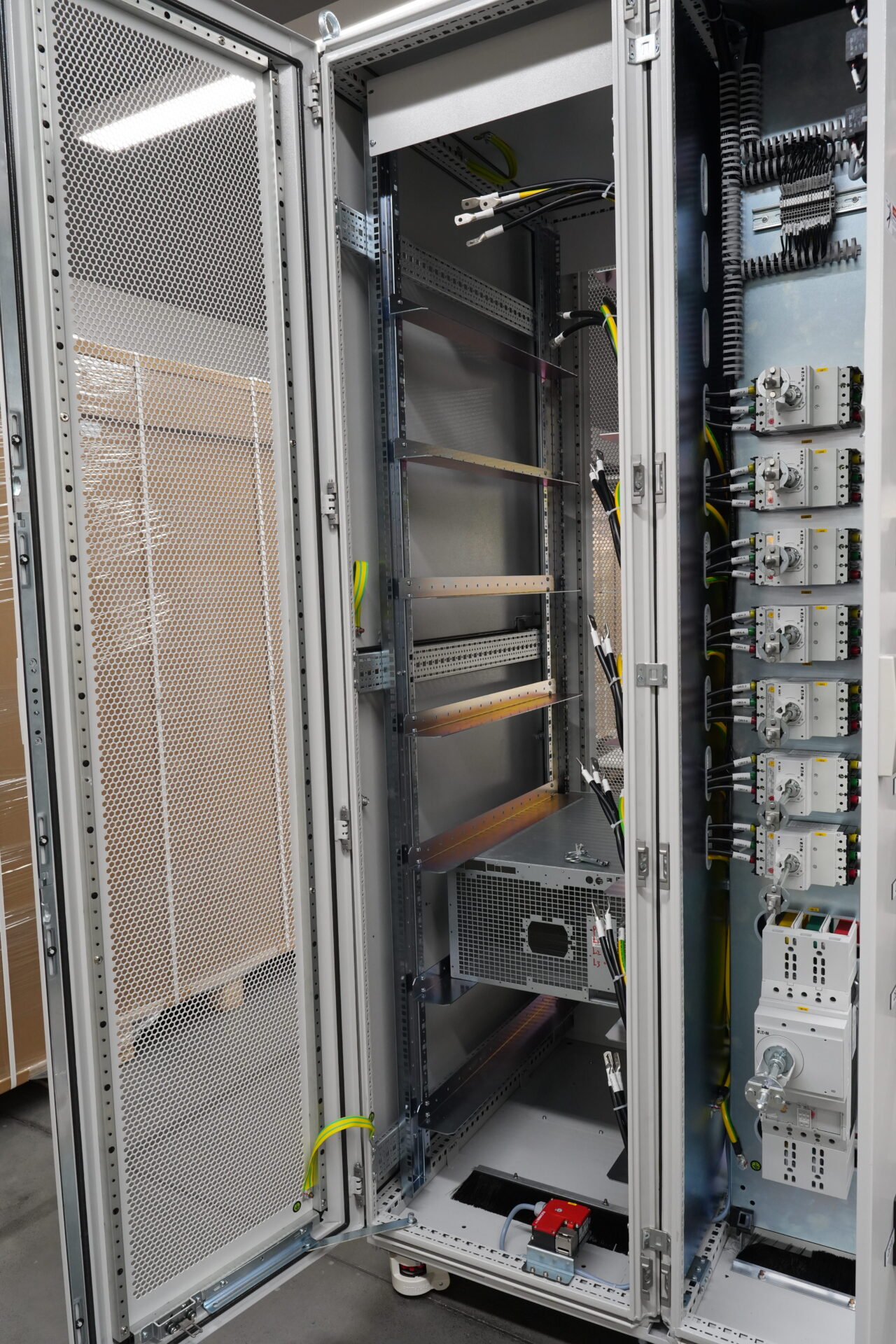
- Solid copper DC busbar infrastructure supports over 2000 A continuous, maintaining a conservative 30K temperature rise at full 420 kW.
- Advanced cooling architecture with redundant fans delivers over 2000 CFM airflow through 85 percent open perforation front and rear doors.
- Hotspot temperatures remain within 50K temperature rise limits, enabling a true 100‑percent‑duty‑cycle ultra‑high‑power application.
- Low I²R losses reduce wasted energy, directly lowering the thermal load on the plant’s HVAC system.
- The reinforced frame, rated for 1600 kg weight capacity, securely supports up to seven 60 kW power modules and the massive copper busbar assembly.
Grid friendliness has an efficiency dimension that many people overlook. Every watt of heat lost inside a power distribution cabinet forces the utility to generate more, the transformer to carry more, and the HVAC to work harder — a triple penalty. The 48U Power Cabinet attacks this loss at its source with a multi‑layer copper DC busbar infrastructure. Busbar cross‑sections limit the temperature rise to just 30K under nominal 420 kW. This dramatically reduces I²R losses compared to cable‑based internal wiring.
Cooling That Keeps Its Promise
The thermal engineering design then manages the remaining heat with a high‑volume vertical cooling path. Air enters through the 85 percent open perforation front door. A redundant fan matrix accelerates it through the module bays and exhausts it through the rear. With 2000 CFM airflow, the internal ambient stays well within the 50K temperature rise envelope — even on a hot European summer day. For a facility already managing the thermal output of several 19 inch server rack cabinets, this disciplined heat rejection means no new cooling crisis. The overheat protection system with module‑level temperature sensors can automatically throttle power if needed. The cabinet protects itself while preserving uptime.
5. When Things Go Wrong, the Grid Shouldn’t Feel It: Short Circuit Current Protection, Safety Door Interlock, and Emergency Stop Function
- Standard 10kA SCCR with field‑upgradeable 65kA rating, fully documented with a permanent SCCR nameplate per UL 508A Supplement SB.
- Class J current‑limiting fuses and UL 489 breakers form the short circuit current protection backbone, isolating faults before they propagate.
- Safety door interlock removes hazardous voltages before personnel can access the programmable power supply integration bay.
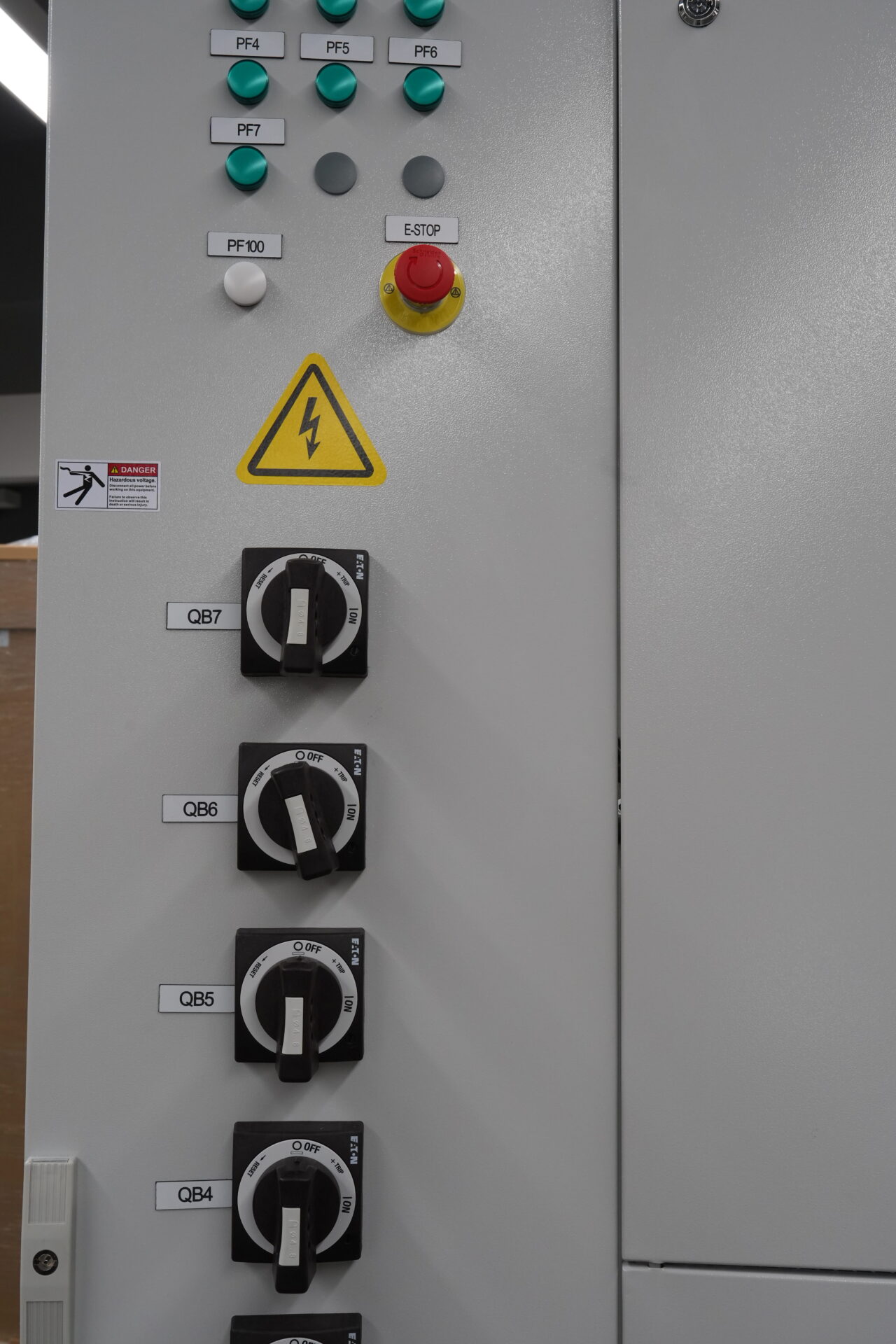
- Dual‑channel emergency stop function with a PILZ safety relay meets ISO 13849 Cat.4 / PL d for reliable, hardwired power removal.
- True electrical risk elimination: a contained internal fault must not cascade into the plant’s main switchgear.
A screwdriver slips. A busbar bolt loosens over years of thermal cycling. When a fault occurs inside an industrial control panel, the real question is not whether protection clears it. It is how far the disturbance travels before the system extinguishes it. In a facility where the 48U Power Cabinet sits next to rows of rack mount cabinets and mini rack mount test stations, a poorly contained arc flash could mean months of equipment replacement and a regulatory investigation.
Surgical Fault Isolation
The 48U Power Cabinet isolates faults with surgical speed. On the AC input, current‑limiting Class J fuses melt before the prospective fault current reaches its destructive peak. This lets the cabinet carry a 65kA SCCR rating, even close to a large supply transformer. Inside, the safety door interlock prevents any contact with live high‑current DC distribution conductors. Opening the door triggers a controlled shutdown. The emergency stop function provides a final hardwired safety net. It does not rely on software or network integrity. Together, these layers of short circuit current protection keep a serious internal fault internal. For the arc‑flash assessor, the permanent SCCR nameplate and UL 508A certification simplify the analysis. For the facility manager, they prove this industrial power solution respects the entire ecosystem.
6. From Factory Floor to Full Power in Hours: Pre-Wired Power Cabinet and Custom Power Configuration
- Every 48U Power Cabinet is a pre‑wired power cabinet, delivered with AC input, DC busbar infrastructure, control wiring, and safety circuits fully terminated and factory‑tested.
- Documented field wiring time savings exceed 70 %, directly cutting the cost of high‑skilled electrical labour in European markets.
- Custom power configuration options include left/right power‑bay orientation, top or bottom cable entry, and remote control function over Modbus TCP, Profinet, or EtherNet/IP.
- RAL 7035 finish and 1600 kg weight capacity frame integrate visually and mechanically with existing 19 inch rack, rack cabinet, and small server cabinet footprints.
- Complete documentation package, including UL 508A and IEC 61439 compliance, supports third‑party inspection by TÜV or equivalent bodies.
The most grid‑friendly cabinet is the one that enters service correctly and quickly. Field wiring is the phase where a misplaced conductor or an untorqued busbar bolt can undo well‑engineered power quality management. The 48U Power Cabinet removes this variable by arriving on site as a complete industrial power solution. The factory terminates, hi‑pot tests, and verifies all internal wiring — from the AC input to the DC busbar infrastructure to the safety circuits. On‑site, the contractor simply lands the 400VAC or 480VAC cables, checks phase rotation at 50Hz or 60Hz, and the system is ready for the soft‑start sequence.
Speed Without Compromise
This pre‑wired approach delivers more than speed. It guarantees that the active power factor correction, overheat protection system, and soft‑start sequence all work exactly as they did during factory acceptance testing. For a European automotive test centre that needs to add a 420 kW power cabinet to a hall already filled with rack servers and 19 inch server rack installations, the ability to commission in a single shift provides a measurable production‑uptime advantage. The cabinet’s scalable power system design also protects your investment. An initial three‑module deployment can grow to the full 420 kW total power without changing the external footprint. Floor space and power routing remain secure for years.
For too long, industrial sites treated high‑power DC systems as necessary grid disturbances, tolerating them because the process could not run without them. The 48U Power Cabinet changes that equation. It keeps THDi below 5 percent with active power factor correction. A soft‑start sequence eliminates nuisance tripping. An inherently balanced three‑phase design prevents neutral‑point shift. The cabinet joins the network as a cooperative, predictable element. Its DC busbar infrastructure and advanced cooling architecture deliver 2000 CFM airflow through 85 percent open perforation doors. Efficiency and reliability come built in, not retrofitted.
As a pre‑wired power cabinet with field wiring time savings exceeding 70 percent, it respects the high cost of European electrical labour. Its UL 508A certification, combined with a safety door interlock, emergency stop function, and a short circuit current protection scheme rated up to 65kA SCCR, meets the strictest industrial control panel compliance requirements. It does so without adding complexity to commissioning. Whether you are building a new ultra‑high‑power application or expanding an existing test facility that already houses server racks, 19 inch server rack rows, and precision instrumentation, this 48U Power Cabinet proves that 420 kW of programmable DC power can live harmoniously on the busbar — a true premium grid citizen.