

System integrators, procurement teams, and electrical engineers in consumer electronics rarely fail because they lack a product concept. They lose time—and budget—when radiated emissions exceed CISPR 32 or FCC Part 15 limits during formal certification, forcing emergency filter redesigns and delaying retail launch.
TPS Elektronik’s EMI test laboratory is built to reduce that risk: CISPR 32 and FCC Part 15 pre-compliance testing for radiated emissions, near-field debugging, filter evaluation, and close integration with development so that issues are resolved before accredited certification begins.
1. The customer challenge: consumer device failing radiated emissions
A European consumer electronics company (name withheld under NDA) was developing a smart home hub with integrated Wi-Fi, Bluetooth, and a switching power supply. During pre-launch discussions with a test house, the company learned that their scheduled formal certification was at risk: preliminary measurements suggested radiated emissions would exceed CISPR 32 Class B limits in the 30–230 MHz range.
The product was three weeks from a retail launch commitment. A failed certification would delay revenue, require expensive re-testing, and potentially force a redesign of the enclosure and PCB. The company needed a fast, accurate diagnosis—not a full certification service, but a pre-compliance partner who could identify the root cause and verify corrective actions before the formal lab visit.
2. CISPR 32 and FCC Part 15: what consumer electronics must meet
Consumer electronics sold in the European Union must comply with the EMC Directive 2014/30/EU, which lists CISPR 32 as the harmonized emissions standard for multimedia equipment. In the United States, the FCC Part 15 Subpart B regulations govern unintentional radiators. Both standards define radiated emissions limits for residential environments.
2.1 CISPR 32 Class B limits for residential environments
CISPR 32 Class B limits apply to equipment intended for use in residential environments. For radiated emissions at 3 meters measurement distance, the limits are:
- 30–230 MHz: 40 dBμV/m quasi-peak
- 230–1000 MHz: 47 dBμV/m quasi-peak
These limits are stricter than Class A (industrial) limits by approximately 10 dB. The measurement method is defined in CISPR 16-2-3, using a semi-anechoic chamber, calibrated antennas, and a quasi-peak detector with specified bandwidths.
2.2 FCC Part 15 Subpart B: unintentional radiators
FCC Part 15 Subpart B applies to unintentional radiators, including digital devices and peripheral equipment. The radiated emissions limits for Class B digital devices at 3 meters are harmonized with CISPR 22 and CISPR 32, with the same 40 dBμV/m (30–88 MHz), 43.5 dBμV/m (88–216 MHz), 46 dBμV/m (216–960 MHz), and 54 dBμV/m (above 960 MHz) quasi-peak limits. Compliance with FCC Part 15 is required for any digital device marketed in the United States.
For the customer, the practical implication was clear: a single radiated emission peak exceeding the limit would fail both EU and US market access requirements. TPS’s EMC compliance guide and how to test EMC guide provide additional context on these standards.
3. How TPS EMI test lab solved the problem
TPS received the customer’s prototype and conducted a full radiated emissions pre-compliance scan in its semi-anechoic chamber. The scan was performed to CISPR 32 measurement procedures, covering 30 MHz to 1 GHz with both horizontal and vertical antenna polarizations.
3.1 Initial radiated emissions scan and diagnosis
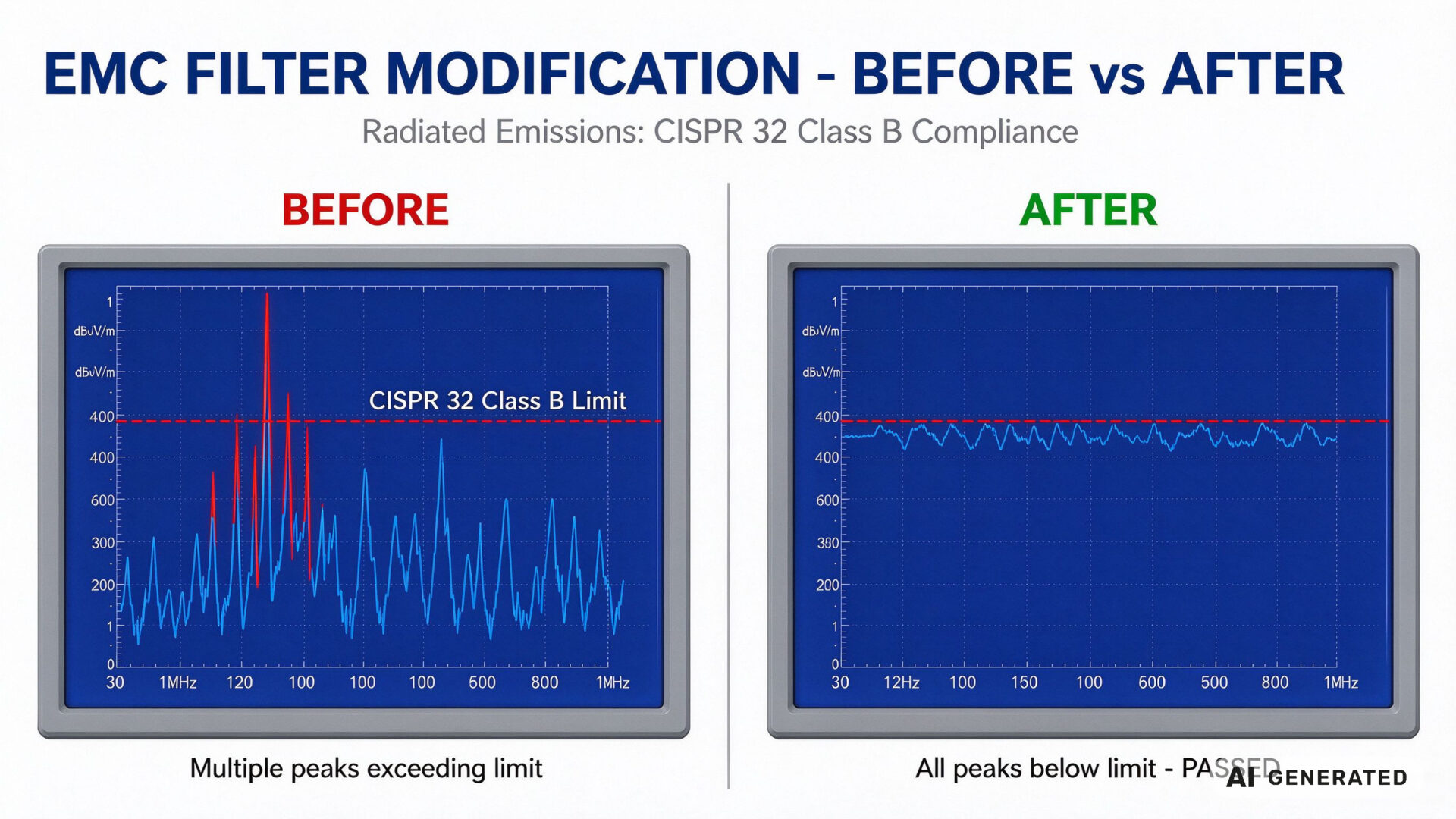
The initial scan confirmed the customer’s concern: a prominent emission at 120 MHz exceeded the CISPR 32 Class B limit by 6 dB. A second harmonic at 240 MHz also exceeded the limit. The emissions were present in both horizontal and vertical polarizations, suggesting a common-mode current source on the PCB or cables.
3.2 Root cause: 120 MHz harmonic from switching regulator
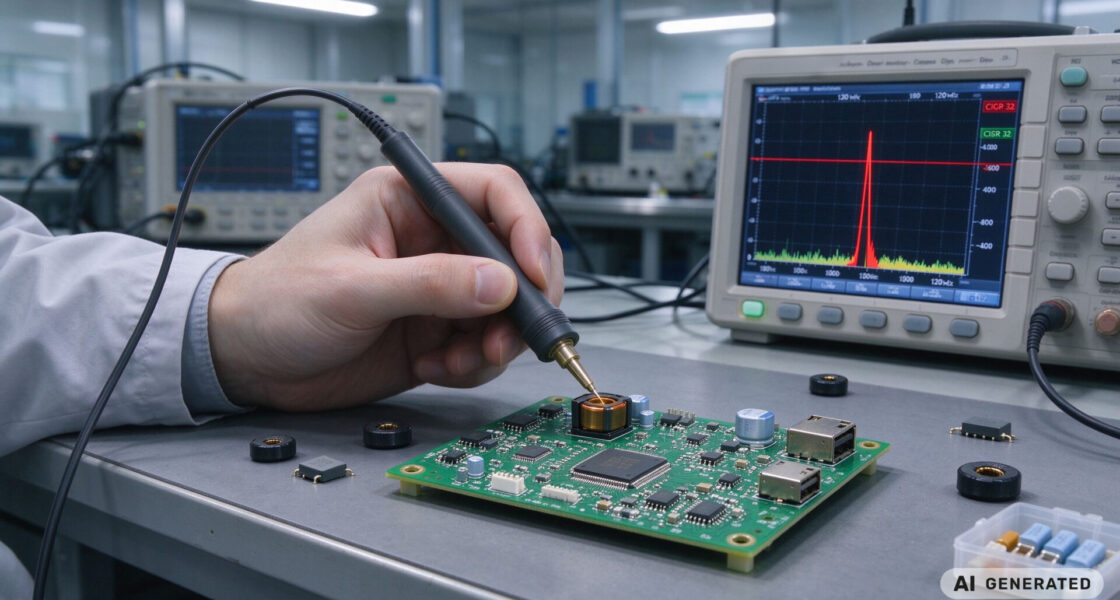
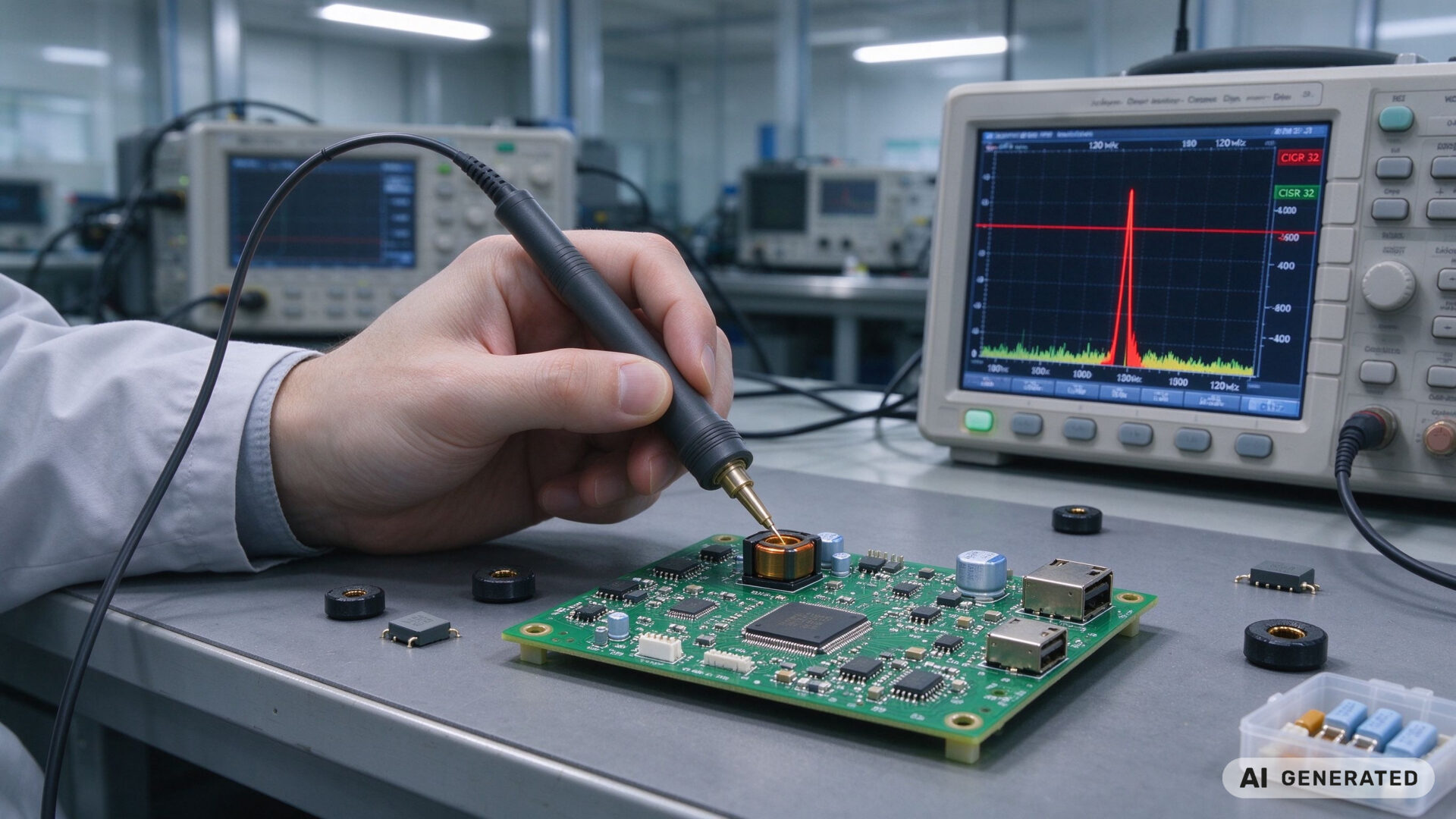
Using near-field probes, TPS engineers localized the emission source to the switching regulator circuit. The regulator’s 1.2 MHz switching frequency had a 100th harmonic at 120 MHz that was coupling onto the input power cable and radiating. The existing input filter was designed for conducted emissions but had insufficient attenuation at 120 MHz.
3.3 Filter and layout modifications
TPS recommended a three-part corrective action:
- Add a common-mode choke on the DC input cable, rated for the operating current and with high impedance at 120 MHz.
- Improve PCB grounding around the switching regulator, reducing the loop area for high-frequency currents.
- Add a small ferrite bead on the regulator’s switch node to slow the edge rate and reduce harmonic energy.
These modifications were implemented on the prototype and re-tested. The 120 MHz peak was reduced by 12 dB, bringing it 6 dB below the CISPR 32 Class B limit. The 240 MHz harmonic was also reduced below the limit.
4. Measured results and customer outcome
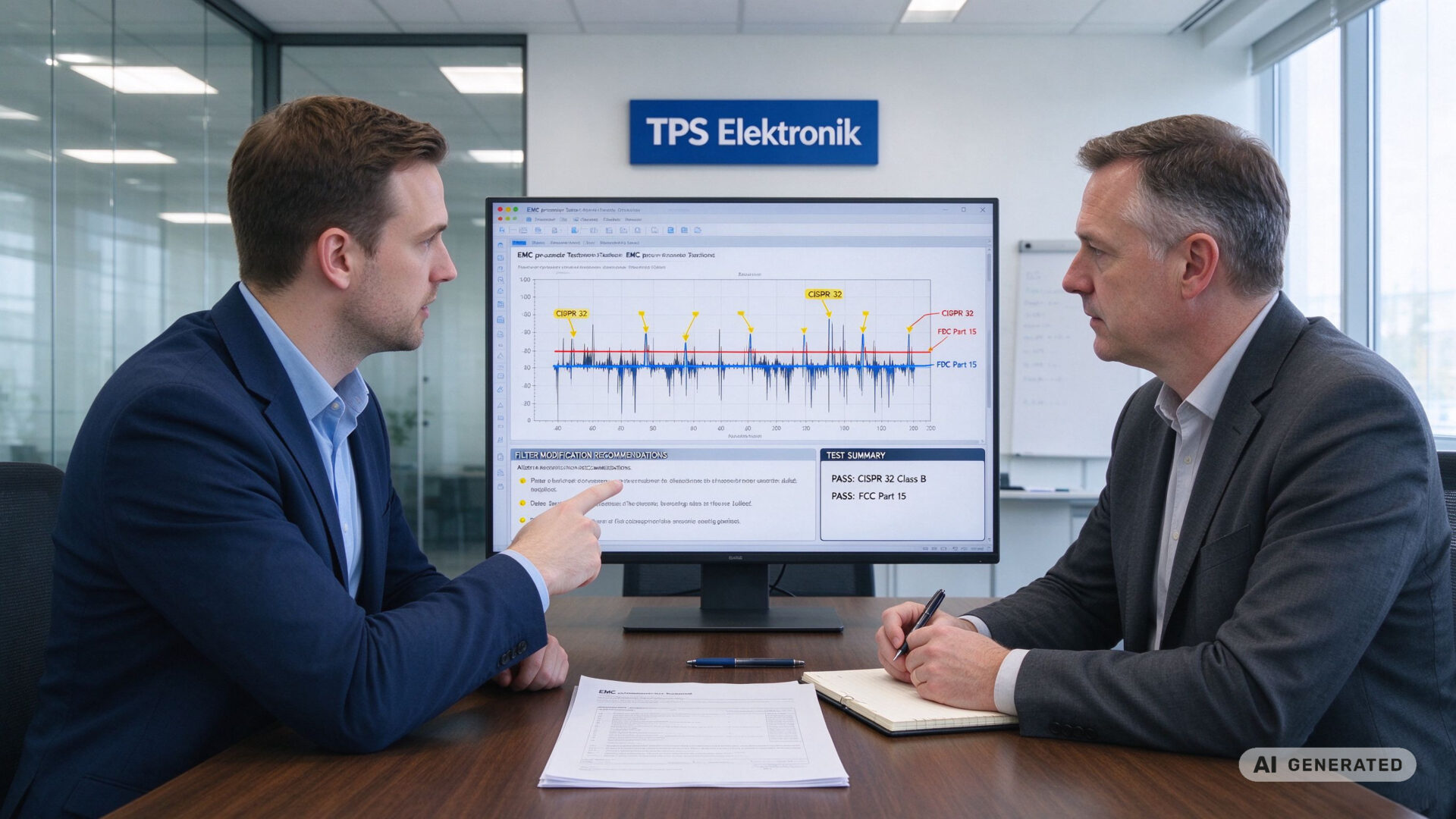
The customer proceeded to formal certification at an accredited test house with confidence. The formal test confirmed that the product met both CISPR 32 Class B and FCC Part 15 Subpart B radiated emissions limits with margin. The retail launch proceeded on schedule.
TPS provided a detailed pre-compliance test report documenting the initial failure, the root cause analysis, the corrective actions, and the final passing measurement. This report was accepted by the customer’s quality team and referenced in the technical file for the EU Declaration of Conformity.
This project reflects TPS’s broader approach to EMC pre-compliance. The EMC testing customer case and the EMC testing collaboration case study document similar engagements. For projects requiring both EMC and electrical safety, see the EMC and electrical safety testing guide.